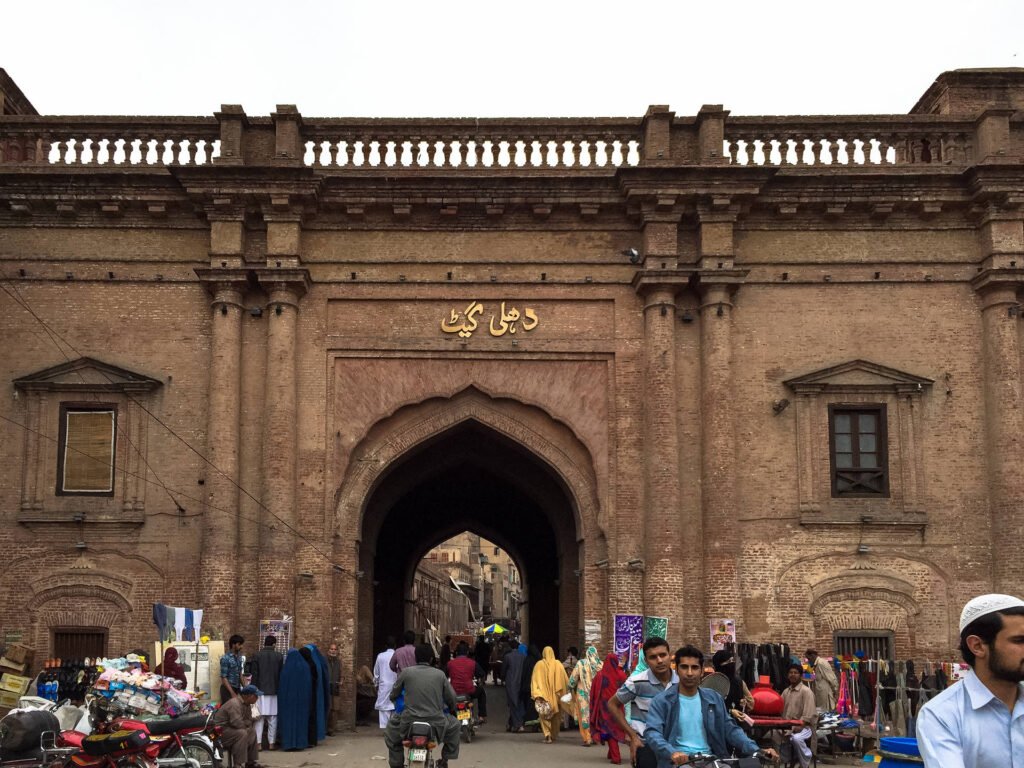
Every city has a doorway into its soul, and in Lahore that doorway is the Delhi Gate. Step through its grand arch and you leave modern Lahore behind: suddenly you are in a world of narrow lanes, spice-scented air, 400-year-old havelis, and bazaars that have traded the same way for centuries. If you are planning a Lahore trip and wondering which corner of the city deserves your time, this Delhi Gate travel guide will convince you to start here.
Delhi Gate is not just a monument you photograph and forget. It is the living eastern entrance of the Walled City of Lahore, a Mughal-era gateway that still hums with daily life. Inside it lies one of the most rewarding heritage walks in Pakistan: the restored Shahi Hammam royal baths, the breathtaking Wazir Khan Mosque, the spice mountains of Akbari Mandi, and food that Lahoris themselves travel across the city to eat. Whether you are a history lover, a photographer, a foodie, or simply a traveler who wants to feel the real Lahore, Delhi Gate belongs on your itinerary.
This guide covers everything you need: the gate’s remarkable history, the best things to do, how to reach Delhi Gate from Islamabad, Lahore, and Karachi, where to stay, what to eat, weather, culture, shopping, and practical travel tips.
Quick Facts
- Location: Eastern edge of the Walled City of Lahore, Punjab, Pakistan
- Altitude: Around 217 meters (712 feet) — Lahore sits on the plains
- Famous For: One of the six surviving gates of Lahore’s Walled City; gateway to the Shahi Hammam, Wazir Khan Mosque, and the old bazaars
- Nearest City: Lahore itself — the gate is inside the city; Allama Iqbal International Airport is about 14 km away
- Accessibility: Easy — reachable by car, rickshaw, taxi, or ride-hailing from anywhere in Lahore; best explored on foot
- Known Landmarks: Delhi Gate, Shahi Hammam (royal baths), Wazir Khan Mosque, Akbari Mandi spice market
- Best For: History lovers, photographers, foodies, cultural travelers, and families on a heritage day out
Why Visit Delhi Gate
Because Delhi Gate is where Lahore’s history stops being a story in books and becomes something you can touch, smell, and taste. Most visitors to Lahore see the Badshahi Mosque and Lahore Fort, then leave thinking they have seen the old city. They have not. The real old Lahore — the one of Mughal emperors, Sufi saints, spice traders, and artisan workshops — begins the moment you pass under Delhi Gate’s arch.
The walk from the gate into the Walled City is one of the great urban experiences of South Asia. In the space of a few hundred meters you can descend into the 17th-century Shahi Hammam with its frescoed domes, stand beneath the kaleidoscopic tilework of the Wazir Khan Mosque, climb through lanes where craftsmen hammer copper the way their grandfathers did, and emerge with your hands full of spices from Akbari Mandi, one of the oldest spice markets in the region. Few places in Pakistan pack this much heritage into such a small walk.
Delhi Gate is also perfect for travelers who like their history alive rather than behind glass. This is not a fenced-off monument. Shops operate inside the gate’s two-storey structure, children run through the lanes, the smell of fresh naan drifts from tandoors, and the bazaar does what it has done for centuries: trade. Photographers get golden-hour shots of the illuminated facade; food lovers get some of Lahore’s most authentic street food; families get a day trip that entertains every generation. And because it sits in the heart of Lahore, it costs almost nothing to add to your plans — which makes it one of the highest-value stops in this Delhi Gate travel guide.
If you are building a Lahore itinerary, pair Delhi Gate with the Badshahi Mosque travel guide for a full old-city day, or browse more ideas in our Explore Pakistan collection.
History of Delhi Gate
The history of Delhi Gate begins with the Mughal Empire’s love affair with Lahore. When Emperor Akbar rebuilt and fortified Lahore in the 16th century, the city received a strong defensive wall pierced by thirteen gates. Delhi Gate, opening toward the east in the general direction of Delhi, became the most important of them all. During the Mughal era it was the main gateway into Lahore: traders, travelers, diplomats, and royal officials arriving from Delhi and beyond entered the city here, and the gate’s doors were shut every evening as the city settled for the night.
Because so much traffic flowed through it, the area around the gate grew into a thriving commercial quarter. Markets, caravanserais, workshops, and havelis clustered along the routes leading inward, and the lanes you walk today follow paths laid down centuries ago. The gate watched over the rise of Mughal Lahore, the Sikh period, and the arrival of the British — each era leaving its mark on the surrounding streets.
The British period brought both destruction and reconstruction. After the uprising of 1857, the colonial administration tore down Lahore’s city walls, and the original Delhi Gate was destroyed along with them. The gate you see today was reconstructed in the 19th century under the British Raj; the older gate’s site, about a hundred meters to the west, is remembered as the Chitta Gate. Following the Partition of British India in 1947, the gate found an unexpected new role as the home of a girls’ school.
The gate’s fame traveled far beyond Lahore. Rudyard Kipling mentioned Delhi Gate in his 1891 short story “The City of Dreadful Night,” and Lahore’s celebrated Zamzama Gun — the great cannon now standing before the Lahore Museum — was originally placed at Delhi Gate before the British moved it. In 2015, the gate and the neighboring Shahi Hammam underwent a major restoration by the Aga Khan Cultural Service Pakistan, funded by the government of Norway, as part of a wider effort that also conserved the Wazir Khan Mosque. Today the restored gate stands as one of only six surviving gates of the Walled City, a proud, illuminated landmark greeting everyone who enters old Lahore from the east.
Top Things to Do in Delhi Gate
Walk Through the Restored Gate
Start your visit the way travelers have for centuries: by walking through the arch itself. The two-storey structure once held ten to twelve shops within its walls, and a staircase leads to the rooftop, offering a rare elevated view over the Walled City’s rooftops and domes. Come at dusk if you can — the gate is illuminated after dark and photographs beautifully against the evening sky.
Descend into the Shahi Hammam
Just inside the gate lies one of Lahore’s best-kept secrets: the Shahi Hammam, a 17th-century Mughal royal bathhouse built in 1635 during the reign of Shah Jahan. Its domed chambers are covered in stunning frescoes, and walking through its cool, echoing halls feels like stepping into a Mughal miniature painting. The 2015 restoration brought its colors back to life, and it is now one of the finest small museums of Mughal art in Pakistan. Do not skip this — many visitors call it the highlight of their Walled City walk.
Visit the Wazir Khan Mosque
A short walk from the gate brings you to the Wazir Khan Mosque, built in 1634–35 and widely considered the most ornate Mughal mosque in Lahore. Its facade is a riot of faience tilework, frescoes, and calligraphy in colors that seem to glow in the morning light. The mosque is still an active place of worship, so visit outside prayer times, dress modestly, and take a moment to simply sit in the courtyard and absorb four centuries of devotion.
Wander the Akbari Mandi Spice Market
Adjacent to Delhi Gate sprawls Akbari Mandi, Lahore’s historic spice market — the local answer to Istanbul’s spice bazaar. Sacks of turmeric, chilies, cardamom, and dried fruits pile up in mountains of color and scent. Even if you buy nothing, the walk through the market is a full sensory experience. Bargain politely, keep your camera ready, and try the roasted nuts sold by street vendors.
Taste the Walled City’s Food
The lanes around Delhi Gate are a food lover’s hunting ground. Stop for a plate of siri paye or nihari at a decades-old eatery, sip a tall glass of creamy lassi, and pick up nankhatai biscuits from the area’s old bakeries — visitors have been praising these crumbly shortbread cookies for generations. Come hungry; the old city rewards appetite.
Photograph the Old City
Between the gate’s illuminated facade, the frescoed walls of the Shahi Hammam, the tilework of Wazir Khan Mosque, and the chaotic beauty of the bazaars, this is one of Pakistan’s richest photography locations. Mornings bring soft light and fewer crowds; evenings bring the gate’s floodlights and the bazaar at its liveliest.
Famous Places In and Around Delhi Gate
- Shahi Hammam — 17th-century royal baths with restored Mughal frescoes, just inside the gate
- Wazir Khan Mosque — 1634–35, Lahore’s most elaborately decorated Mughal mosque
- Akbari Mandi — historic spice market beside the gate
- Shah Alam Market — one of Lahore’s biggest wholesale bazaars, a short walk away
- Suha Bazaar — famous market street continuing the old-city shopping trail
- Badshahi Mosque and Lahore Fort — the city’s great Mughal monuments, a short drive west
- Anarkali Bazaar — historic shopping street near the Walled City
How to Reach Delhi Gate
Reaching Delhi Gate is easy because it sits inside Lahore, Pakistan’s second-largest city and one of its best-connected. Whether you are coming from Islamabad, Karachi, or across town, here is how to get to the gate and start your Delhi Gate travel guide adventure.
From Islamabad: The drive is about 380 km via the M-2 Motorway and typically takes 4 to 4.5 hours. Take the M-2 to Lahore, then follow city roads toward the Walled City — the gate is on the eastern side of the old city. Daewoo and other bus services run frequently between Islamabad and Lahore (around 4.5–5 hours), and trains on the main line connect the two cities daily.
From Karachi: The fastest option is a direct flight to Lahore’s Allama Iqbal International Airport (about 1 hour 40 minutes), with multiple daily flights. By road it is roughly 1,200 km — a long 14–16 hour drive via the M-9 and N-5, best broken with an overnight stop. Trains including the Karachi Express and Business Express run overnight between Karachi and Lahore.
From Lahore Airport: Allama Iqbal International Airport is only about 14 km from Delhi Gate. A taxi or ride-hailing car (Careem, InDrive, Uber) takes 30–45 minutes depending on traffic. Auto-rickshaws are the cheapest way to cover the last stretch into the Walled City’s narrow streets, where cars cannot always go.
Nearest airport: Allama Iqbal International Airport (LHE), Lahore.
Road conditions and transport: Lahore’s main roads are excellent year-round. The lanes inside the Walled City are narrow, crowded, and often closed to cars — plan to park near the gate and continue on foot, which is the whole point of the visit anyway. The best approach is to hire a local guide through the Walled City of Lahore Authority or a reputable tour operator; the lanes are a maze, and a guide unlocks stories you would otherwise walk straight past.
Route Details
- By air: Fly into Allama Iqbal International Airport (LHE) from Karachi, Islamabad, or international destinations.
- Airport to the Walled City: Take a taxi or ride-hailing car toward Circular Road / the Walled City (30–45 minutes). Ask the driver for “Delhi Gate” — every Lahori driver knows it.
- Last stretch: From the main road, switch to a rickshaw or walk into the gate area. Park vehicles outside the congested lanes.
- On foot: Enter through Delhi Gate, visit the Shahi Hammam immediately inside, then follow the heritage trail to Wazir Khan Mosque, Akbari Mandi, and onward into the bazaars.
- By road from Islamabad: M-2 Motorway south to Lahore (4–4.5 hours), then city roads to the Walled City.
- By road from Karachi: M-9/N-5 north via Hyderabad, Sukkur, and Multan (14–16 hours); consider the motorway network where available.
Where to Stay in Delhi Gate
There are no hotels inside the gate itself — it is a heritage monument in a centuries-old bazaar — but Lahore offers stays for every budget within a short drive, and the old city rewards an early start.
Luxury: Lahore’s five-star hotels cluster around Upper Mall, Gulberg, and the Cantonment, about 20–30 minutes by car from Delhi Gate. These offer the full international-hotel experience: pools, spas, multiple restaurants, and reliable Wi-Fi — a comfortable base for a heritage trip.
Mid-range: Dozens of well-run three- and four-star hotels and serviced apartments sit in Gulberg, DHA, and along Main Boulevard, typically 20–25 minutes from the Walled City. Many include breakfast and airport shuttles; book a room with parking if you are driving.
Budget and guesthouses: Budget hotels and family-run guesthouses near the railway station and in the old city put you within walking distance of Delhi Gate — ideal if you want to be at the gate for the morning light. Keep expectations modest: clean, simple rooms with fans or air-conditioning and attached baths.
Tips: Staying near the Walled City saves you from Lahore’s notorious traffic on sightseeing mornings. If you are visiting in summer, confirm air-conditioning when booking. For a heritage trip of two or three days, a mid-range Gulberg hotel plus ride-hailing to the old city is the sweet spot most travelers choose.
Where to Eat: Local Foods of Delhi Gate
The streets around Delhi Gate are some of the best eating streets in Lahore, and Lahoris are famously serious about food. This is the city of the saying “jine Lahore nahin vekhya, o jamya nahin” — one who has not seen Lahore has not lived — and its food is a big reason why.
Must-try dishes: Start the morning with siri paye (slow-cooked trotters and head curry) or nihari (overnight beef stew) scooped up with hot naan from a clay tandoor. Midday, look for chargha (steamed-then-fried whole chicken), seekh kebabs, and daal fry at the old-city dhabas. Sweeten the deal with falooda, kulfi, jalebi, and a tall glass of thick Punjabi lassi — sweet or salted. Snackers should try golgappay, dahi bhallay, and samosa chaat from bazaar stalls.
Where to eat: The lanes inside and around the gate hold decades-old eateries that locals swear by, plus the Walled City’s famous old bakeries known for nankhatai shortbread. For a sit-down dinner with a view, food streets near the old city serve Lahori barbecue as the Badshahi Mosque glows across the rooftops — ask your hotel or guide for the current favorite spots, as the food-street scene keeps evolving.
Costs: Street food and dhaba meals around the Walled City are very budget-friendly — a filling local meal typically costs a few hundred rupees per person, while a comfortable restaurant dinner in Gulberg or DHA costs more. Carry cash; small eateries rarely take cards.
Weather in Delhi Gate
Delhi Gate shares Lahore’s classic Punjab-plains climate: a blazing summer, a short monsoon, and a cool, foggy winter. The gate itself is an outdoor experience — much of the best of it is walking between the gate, the hammam, the mosque, and the bazaars — so timing your visit around the weather makes a real difference.
| Season | Temperature Range | Conditions |
|---|---|---|
| Winter (Dec–Feb) | 5–20°C | Cool and pleasant days; cold nights; morning fog can delay early starts |
| Spring (Mar–Apr) | 15–32°C | Warm, bright, and comfortable — excellent for walking tours |
| Summer (May–Jun) | 30–45°C | Very hot with dusty winds; sightsee early morning or late evening only |
| Monsoon (Jul–Sep) | 28–38°C | Hot and humid with heavy rain spells; streets can flood briefly |
| Autumn (Oct–Nov) | 15–30°C | Mild and dry — one of the best windows for the Walled City |
The sweet spots are October to November and February to April, when you can comfortably walk the old city for hours. If you must visit in summer, plan the gate and mosque for 8–10 AM, retreat indoors at midday, and return for the illuminated gate in the evening.
Language and Culture of Delhi Gate
The Walled City speaks Punjabi first and Urdu second — you will hear the warm, rapid-fire Lahori Punjabi in every shop and lane, with Urdu bridging conversations with visitors. English is understood at hotels and by guides, but a few Punjabi greetings (“Sat Sri Akaal” to Sikhs, “Assalam-o-Alaikum” generally) earn instant smiles.
Culturally, you are in the heart of Lahori life: famously hospitable, food-obsessed, and proud of the city’s Mughal heritage. Shopkeepers may offer you tea; accept it — refusing hospitality can seem cold. When visiting the Wazir Khan Mosque and other religious sites, dress modestly (cover shoulders and knees; women should carry a scarf), remove shoes where required, and avoid visiting during Friday congregational prayers unless you are there to observe respectfully.
The bazaar has its own etiquette: bargain with good humor (it is expected in the markets, not in fixed-price shops), ask before photographing people closely, and keep to the side of narrow lanes to let porters and motorcycles pass. The old city is conservative in the best sense — polite, curious about visitors, and quick to help a lost traveler.
Shopping in Delhi Gate
Come with an empty bag. The bazaars around Delhi Gate are among Lahore’s oldest shopping streets, and they specialize in the things the Walled City has traded for centuries.
Akbari Mandi is the star: sacks of spices, dried fruits, nuts, herbs, and traditional remedies at wholesale prices — buy small quantities of premium saffron, cardamom, and mixed spice blends as edible souvenirs. Shah Alam Market, a short walk away, is a vast wholesale bazaar for fabrics, clothing, and household goods at some of the lowest prices in the city. Suha Bazaar continues the trail with bridal wear and traditional clothing.
Handicrafts and souvenirs: Look for copper and brass ware hammered in the old workshops, traditional khussa shoes, embroidered fabrics, and miniature paintings. Prices are negotiable — start at about two-thirds of the quoted price and meet in the middle with a smile.
Note: There are no modern shopping malls at the gate itself; this is traditional bazaar shopping at its most authentic. For malls and brands, head to Gulberg or DHA after your old-city day.
Travel Tips for Delhi Gate
Packing Essentials
Comfortable walking shoes with good grip (the old lanes are uneven), a scarf or shawl for mosque visits, sunscreen and a hat in summer, a light jacket for winter mornings, a reusable water bottle, and a power bank — you will take more photos than you expect.
Safety Tips
The Walled City is generally safe for tourists during the day, but it is crowded: keep valuables in a front pocket or money belt, beware of pickpockets in packed bazaars, and agree on rickshaw fares before riding. Hire a registered guide for the inner lanes — you will see more and stay oriented. Women travelers will find the area manageable during daylight with modest dress; as everywhere, avoid isolated lanes after dark.
Money & Connectivity
Carry cash in rupees — ATMs are available on the main roads around the Walled City but scarce inside the lanes, and small shops are cash-only. Jazz, Telenor, Zong, and Ufone all have strong signals in Lahore, and 4G data works well for maps and ride-hailing. Most mid-range and luxury hotels offer Wi-Fi.
Best Time to Visit Delhi Gate
October to November — The Golden Window
Mild, dry, and glowing — this is the finest season for the Walled City. Daytime temperatures sit in the comfortable 20s, the light is perfect for photography, and you can walk from the gate to the mosque to the bazaars without breaking a sweat.
December to February — Cool and Atmospheric
Crisp days made for walking, with the bazaars at their most vibrant. Mornings can be foggy (which makes for moody photos of the gate), and nights are cold — pack a warm layer. This is also wedding season, so book hotels early.
March to April — Spring’s Last Call
Warm but still pleasant, with long bright days. A lovely time for the heritage trail before the summer heat arrives.
May to September — For the Determined
Summer heat and monsoon humidity make midday sightseeing punishing. If this is your only window, visit at dawn, rest midday, and return for the illuminated gate and evening food scene. The monsoon can also bring sudden downpours — carry an umbrella and waterproof your camera bag.
Final Thoughts
Delhi Gate is proof that the best travel experiences are not always the farthest ones. In a single morning you can walk through a Mughal gateway, bathe your eyes in 17th-century frescoes, stand beneath one of the world’s most beautiful mosque facades, and eat food that people cross the city for — all within a few hundred meters. It is Lahore distilled to its essence: grand, chaotic, generous, and delicious.
So when you plan your Lahore trip, do not just drive past the Walled City on your way to somewhere else. Park the car, hire a guide, step through Delhi Gate, and let the old city do what it has done for four hundred years — welcome the traveler in. For more northern adventures after your Lahore days, see our Hunza Valley guide and keep exploring with Explore Pakistan.
FAQs
Where is Delhi Gate located?
Delhi Gate stands on the eastern side of the Walled City of Lahore, Punjab, Pakistan. It is inside Lahore city, about 14 km from Allama Iqbal International Airport.
What is the best time to visit Delhi Gate?
October to November and February to April offer the most comfortable weather for walking the Walled City. Winter (December–February) is also pleasant, while May–September is very hot and humid.
How do I reach Delhi Gate from Islamabad?
Drive the M-2 Motorway from Islamabad to Lahore (about 380 km, 4–4.5 hours), then take a taxi or rickshaw to the Walled City. Buses and trains also connect Islamabad and Lahore frequently.
Is Delhi Gate safe for tourists?
Yes, during daylight hours it is generally safe and welcoming. Keep valuables secure in the crowded bazaars, hire a registered guide for the inner lanes, and dress modestly for mosque visits.
Is Delhi Gate suitable for families?
Absolutely. Children enjoy the bazaars, the rooftop views, and the Shahi Hammam’s colorful halls. Go in the morning, take breaks for food, and keep little ones close in crowded lanes.
Where should I stay near Delhi Gate?
Stay in Gulberg or DHA for mid-range and luxury hotels (20–30 minutes away), or choose a budget guesthouse near the old city to be within walking distance of the gate.
What food should I try near Delhi Gate?
Try siri paye, nihari, chargha, falooda, kulfi, golgappay, and a tall Punjabi lassi. The Walled City’s old eateries and bakeries (famous for nankhatai biscuits) are the places locals trust.
What makes Delhi Gate historically unique?
It was the main Mughal-era gateway into Lahore on the road from Delhi, was rebuilt under the British after 1857, housed a girls’ school after Partition, was mentioned by Rudyard Kipling in 1891, and was restored in 2015 — layers of history in a single arch.