The Badshahi Mosque stands directly opposite the Lahore Fort across Hazuri Bagh in the heart of the Walled City of Lahore. Commissioned by the Mughal emperor Aurangzeb and completed in 1673, it was the largest mosque in the world for roughly three centuries and remains one of the most recognisable symbols of Pakistan. Entry is free, visitors of all faiths are welcome outside prayer times, and the courtyard alone can hold 100,000 worshippers. This badshahi mosque travel guide covers its history, architecture, the best time to visit, how to reach it, and everything you need to plan a perfect visit.
Quick Facts
- Location: Hazuri Bagh, Walled City of Lahore, Punjab, Pakistan — facing the Alamgiri Gate of Lahore Fort.
- Altitude: Around 215 metres above sea level.
- Famous For: The last great imperial Mughal mosque; largest mosque in the world for ~300 years; red sandstone and marble architecture.
- Nearest City: Lahore itself (in the city centre); Islamabad is about 370 km to the north-west.
- Accessibility: Easily reached by car, taxi, ride-hailing apps and metro bus within Lahore; about 15-20 minutes from central Lahore, ~30 minutes from Allama Iqbal International Airport.
- Known Landmarks: Lahore Fort, Hazuri Bagh and its Baradari, the Tomb of Allama Iqbal, Minar-e-Pakistan, Fort Road Food Street.
- Best For: Families, history lovers, photographers, architecture enthusiasts, and first-time visitors to Lahore.
Why Visit Badshahi Mosque
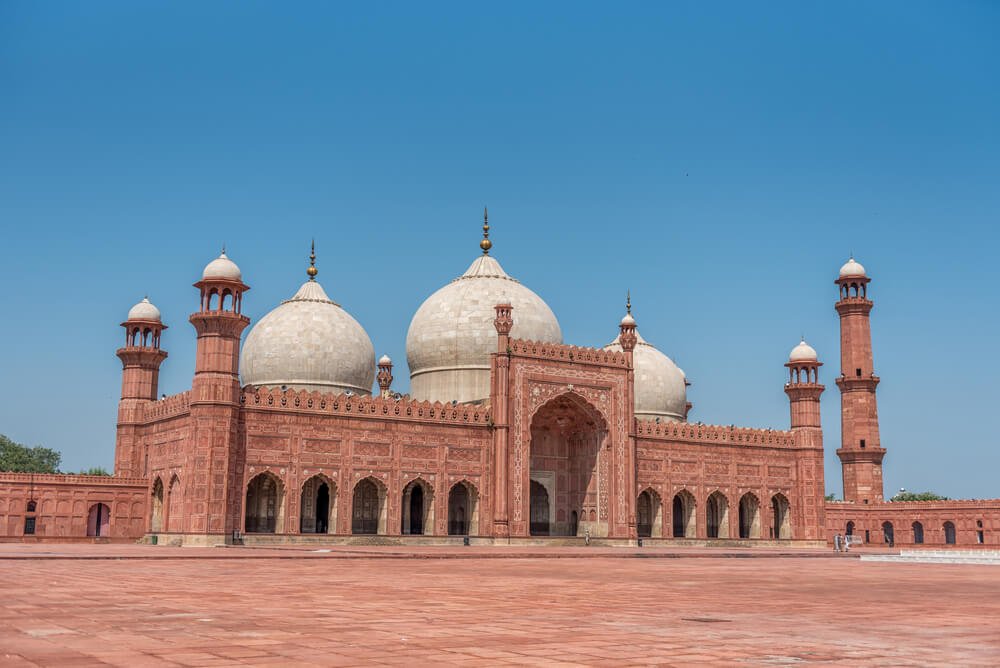
There are mosques you admire, and there are mosques that make you stop walking. The Badshahi Mosque does the second thing. You enter through the grand eastern gateway, cross into a courtyard of 276,000 square feet, and the scale simply recalibrates around you: a prayer hall of carved red sandstone with three white marble domes, four minarets rising about 54 metres at the courtyard corners, and open sky filling every gap. It is the closest thing in Pakistan to standing inside a Mughal court painting.
The mosque matters because it is the last and greatest of the imperial Mughal mosques. Built between 1671 and 1673 by Aurangzeb, the sixth Mughal emperor, it was designed on the plan of his father Shah Jahan’s Jama Masjid in Delhi but executed on a far grander scale. From its completion until Islamabad’s Faisal Mosque opened in 1986, it held the record as the largest mosque in the world for over three hundred years — a span of time in which the British Raj rose and fell and Pakistan was born. That continuity is visible in the stone itself, which has absorbed Mughal, Sikh, British and Pakistani history in turn.
It is also the easiest great monument in Pakistan to visit properly. Entry is free, photography is allowed, the location could not be more central, and the whole visit pairs naturally with the Lahore Fort, Hazuri Bagh, the Tomb of Allama Iqbal and the Fort Road Food Street — all within walking distance. One well-planned afternoon covers four centuries of Lahore.
Finally, the Badshahi Mosque is alive. It is not a museum but an active house of worship that hosts daily prayers, Ramadan gatherings and some of the country’s largest Eid congregations. Visiting respectfully during ordinary hours lets you see the monument as it was meant to be seen: full of people, full of purpose, and utterly magnificent.
History of Badshahi Mosque
Aurangzeb chose Lahore — then the capital of the Punjab province of the Mughal Empire — as the site for his new imperial mosque. Construction began in 1671 under the supervision of his foster brother Muzaffar Hussain, known by his title Fidai Khan Koka, then the governor of Lahore. Fidai Khan Koka had earlier experience of major Mughal building works, and the speed of construction was remarkable: thousands of labourers and craftsmen mobilised simultaneously completed the mosque in just two years, and it was consecrated in 1673.
The building is the supreme expression of late Mughal architecture. The exterior is carved red sandstone with marble inlay, the three great domes of the prayer hall are white Makrana marble (the same marble used for the Taj Mahal), and the interior carries stucco tracery, frescoes and marble inlay work. The four octagonal minarets at the corners of the courtyard — each a little over 50 metres tall, with four smaller minarets flanking the prayer hall — give the composition its famous silhouette. The design consciously echoes Shah Jahan’s Jama Masjid in Delhi while surpassing it in size, making the Badshahi Mosque the largest mosque of the Mughal era.
After the fall of the Mughal Empire, the mosque endured a turbulent century. Under the Sikh Empire of Maharaja Ranjit Singh it suffered badly — the courtyard was used as a stable for horses and as a military garrison — and under British rule it served as a military camp and sustained further damage. Restoration began in the late 19th century, and major conservation continued after independence, including extensive work by the Walled City of Lahore Authority (WCLA). Beside the mosque’s entrance lie two figures central to Pakistan’s memory: the white-marble Tomb of Allama Iqbal, the national poet and philosopher of the Pakistan Movement, and the tomb of Sir Sikandar Hayat Khan, who played a major role in the mosque’s preservation and restoration.
In 1993, the Government of Pakistan included the Badshahi Mosque in its tentative list for UNESCO World Heritage inscription, recognising its outstanding value as a monument of Mughal craftsmanship and imperial patronage. Today the mosque stands as Lahore’s most iconic landmark — active, maintained, and visited by millions each year.
Top Things to Do in Badshahi Mosque
Give the mosque at least an hour; two if you want to photograph it properly and visit the surrounding monuments.
Cross the Great Courtyard
Enter through the massive eastern gateway and walk the length of the courtyard toward the prayer hall. The courtyard spreads over 276,000 square feet and can accommodate around 100,000 worshippers — standing in its centre, with the prayer hall ahead and the minarets at the four corners, is the single most impressive experience here. Early morning, before the crowds arrive, is magical.
Enter the Prayer Hall
The red sandstone prayer hall holds space for about 10,000 worshippers under its three marble domes. Inside, look up at the stucco tracery and frescoes, and study the marble inlay in the walls. Remove your shoes before entering, keep your voice low, and remember this is an active prayer space. Non-Muslim visitors are welcome outside the five daily prayer times.
Photograph the Minarets at Golden Hour
The four corner minarets, each about 54 metres tall with delicate balconies, define the Lahore skyline. The best shots come from Hazuri Bagh at sunset, when the red sandstone glows and the marble domes catch the last light, or from the main entrance steps for the classic symmetrical composition.
Visit the Tomb of Allama Iqbal
Just outside the mosque’s entrance stands the white marble mausoleum of Muhammad Iqbal, Pakistan’s national poet, flanked by fountains and cypress trees. Verses are etched in the stone. Literature lovers consider a visit incomplete without paying respects here.
Walk to Lahore Fort and Hazuri Bagh
The mosque faces the Alamgiri Gate of Lahore Fort across Hazuri Bagh, where Ranjit Singh’s 1818 Baradari pavilion stands. The fort — a UNESCO World Heritage Site — is a half-day visit in its own right. The Roshnai Gate, one of the thirteen gates of the Walled City, is also nearby.
Eat on Fort Road Food Street
Next to the mosque and fort, the Fort Road Food Street serves the full Lahori spread — paya, nihari, chargha, kebabs, kulfi — with rooftop views of the mosque and fort. Come hungry; this is as much a part of the visit as the monuments.
Famous Places In and Around Badshahi Mosque
- Lahore Fort (Shahi Qila) — UNESCO World Heritage Site with Mughal palaces, directly opposite across Hazuri Bagh (separate entry ticket).
- Hazuri Bagh & Ranjit Singh’s Baradari — the garden between mosque and fort; free entry, open sunrise to sunset.
- Minar-e-Pakistan — the independence-movement tower in Greater Iqbal Park, a short drive away.
- Fort Road Food Street — traditional Lahori dining with rooftop monument views.
- Wazir Khan Mosque — the jewel of Mughal tile-work, inside the Walled City.
- Delhi Gate & the Walled City — historic gates and old-city bazaars within walking distance.
- Shalamar Gardens — the Mughal paradise garden, about 8 km away.
How to Reach Badshahi Mosque
The mosque sits in the Walled City of Lahore, at the western edge of Hazuri Bagh, directly opposite the Alamgiri Gate of Lahore Fort. Because it is in the historic centre, reaching it is straightforward but parking nearby is limited — many visitors park near Lahore Fort and walk.
From Islamabad: about 370 km via the M-2 motorway, roughly 4 to 5 hours by car. From Karachi: about 1,215 km — this is a flight route (around 1 hour 45 minutes to Lahore) or a long train/car journey. Within Lahore: the mosque is 15-20 minutes by car or taxi from central areas like Gulberg or DHA, and about 30 minutes from Allama Iqbal International Airport (roughly 20 km). Ride-hailing apps work well; the Metro Bus (Lakshmi Chowk station) and local buses serve the area, and ‘chingchi’ rickshaws handle the last stretch into the Walled City.
The nearest airport is Allama Iqbal International Airport, Lahore. Lahore Junction railway station is the nearest major rail terminal. Transport options inside the city include private cars, taxis, ride-hailing apps, rickshaws, and the metro bus; walking is the best way to move between the mosque, the fort and the food street. The site is accessible year-round and roads are paved and usable in all seasons.
Route Details
- From Allama Iqbal International Airport, take the airport road towards the city centre (about 20 km, 30 minutes).
- Head for the Walled City via Mall Road or Circular Road; follow signs for Lahore Fort / Badshahi Mosque.
- Park in the designated lots near Lahore Fort or Hazuri Bagh — parking inside the immediate precinct is restricted.
- Walk through Hazuri Bagh to the mosque’s eastern gateway; the Tomb of Allama Iqbal is beside the entrance.
- Plan 1-2 hours for the mosque, then cross to the fort or the food street on foot.
Where to Stay in Badshahi Mosque
The mosque has no accommodation of its own, but Lahore offers every tier of lodging within a short drive. Luxury travellers head to the established five-star hotels of central Lahore — well-known names like Pearl Continental and Avari are a 15-20 minute drive from the Walled City and offer full-service comfort. Mid-range business hotels and boutique guesthouses cluster in Gulberg, Model Town and DHA, all easily connected to the fort area by ride-hailing.
Budget travellers find simple hotels and hostels around Lahore Junction railway station and in the old city itself, which put you within walking distance of the mosque — a good option if you want to be at the gates at sunrise. Camping is not a thing here; this is a city monument, not a wilderness destination. Book ahead on weekends and during the winter tourist season, when Lahore’s hotels fill with domestic and international visitors.
Where to Eat: Local Foods of Badshahi Mosque
Eating near the Badshahi Mosque is half the experience. The Fort Road Food Street, right beside the mosque and fort, is the headline act: dozens of outlets serving the Lahori canon — paya (trotter curry), nihari (slow-cooked beef shank), chargha (deep-fried whole chicken), seekh and malai boti kebabs, mutton karahi, and kulfi or gulab jamun for dessert. Rooftop tables look out over the illuminated mosque and fort at night.
Beyond the food street, the Walled City’s bazaars hide legendary eateries serving halwa puri breakfasts, lassi in clay cups, and chanay. Anarkali and the surrounding old-city streets are full of dhabas and traditional kitchens at budget-friendly prices. A full meal at a dhaba is inexpensive; the Fort Road restaurants are moderately priced by Pakistani standards. Carry cash for the small shops, though larger restaurants accept cards. Lahore is a food city — pace yourself, because you will want to try everything.
Weather in Badshahi Mosque
Lahore has a hot semi-arid climate. Summers are fierce, winters are cool and foggy, and the best visiting weather falls between October and March. Plan outdoor monument-hopping for the morning or late afternoon in the warmer months.
| Season | Temperature Range | Conditions |
|---|---|---|
| Winter (Dec-Feb) | Around 5-22°C | Cool, often foggy mornings; crisp, sunny afternoons; ideal for sightseeing. |
| Spring (Mar-Apr) | Around 15-32°C | Pleasant, blooming gardens; excellent for photography. |
| Summer (May-Aug) | Around 28-42°C | Very hot, especially June; monsoon rain July-August; visit at dawn or dusk. |
| Autumn (Oct-Nov) | Around 18-32°C | Warm days, cooler nights, clear skies; peak tourist season. |
Language and Culture of Badshahi Mosque
Lahore is the cultural heart of Punjab. Punjabi is the everyday language of the Walled City, Urdu is understood by everyone, and English is widely spoken in hotels, restaurants and tourist areas. Lahoris are famously warm and hospitable — expect strangers to help you find your way, and don’t be surprised if someone insists on taking your photograph for you.
As an active mosque, the Badshahi Mosque asks for mosque etiquette: cover shoulders and knees, women should carry a headscarf, remove shoes before entering the prayer hall, keep voices low, and ask permission before photographing worshippers. Drones are not allowed. Tourists are welcome outside the five daily prayers; Friday midday prayers are for worshippers, so plan around them. Modest dress applies across the Walled City’s religious sites generally.
Shopping in Badshahi Mosque
The mosque itself has no shops, but the surrounding Walled City is one of Pakistan’s great shopping experiences. Anarkali Bazaar — one of South Asia’s oldest markets — sells everything from traditional clothing and jewellery to books and electronics. The bazaars around Delhi Gate and the old city offer embroidered fabrics, shawls, khussay (traditional shoes), brass work and spices.
For handicrafts and souvenirs — camel-skin lamps, blue Multani pottery, onyx pieces, miniature paintings — the craft shops of Anarkali and Ichhra are worth browsing. Dry fruits and mithai (sweets) from old-city shops make good gifts. Prices are negotiable in the bazaars; polite bargaining is expected. There is no shopping mall at the monument itself, but modern malls like Emporium and Packages are a short drive away in the newer parts of the city.
Travel Tips for Badshahi Mosque
Packing Essentials
Modest clothing (long trousers or skirt, covered shoulders; a headscarf for women), comfortable walking shoes you can slip off easily, a hat and sunscreen for the courtyard, a water bottle, and your camera. A small bag for your shoes is handy — shoe storage at the entrance charges a nominal fee.
Safety Tips
Lahore’s old city is busy and generally safe for tourists. Keep valuables close in crowded bazaars, agree rickshaw and taxi fares before the ride, and drink bottled water. The mosque precinct is well-attended; stick to daylight hours for the surrounding streets and hire a licensed guide outside the mosque if you want detailed commentary. Remove shoes only where required and keep an eye on them at the entrance.
Money & Connectivity
Entry to the mosque is free; carry small cash (Pakistani rupees) for shoe storage, guides, food and bazaar shopping. ATMs are plentiful in central Lahore. All major mobile networks (Jazz, Zong, Telenor, Ufone) have strong 4G coverage, and most hotels and restaurants offer Wi-Fi.
Best Time to Visit Badshahi Mosque
Winter (December-February): The Best Season
Cool, dry, often sunny — winter is the classic season for Lahore’s monuments. Mornings can be foggy, so aim for late morning or afternoon visits; the golden-hour light on the red sandstone is spectacular. This is peak tourist season, so arrive early.
Spring (March-April): Excellent
Pleasant temperatures and green gardens make spring nearly as good as winter, with fewer crowds. Photography conditions are ideal, and the surrounding parks are at their prettiest.
Summer (May-August): Visit Early or Late
Lahore’s summer is punishing, but the mosque is open year-round. Come at dawn or near sunset, drink plenty of water, and combine the visit with air-conditioned stops (the fort’s museums, a restaurant lunch). The courtyard’s marble floors stay surprisingly cool underfoot.
Autumn (October-November): Very Good
Post-monsoon clarity and comfortable warmth make autumn a favourite with photographers. Evenings are pleasant, and the food street comes alive after dark with the monuments illuminated.
Final Thoughts
The Badshahi Mosque has watched Lahore for over 350 years — through Mughal splendour, Sikh rule, British barracks and Pakistani independence — and it remains what Aurangzeb intended it to be: an overwhelming statement of faith and imperial ambition. Standing in that courtyard, you understand the Mughal Empire in a way no textbook can deliver. It is free, it is central, it is open to everyone, and it pairs with the fort, the food street and the Walled City to make the single best half-day in Lahore.
Go early, dress respectfully, take your time, and finish with dinner on Fort Road under the floodlit domes. Few monuments in South Asia reward a visit like this one. The Badshahi Mosque is not just Lahore’s most famous landmark — for many travellers, it becomes the memory that defines Pakistan.
FAQs
Where is Badshahi Mosque located?
It stands in the Walled City of Lahore, facing the Alamgiri Gate of Lahore Fort across Hazuri Bagh, next to the Roshnai Gate.
What is the best time to visit Badshahi Mosque?
October to March offers the best weather. Early morning or sunset give the best light and cooler temperatures year-round.
How do I reach Badshahi Mosque?
It is in central Lahore, 15-20 minutes from Gulberg/DHA by taxi or ride-hailing, about 30 minutes from Allama Iqbal International Airport. Metro Bus, buses and rickshaws also serve the area.
Is entry to Badshahi Mosque free?
Yes, entry is free for all visitors. Shoe storage at the entrance charges a small nominal fee.
Can non-Muslims visit Badshahi Mosque?
Yes. Visitors of all faiths are welcome outside the five daily prayer times. Friday midday prayers are reserved for worshippers.
What are the mosque timings?
Generally open daily from around 8 AM to 7 PM (later in peak season), closed to tourists during prayer times.
Where can I stay near Badshahi Mosque?
Luxury and mid-range hotels in central Lahore (Gulberg, DHA) are 15-20 minutes away; budget hotels near the railway station and old city put you within walking distance.
What food should I try nearby?
The Fort Road Food Street beside the mosque serves paya, nihari, chargha, kebabs and kulfi; the Walled City’s dhabas are famous for halwa puri breakfasts.
What else can I see on the same trip?
Lahore Fort (UNESCO), Hazuri Bagh and its Baradari, the Tomb of Allama Iqbal, Minar-e-Pakistan, Wazir Khan Mosque and Shalamar Gardens are all nearby.
Related reading: explore more heritage destinations on our Explore Pakistan page, and see our guides to Malam Jabba, Hunza Valley, and places to visit in Islamabad.