Quick Facts
- Location: Choa Saidan Shah Tehsil, Chakwal District, Punjab, Pakistan — on the road between Choa Saidan Shah and Kallar Kahar, in the Kahoon Valley of the Salt Range
- Altitude: Low Salt Range foothills, a few hundred metres above sea level
- Famous For: Being known across Pakistan as the “village with the gun” — the historic 12-pounder cannon awarded by the British for its soldiers’ service in World War I
- Nearest City: Chakwal (about 40 km); Islamabad is about 150 km to the north
- Accessibility: Easy road access via the M-2 motorway (Kallar Kahar interchange) and the Choa Saidan Shah–Kallar Kahar road; a comfortable day trip from Islamabad
- Known Landmarks: The Dulmial cannon on its marble platform by the village pond, the WWI memorial plaque at the primary school, the village’s one-room military museum, the old graveyard of veteran soldiers
- Best For: History enthusiasts, military-heritage travelers, photographers, and anyone exploring the Salt Range’s temples, lakes, and mines
Why Visit Dulmial
Every country has places where history sits quietly in the open air, waiting for someone to stop and look. Dulmial is one of Pakistan’s. This unassuming town in the Kahoon Valley of the Salt Range does not appear in glossy tourism brochures, yet it holds one of the most remarkable military-heritage stories in South Asia: in the First World War, 460 men from this single village served in the British Indian Army, nine never came home, and in recognition the British government awarded the village a 12-pounder cannon — made in Scotland in 1816 and installed on a marble platform by the village pond in 1925. It still stands there today, gleaming black, and Pakistanis across the country know Dulmial simply as “the village with the gun.”
That alone would be worth the drive from Islamabad. But Dulmial rewards the curious in other ways too. The village was founded some eight centuries ago, and its old graveyard — shaded by ancient phulahi trees — holds the weathered gravestones of generations of soldiers, including Captain Ghulam Mohammad Malik, the village’s most decorated officer, who chose the cannon as Dulmial’s reward. A one-room museum preserves photographs, medals, letters, a ceremonial sword, and mementoes of both world wars. Walking through Dulmial is like turning the pages of a regimental history written in stone and brass.
A Dulmial travel guide should be clear about what kind of trip this is: not a mountain adventure or a resort holiday, but a heritage pilgrimage — the sort of day trip that history lovers dream about. It pairs beautifully with the Salt Range’s other wonders, which is the real strategic reason to come. Dulmial sits in the middle of one of Punjab’s richest heritage corridors: the ancient Katas Raj Temples are nearby on the same road network, Kallar Kahar’s lake and gardens are a short drive away, and the Khewra Salt Mine — among the largest in the world — is within easy reach. Come for the cannon, stay for the Salt Range.
Who is Dulmial perfect for? Military history buffs, students of the world wars’ South Asian story, photographers of heritage and portraiture, and families from Islamabad, Rawalpindi, and Lahore looking for a meaningful day trip with real stories to tell at dinner. If you believe the best travel teaches you something, Dulmial will not disappoint.
History of Dulmial
Dulmial’s story begins long before the cannon — about eight centuries ago, when, according to local history recorded by researchers, the settlement was founded by a man named Dolmi, a general in the army of Shahabuddin Ghauri. The Ghurid connection places the village’s origins in the late 12th or early 13th century, in the era when the Salt Range sat astride the invasion routes into the Punjab plains. The village grew in the rocky, beautiful Kahoon Valley, its people farming the thin soil and, over the centuries, developing the martial tradition that would define it.
That tradition found its moment in the First World War. When Britain called for volunteers in 1914, Dulmial answered on an extraordinary scale: 460 men from this one village enlisted, one of the largest contributions from any single village in British India. They served in the trenches and campaigns of the Great War; nine of them were killed. The village’s senior-most and most decorated officer, Captain Ghulam Mohammad Malik, was asked what reward Dulmial should receive for its service — and he chose a cannon. The British presented a 12-pounder artillery gun, manufactured in Scotland in 1816, which was installed on a marble platform by the village pond in 1925, with a plaque honoring the 460. A second plaque at the village primary school records the stark facts: “From this village 460 men went to the Great War 1914-1919. Of these 9 gave their lives.”
The Second World War deepened the record: more than 730 men from Dulmial served, and 36 were killed. After the creation of Pakistan, the village’s military tradition continued in the Pakistan Army — Dulmial is credited with producing five lieutenant generals and 23 brigadiers, among many other officers. One note of honest history: later research has shown that a few other Punjabi villages sent even more men in WWI than Dulmial did, so the old claim of “the largest contribution in Asia” is debated — but nothing about the cannon, the plaques, or the 460 names is in doubt.
In 2014, during the First World War centenary, Dulmial’s story reached an international audience when the British High Commissioner unveiled a plaque honoring Pakistani recipients of the Victoria Cross, with Dulmial’s community present. The village’s one-room museum — maintained for decades by local custodians — keeps the memory alive with photographs, medals, letters, a 1914 Christmas gift box, and old military equipment. Dulmial’s history is not in a textbook; it is in the pond-side cannon, the graveyard epitaphs, and the pride of the families who still live here.
Top Things to Do in Dulmial
See the Dulmial Cannon
The centerpiece of any visit. The 12-pounder gun stands on its marble platform on the bank of the village pond, just as it has since 1925 — maintained, villagers will tell you proudly, in immaculate condition. Read the plaque, walk around the piece, and take in the strangeness and poignancy of it: a Scottish-made artillery gun, over two centuries old, standing guard over a Punjabi village pond because 460 young men went to a war on another continent. Early morning or late afternoon light is best for photographs, and the pond’s reflections add a quiet beauty to the scene.
Visit the WWI Memorial Plaque at the Primary School
A few minutes from the cannon, the village primary school carries the second memorial: a monument with a plaque recording the 460 men and the 9 who died in 1914–1919. It is a simple, moving stop — history at its most direct, carved in stone where village children pass every day. Pair it with the cannon to complete the memorial circuit.
Explore the One-Room Military Museum
Dulmial’s small museum, maintained by local custodians over decades, is a treasure chest of the village’s martial past: photographs of soldiers from both world wars, medals and letters home, a ceremonial sword, old coins, a 1905 telescope, a WWII-era camera, and even a 1914 Christmas gift box. It is not a polished national museum — it is better than that: a community’s own archive, kept with love. Ask locally for access; the custodians are usually happy to show visitors around and share stories.
Walk the Old Soldiers’ Graveyard
Before you enter the village proper, the old graveyard draws the eye — centuries-old, dotted with phulahi trees, holding the graves of Dulmial’s great men. Here rests Captain Ghulam Mohammad Malik, who chose the cannon, alongside generations of soldiers whose epitaphs can still be read on weathered stones. It is a peaceful, contemplative place and a reminder that Dulmial’s military story spans far more than the two world wars. Walk quietly and with respect.
Day Trip to the Katas Raj Temples
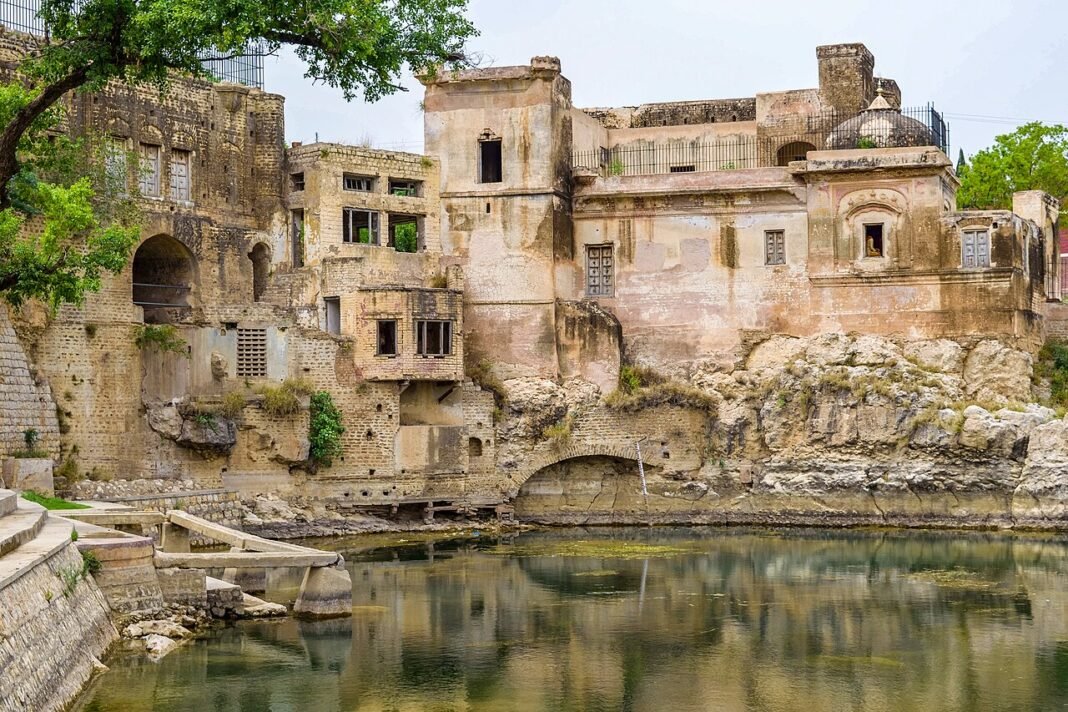
Dulmial sits near one of Pakistan’s most important Hindu heritage sites: the Katas Raj Temples, a complex of ancient temples clustered around a sacred pond, with parts dating back over a thousand years and legends linking the site to the Mahabharata. The temples lie on the same Salt Range road network as Dulmial, making the two a natural pairing — a morning with the cannon and the museum, an afternoon among ancient stone and sacred water. It is one of the finest heritage day-trips in Punjab.
Combine with Kallar Kahar and Khewra Salt Mine
The Salt Range around Dulmial is dense with attractions. Kallar Kahar — about 40 km from Chakwal city — offers its famous lake, gardens, and peacock enclosures, a classic family picnic spot. The Khewra Salt Mine, among the largest salt mines in the world, runs guided tours through glittering underground chambers and tunnels. A two-day Salt Range circuit — Dulmial and Katas Raj one day, Kallar Kahar and Khewra the next — is one of the best-value heritage itineraries in the country.
Famous Places In and Around Dulmial
- The Dulmial Cannon — the 1816 Scottish 12-pounder on its marble platform by the village pond, installed 1925.
- WWI Memorial Plaque — the monument at the village primary school honoring the 460 men of 1914–1919.
- Dulmial Military Museum — the one-room community archive of photographs, medals, and wartime mementoes.
- Katas Raj Temples — the ancient Hindu temple complex around its sacred pond, nearby in the Salt Range.
- Kallar Kahar Lake — the scenic Salt Range lake and gardens, a popular family stop.
- Khewra Salt Mine — among the world’s largest salt mines, with guided underground tours.
How to Reach Dulmial
Dulmial is one of the most accessible heritage destinations in Punjab — an easy day trip from Islamabad on good roads. The village lies on the road connecting Choa Saidan Shah and Kallar Kahar, about 40 km from Chakwal city and roughly 150 km south of Islamabad.
From Islamabad: Take the M-2 motorway toward Lahore and exit at the Kallar Kahar interchange, then follow the local road toward Choa Saidan Shah — Dulmial lies on this road. The drive takes about 3 hours. Alternatively, come via Chakwal city on the Talagang–Chakwal road network.
From Lahore: Take the M-2 toward Islamabad, exit at Kallar Kahar, and follow the same local road — about 3.5 to 4 hours.
From Karachi: Fly to Islamabad and continue by road; the overland journey is far too long for a day trip.
Nearest airport: Islamabad International Airport, about 3 hours by road.
Road conditions: The M-2 motorway is excellent. The local roads between Kallar Kahar, Dulmial, and Choa Saidan Shah are metalled and passable by ordinary car year-round, though they wind through the Salt Range hills — drive carefully and enjoy the views. There is no difficult terrain on this trip; any sedan can do it.
Route Details
- Islamabad → M-2 motorway south to the Kallar Kahar interchange (about 2 hours).
- Kallar Kahar → Dulmial via the Choa Saidan Shah road (under an hour); the village, cannon, and pond are signposted locally — ask any villager.
- Combine with Katas Raj Temples (same road network) and, with an early start, Kallar Kahar Lake on the return.
- For a two-day trip, overnight in Kallar Kahar or Chakwal and add the Khewra Salt Mine on day two.
Where to Stay in Dulmial
Dulmial is a village, not a tourist town — there are no hotels in the village itself, and you don’t need them. This is a day-trip destination, best done from a nearby base. The most convenient overnights are in Kallar Kahar, which has a cluster of small hotels and rest houses catering to lake visitors and Salt Range tourists, and in Chakwal city, about 40 km away, which offers a wider range of budget and mid-range hotels with the usual amenities.
For a two-day Salt Range circuit, base yourself in Kallar Kahar: it puts Dulmial, the Katas Raj Temples, and the town’s own lake within easy reach, and the Khewra Salt Mine is a manageable drive for day two. Expect simple, clean, budget-friendly accommodation — this is small-town Punjab hospitality, not luxury, and the rates reflect that. Book ahead on public holidays and long weekends, when Salt Range picnic traffic peaks.
Where to Eat: Local Foods of Dulmial
Eat like the Potohar plateau eats. The signature flavors here are makai di roti with sarson da saag in winter, cooked in desi ghee and washed down with a tall glass of lassi — the classic Punjabi village meal, and genuinely delicious when the saag is fresh from the fields. Village dhabas around Dulmial and along the Kallar Kahar road serve desi murghi (free-range chicken) karahi, daal, and tandoori rotis at prices that will make city dwellers smile — a full, filling meal for a few hundred rupees.
In Chakwal and Kallar Kahar, the bazaars add sweet shops doing fresh jalebi and barfi, fruit sellers with Salt Range citrus and guavas in season, and tea stalls that never seem to close. Pack water and snacks for the village itself — Dulmial’s shops are basic — and plan your main meal in Kallar Kahar or Chakwal. If you are offered food by a village family, accept graciously; Potohari hospitality is the real deal.
Weather in Dulmial
Dulmial sits in the Salt Range foothills, which gives it a classic Punjab climate with a hill-country edge: hot summers, a monsoon break, and winters cold enough for frost. The comfortable window for heritage touring is long — roughly October through March — when the air is clear, the light is golden, and walking between the cannon, the museum, and the graveyard is a pleasure rather than an endurance test.
| Season | Temperature Range | Conditions |
|---|---|---|
| Winter (Dec–Feb) | 2 to 15°C | Cool, crisp, occasionally frosty mornings; excellent for sightseeing |
| Spring (Mar–Apr) | 15 to 30°C | Pleasant and green; wildflowers in the hills; ideal visiting weather |
| Summer (May–Jul) | 30 to 42°C | Hot and dry; plan village walks for early morning or late afternoon |
| Autumn/Monsoon (Aug–Nov) | 20 to 35°C | Monsoon rains freshen the hills; clear, pleasant weather returns by October |
Language and Culture of Dulmial
Punjabi — in its Potohari dialect — is the language of Dulmial’s streets, homes, and dhabas; Urdu is widely understood and works fine for visitors. The culture is that of the Potohar plateau: a martial tradition that still sends its sons to the army, deep village community bonds, and the famous Punjabi hospitality that treats a guest as a blessing. The village’s pride in its military heritage is palpable and genuine — show interest, and you will hear stories.
Visit with the respect a memorial village deserves. Dress modestly, ask before photographing people (especially at the graveyard and memorials), and keep noise down at the cannon site and cemetery — these are places of remembrance, not backdrops. If you visit the museum, a small donation or purchase toward its upkeep is a gracious gesture. Friday midday prayers mean a quieter village; plan around them.
Shopping in Dulmial
Dulmial’s own shops cover daily needs — think of the village as the experience and the nearby towns as the marketplace. In Chakwal and Kallar Kahar bazaars, look for khaddar cloth (the handspun Potohari fabric), desi ghee sold by the kilo, Salt Range peanuts and dried fruits, and traditional jutti footwear. These are authentic regional products at small-town prices. There are no shopping malls in the Dulmial area, and none are needed — the bazaars here sell things people actually use.
Travel Tips for Dulmial
Packing Essentials
This is an easy day trip — pack light. Comfortable walking shoes for the village lanes and graveyard paths, sun protection (the Salt Range sun is strong even in winter), a hat, water, and a camera with plenty of battery for the cannon, temples, and mine. In winter, bring a warm jacket for frosty mornings; in summer, light cotton and an early start.
Safety Tips
Dulmial and the Salt Range tourist circuit are safe, well-traveled, and welcoming. The main precautions are mundane: watch your step on uneven village paths and at the mine, keep valuables out of sight in bazaars as you would anywhere, and drive carefully on the winding Salt Range roads. At the Khewra Salt Mine, follow your guide’s instructions underground.
Money & Connectivity
Carry cash in Pakistani rupees — village shops and dhaba owners operate on cash, though Chakwal and Kallar Kahar have ATMs and banks. Mobile coverage from all major networks is good across the Salt Range corridor. Fuel up in Chakwal or at the motorway services; village fuel stations are sparse.
Best Time to Visit Dulmial
October to March — The Heritage Season
Cool, clear, golden-light months — perfect for walking the village, photographing the cannon, and combining Dulmial with Katas Raj, Kallar Kahar, and Khewra. This is the best time for a Dulmial travel guide to recommend without hesitation.
April and November — The Shoulders
Still very pleasant, with spring greenery or autumn clarity. Fewer picnic crowds than the winter peak.
May to September — Hot but Doable
Summer heat makes midday village walks uncomfortable, but early mornings and late afternoons work fine, and the Khewra mine stays cool underground year-round. The monsoon freshens the hills dramatically.
Final Thoughts
Dulmial is proof that you don’t need mountains or beaches to have a travel experience that stays with you. A village pond, a black cannon, a plaque with 460 names, a graveyard under old trees — these are quiet things, but they carry the weight of a century. To stand where Captain Ghulam Mohammad Malik stood and understand why he asked for a gun rather than gold is to touch a very human kind of history: pride, loss, and remembrance, kept polished by the grandchildren of the men who earned it.
Go as a day trip from Islamabad, pair it with the temples, lakes, and salt mines of the Salt Range, and give this remarkable village the afternoon it deserves. And if the high mountains call next, our Malam Jabba guide is waiting.
FAQs
Where is Dulmial located?
Dulmial is a town in Choa Saidan Shah Tehsil, Chakwal District, Punjab, on the road between Choa Saidan Shah and Kallar Kahar in the Salt Range’s Kahoon Valley — about 150 km south of Islamabad.
Why is Dulmial called the “village with the gun”?
After 460 of its men served in WWI (9 killed), the British awarded the village a 12-pounder cannon, made in Scotland in 1816 and installed by the village pond in 1925. It still stands there today.
What is the best time to visit Dulmial?
October to March, when the weather is cool and clear — ideal for the village memorials and for combining the trip with Katas Raj, Kallar Kahar, and Khewra Salt Mine.
How do I reach Dulmial?
Drive from Islamabad via the M-2 motorway to the Kallar Kahar interchange, then the local road toward Choa Saidan Shah — about 3 hours total. The nearest airport is Islamabad International.
Is Dulmial safe for tourists?
Yes — it is a peaceful, welcoming village on a well-traveled Salt Range circuit, suitable for families and solo travelers alike.
Is Dulmial suitable for families?
Absolutely. It is an easy, educational day trip — children respond strongly to the cannon and the museum, and nearby Kallar Kahar Lake adds picnic fun.
Where can I stay near Dulmial?
There are no hotels in the village; stay in Kallar Kahar or Chakwal (about 40 km away), both with budget and mid-range options.
What else can I see near Dulmial?
The Katas Raj Temples, Kallar Kahar Lake, and the Khewra Salt Mine — together they make one of Punjab’s best two-day heritage circuits.