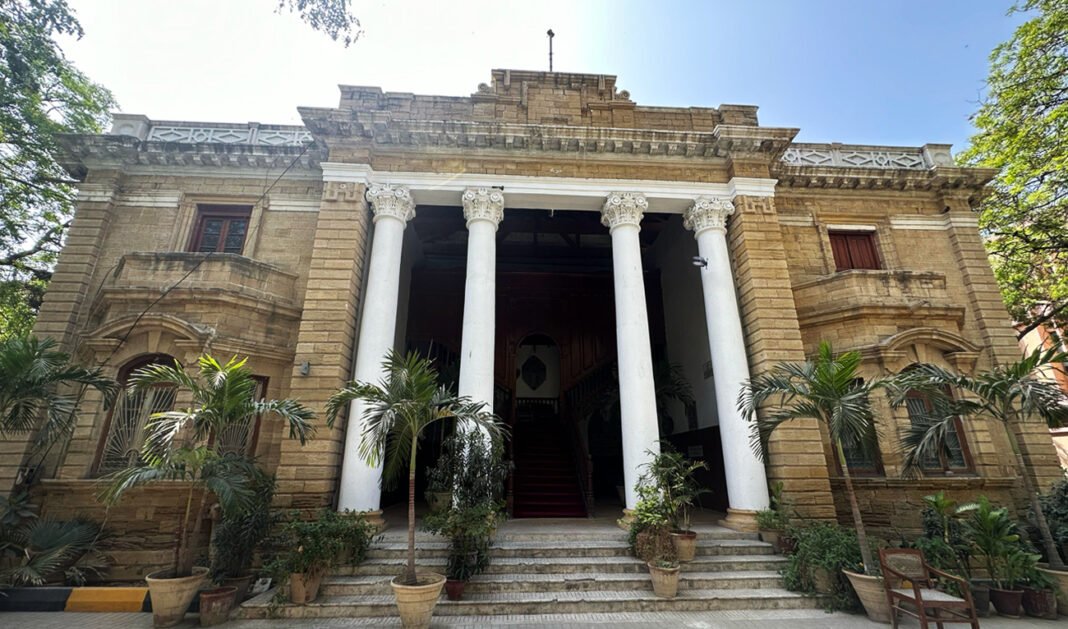
Every city has buildings that everyone walks past and almost no one really sees. In Karachi, one of the most intriguing of them stands on Strachan Road, a handsome yellow-sandstone building that spent more than a century as the headquarters of one of the most talked-about fraternities in the city’s history — and then, almost overnight, became a government office. The Freemasons’ Lodge Building in Karachi is not a conventional tourist attraction. It is something rarer: a protected heritage site with a genuinely mysterious past, a building locals once nicknamed the “jadoo ghar,” the house of sorcery.
This freemasons’ lodge building Karachi travel guide tells the real, documented story of the Lodge of Hope — from its founding in the 1840s under a Scottish warrant, through its glittering colonial heyday, to the 1973 government takeover and its second life as the home of the Sindh Wildlife Department. If you love hidden history, colonial architecture, and the strange afterlives of old buildings, this one is worth your afternoon.
Quick Facts
- Location: Strachan Road, near Molana Din Muhammad Wafai Road and D.J. Sindh Govt. Science College, Karachi, Sindh
- Altitude: Sea level — central Karachi
- Famous For: The historic headquarters of Karachi’s Freemason fraternity (Lodge Hope), yellow-sandstone colonial architecture, and its dramatic 1973 government takeover
- Nearest City: Karachi itself — the building is in the old colonial core of the city
- Accessibility: Easily reached by car, rickshaw, or ride-hailing anywhere in central Karachi; it is an exterior-viewing heritage stop, as the interior is a working government office
- Known Landmarks: Pakistan Institute of International Affairs (adjacent), D.J. Science College, Sindh Club area
- Best For: History lovers, architecture fans, photographers of colonial Karachi, and anyone fascinated by the city’s hidden stories
Why Visit Freemasons’ Lodge Building, Karachi
Karachi’s Freemasons’ Lodge Building rewards a particular kind of curiosity. This is not a museum with guides and gift shops; it is a living piece of the city’s secret history, still standing on the same Strachan Road plot it has occupied for over a century. The building’s story touches almost every era of modern Karachi — the British conquest of Sindh, the cosmopolitan colonial city of merchants and clubs, the anxieties of post-partition Pakistan, and the heritage-preservation battles of today. To stand outside it is to stand at the intersection of all those eras at once.
The mystique is real and it is documented. For generations, Karachiites called this place the “jadoo ghar” — the house of sorcery — and wove stories around what happened behind its doors. The truth, as former caretakers and historians tell it, was less supernatural but more interesting: evening gatherings of the city’s elite — Englishmen, Muslims, Parsis, Hindus — arriving in Austins and Victoria buggies, dining on food brought from the Boat Club and later the Metropole Hotel, conducting the rituals of a fraternity that counted inventors and statesmen among its worldwide members. The building still carries the physical traces of that life: the compass-and-square symbols of the society engraved in its fabric, memorial tablets on its walls, the same tiled floors that a caretaker’s family polished for three generations.
There is also the sheer drama of what happened here. In July 1973, a team led by a magistrate sealed the Freemason Hall on behalf of the Government of Sindh, confiscated its documents, and posted a police posse at the door — acting, the newspapers of the day reported, on public sentiment that the society was a foreign conspiracy. A fraternity that had operated openly in Karachi for 130 years vanished from public life in a single afternoon. The building survived, was eventually declared protected heritage, and now houses wildlife department offices — one of the strangest second acts of any colonial building in Pakistan. Visiting it is a way of touching a story that official histories tend to skip.
Finally, the practical case: it is easy. The lodge sits in central Karachi, minutes from other colonial-era landmarks, and costs nothing to see from the outside. Pair it with a walking tour of the old city core and you have one of the most historically dense afternoons Karachi offers.
History of Freemasons’ Lodge Building, Karachi
The documented history begins in the early 1840s, almost immediately after the British conquest of Sindh. In 1842, Dr. James Burnes, the provincial grandmaster of the Scottish Freemasons, issued orders for the formation of a Hope Lodge in “Kurrachee” — and on September 7, 1843, Lodge Hope was formally established under the Scottish Constitution, with a warrant granted by Lord Ramsay, the Marquess of Dalhousie. Sir Charles Napier, the first governor of Sindh, became an honorary member of the lodge, and he laid the foundation stone of the original Masonic lodge building in 1845. Freemasonry itself had come to the subcontinent much earlier — lodges were established in Calcutta in 1730, Madras in 1732, and Bombay in 1758 — but Karachi’s lodge was among the first in what is now Pakistan.
The lodge’s first home stood where the Sindh Club’s residential accommodation now exists. When that land passed to the club, the lodge shifted to its present site on Strachan Road, and a new building — the “new temple” — was constructed in the early 20th century, around 1914 (some accounts say the present structure was rebuilt in 1917). Built of yellow sandstone by the Freemasons’ Trust, it became the headquarters of the fraternity not just in Karachi but effectively for the country: at their peak, the lodges in Pakistan counted some 1,750 members, with active lodges in Hyderabad, Sukkur, Lahore, Multan, Rawalpindi, Quetta, and Peshawar.
Life at the lodge in its heyday was the life of colonial Karachi’s establishment. A former caretaker, Jeevan, whose family served the lodge for three generations since its founding era, described evenings when well-heeled members — English, Muslim, Parsi, Hindu — arrived around six o’clock as the sun set. The British members ate baked food, custards, and puddings sent over from the Boat Club and later the Metropole Hotel; the local members often ate food prepared by the caretaker’s own family. “The floors have the same tiles you see in the high court,” Jeevan recalled. “We used to keep it shining. In my father’s time, the goras would check for dust by sliding a finger down the floor.”
The end came with shocking speed. After partition, suspicion of freemasonry grew in Pakistan; many regarded it as a secretive foreign cult or conspiracy. In 1972, President Zulfikar Ali Bhutto’s government banned Freemasonry in Pakistan. Then, on July 18, 1973, the past came into the limelight: the Sindh government sealed the Freemason Hall and took it over along with its documents, under a magistrate’s supervision, with a police posse posted at the hall. The Daily Dawn’s report of July 19, 1973 noted that the government had acted on public demands and information from a rebel group within the organization, amid a common understanding that the Freemasons were a pro-Jewish, anti-Israel-war-era conspiracy — this was the same year Egypt and its allies went to war with Israel, and sentiment ran high. Later, on June 16, 1983, all Freemason activities were banned under Martial Law Regulation 56, and on December 29, 1985, the ban was extended to any and all Freemason activities in the country.
The building itself survived the ban. In the early 1990s it was allocated to the Sindh Wildlife Department, whose offices — and later the Sindh Wildlife Fund — occupy it to this day. Around 2001 it was declared a protected heritage site under the Sindh Cultural Heritage (Preservation) Act of 1994. A restoration effort by the provincial antiquities department ran from about 2008 to 2011 under archaeologist Kaleem Lashari, then stalled for lack of continued support — a familiar story for Karachi’s heritage. Inside, the building still holds its small library, an exhibition space, the wooden staircase near the entry, and the wall tablets of long-dead brethren, including one erected in 1896 by Lodge Hope No. 360 S.C. in memory of Worshipful Brother Robert Shepherd (1863–1896). The compass and square of the society remain engraved in the building — quiet signatures of the fraternity that built it.
Top Things to Do in Freemasons’ Lodge Building, Karachi
Study the Yellow-Sandstone Facade
Start with the architecture. The lodge is built of yellow sandstone in the solid, dignified colonial style of early-20th-century Karachi — the same stone vocabulary you see in the city’s other great public buildings of the era. Walk slowly around the exterior and look for the Masonic symbols — the compass and square — engraved in the building’s fabric. They are subtle, easy to miss, and genuinely thrilling to find: the literal marks of a secretive fraternity hiding in plain sight on a Strachan Road wall.
Read the Memorial Tablets
If you can arrange a look inside (the building is a working government office, so interior access is limited and not guaranteed), the wall tablets are the most moving artifacts of the lodge’s past. The 1896 tablet to Robert Shepherd of Lodge Hope No. 360 S.C. — “an efficient Master, a kind friend, and a loving brother” — is a direct, human voice from Victorian Karachi. Other plaques carry Muslim names, a quiet reminder that the fraternity’s membership crossed the religious lines of its time.
Climb the Wooden Staircase
The wooden staircase near the entry is one of the building’s most atmospheric surviving features — old timber, worn by more than a century of footsteps, leading up past rooms where restoration work has proceeded in fits and starts. Even a brief look gives you the feeling previous visitors describe: an air of quiet eeriness, the sense of a building that remembers more than it says.
Walk the Strachan Road Heritage Stretch
The lodge does not stand alone historically. It sits adjacent to the Pakistan Institute of International Affairs and within easy reach of D.J. Sindh Government Science College and the old colonial club district. Make the lodge one stop on a self-guided walk through central Karachi’s colonial core — the contrast between the grand public buildings and this secretive, shuttered fraternity house tells you more about the old city than any single monument could.
Famous Places In and Around Freemasons’ Lodge Building, Karachi
- Frere Hall and Bagh-e-Jinnah — Karachi’s great Venetian Gothic town hall (1865) with its library and Sadequain art gallery, a short drive away.
- D.J. Sindh Govt. Science College — another landmark colonial-era institution, very close to the lodge.
- Empress Market — the Victorian market hall in Saddar, the commercial heart of old Karachi.
- Mohatta Palace — the city’s beloved museum palace, an easy addition to a heritage day.
How to Reach Freemasons’ Lodge Building, Karachi
The lodge is in central Karachi on Strachan Road, near the junction with Molana Din Muhammad Wafai Road and close to D.J. Science College — one of the easiest heritage stops in the city to reach.
From within Karachi: Any taxi, rickshaw, or ride-hailing car can take you to Strachan Road; the building is adjacent to the Pakistan Institute of International Affairs office, a well-known landmark for drivers. From Saddar/Empress Market it is only a few minutes’ drive.
From Islamabad: Fly to Karachi’s Jinnah International Airport (about a 2-hour flight), then take a 30–45 minute drive into the city center, depending on traffic. By road, the journey via the M-9 Motorway and national highway network is roughly 1,400 km and takes the best part of two days of driving.
From Lahore: Fly to Karachi (about 1 hour 45 minutes) and drive into the center. By road it is roughly 1,200 km via the motorway network to Karachi.
Nearest airport: Jinnah International Airport, Karachi.
Transport options: Ride-hailing cars, auto-rickshaws, and private cars are all practical. Public buses serve the Saddar area nearby. Parking near Strachan Road can be tight — consider leaving the car a short walk away.
Route Details
- Step 1: Make your way to central Karachi (Saddar/Civil Lines area).
- Step 2: Head to Strachan Road, near Molana Din Muhammad Wafai Road and D.J. Sindh Govt. Science College.
- Step 3: Look for the yellow-sandstone building adjacent to the Pakistan Institute of International Affairs — that is the former Freemasons’ Lodge.
- Step 4: View the exterior and symbols from the street; remember it is a working government office, so be respectful and do not expect to wander in unannounced.
Where to Stay in Freemasons’ Lodge Building, Karachi
You will stay in Karachi itself, which has the country’s widest range of accommodation. Near the lodge, the Civil Lines and Saddar areas put you within minutes of the Strachan Road heritage stretch: this zone has everything from grand colonial-era hotels to mid-range business hotels and budget guesthouses. Luxury travelers gravitate to the five-star properties along Club Road and in Clifton; mid-range travelers have solid three- and four-star options in Saddar and PECHS; and budget travelers will find clean, affordable guesthouses throughout the old city. Because the lodge is a half-day stop at most, choose your base for the rest of your Karachi plans — the sea-facing hotels of Clifton and DHA if you want the coast, or the central hotels if your trip is about the old city’s history and food.
Where to Eat: Local Foods of Freemasons’ Lodge Building, Karachi
The area around the lodge sits in the middle of Karachi’s greatest food territory. Within a short drive you can eat your way through the city’s signatures: biryani (Karachi’s beloved, fiercely debated version), nihari, haleem, and kebabs of every description in the Saddar and Burns Road quarters. Burns Road — Karachi’s famous food street — is close by and comes alive in the evening with barbecue smoke, fresh tandoori naan, lassi, and falooda. For a sit-down meal, the old Irani cafes of Saddar serve bun kebab and chai in surroundings that have barely changed in decades. A street-food feast is budget-friendly; a restaurant meal in the area ranges from modest to mid-range by big-city standards. Time your lodge visit for the late afternoon, then walk or drive to Burns Road for dinner — it is the perfect pairing of hidden history and the city’s most storied food.
Weather in Freemasons’ Lodge Building, Karachi
Karachi’s coastal climate is famously moderate by Pakistani standards — hot but sea-breezed in summer, mild in winter, and humid for much of the year. Since the lodge is an exterior-viewing stop, the best visiting weather is simply the most comfortable walking weather: winter and early spring.
| Season | Temperature Range | Conditions |
|---|---|---|
| Winter (Dec–Feb) | Around 12–26°C | Mild, dry, sunny; ideal for heritage walks |
| Spring (Mar–Apr) | Around 22–34°C | Warm and pleasant; good for sightseeing |
| Summer (May–Sep) | Around 28–38°C | Hot and humid with sea breeze; monsoon showers possible Jul–Aug |
| Autumn (Oct–Nov) | Around 22–34°C | Warm; humidity eases; comfortable evenings |
Language and Culture of Freemasons’ Lodge Building, Karachi
Karachi is Pakistan’s great melting pot, and the languages you will hear around Strachan Road reflect it: Urdu is the common language of the street, Sindhi is the language of the province, and you will also hear Punjabi, Pashto, Balochi, and English. The lodge’s own history mirrors this cosmopolitanism — its membership once spanned Englishmen, Muslims, Parsis, and Hindus. As a visitor, standard city etiquette applies: dress reasonably modestly, ask before photographing people or the interiors of any building you are allowed into, and remember that the lodge is a working government office — quiet, respectful behavior is expected. The staff of the wildlife department are the building’s current custodians; courtesy toward them costs nothing and is sometimes rewarded with a story.
Shopping in Freemasons’ Lodge Building, Karachi
There is no shopping at the lodge itself, but you are minutes from some of Karachi’s best bazaars. Empress Market in Saddar — the great Victorian market hall — sells everything from spices and dry fruits to textiles and household goods, and the surrounding streets are dense with shops. Zainab Market and the Bohri Bazaar area offer fabrics, garments, and local crafts at bargain prices. For a more curated experience, the shops of Clifton and DHA sell Pakistani designer wear, Ajrak prints, Sindhi embroidery, and souvenirs. No malls are needed for this trip, though Karachi has plenty if you want them — the old bazaars near the lodge are the more authentic buy.
Travel Tips for Freemasons’ Lodge Building, Karachi
Packing Essentials
Comfortable walking shoes, sun protection (Karachi sun is strong even in winter), a camera or phone for the facade and symbols, and drinking water. If you visit in summer, carry an umbrella for the fierce midday sun.
Safety Tips
Central Karachi is busy and generally fine for daytime sightseeing. Keep valuables discreet, use ride-hailing rather than hailing random transport late at night, and stay aware in crowded bazaar areas. The lodge area itself is a quiet government-office street — visit during working hours.
Money & Connectivity
ATMs are everywhere in central Karachi, and cards are accepted at most restaurants and larger shops — but carry some cash for street food and small bazaars. Mobile signals from all major networks (Jazz, Telenor, Zong, Ufone) are strong throughout the area, and 4G data is reliable.
Best Time to Visit Freemasons’ Lodge Building, Karachi
Winter (December–February)
The best season. Mild, dry, sunny days make walking the Strachan Road heritage stretch a genuine pleasure, and the low winter light flatters the yellow sandstone beautifully.
Spring (March–April)
Warm but very manageable — a good time to combine the lodge with longer days exploring Saddar’s bazaars and food streets.
Summer (May–September)
Hot and humid, though the sea breeze helps. Visit early in the morning or late in the afternoon, and plan indoor or food-street activities for midday.
Autumn (October–November)
Comfortable and crowd-free — a fine time for unhurried heritage wandering before the winter season begins.
Final Thoughts
The Freemasons’ Lodge Building is Karachi history at its most deliciously strange: a Scottish-warranted lodge founded in the 1840s, a yellow-sandstone temple raised in 1914, the headquarters of 1,750 brethren across Pakistan, sealed by the state in a single dramatic afternoon in July 1973, and reborn as the offices of the Sindh Wildlife Department. Few buildings anywhere have lived so many lives. It will not take up your whole day — but it will give you one of the best stories you bring home from Karachi.
Go in winter, walk the Strachan Road stretch slowly, look for the compass and square in the stonework, and then head to Burns Road for dinner. That is Karachi at its best: hidden history by day, legendary food by night. For more of the city’s storied corners, browse our Explore Pakistan guides.
FAQs
Where is the Freemasons’ Lodge Building in Karachi?
On Strachan Road in central Karachi, near Molana Din Muhammad Wafai Road and D.J. Sindh Govt. Science College, adjacent to the Pakistan Institute of International Affairs.
Can I go inside the Freemasons’ Lodge Building?
It is a working government office (Sindh Wildlife Department), not a museum, so interior access is limited and not guaranteed. The exterior, facade, and engraved symbols can be viewed from the street at any reasonable hour.
When was the Freemasons’ Lodge in Karachi founded?
Lodge Hope was formed in 1842 under orders of Dr. James Burnes and formally established on September 7, 1843 under the Scottish Constitution; the present Strachan Road building dates to around 1914.
Why was Freemasonry banned in Pakistan?
It was banned in 1972 under Zulfikar Ali Bhutto’s government amid public suspicion of the fraternity; the Karachi hall was sealed and taken over by the Sindh government in July 1973, with the ban extended under martial law in the 1980s.
What is the best time to visit the Freemasons’ Lodge Building?
Winter (December–February) is ideal for walking and photography; spring and autumn are also comfortable. Summer is hot and humid — visit early morning or late afternoon.
Is it safe for families?
Yes — it is a short, easy exterior-viewing stop on a quiet central-Karachi street, suitable for all ages as part of a wider heritage day.
What else can I see nearby?
Frere Hall and Bagh-e-Jinnah, Empress Market, D.J. Science College, Mohatta Palace, and the Burns Road food street are all within easy reach.
Why do locals call it the “house of sorcery”?
Generations of Karachiites nicknamed it “jadoo ghar” because of the secrecy surrounding the fraternity’s rituals — the closed doors, the evening gatherings, and the mysterious symbols on the building fueled decades of local legend.