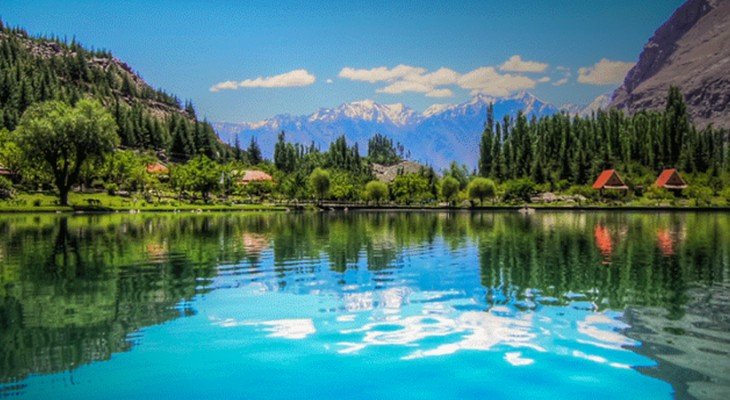
Ask most Pakistani travelers to name the lakes of Baltistan and you will hear Satpara, Shangrila, Sheosar and Attabad. Almost nobody will say Ghandus Lake — and that is exactly why it belongs on your list. Tucked above the small village of Ghandus in the Kharmang Valley, roughly 110 kilometres from Skardu, Ghandus Lake is one of those quiet alpine waters that the Karakoram keeps for the travelers willing to look beyond the famous names. Kharmang itself is known as a land of waterfalls and singing streams, and the lake sits in that same green, glacier-fed landscape — a mirror of sky and peaks with hardly another visitor in sight. This ghandus lake travel guide covers why this hidden lake deserves your trip, how to reach it, and how to build a full Kharmang Valley journey around it.
The honest truth about Ghandus Lake is that it rewards the explorer’s mindset. This is not a drive-up viewpoint with a parking lot and a tea stall. Reaching it means traveling deep into Kharmang — past the Shyok-Indus confluence, through apricot villages, over the scenic Ghandus Bridge — and then walking up from the village into the high pastures where the lake waits. What you get in return is rare in 2026: a Himalayan-Karakoram lake experience with no crowds, no noise and no commercial clutter. If your idea of travel is discovery rather than sightseeing, keep reading.
Quick Facts
- Location: Above Ghandus village, Kharmang Valley (Kharmang District), Gilgit-Baltistan — about 110 km from Skardu
- Altitude: high alpine pastures above the village (exact surveyed altitude not published; the valley floor here sits around 2,500–2,700 m)
- Famous For: A quiet, little-visited alpine lake in a valley of waterfalls, glaciers and trout streams; total solitude
- Nearest City: Skardu (about 110 km; 3–4 hours by road to Ghandus village)
- Accessibility: Road to Ghandus village, then a trek up to the lake. A local guide is recommended; the trail is not a developed tourist track.
- Known Landmarks: Ghandus village and bridge, Manthokha Waterfall (180 ft), Khamosh Waterfall, Kharmang’s trout fish farms
- Best For: Trekkers, solitude seekers, photographers, anglers, and travelers exploring Kharmang beyond Manthokha
Why Visit Ghandus Lake
The strongest reason to visit Ghandus Lake is also the simplest: almost nobody else does. Pakistan’s famous northern lakes now receive thousands of visitors on summer weekends, and the experience at the popular ones increasingly involves traffic, litter and queues for the same photograph. Ghandus Lake is the opposite. The village of Ghandus is described by travelers who have been there as one of the most beautiful places in Baltistan, and the lake above it sees only a trickle of visitors — mostly local herders, the occasional trekker, and travelers who heard about it from a Kharmang local. If you want to sit beside still mountain water and hear nothing but wind and the occasional bird, this is one of the few places left in the north where that is guaranteed.
The second reason is Kharmang Valley itself. Kharmang is one of Baltistan’s most water-blessed valleys — a place of glaciers, springs, rivers and waterfalls that locals call a land of singing streams. The 180-foot Manthokha Waterfall thunders through green pastures about 80 km from Skardu; the Khamosh waterfall hides further in; trout swim in the cold streams and are farmed for the valley’s restaurants. Ghandus Lake belongs to this waterscape. Visiting the lake naturally becomes a Kharmang circuit: waterfalls one day, the lake trek the next, trout dinner in the evening. It turns a single lake visit into a full valley experience.
The third reason is the journey. The road from Skardu to Kharmang is one of the great undiscovered drives of Gilgit-Baltistan: the confluence where the Shyok meets the Indus, villages like Ghawari draped in apricot blossom in spring, the scenic Ghandus Bridge spanning the valley, and the Karakoram rising on every side. By the time you start the walk up to the lake, you have already had a full day of Baltistan at its most authentic — and the lake is the quiet crown at the end of it. For travelers who believe the journey matters as much as the destination, Ghandus delivers both.
History of Ghandus Lake
Like many of the Karakoram’s smaller alpine lakes, Ghandus Lake has no recorded history of discovery — it has simply always been there, known to the herders and villagers of Ghandus who grazed their animals in the high pastures around it. The lake’s story is inseparable from the story of Kharmang, one of the old valleys of Baltistan. Kharmang’s villages — Ghandus, Tolti, Manthokha — were part of the cultural world of greater Baltistan, shaped by Tibetan Buddhist roots and later by Islam, living on apricots, barley, wheat and livestock, largely cut off from the outside world until the modern road network arrived.
What changed for Kharmang was the road. As the Skardu–Kharmang road improved, the valley’s waterfalls began drawing visitors — Manthokha, at 180 feet one of the tallest waterfalls in the region, became a fixture of Skardu itineraries, and travelers started pushing deeper into the valley. Ghandus, about 110 km from Skardu, entered the picture as travelers and vloggers documented it as one of Baltistan’s most beautiful villages, and the lake above the village began appearing in travel videos and local guides as “Ghandus Lake” or “Ghandus Jheel.” Its rise has been entirely word-of-mouth: no tourism department campaign, no signboards on the highway — just travelers telling travelers.
That word-of-mouth history is still being written, which is part of the lake’s charm and part of the responsibility of visiting. There are no published surveys of the lake’s depth or exact altitude, no ticket office, no facilities — it remains what the great northern lakes were a generation ago. Visitors who go now are seeing it in its natural state, and keeping it that way depends on the low-impact habits of everyone who walks up: carry out all waste, camp on durable ground, and leave the pastures as the herders keep them.
Top Things to Do in Ghandus Lake
Trek Up to the Lake from Ghandus Village
The walk from Ghandus village up to the lake is the heart of the visit. The trail climbs through terraced fields and then into high summer pastures, with the Karakoram opening up behind you as you gain height. It is a moderate walk rather than a technical trek, but it is not a marked tourist trail — go with a local from the village who knows the route, the water points and the weather. Start early, carry water and food, and give yourself the whole day so you can sit at the lake unhurried. The moment the water comes into view — still, clear, ringed by peaks — is the payoff for the entire journey into Kharmang.
Sit in Silence at the Water
This sounds like nothing, and it is everything. Ghandus Lake’s greatest luxury is the absence of crowds. Bring a book, a journal or just yourself, and spend an hour on the shore. The stillness of a high Karakoram lake — broken only by wind on the water — is increasingly hard to find in Pakistan’s north, and it is the experience most visitors remember longest.
Photograph Kharmang’s Waterscape
Photographers get two subjects for the price of one trip: the lake’s mirror-calm reflections in the morning, and Kharmang’s waterfalls on the way. Manthokha’s 180-foot cascade through green pastures is one of the most photogenic waterfalls in Gilgit-Baltistan, and the smaller Khamosh waterfall rewards those who seek it out. Morning light is best at the lake; late afternoon flatters the waterfalls.
Visit Manthokha Waterfall
No Kharmang trip is complete without Manthokha. About 80 km from Skardu, the 180-foot (55-metre) waterfall drops through lush green pastures amid the Karakoram, with a nearby restaurant serving local trout and a fish farm to visit. It is the valley’s headline attraction and the natural companion to a Ghandus Lake trek — do the waterfall on the drive in and the lake the next day.
Fish for Trout and Taste the Valley
Kharmang’s cold streams are trout country, and the valley is known for its fish farms. Try fresh trout at a local restaurant near Manthokha or in the valley villages — it is the definitive Kharmang meal. Anglers should ask locals about permitted spots and seasons; the streams around Ghandus run clear and cold.
Famous Places In and Around Ghandus Lake
- Manthokha Waterfall — 180 ft waterfall in green pastures, ~80 km from Skardu, with trout restaurants and a fish farm
- Khamosh Waterfall — Kharmang’s quieter cascade, for waterfall completists
- Ghandus Bridge — scenic bridge connecting the valley’s villages towards Skardu
- Shyok–Indus confluence — where the two great rivers meet, on the Skardu–Kharmang road
- Kharmang Rumbukha — scenic valley of singing streams, orchards and apricots (best in July–August)
- Tolti — the Kharmang district headquarters town, on the route into the valley
- Barah Valley — another hidden valley of crystal lakes, further east towards Khaplu
How to Reach Ghandus Lake
The gateway is Skardu. Fly into Skardu International Airport from Islamabad (about an hour) or drive the long road via the Karakoram Highway. From Skardu, take the road west/southwest into Kharmang Valley — the drive to Ghandus village covers about 110 km and takes roughly 3–4 hours depending on road conditions. The route passes the Shyok–Indus confluence and threads through Balti villages; a 4×4 or high-clearance vehicle is advisable, and in the upper stretches a local driver who knows the road is worth every rupee. Public transport into deep Kharmang is limited — shared vans run from Skardu towards Kharmang’s main towns, but for Ghandus village you will most likely need a hired jeep or a tour operator. From the village, the lake is reached on foot with a local guide; allow a full day for the round trek.
Route Details
From Islamabad: Fly Islamabad–Skardu (about 1 hour; weather-dependent, book early in season), then drive 110 km to Ghandus village (3–4 hours by jeep). By road, Islamabad–Skardu via the KKH takes 16–20 hours — split it with an overnight in Chilas or Gilgit. From Skardu, hire a jeep for Kharmang; agree the full itinerary (Manthokha, Ghandus village, lake trek) in advance.
From Lahore: Reach Islamabad first (4–5 hours by motorway), then follow the Islamabad route. There is no practical direct route from Lahore to Kharmang that bypasses Islamabad.
From Karachi: Fly Karachi–Islamabad, then connect to Skardu. The road journey from Karachi to Skardu is a multi-day undertaking; flying saves two to three days. Build buffer days into the plan for weather-delayed mountain flights.
Nearest airport: Skardu International Airport. There is no airport in Kharmang.
Road conditions by season: The Skardu–Kharmang road is a mountain road — passable for most of the year but subject to landslides and winter snow. The lake trek is a June–October undertaking; in winter the upper pastures are snowbound. July–August monsoon effects are milder here than in the Himalayan foothills, but streams on the trail can swell after rain.
Transport options: Flights to Skardu; hired jeeps/4×4 from Skardu for the Kharmang circuit (the standard choice); limited shared vans from Skardu towards Kharmang towns; local guides in Ghandus village for the lake trek; organized Skardu-based tour operators who can bundle transport, guide and camping gear.
Where to Stay in Ghandus Lake
Base yourself in Skardu for comfort and in Kharmang’s villages for authenticity. Skardu has the full range — from well-known hotels on the main road to mid-range guesthouses and budget lodges — and it is where you will arrange your jeep and supplies. Inside Kharmang, accommodation is simpler: family-run guesthouses and small hotels in the valley’s towns serve travelers heading to Manthokha and beyond, offering clean basic rooms and home-cooked food. These village stays are part of the experience — expect warm Balti hospitality, star-filled skies and very reasonable rates. At Ghandus village itself, ask locally about guest rooms or homestay-style lodging; in peak summer, Skardu-based operators can also arrange camping. For the lake, you have two choices: trek up and back in a day from the village, or camp overnight near the lake for sunrise on the water. If you camp, bring a proper tent and a warm sleeping bag — nights at altitude are cold even in August — and carry all your gear and waste with you. Book Skardu hotels ahead in July–August; Kharmang’s guesthouses rarely need advance booking but a phone call ahead is wise.
Where to Eat: Local Foods of Ghandus Lake
Eat trout — it is the law of the valley, or should be. Kharmang’s cold streams produce excellent trout, served fresh at restaurants near Manthokha Waterfall and in the valley villages, usually fried or grilled with simple seasoning. Beyond trout, you are in Balti food country: hearty wheat and barley breads, noodle soups, potato and meat stews, and apricots in every form — fresh in summer, dried year-round. Village guesthouses serve home-style meals that are simple, filling and very budget-friendly; a full local meal typically costs a few hundred rupees. In Skardu, the restaurant scene is broader, with everything from Balti and Pakistani staples to tourist-oriented menus. For the lake trek, pack your own food from Skardu or your Kharmang guesthouse — there are no shops or dhabas on the trail, and the village shops carry only basics.
Weather in Ghandus Lake
Kharmang’s climate is classic central Baltistan: dry, with big temperature swings between day and night and between the valley floor and the high pastures. Skardu and the valley towns are pleasant in summer and bitterly cold in winter; the lake, sitting in the high pastures above Ghandus village, is accessible only in the snow-free months. As ever in the Karakoram, mountain weather can change quickly — carry a layer even on a sunny morning.
| Season | Temperature Range | Conditions |
|---|---|---|
| Winter (Dec–Feb) | -10 to 5°C in the valley; far below freezing at the lake | Valley towns cold and quiet; lake snowbound and inaccessible. Road subject to snow closures. |
| Spring (Mar–May) | 5–22°C in the valley | Apricot blossom in the villages (March–April); upper pastures still snowbound. Waterfalls begin to swell with meltwater. |
| Summer (Jun–Aug) | 15–30°C in the valley; 5–18°C at the lake | The season for the lake trek. Green pastures, full waterfalls, longest days. Occasional rain; streams can run high. |
| Autumn (Sep–Oct) | 5–22°C in the valley; 0–12°C at the lake | Clear, stable weather and golden autumn colors — an excellent window before the snows return. Cold nights at altitude. |
Language and Culture of Ghandus Lake
Kharmang is Balti country. Balti, a Tibetic language, is the mother tongue of Ghandus and the surrounding villages, and the culture reflects Baltistan’s layered heritage — Tibetan roots, Islamic faith, and a mountain economy of apricots, wheat and livestock. The people of these valleys are known across Pakistan for their hospitality and their peaceful way of life; a traveler who shows respect will be treated like an honored guest. Practical notes: dress modestly, ask before photographing people (especially women), and accept offered tea graciously. On the trek, remember the pastures are working grazing land — do not disturb livestock, keep to the trail where one exists, and carry out every scrap of litter. Urdu is understood in the valley’s towns; in Ghandus village itself, a guide smooths everything.
Shopping in Ghandus Lake
There is no shopping at the lake — and barely any in Ghandus village — so plan your souvenirs around Skardu and the Kharmang towns. The valley’s signature products are apricots: dried apricots, apricot oil and apricot jam, sold in Skardu’s bazaars and along the Kharmang road at very fair prices. Look for Balti handicrafts — handwoven textiles, traditional caps, woodwork — and local honey. Buy trek snacks (dried fruit, nuts) in Skardu before heading into the valley. Prices in Baltistan’s bazaars are generally modest, and bargaining is gentle and good-natured.
Travel Tips for Ghandus Lake
Packing Essentials
Sturdy trekking shoes, layered clothing, a windproof jacket, sun protection (hat, sunscreen, sunglasses — the high-altitude sun is strong), 2+ litres of water capacity, high-energy snacks, a basic first-aid kit, and a headlamp if you might be out till dusk. If camping at the lake: tent, warm sleeping bag, stove and fuel (do not burn the sparse alpine vegetation). A power bank is essential — there is no charging on the trail.
Safety Tips
Go with a local guide — the trail is unmarked in places and mountain weather is unpredictable. Start early, keep an eye on the sky, and turn back if weather closes in. The altitude of the high pastures demands respect: pace yourself, hydrate, and do not push through symptoms of altitude sickness. Hire a reliable 4×4 with an experienced local driver for the Skardu–Kharmang road. As everywhere in Baltistan, the people are welcoming and the area is peaceful; the risks here are natural, not human.
Money & Connectivity
Carry all cash from Skardu — there are ATMs in Skardu but essentially no banking once you are deep in Kharmang, and none on the trail. Mobile coverage exists in the valley’s towns on the major networks but fades badly as you climb; expect no signal at the lake. Download offline maps and tell someone your plan before the trek.
Best Time to Visit Ghandus Lake
Summer (June–August) — The Trekking Window
The pastures are green, the lake is thawed, the waterfalls are at full flow and the days are long. This is when the lake is at its most beautiful and the trail at its most walkable. It is also when Kharmang’s apricots ripen — eat them fresh from the orchards.
Autumn (September–October) — Clear and Golden
Stable weather, crystalline air, and the valley turning gold. The trek is excellent in early autumn; by late October, nights at the lake are freezing and the first snows can arrive. Fewer travelers than summer.
Spring (March–May) — Blossom, Not the Lake
The lake trail is still snowbound, but the valley floor is lovely — apricot and almond blossom in March–April, waterfalls gathering force. Come for Kharmang’s spring and save the lake for summer.
Winter (November–February) — Closed
The lake is frozen and buried; the upper valley is a winter wilderness. Only the valley towns remain accessible, for travelers who want Baltistan’s stark winter beauty.
Final Thoughts
Ghandus Lake will never be famous, and that is its promise. While the crowds queue at the well-known lakes, this quiet water above a beautiful Kharmang village waits for the travelers who go one valley further, ask one local more, and walk one trail higher. The reward is the rarest thing in modern travel: a genuinely undiscovered-feeling place, in one of the most water-blessed valleys of the Karakoram.
So build the Kharmang circuit — Skardu to the Shyok-Indus confluence, Manthokha’s thundering falls, trout by a cold stream, the villages of the valley, and then the long walk up to Ghandus Lake. Go gently, leave nothing behind, and the lake will give you what it gives everyone who earns it: silence, scale, and a story nobody else at the dinner table has. For more hidden valleys, browse our Explore Pakistan collection.
FAQs
Where is Ghandus Lake located?
Ghandus Lake sits in the high pastures above Ghandus village in Kharmang Valley, Kharmang District, Gilgit-Baltistan — about 110 km from Skardu.
How do I reach Ghandus Lake?
Drive from Skardu to Ghandus village (about 110 km, 3–4 hours by jeep), then trek up to the lake with a local guide. Allow a full day for the round trip.
What is the best time to visit Ghandus Lake?
June to October. Summer offers green pastures and full waterfalls; September–October offers clear, stable weather. The lake is snowbound in winter.
Is Ghandus Lake crowded?
No — it is one of the least-visited lakes in Baltistan. You are likely to have it entirely to yourself.
What else is there to see in Kharmang Valley?
Manthokha Waterfall (180 ft), Khamosh Waterfall, the Ghandus Bridge, the Shyok–Indus confluence, trout fish farms and apricot orchards.
Can families visit Ghandus Lake?
Families can enjoy the Kharmang Valley circuit — Manthokha Waterfall and the villages — comfortably. The lake trek itself suits fit walkers; young children and elderly travelers may prefer to enjoy the valley floor.
Where can I stay near Ghandus Lake?
In Skardu’s hotels or Kharmang’s village guesthouses; ask in Ghandus village about local lodging, or camp near the lake with full gear.
Is it safe to visit Kharmang Valley?
Yes — Baltistan is known for its peace and hospitality. The main precautions are natural: mountain roads, weather and altitude. Travel with a local driver and guide.