Every mountain range has one peak that climbers speak about in hushed tones. In the Karakoram, that peak is Gasherbrum IV. At 7,925 metres it is not even an eight-thousander — yet its immense West Face, the legendary Shining Wall, towering nearly 2,500 metres above the glacial junction of Concordia, is considered one of the greatest unclimbed challenges in all of mountaineering. If you are choosing a mountain journey in Pakistan, few destinations carry as much aura as the trek to stand beneath this wall of rock and ice.
This Gasherbrum IV travel guide explains why this “smaller” giant deserves your journey, the extraordinary history written on its faces, what the trek involves, how to reach it from Islamabad, Lahore, or Karachi, and when the Karakoram opens its doors.
Quick Facts
- Location: Gasherbrum Massif, Baltoro Muztagh, Karakoram — Gilgit-Baltistan, Pakistan
- Altitude: 7,925 metres (26,001 feet) — the 17th highest mountain in the world and the 6th highest in Pakistan
- Famous For: The Shining Wall (West Face), the 1958 Bonatti–Mauri first ascent, and being mountaineering’s most venerated sub-8,000m challenge
- Nearest City: Skardu (trailhead village: Askole)
- Accessibility: Fly or drive to Skardu, jeep to Askole, then trek via the Baltoro Glacier to Concordia — the wall looms directly above it
- Known Landmarks: Concordia, the Baltoro Glacier, the Shining Wall itself
- Best For: Experienced trekkers, photographers, and devotees of mountaineering history — a pilgrimage, not a picnic
Why Visit Gasherbrum IV
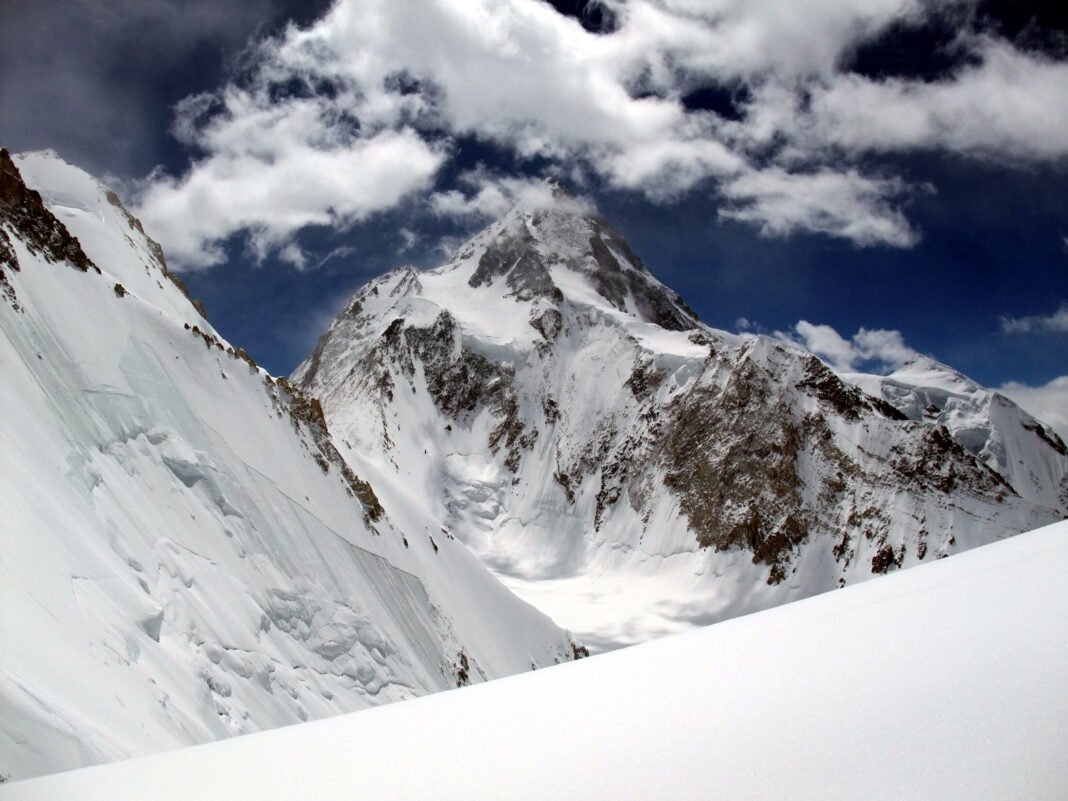
Here is what makes Gasherbrum IV special: you do not need to climb it to be overwhelmed by it. The mountain’s West Face rises directly above Concordia, the great glacial crossroads of the Karakoram, which means every trekker on the classic Baltoro route — the K2 base camp trek, the Gasherbrum treks — stands in the shadow of the Shining Wall. At sunset, when the face catches the last light and glows, you understand instantly why the British explorer William Martin Conway, who coined the phrase in 1892, called it the “shining wall.” (The Balti name itself actually means “beautiful mountain” — but nobody who has seen that face at dusk argues with Conway’s poetry.)
Among climbers, Gasherbrum IV holds a reverence out of all proportion to its height. It is the highest independent mountain under 8,000 metres in Pakistan, and its faces — above all the West Face — have repelled or humbled some of the greatest alpinists in history. The original 1958 route has never been repeated. The West Face has never been fully climbed. To stand at Concordia and look up at 2,500 metres of steep rock and ice that has defied six decades of attempts is to feel the true scale of the Karakoram in a way that statistics cannot convey.
Choose Gasherbrum IV if you want the Baltoro trek with an extra dimension of meaning. The journey is the same legendary walk — Askole, Paiju, Urdukas, Concordia — but your eyes will keep returning to one mountain. Photographers get the most dramatic single face in the range; history lovers get the story of Bonatti and Mauri, of the great Polish attempt of 1985, of the tragedies and triumphs etched into that wall. It is the thinking person’s Karakoram destination.
History of Gasherbrum IV
Gasherbrum IV entered the maps as K3, designated in 1856 by T. G. Montgomerie during the Great Trigonometric Survey of India, when the great Karakoram peaks were first sighted from more than 200 kilometres away. In 1892, William Martin Conway’s exploration gave the climbing world the evocative description of the peak’s great West Face as a “shining wall,” noting how it reflects the rays of the setting sun above Concordia. The name “Gasherbrum,” often claimed to mean “shining wall,” actually derives from the Balti rgasha (beautiful) and brum (mountain).
The mountain’s defining hour came in 1958. A strong Italian expedition led by the legendary Riccardo Cassin targeted the peak via the Northeast Ridge. After weeks of difficult climbing — including a storm-bound ordeal at their highest camp — Walter Bonatti and Carlo Mauri made the summit push. On August 6, 1958, they topped out at 12:30 in the afternoon, having crossed the pinnacled ridge from the North Summit to the main summit in a feat of bold, near-alpine-style climbing. It was one of the great ascents of the 1950s, achieved with minimal fixed support on unstable rock and knife-edge ridges. Remarkably, the Bonatti–Mauri route has never been successfully repeated.
What followed cemented the mountain’s fearsome reputation. In 1985, Polish climbers Wojciech Kurtyka and Robert Schauer attempted the unclimbed West Face — the Shining Wall itself — in pure alpine style, pushing to extraordinary heights on the face before a storm forced them back just short of the summit ridge. It remains one of the most celebrated near-misses in Himalayan history and a benchmark of bold alpinism. The West Face is still unclimbed in full. In 2018, an Italian military team attempting the Bonatti–Mauri route for the 60th anniversary of the first ascent suffered tragedy when Maurizio Giordano was killed by falling ice during the descent. Gasherbrum IV has also never been climbed in winter. Few mountains anywhere concentrate so much drama into a single summit.
Top Things to Do in Gasherbrum IV
Stand Beneath the Shining Wall at Concordia
The essential Gasherbrum IV experience requires no climbing at all. Trek the Baltoro to Concordia (about 4,650 metres) and position yourself to watch the West Face through the changing light of a full day — grey and forbidding at noon, golden at evening, violet at dusk. It is the single most dramatic mountain face you can view on a non-technical trek anywhere in the Karakoram, and most trekkers rank the moment among the highlights of their traveling lives.
Trek the Classic Baltoro Route
The journey to the mountain is the legendary K2/Gasherbrum approach: Askole → Jhola → Paiju → Urdukas → Goro II → Concordia, 7–8 days along the great Baltoro Glacier. Each camp brings new giants into view — the Trango Towers, Masherbrum, Muztagh Tower — building to the Concordia panorama where Gasherbrum IV dominates the northeastern skyline.
Visit the Gasherbrum Base Camp Area
From Concordia, the Abruzzi Glacier leads toward the Gasherbrum base camps, the staging grounds for expeditions on GI, GII, and GIV. In summer you can walk among the expedition camps, meet climbers from around the world, and see the Northeast Ridge — the line of Bonatti and Mauri’s 1958 triumph — from below.
Photograph the West Face
The Shining Wall is a photographer’s obsession: a near-vertical sweep of rock and ice nearly 2,500 metres high, best shot in the low angled light of morning and evening from Concordia and the upper Baltoro. Bring a telephoto lens to isolate the face’s details — the seracs, the rock bands, the hanging glaciers — and a tripod for the blue-hour glow.
Trace Mountaineering History
Before you go, read about the 1958 Cassin expedition, Bonatti’s career, and the 1985 Kurtyka–Schauer attempt. On the trek, your guide can point out the features of the great attempts. Walking where that history was made turns a spectacular trek into something approaching a pilgrimage.
Combine with K2 Base Camp and the Gondogoro La
Adventurous trekkers often extend the journey: from Concordia to K2 base camp up the Godwin-Austen Glacier, or the committing Gondogoro La crossing (about 5,585 metres) into the Hushe Valley. Both are serious undertakings requiring a strong operator, but they complete the ultimate Karakoram circuit.
Famous Places In and Around Gasherbrum IV
- The Shining Wall (West Face) — the legendary 2,500-metre face above Concordia
- Concordia (4,650 m) — the glacial junction and the wall’s great viewpoint
- Baltoro Glacier — the approach highway, one of the world’s great glaciers
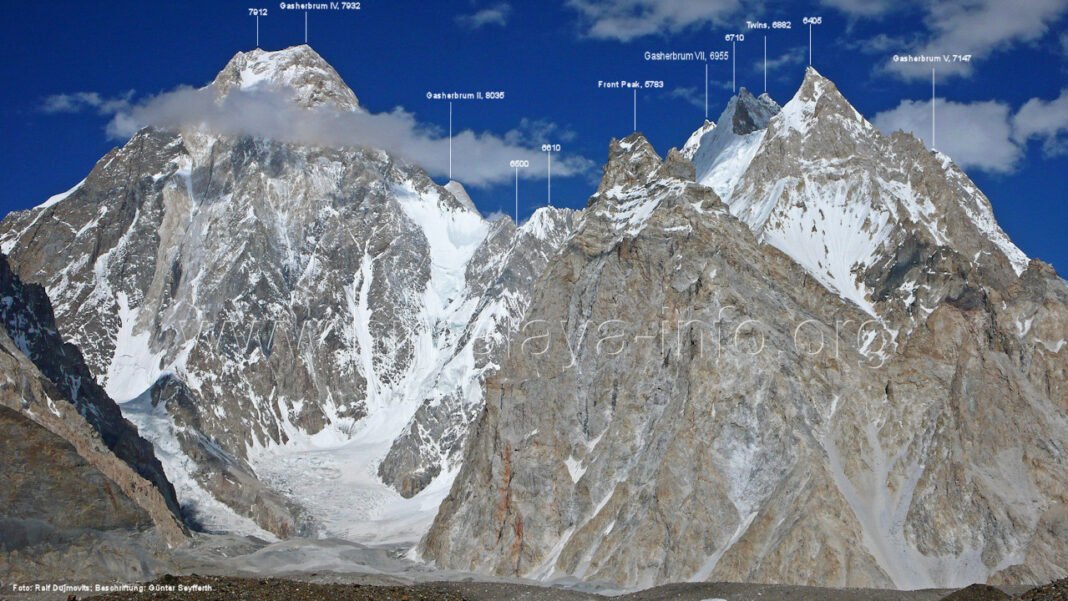
- Gasherbrum I (8,080 m) and Gasherbrum II (8,035 m) — the eight-thousander siblings
- K2 (8,611 m) and Broad Peak (8,051 m) — dominating the Concordia panorama
- Muztagh Tower and the Trango Towers — the granite spires of the lower Baltoro
- Askole and the Shigar Valley — Balti villages at the trek’s start
How to Reach Gasherbrum IV
Gasherbrum IV is reached exactly like its massif siblings — the funnel is Skardu, then Askole, then the long walk up the Baltoro.
From Islamabad: Fly to Skardu in about an hour (unforgettable views, but cancellations are common — keep spare days), or drive the Karakoram Highway: Islamabad to Chilas is roughly 461 km (11–12 hours), Chilas to Skardu about 290 km (8–9 hours) beside the Indus. From Skardu, hire a 4×4 for the 6–7 hour jeep track to Askole.
From Lahore: Motorway to Islamabad (4–5 hours), then the Islamabad–Skardu options. Organized treks almost always muster in Islamabad.
From Karachi: Fly to Islamabad (about 2 hours) and continue north as above. All Gasherbrum logistics flow through the capital.
Nearest airport: Skardu Airport. After Skardu, it is jeeps and trekking boots all the way.
Route Details
- Islamabad → Skardu: by air (~1 hour, weather-dependent) or by road via Chilas on the Karakoram Highway (two driving days).
- Skardu → Askole: 6–7 hours by jeep through the Shigar Valley to the last village (~3,000 m).
- Askole → Jhola → Paiju → Urdukas → Goro II → Concordia: the classic 7–8 day Baltoro trek, with an acclimatization rest day at Paiju.
- Concordia → Gasherbrum base camp area: up the Abruzzi Glacier toward the foot of the massif, with the Shining Wall towering to the side.
- Permits and logistics: expedition permits come from Pakistan’s tourism authorities via licensed operators and the Alpine Club of Pakistan, with a liaison officer assigned. Trekkers to Concordia should travel with a registered company providing guides, cooks, and porters.
Where to Stay in Gasherbrum IV
There are no hotels at Gasherbrum IV — accommodation is tents, and gloriously so. Trekkers sleep in expedition dome tents at the established Baltoro campsites; anyone joining a climbing expedition stays in the operator’s base camp village of sleeping, kitchen, dining, and communications tents. Nights at Concordia, at 4,650 metres with the Shining Wall overhead, are among the great camping experiences on Earth. Bring or confirm a sleeping bag rated far below freezing and a warm, storm-proof tent setup through your operator.
Skardu, before and after, offers the full range from simple guesthouses to comfortable mid-range and upper-range hotels — book ahead for June–August. Askole has only very basic guesthouses and campsites for the single staging night. Pack earplugs for Skardu’s lively summer trekking scene and patience for its occasional power cuts.
Where to Eat: Local Foods of Gasherbrum IV
On the trek, your cooks are the unsung heroes: expect filling, calorie-dense meals of rice, lentils, pasta, porridge, and soup, with tea flowing constantly. At Concordia and beyond, food is fuel — eat plenty, drink more water than feels necessary, and supplement with your own energy bars, nuts, and chocolate for the long days.
In Skardu and Shigar, eat like a Balti before the trail diet begins. Balay (hand-pulled noodle soup) and mamtu (steamed dumplings) are the soul foods of Baltistan, joined by barley and buckwheat dishes, fresh dairy, and the region’s famous apricot oil. Stock up in Skardu’s bazaar on dried apricots, mulberries, walnuts, and almonds — the original Karakoram energy food, and the perfect gift to bring home. In Askole, dinner is humble and heartfelt: chapati, lentils, rice, and milk tea.
Weather in Gasherbrum IV
The Karakoram around Gasherbrum IV obeys a brutal, simple calendar. Summer — June to August — is the window when the trekking route is open and the Shining Wall can be viewed in relative comfort. The rest of the year belongs to winter. Approximate conditions at Concordia/base-camp altitudes (~4,650–5,100 m):
| Season | Temperature Range | Conditions |
|---|---|---|
| Winter (Nov–Mar) | -25°C to -40°C | Extreme cold, storms, deep snow; the mountain has never been climbed in winter |
| Spring (Apr–May) | -15°C to -5°C | Still winter at altitude; route generally not yet open for trekkers |
| Summer (Jun–Aug) | -5°C to 12°C (days) | Trekking and expedition season; most stable weather, though storms can arrive suddenly; freezing nights |
| Autumn (Sep–Oct) | -15°C to 5°C | Cooling rapidly; early September occasionally viable, then winter closes the route |
Language and Culture of Gasherbrum IV
The road to the Shining Wall passes through Baltistan, home of the Balti people and their Balti language — a Tibetic tongue that carries the memory of centuries of ties with Ladakh and Tibet. The Baltis are justly famous as high-altitude porters, the strong and skilled men without whom no Karakoram expedition would move. Their culture weaves Tibetan heritage together with Islamic faith, visible in music, dance, dress, and the distinctive architecture of the Shigar Valley.
Visitors owe the valley’s people respect and fair dealing: modest dress in villages, asking before taking portraits, and proper treatment of porters and guides through licensed channels. The traditional music-and-dance welcomes in the villages are genuine expressions of hospitality — receive them with the warmth they are offered. A greeting in Balti will open doors and smiles all the way to Concordia.
Shopping in Gasherbrum IV
Do your shopping in Skardu — there is nothing to buy on the glacier except memories. The bazaar offers dried apricots, apricot oil, walnuts, almonds, and mulberries for the trail and for gifts; woolen caps, gloves, and socks as spares; and Balti handicrafts such as hand-woven rugs, carved wooden items, and traditional knives. There are no shopping malls anywhere on the route, and Skardu’s markets are your last real supply point — check your kit list there, buy spare batteries and snacks, and leave nothing essential to chance. Askole’s tiny shops stock only the basics.
Travel Tips for Gasherbrum IV
Packing Essentials
Full high-altitude trekking kit: four-season layering, heavy down jacket, sleeping bag rated to extreme cold, broken-in mountaineering or sturdy trekking boots, glacier sunglasses, high-SPF sunscreen and lip balm, headlamp with spare batteries, trekking poles, water purification, and personal medications including altitude sickness medication on your doctor’s advice. Confirm the group-gear division with your operator early.
Safety Tips
The Baltoro trek is a serious high-altitude undertaking: altitude sickness, crevasses, rockfall, and fast-moving storms are all real. Travel only with a licensed operator and certified guides; acclimatize with proper rest days; never wander on the glacier alone; and carry a satellite communicator, since there is no mobile coverage beyond the villages. Helicopter evacuation depends entirely on weather and is never guaranteed — comprehensive insurance including high-altitude rescue is essential. This trek is for fit, experienced adults, not children or casual walkers.
Money & Connectivity
Cash is king from Skardu onward — no ATMs, no card payments beyond the city. Settle expedition fees through your operator in advance; carry rupees for porters’ tips, extras, and village purchases. Mobile signal dies in the Shigar Valley; from Askole on, expect nothing. Satellite devices are the expedition standard.
Best Time to Visit Gasherbrum IV
Summer (June to August) — The Window
The only realistic season for the trek and for viewing the Shining Wall in comfort. June has long days and fewer crowds; July brings the most stable weather and the classic Concordia experience; August stays good with a slightly higher chance of precipitation. Base camp areas hum with international expeditions.
Shoulder Months (May and September)
Only for very experienced, self-sufficient trekkers — colder, quieter, and less supported. Climbing activity is minimal outside summer.
Winter (October to April) — The Impossible Season
Temperatures plunge toward -40°C, storms rage, and the route is effectively closed. That Gasherbrum IV has never been climbed in winter tells you everything about what the mountain is like then.
Final Thoughts
Gasherbrum IV proves that greatness in the mountains is not measured in metres. A “mere” 7,925-metre peak, it commands a reverence that many eight-thousanders never earn — because of a wall of rock and ice that glows at sunset and has defied the world’s best for more than sixty years. You do not need to be a climber to feel it. You only need to walk the Baltoro, stand at Concordia, and look up.
If you are choosing your Karakoram journey, let the Shining Wall be part of it. Go in summer, go with a reputable operator, and give yourself time to simply sit and watch the light move across the face. Complete your planning with our Askole travel guide, the Baltoro Glacier travel guide, and the Concordia travel guide — and find more northern journeys in the Explore Pakistan collection.
FAQs
Where is Gasherbrum IV located?
In the Gasherbrum Massif of the Karakoram, in Gilgit-Baltistan, Pakistan — its West Face towers directly above Concordia, reached via Skardu, Askole, and the Baltoro Glacier trek.
How high is Gasherbrum IV?
7,925 metres (26,001 feet) — the 17th highest mountain in the world, the 6th highest in Pakistan, and the highest independent mountain under 8,000 metres in the country.
What is the Shining Wall?
The immense West Face of Gasherbrum IV, rising nearly 2,500 metres above Concordia. British explorer William Martin Conway coined the phrase in 1892 for the way the face reflects the setting sun. It has never been fully climbed.
Who first climbed Gasherbrum IV?
Italians Walter Bonatti and Carlo Mauri, on August 6, 1958, via the Northeast Ridge, as part of an expedition led by Riccardo Cassin. Their route has never been repeated.
Can trekkers see Gasherbrum IV without climbing?
Yes — spectacularly. The West Face looms over Concordia, which is reachable on the classic non-technical Baltoro trek (7–8 days from Askole). No climbing is needed to stand beneath the Shining Wall.
What is the best time to visit Gasherbrum IV?
June to August, the Karakoram summer, when the trekking route is open and weather is most stable.
How do I reach Gasherbrum IV?
Fly or drive from Islamabad to Skardu, take a 4×4 jeep to Askole, then trek 7–8 days up the Baltoro Glacier via Paiju to Concordia, beneath the mountain’s West Face.
Is the trek to Concordia safe for families?
No. The high altitude (above 4,600 m), glacier hazards, remoteness, and lack of medical facilities make it suitable only for fit, experienced adult trekkers traveling with a professional operator.