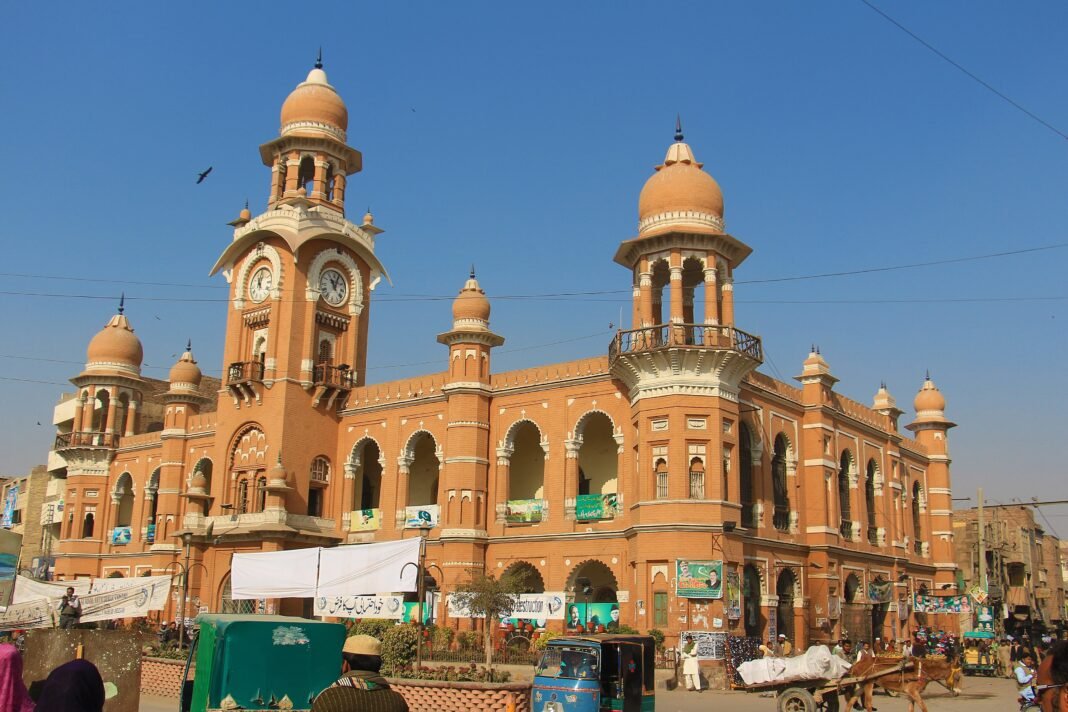
Multan is one of the oldest continuously inhabited cities in South Asia — a city of saints, shrines and bazaars that has been a prize for conquerors for over two thousand years. At the very heart of the old walled city, where the bazaar lanes converge and the city’s pulse beats loudest, stands the Ghanta Ghar: Multan’s clock tower, built by the British between 1884 and 1888 in the Indo-Saracenic style. It is not just a handsome colonial landmark. It is the meeting point of Multan’s many eras — raised on the ruins of a Sikh-era haveli destroyed in the Siege of Multan, named for British viceroys, renamed for Jinnah after independence, and surrounded today by the living chaos of Hussain Agahi Bazaar. If you want to understand Multan in a single stop, start here. This ghanta ghar multan travel guide covers why the tower deserves your visit, its layered history, and how to plan the perfect Multan day around it.
What makes the Ghanta Ghar special is its position at the crossroads of everything. Step out of its shadow and you are in the bazaars; look one way and you see the road climbing to the ancient Qila Kohna Qasim Bagh fort; look the other and the lanes lead towards the great Sufi shrines that made Multan the City of Saints. It is the rare heritage monument that is not fenced off from daily life but buried in it — rickshaws circling, shopkeepers calling, the smell of sohan halwa drifting from the sweet shops. Come for the architecture, stay for the city.
Quick Facts
- Location: Ghanta Ghar Chowk, old walled city, Multan, Punjab — beside Hussain Agahi Bazaar, near Qila Kohna Qasim Bagh
- Altitude: around 120 metres (plains city)
- Famous For: Historic clock tower (1884–1888) in Indo-Saracenic style; formerly Northbrook Tower; the hall (Ripon Hall, later Jinnah Hall) served as the city’s municipal headquarters
- Nearest City: Multan itself — the tower is in the city centre
- Accessibility: Very easy — in the middle of the old city; reach by rickshaw, taxi or the Multan Metro Bus; walkable from the main bazaars
- Known Landmarks: The clock tower and Jinnah Hall; Hussain Agahi Bazaar; Qila Kohna Qasim Bagh; shrines of Shah Rukn-e-Alam and Bahauddin Zakariya
- Best For: Heritage lovers, photographers, bazaar wanderers, food travelers, and anyone exploring South Punjab
Why Visit Ghanta Ghar, Multan
The first reason is the building itself. The Ghanta Ghar is a fine example of Indo-Saracenic architecture — the British colonial style that fused Islamic arches and domes with European planning — and it has stood at Multan’s centre for nearly a century and a half. The tower rises over the chowk with a presence you feel before you analyze: clock faces, arched galleries, and the solid masonry of an empire that built to impress. In a city where most visitors come for the medieval Sufi shrines, the Ghanta Ghar is the great colonial counterpoint, and it photographs beautifully in the golden light of late afternoon.
The second reason is what surrounds it. Few heritage sites in Pakistan sit so completely inside living urban life. The tower anchors Ghanta Ghar Chowk, ringed by the bazaars of the walled city — and Multan’s bazaars are legendary. Hussain Agahi Bazaar, one of the city’s oldest markets, spills out around the tower with its cloth merchants, spice sellers and sweet shops. This is not a sanitized heritage precinct; it is Multan doing what it has done for centuries — trading, bargaining, living — with a 19th-century clock tower watching over it. Travelers who love old cities will find this intoxicating.
The third reason is the history stacked into one site. The tower stands on the ruins of the haveli of Ahmad Khan Sadozai, destroyed in the Siege of Multan of 1848–49 — the battle that ended Sikh rule and brought the Punjab under the British. The hall was named Ripon Hall after the viceroy Lord Ripon, the tower Northbrook Tower after Lord Northbrook; after 1947 the hall became Jinnah Hall. In a single building you can read the Sikh period, the British Raj and independent Pakistan. And because the tower sits minutes from Qila Kohna Qasim Bagh and the Sufi shrines, it makes the perfect starting point for a full day of Multan’s 2,000-year story.
History of Ghanta Ghar, Multan
To understand the Ghanta Ghar, you have to understand the ground it stands on. In 1848–49, Multan was the scene of the Siege of Multan, the decisive conflict of the Second Anglo-Sikh War. The city’s Sikh governor, Diwan Mulraj, rebelled against the British; after months of siege, Multan fell, the Sikh Empire collapsed, and the Punjab was annexed by the British. In the fighting, the haveli of Ahmad Khan Sadozai was completely destroyed. Its ruins became the site for the new city’s municipal headquarters a generation later.
The trigger was administrative: after the municipal act of 1883, the British needed offices to run the city. Construction of the Ghanta Ghar began on 12 February 1884 and took four years to complete. The hall and building were named “Ripon Hall and Ripon Building” after Lord Ripon, the viceroy of India at the time, while the clock tower itself was named “Northbrook Tower” after Lord Northbrook, a former viceroy. The complex was completed and opened in 1888, and the municipal offices shifted in. Built in the Indo-Saracenic style, it combined the arches, domes and decorative vocabulary of Islamic architecture with the functional planning of a colonial civic building.
For six decades it served as the beating administrative heart of Multan — offices by day, and a hall used for meetings and cultural programs. After the independence of Pakistan in 1947, the hall was renamed Jinnah Hall in honour of Quaid-e-Azam Muhammad Ali Jinnah, and it continued to host official meetings and cultural events, with the public allowed to enter. Over time, the building became too small for the growing city’s administration, offices moved elsewhere, and the complex settled into its role as a historic landmark rather than a working headquarters. There have been proposals to convert the building into a museum — a fitting future for a structure that has watched Multan change for 140 years.
The tower has not always been well cared for. A widely reported Dunya News investigation found the historic building in a dilapidated state, with the famous clock no longer functioning and parts of the structure suffering from neglect — a reminder of how fragile even the grandest heritage can be without maintenance. Preservation of the Ghanta Ghar remains a live civic conversation in Multan, and every visitor who comes, photographs and asks about it adds to the case for its care. The tower endures, as Multan itself endures — a little worn, entirely alive.
Top Things to Do in Ghanta Ghar, Multan
Admire the Tower and Jinnah Hall
Start with the architecture. Walk around the chowk and study the tower from all sides — the clock faces, the arched openings, the Indo-Saracenic detailing that blends Mughal-inspired forms with colonial solidity. The adjoining hall building, once Ripon Hall and now Jinnah Hall, completes the composition. Late afternoon light is kindest for photography, when the low sun warms the masonry and the chowk is at its liveliest.
Wander Hussain Agahi Bazaar
From the tower, dive into Hussain Agahi Bazaar, one of Multan’s oldest and most atmospheric markets. This is where the city shops: fabrics, embroidered textiles, spices, crockery, and the famous Multani sweets. Bargaining is expected and good-natured. Even if you buy nothing, the bazaar is a spectacle — narrow lanes, hand-pulled carts, shopkeepers who have traded here for generations.
Climb to Qila Kohna Qasim Bagh
A short distance from the Ghanta Ghar rises the ancient fort of Qila Kohna Qasim Bagh, Multan’s old citadel mound. The fort has been fought over by everyone from Alexander the Great’s army (local tradition holds he was wounded at the bastion between Pak Gate and Delhi Gate) to the British. Walk the ramparts for panoramic views over the old city, and visit the shrines and old structures on the mound.
Visit the Great Sufi Shrines
Multan is the City of Saints, and the two greatest shrines are minutes from the tower: the magnificent tomb of Shah Rukn-e-Alam, with its stunning glazed-tile dome visible across the city, and the shrine of Bahauddin Zakariya, the great Suhrawardi Sufi saint. Visit in the late afternoon when the light plays on the blue tiles and the atmosphere is at its most spiritual.
Taste Multan’s Famous Sohan Halwa
No visit to the Ghanta Ghar area is complete without Multani sohan halwa — the dense, nutty, ghee-rich sweet that is the city’s most famous export. The sweet shops around the old city sell it fresh; buy a box to take home. Pair it with a walk through the bazaar for the full sensory experience.
Famous Places In and Around Ghanta Ghar, Multan
- Qila Kohna Qasim Bagh — Multan’s ancient fort mound with city views
- Shrine of Shah Rukn-e-Alam — the iconic blue-tiled tomb, Multan’s most recognizable monument
- Shrine of Bahauddin Zakariya — great 13th-century Sufi saint’s mausoleum
- Bloody Bastion (Khooni Burj), Multan — the historic bastion between Pak Gate and Delhi Gate
- Bakhar Fort — another of the region’s historic fortifications
- Hussain Agahi Bazaar — the old city’s legendary market, wrapped around the tower
- Multan’s old city gates — Delhi Gate, Pak Gate, Haram Gate and the surviving walled-city fabric
How to Reach Ghanta Ghar, Multan
The Ghanta Ghar stands in the centre of Multan’s old walled city, so reaching it means reaching Multan and then heading for the old city. Multan is a major city of South Punjab with excellent connections: Multan International Airport has flights from Karachi, Lahore, Islamabad and Gulf destinations; the railway station is on the main Karachi–Peshawar line with frequent trains; and the motorway network (M-4/M-3 to Lahore, M-5 towards Sukkur/Karachi) makes road travel smooth. Within Multan, take an auto-rickshaw or taxi to Ghanta Ghar Chowk — every driver knows it — or ride the Multan Metro Bus part of the way and switch to a rickshaw for the old-city lanes. The old city is congested, so the last stretch is best done on foot or by rickshaw rather than private car.
Route Details
From Islamabad: Drive via the M-2 to Lahore and then the M-3/M-4 to Multan — about 650–700 km, roughly 7.5–9 hours. Alternatively, take the train (several daily services, 8–10 hours) or fly Islamabad–Multan (about 1.5 hours). Coaches and vans also run the route.
From Lahore: The easiest leg — Multan is about 330–350 km from Lahore via the M-3/M-4 motorway, roughly 4.5–5.5 hours by car. Trains run frequently (4–6 hours), and there are regular flights (about 1 hour). Day trips are possible but an overnight stay lets you see the city properly.
From Karachi: About 850–900 km by road via the M-5/N-5 — a long 11–13 hour drive, best split or avoided. The practical choices are the train (overnight services on the main line, 12–16 hours) or a direct flight Karachi–Multan (about 1.5–2 hours), with several daily options.
Nearest airport: Multan International Airport, about 10–15 km from the old city (20–30 minutes by taxi/rickshaw depending on traffic).
Road conditions by season: Multan is a plains city on the motorway network — roads are good year-round. Summer heat (May–July) makes midday sightseeing punishing; plan outdoor walking for mornings and evenings. Winter fog (December–January) can delay flights and slow motorway traffic.
Transport options: Flights to Multan International; trains on the Karachi–Peshawar main line; intercity coaches and vans; Multan Metro Bus within the city; auto-rickshaws and taxis for the old city (agree fares first); walking for the bazaar lanes around the tower.
Where to Stay in Ghanta Ghar, Multan
Stay in Multan city — the tower is in the old city, but the best hotels are in the modern areas a short rickshaw ride away. Multan has solid options across budgets: well-known four-star and business hotels on the main boulevards offer comfortable rooms, restaurants and reliable service for mid-range and upscale travelers. Budget travelers will find plenty of economy hotels and guesthouses near the railway station and in the city centre. For atmosphere, consider staying closer to the old city — a few heritage-style guesthouses put you within walking distance of the bazaars and the fort, though the lanes can be noisy. Book ahead during the urs season and in winter (Multan’s peak tourist months), when the city fills with pilgrims and travelers. Wherever you stay, the Ghanta Ghar is an easy rickshaw ride away, and most hotels can arrange a driver for a full old-city day.
Where to Eat: Local Foods of Ghanta Ghar, Multan
Multan is one of Pakistan’s great food cities, and the area around the Ghanta Ghar is the place to taste it. The headliner is sohan halwa — buy it from the famous old-city sweet shops, where it is made fresh in huge trays and cut to order. For savory food, try Multani cholay (spicy chickpeas), the city’s beloved breakfast; siri paye; and the hearty desi meat dishes of the old-city food streets. In mango season (June–July), Multan’s mangoes — the region grows some of Pakistan’s finest, including the celebrated Anwar Ratol — are everywhere, sold by the crate in the bazaars. Wash it down with rabri doodh or a glass of fresh sugarcane juice from a bazaar stall. Food around the tower is very budget-friendly: a full local meal costs a few hundred rupees, and street snacks cost pocket change. The food streets near Hussain Agahi Bazaar and the restaurants around the old city gates are the most atmospheric places to eat.
Weather in Ghanta Ghar, Multan
Multan has one of the most extreme climates of any major Pakistani city: famously scorching summers and pleasantly mild winters. The Ghanta Ghar is an outdoor, walking-heavy visit — bazaar lanes, the fort mound, the shrines — so timing matters enormously. Winter is the season Multan was made for; summer demands strategy.
| Season | Temperature Range | Conditions |
|---|---|---|
| Winter (Dec–Feb) | 5–22°C | The best season — cool mornings, sunny days, perfect for walking the old city. Occasional fog can delay travel in December–January. |
| Spring (Mar–Apr) | 18–35°C | Pleasant early, warming fast. Good for sightseeing before the heat arrives; mango blossom season in the orchards. |
| Summer (May–Jul) | 32–47°C | Extremely hot — among the hottest cities in Pakistan. Sightsee only early morning or evening; mango season peaks in June–July. |
| Autumn (Sep–Nov) | 20–38°C | Heat eases from October; late autumn is comfortable and a fine second-choice window for the old city. |
Language and Culture of Ghanta Ghar, Multan
Multan is the cultural heart of the Saraiki region. Saraiki is the mother tongue of the old city — you will hear it in the bazaars around the Ghanta Ghar — alongside Punjabi and Urdu, which everyone understands. The city’s identity is deeply Sufi: the shrines of Shah Rukn-e-Alam, Bahauddin Zakariya and dozens of lesser saints shape daily life, and the annual urs festivals draw pilgrims from across Pakistan. Respect at the shrines matters: dress modestly, remove shoes where required, and follow the local customs of each shrine.
In the bazaars, the culture is commercial and warm — shopkeepers expect bargaining and enjoy it, and a cup of tea is often part of the negotiation. Multanis are proud of their city and happy to direct a lost traveler. As in any old city, keep valuables secure in crowded lanes, agree rickshaw fares before riding, and carry water in the hot months. Friday afternoons are quiet in the bazaars; evenings are when the old city comes alive.
Shopping in Ghanta Ghar, Multan
The bazaars around the Ghanta Ghar are the shopping. Hussain Agahi Bazaar is the historic core — fabrics, embroidered Multani textiles, khussas (traditional embroidered shoes), blue pottery (Multan’s famous kashi-kari ceramics), spices and brassware. For the city’s signature souvenirs, buy sohan halwa from the old sweet shops and blue pottery from the craft shops — the glazed blue tiles you see on the shrines are a Multan art form centuries old. The old city also has markets for traditional garments and wedding goods that are worth browsing even without buying. Bargain politely; start at roughly two-thirds of the asking price and meet in the middle. For modern mall shopping, Multan’s newer boulevards have contemporary malls — but around the Ghanta Ghar, the bazaar is the point.
Local Events and Festivals
Multan’s calendar is built around its saints. The annual urs of Shah Rukn-e-Alam — the city’s greatest saint, whose blue-tiled tomb dominates the skyline — is the biggest religious gathering of the year, drawing thousands of pilgrims with qawwali nights, communal meals and a fair-like atmosphere around the shrine. The urs of Bahauddin Zakariya is similarly significant. These are deeply authentic cultural experiences, though the city is crowded at urs time — book hotels early. The Eid festivals transform the bazaars around the Ghanta Ghar with lights, shopping rushes and festive food. In June–July, mango season is its own celebration, with the fruit everywhere and mango festivals held in the region. Basant (the kite festival) is celebrated with enthusiasm in Punjab — check locally, as its official status varies year to year.
Travel Tips for Ghanta Ghar, Multan
Packing Essentials
In winter (the recommended season): a light jacket for cool mornings and evenings, comfortable walking shoes for the bazaar lanes and fort mound, sunscreen and a hat even in winter, and a water bottle. In summer: the lightest clothes you own, a hat, sunglasses, sunscreen, and far more water than you think you need — sightseeing is an early-morning and late-evening activity. A small backpack keeps hands free in crowded bazaars.
Safety Tips
The old city around the Ghanta Ghar is busy and generally safe during the day, but it is crowded — keep phones and wallets secure, especially in the bazaar rush. Use registered rickshaws or hotel-arranged transport; agree fares before you ride. The fort mound and shrine areas are fine for visitors, but dress modestly and follow shrine etiquette. Avoid the congested old-city lanes late at night if you are unfamiliar with the area.
Money & Connectivity
Multan is a major city with ATMs and banks everywhere — withdraw in the modern areas before diving into the old-city bazaars, where cash is king. Bargaining is cash-based. All major mobile networks (Jazz, Telenor, Zong, Ufone) have strong 4G coverage across the city, including the old city. Most mid-range and upscale hotels offer Wi-Fi.
Best Time to Visit Ghanta Ghar, Multan
Winter (November–February) — Perfect
This is Multan’s glory season: cool, sunny days made for walking the bazaars, climbing the fort and lingering at the shrines. The urs season falls in the cooler months, adding cultural depth. If you can choose, choose winter.
Spring (March–April) — Pleasant
Warm but manageable, with the city’s orchards in blossom. A good shoulder season before the furnace of May.
Mango Season (June–July) — Hot but Delicious
The most punishing heat of the year — but also mango season, when Multan’s orchards produce their legendary fruit. If you come now, sightsee at dawn and dusk, rest at midday, and eat mangoes like it is your job.
Autumn (September–October) — Warming Down
The heat breaks gradually; by late October the old city is walkable again. A fine alternative to winter with fewer crowds.
Final Thoughts
The Ghanta Ghar is not Multan’s most famous monument — the blue dome of Shah Rukn-e-Alam takes that honour. But it may be the city’s most honest one. It does not stand apart from Multan; it stands inside it, wrapped in bazaars, watched by rickshaw drivers, part of the daily rhythm of one of the oldest cities on Earth. To visit the tower is to visit Multan as it actually is: layered, loud, devout, commercial, and utterly itself.
So give the old city a full day. Start at the Ghanta Ghar, lose yourself in Hussain Agahi Bazaar, climb the fort mound, pay your respects at the shrines, and finish with sohan halwa as the evening call to prayer drifts over the walled city. That is Multan — and the clock tower at its heart has been keeping time over it all for 140 years. For more journeys through the country’s heritage cities, explore our Explore Pakistan collection.
FAQs
Where is the Ghanta Ghar in Multan?
The Ghanta Ghar (clock tower) stands at Ghanta Ghar Chowk in Multan’s old walled city, beside Hussain Agahi Bazaar and near Qila Kohna Qasim Bagh.
When was the Ghanta Ghar built?
Construction began on 12 February 1884 and was completed in 1888, during the British Raj. It was built in the Indo-Saracenic style on the ruins of a haveli destroyed in the Siege of Multan (1848–49).
Why is it also called Northbrook Tower?
The tower was originally named Northbrook Tower after Lord Northbrook, a former viceroy of India, while the hall was named Ripon Hall after Lord Ripon. After 1947, the hall was renamed Jinnah Hall.
How do I reach the Ghanta Ghar?
Reach Multan by flight (Multan International Airport), train or motorway, then take a rickshaw or taxi to Ghanta Ghar Chowk in the old city. The last stretch is best on foot or by rickshaw.
What is the best time to visit Multan?
November to February — cool, sunny weather ideal for walking the old city, bazaars and shrines. Avoid midday sightseeing in the extreme summer heat (May–July).
Is the Ghanta Ghar area safe for tourists?
Yes — the old city is busy and welcoming during the day. Take normal precautions in crowded bazaars, agree rickshaw fares in advance, and dress modestly at the shrines.
What should I buy near the Ghanta Ghar?
Multani sohan halwa, blue pottery (kashi-kari), embroidered textiles and khussas from Hussain Agahi Bazaar — and mangoes in season (June–July).
What else can I see near the Ghanta Ghar?
Qila Kohna Qasim Bagh fort, the shrines of Shah Rukn-e-Alam and Bahauddin Zakariya, the Bloody Bastion (Khooni Burj), the old city gates, and the full length of Hussain Agahi Bazaar.