


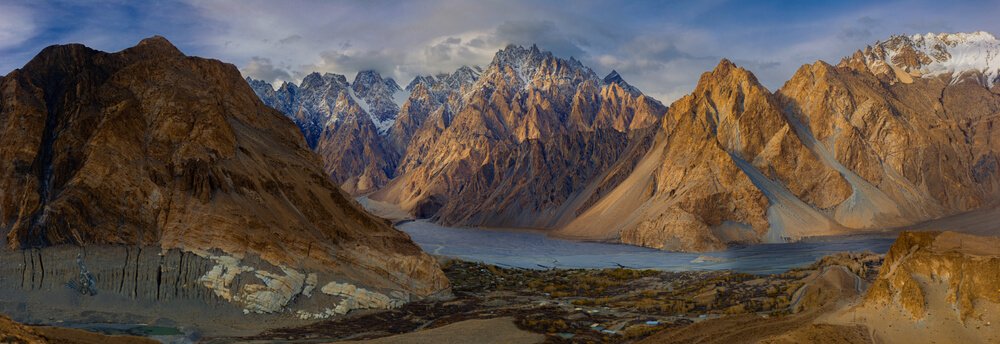
Of all the valleys in Pakistan, one name keeps appearing on travellers’ wish lists: Gojal, the Upper Hunza. This is the land of the Passu Cones, the sapphire Attabad Lake, the dizzying Hussaini suspension bridge, and the highest paved border crossing on earth at Khunjerab. But Gojal is more than a checklist of famous sights. It is a living Wakhi culture of orchards, glaciers, and warm hospitality, where villages like Gulmit, Ghulkin, Hussaini, and Passu have welcomed travellers since the days of the Silk Road. If you are choosing one mountain destination in Pakistan, this Gojal (Upper Hunza) travel guide will show you why this valley deserves your trip, and when to time it perfectly.
Quick Facts
- Location: Gojal (Upper Hunza) tehsil, Hunza District, Gilgit-Baltistan, Pakistan, along the Karakoram Highway north of central Hunza to the China border
- Altitude: Around 2,400 metres at Gulmit, rising to 4,693 metres (15,397 feet) at Khunjerab Pass
- Famous For: Passu Cones, Attabad Lake, Hussaini Suspension Bridge, Khunjerab Pass, Gulmit village, Borith Lake, Wakhi culture
- Nearest City: Gilgit, about 140 km south of Gulmit on the Karakoram Highway
- Accessibility: Paved Karakoram Highway all the way to Khunjerab; jeep tracks to Shimshal and Chipursan
- Known Landmarks: Attabad Lake, Passu Cones, Khunjerab Pass, Hussaini Suspension Bridge, Borith Lake, Ondra Fort (Gulmit)
- Best For: Photographers, road-trippers, culture seekers, honeymooners, trekkers, and families wanting a safe, scenic mountain holiday
Why Visit Gojal (Upper Hunza)
Gojal is Pakistan’s most complete mountain experience in a single valley. Nowhere else can you drive one road and see a turquoise lake born from a 2010 landslide, the serrated teeth of the Passu Cones, glaciers calving into rivers, and then stand at 4,693 metres on the Pakistan-China border, all in two days. The Karakoram Highway strings Gojal’s wonders together like beads, and every bend delivers a new postcard. For the traveller who wants maximum awe per kilometre, Gojal wins.
But the scenery is only half the story. Gojal is the homeland of the Wakhi people, a mountain community famous across Pakistan for its warmth, its orchards, and its remarkable way of life. Gulmit, the administrative heart of Gojal, is a village of stone houses, apricot orchards, and centuries-old traditions where elders are living archives of the valley’s history. Travellers consistently say it is the people, the shared meals, the stories, the unhurried hospitality, that turn a Gojal trip from a sightseeing tour into a memory they carry for years.
Gojal also rewards every kind of traveller. Photographers get the Passu Cones at sunrise and the Attabad Lake at sunset. Adventurers get glacier treks, the Hussaini suspension bridge, and the remote jeep-track valleys of Shimshal and Chipursan. Families get safe, peaceful villages with clean guesthouses and gentle walks through orchards. Honeymooners get some of the most romantic mountain scenery in the country. And because the Karakoram Highway is paved all the way to Khunjerab, you can experience all of this without hardcore trekking.
Finally, Gojal is a journey through living history. This valley sat on the ancient Silk Road, and its villages have traded with the Wakhan corridor of Afghanistan and with China for centuries. Standing in Sost, the last town before Khunjerab, or watching Kyrgyz traders cross the high passes in summer, you feel the valley’s old role as a crossroads of civilisations. Few places in Pakistan connect you to that story so directly.
History of Gojal (Upper Hunza)
Gojal’s history is the history of a crossroads. The upper Hunza valley lay on the southern branch of the ancient Silk Road, the caravan route that linked China with Central Asia and the subcontinent. For centuries, Wakhi traders and herders moved through these valleys, exchanging goods with the Wakhan corridor of Afghanistan to the north and with Kashgar in Chinese Turkestan to the east. The villages of Gojal, Gulmit, Passu, Hussaini, Misgar, and Shimshal, grew up as waystations and farming settlements along these routes, their terraced fields and stone houses shaped by the demands of high-altitude life.
Politically, Gojal was part of the princely state of Hunza, ruled by the Mir of Hunza from his courts at Baltit and Altit in central Hunza. The Mirs governed the valley for centuries, and their era ended only in 1974, when the state was fully merged into Pakistan. The old order left its marks: Ondra Fort above Gulmit, one of Gojal’s key historic sites, and the village of Gulmit itself, long the seat of local administration and still the headquarters of the Gojal subdivision today.
The modern transformation of Gojal began with the Karakoram Highway. Built between 1959 and 1979 by Pakistani and Chinese engineers, the KKH turned a weeks-long journey into a day’s drive and opened the valley to the world. Tourism grew steadily, and then, in January 2010, a massive landslide at Attabad village dammed the Hunza River and created Attabad Lake, submerging villages and a long stretch of the highway. The disaster was a tragedy for the valley, but the lake it left behind, 21 kilometres of brilliant turquoise water, became Pakistan’s most famous lake and put Gojal on every traveller’s map.
Today Gojal is one of Pakistan’s premier tourist destinations, balancing growing visitor numbers with its traditional Wakhi culture. The villages remain deeply rooted: the Wakhi language is spoken at home, the orchards are still tended by hand, and community institutions shaped by the area’s Ismaili Muslim heritage, including schools and development organisations, continue to give Hunza its famously high literacy and quality of life. Travellers who come for the scenery leave with an education in how a mountain community thrives.
Top Things to Do in Gojal (Upper Hunza)
See the Passu Cones
The Passu Cones are Gojal’s signature sight: a row of sharp, cathedral-like rock spires rising above the village of Passu, about 45 to 50 kilometres from Karimabad. They are among the most photographed mountains in Pakistan, and they change character through the day, golden at sunrise, stark white against blue sky at noon, and glowing at sunset. The classic viewpoint is from the Karakoram Highway just before Passu village. Stay a night in Passu and you will wake to the cones framed by your window.
Boat on Attabad Lake
Attabad Lake, also called Gojal Lake, is the valley’s great accident-turned-wonder. Formed in January 2010 when a landslide blocked the Hunza River, its turquoise water stretches for kilometres between steep cliffs. Jet skis, motorboats, and rowing boats operate from the lakeside near Shishkat, and the tunnel section of the KKH runs alongside it. Go in the morning for the calmest water and the most intense colour.
Cross the Hussaini Suspension Bridge
The Hussaini suspension bridge is one of the most thrilling walks in Pakistan. Strung across the Hunza River near Hussaini village, this long, swaying bridge of ropes and wooden planks, with wide gaps between the planks, connects the village to the pastures of Zarabad across the river. It was rebuilt and strengthened over the years, but it remains an adventure: look down through the planks at the rushing river below. The bridge is about 635 feet long and offers staggering views of the Passu Glacier.
Drive to Khunjerab Pass
The day trip to Khunjerab Pass, at 4,693 metres, is the crown of a Gojal visit. The drive from Passu or Sost climbs through Khunjerab National Park, past glaciers, wide valleys, and grazing yaks, to the Pakistan-China border gate, the highest paved international crossing in the world. The air is thin and cold even in summer, the wind is strong, and the sense of standing on the roof of the Karakoram is unforgettable. The pass is typically open from May to October or November, depending on snow.
Explore Gulmit, the Cultural Heart
Gulmit is where Gojal’s soul lives. Walk the old village lanes, visit the centuries-old Gulmit Old House, climb to Ondra Fort for the valley view, and sit with a cup of tea in an orchard. The village museum and the stories of its elders give you the Wakhi culture in a way no viewpoint can. Gulmit is also the best base for exploring Gojal, with the valley’s widest choice of hotels and guesthouses.
Walk to Borith Lake
Above the KKH near the village of Ghulkin sits Borith Lake, a serene high lake reached by a jeep track and a short walk. It is a haven for migratory birds, including Siberian ducks, and a peaceful contrast to busy Attabad. The lake reflects the surrounding peaks on calm mornings, and the walk up through Ghulkin’s fields is lovely in itself.
Venture to Shimshal and Chipursan
For the adventurous, the side valleys are Gojal’s final frontier. Shimshal, reached by a dramatic jeep track along the Shimshal River, is known as the valley of mountaineers: many of Pakistan’s great high-altitude porters and climbers come from here. Chipursan (Chapursan), near the Afghan border, is a remote Wakhi valley of stone villages and summer pastures, where barter trade with Wakhan has continued for centuries. Both need a 4×4 and a full day at least.
Famous Places In and Around Gojal (Upper Hunza)
Attabad Lake: The turquoise lake born of the 2010 landslide, with boating and lakeside resorts. Khunjerab National Park: Home to snow leopards, ibex, markhor, and blue sheep. Sost: The last town before Khunjerab, with the dry port and border bazaars. Misgar: A historic village on the old Silk Road route. Ghulkin: The orchard village above Borith Lake. Shishkat: The blossom-filled village beside Attabad Lake.
How to Reach Gojal (Upper Hunza)
Gojal is reached via Gilgit, and Gilgit is reached via the Karakoram Highway from Islamabad or by air. From Islamabad, the KKH journey to Gilgit is roughly 600 kilometres and takes 12 to 14 hours of driving through Mansehra, Besham, Chilas, and the junction of the three great mountain ranges. Most travellers break it with an overnight stop in Chilas or Besham. From Gilgit, the onward drive to Gulmit is about 140 kilometres, roughly three hours on the paved KKH, passing Attabad Lake and the tunnels on the way.
From Lahore, the trip means driving to Islamabad first, then following the KKH, so plan two days with a night halt. From Karachi, the sensible option is to fly to Islamabad and continue by road or take a connecting flight to Gilgit. PIA operates flights from Islamabad to Gilgit, but they are weather-dependent and often cancelled in winter, so keep a road backup in your plan.
An alternative summer route runs via Naran and Babusar Top (4,173 metres), which shortens the Islamabad to Gilgit journey considerably. Babusar is typically open from May or June to October, depending on snow. Within Gojal, the KKH is paved all the way to Khunjerab, and regular vans, coasters, and jeeps run between Gilgit, Aliabad, Gulmit, Passu, and Sost. For Shimshal and Chipursan you will need to hire a 4×4 jeep with a local driver.
Route Details
The standard route: Islamabad to Mansehra on the Hazara Motorway, then the Karakoram Highway through Besham and Chilas to Gilgit (night halt in Chilas or Gilgit). From Gilgit, follow the KKH north: after about 122 kilometres you reach Attabad Lake and its tunnels, then Shishkat, Gulmit (around 140 kilometres from Gilgit), Ghulkin, Hussaini, Passu, and Sost. From Sost, the road climbs 87 kilometres through Khunjerab National Park to the Khunjerab Pass border gate. The whole Gilgit to Khunjerab run is about 270 kilometres and makes a magnificent full-day excursion.
Where to Stay in Gojal (Upper Hunza)
Gojal has grown into a well-served tourist valley, and Gulmit offers the widest choice of places to stay. Verified options in the valley include the Silk Route Lodge on the main Karakoram Highway in Gulmit, Moksha Resorts in Chamangul village near Gulmit, Jovenna Resort in Gulmit, the Gulmit Tourist Inn, and the Roomy Yurts at the Marco Polo Inn for something more unusual. In Passu, the Passu Cones Hotel sits beneath the famous peaks, and around Attabad Lake you will find lakeside resorts such as Luxus Hunza Attabad Lake Resort, while Pamir Huts near Borith Lake cater to those heading up to the lake.
Expect mid-range hotels and guesthouses to form the backbone of the valley’s accommodation, with a smaller number of upscale resorts around Attabad Lake and in Gulmit. Family-run guesthouses in Ghulkin, Hussaini, and Sost offer simpler, warmer stays, often with home-cooked meals included. Book well ahead for the peak season from June to August and for the cherry-blossom weeks of late March and April, when the valley’s best rooms sell out. In winter, many hotels close or run minimal services, so confirm heating and hot water before you commit.
Where to Eat: Local Foods of Gojal (Upper Hunza)
Hunza’s food is a highlight of any Gojal trip, and the valley’s restaurants and guesthouses serve it proudly. The cuisine blends Central Asian, Pakistani, and Chinese influences. Try mamtu, the steamed meat dumplings that are Hunza’s answer to comfort food; diram phitti, a hearty traditional soup; and shapta, a local pancake-style bread. Wheat, potatoes, and barley from the valley’s own terraced fields are the staples, and meals are wholesome and filling.
Hunza is most famous for its apricots: fresh in summer, dried year-round, pressed into oil, and cooked into the sweet dishes the valley is known for. Dried apricots, apricot oil, and walnuts from Gojal’s orchards are sold in every bazaar and make excellent gifts. The Hunzai people are renowned for their longevity, and visitors love to attribute it to this simple, natural diet of whole grains, dried fruit, and mountain water.
Restaurants cluster along the KKH in Gulmit, Passu, and Sost, serving Pakistani, Chinese, and continental dishes alongside the local specialities. A meal at a roadside hotel is budget-friendly, while the resort restaurants around Attabad Lake charge more for the view. In the villages, many guesthouses will cook for you if you ask in advance, and a home-cooked Wakhi meal is worth planning your evening around.
Weather in Gojal (Upper Hunza)
Gojal’s climate is classic high Karakoram: a short, glorious summer, a long, snowy winter, and two shoulder seasons of blossom and gold. The valley floor villages sit around 2,400 metres, so even summer nights are cool, while Khunjerab at 4,693 metres is cold year-round. The weather can change fast in the mountains, so layer your clothing whatever the month, and always check the KKH status before a long drive, since landslides can follow heavy rain.
| Season | Temperature Range | Conditions |
|---|---|---|
| Winter (Dec-Feb) | Around -10 to 5°C in the villages | Cold and snowy; many hotels closed; Khunjerab Pass shut; magical for winter photographers who come prepared |
| Spring (Mar-May) | Around 5 to 20°C | Cherry and apricot blossom from late March; mild days, cool nights; the valley’s most romantic season |
| Summer (Jun-Sep) | Around 15 to 30°C in villages | Warm days, perfect for the lake, the pass, and trekking; Khunjerab open; peak tourist season |
| Autumn (Oct-Nov) | Around 0 to 15°C | Golden poplar and apricot foliage; clear skies; harvest time; Khunjerab usually closes by November |
Language and Culture of Gojal (Upper Hunza)
Gojal is the homeland of the Wakhi people, and Wakhi is the language you will hear in the villages, alongside Urdu and increasingly English among the younger generation. The valley’s culture is shaped by its Ismaili Muslim heritage, which emphasises education, community service, and harmony: Hunza’s famously high literacy rate and its well-kept villages are no accident. Visitors are welcomed warmly, and the local tradition of hospitality runs deep, a legacy of the Silk Road caravans this valley once served.
A few cultural notes will make your visit smoother. Dress modestly, as in all of Gilgit-Baltistan; the valley is relaxed, but respectful clothing is appreciated. Ask before photographing people, especially women and elders. If you are invited into a home, accept tea: refusing hospitality can offend. Remove your shoes when entering homes and mosques. The famous longevity of the Hunzai people is tied to their active, simple mountain life; you will notice that even elderly villagers walk the steep lanes with ease, a quiet inspiration for every visitor.
Shopping in Gojal (Upper Hunza)
Gojal’s bazaars are small but full of mountain treasures. The KKH-side markets in Gulmit, Passu, and Sost sell the valley’s signature products: dried apricots, apricot oil, walnuts, and almonds from the local orchards, sold at fair prices and far fresher than anything in the cities. Handicrafts include the traditional Hunzai caps (the flat woollen topi with its distinctive rolled brim), handwoven shawls, and embroidered purses made by local women.
Sost’s bazaar, near the China border, has a different flavour: Chinese goods, from thermals and jackets to electronics and toys, sold in the border-town shops. It is a fun place to browse, though quality varies, so inspect before you buy. There are no shopping malls in Gojal; the pleasure here is the village shop and the roadside stall, where the seller will likely offer you tea while you browse.
Local Events and Festivals
Ginani (Chineer), 21 June: Gojal shares in Hunza’s great harvest thanksgiving. Known as Ginani in central Hunza and Chineer in Wakhi here in upper Hunza, the festival is celebrated on the summer solstice, 21 June, to give thanks for the wheat harvest. The day brings prayers for the community’s prosperity, the cutting of the first wheat, traditional music and dancing, and shared meals. The festival was revived in 2001 after a long gap and is now one of the valley’s proudest cultural occasions. If your trip falls in late June, ask in Gulmit or Passu where the local celebrations are being held.
Spring blossom season (late March to April): Not a formal festival, but the valley’s most celebrated natural event. When the cherry, apricot, and almond orchards bloom, Gojal turns pink and white against the snow peaks, and photographers and honeymooners arrive in droves. Villages like Shishkat and Ghulkin are at their most beautiful.
Travel Tips for Gojal (Upper Hunza)
Packing Essentials
Layer, layer, layer. Even in July, Khunjerab can be near freezing, while the valley floor is warm: pack a warm jacket, a fleece, and a windproof outer layer alongside your summer clothes. Sun protection is essential at altitude: strong sunscreen, sunglasses, and a hat. Bring sturdy walking shoes, a reusable water bottle, any personal medication (the nearest well-stocked pharmacies are in Gilgit), and a power bank, since electricity can be intermittent in the smaller villages.
Safety Tips
Gojal is considered one of the safest tourist regions in Pakistan, and the local culture is famously welcoming to visitors, including solo women travellers. The main risks are mountain ones, not human ones: drive carefully on the KKH, never cross flooded nullahs, acclimatise before exerting yourself at Khunjerab’s 4,693 metres, and keep an eye on children near the Hussaini bridge and the lake edges. Carry a basic first-aid kit.
Money & Connectivity
ATMs exist in Gilgit and in the larger Hunza towns, but they can run dry in peak season, so carry enough cash from Islamabad or Gilgit for your whole Gojal stay. Most hotels and larger restaurants accept cash only. Mobile signals from SCOM, Telenor, and Zong work along the KKH and in the main villages, though data can be slow; SCOM has the best mountain coverage. Wi-Fi is available in most hotels in Gulmit and Passu.
Best Time to Visit Gojal (Upper Hunza)
Spring: Blossom Season (Late March to May)
The valley’s most magical season. Cherry, apricot, and almond blossoms blanket the villages, temperatures are mild, and the snow peaks gleam above the flowers. This is the season for photographers, honeymooners, and romantics. Book hotels well ahead.
Summer (June to September)
The classic season for the full Gojal experience: Khunjerab Pass is open, the lake is at its bluest, and all the side valleys are accessible. Warm days are perfect for boating, the bridge, and trekking. Expect the most fellow travellers and the highest prices.
Autumn (October to Early November)
Gojal’s golden season. The poplar and apricot trees turn gold and red, the harvest is in, the skies are crystal clear, and the crowds thin out. A wonderful time for a peaceful, photogenic trip, though Khunjerab usually closes by November.
Winter (December to February)
Only for the hardy and the well-prepared. The valley is hushed under snow, the scenery is stark and beautiful, but many hotels close, the pass is shut, and temperatures drop well below freezing. Winter photographers love it; casual tourists should wait for spring.
Final Thoughts
Gojal is the rare destination that exceeds its photographs. You arrive expecting the Passu Cones and Attabad Lake, and you leave remembering the taste of fresh apricots in a Gulmit orchard, the sway of the Hussaini bridge under your feet, and the thin, cold air at Khunjerab that made you feel on top of the world. It is a valley that works on every level: the scenery for the eyes, the culture for the mind, and the hospitality for the heart.
If you are choosing where to go in northern Pakistan, choose Gojal, and time it for the blossom or the gold of autumn if you can. Drive the Karakoram Highway slowly, stop at every viewpoint, talk to the people, and stay an extra day in Gulmit. You will not regret it. For the rest of the valley, see our guides to Attabad Lake and Batura Glacier, and browse the full Explore Pakistan collection for your next destination.
FAQs
Where is Gojal (Upper Hunza)?
Gojal is the upper tehsil of Hunza District in Gilgit-Baltistan, stretching along the Karakoram Highway from central Hunza north to the Khunjerab Pass on the Pakistan-China border. Its main villages are Gulmit, Ghulkin, Hussaini, Passu, and Sost.
What is the best time to visit Gojal?
Late March to May for the cherry and apricot blossom, June to September for Khunjerab Pass and lake activities, and October for the golden autumn foliage. Winter is very cold with many facilities closed.
How do I reach Gojal from Islamabad?
Drive the Karakoram Highway from Islamabad to Gilgit (12-14 hours, usually with a night halt in Chilas), then continue north on the KKH to Gulmit (about 140 km, 3 hours). Alternatively, fly Islamabad to Gilgit (weather permitting) and drive north from there.
Is Gojal safe for families and solo travellers?
Yes. Gojal is regarded as one of the safest tourist regions in Pakistan, with a welcoming Wakhi culture. Families, couples, and solo travellers, including women, visit routinely. Take normal mountain precautions on roads and at altitude.
How high is Khunjerab Pass?
Khunjerab Pass stands at 4,693 metres (15,397 feet) above sea level, making it the highest paved international border crossing in the world. It is typically open from May to October or November.
Where should I stay in Gojal?
Gulmit has the widest choice, including the Silk Route Lodge, Moksha Resorts, and several guesthouses. Passu has hotels beneath the cones, and there are lakeside resorts around Attabad Lake. Book ahead in peak season.
What food is Gojal famous for?
Hunza specialities like mamtu (steamed dumplings), diram phitti (hearty soup), and shapta, plus the valley’s celebrated apricots, fresh and dried, apricot oil, and walnuts.
What is the Chineer festival?
Chineer is the Wakhi name in upper Hunza for Ginani, the traditional harvest thanksgiving celebrated on 21 June, the summer solstice, with prayers, music, dancing, and shared meals. It was revived in 2001 and remains one of the valley’s proudest cultural events.
, Pakistan? Discover why it deserves your visit, the best time to go, top things to do and how to reach.)