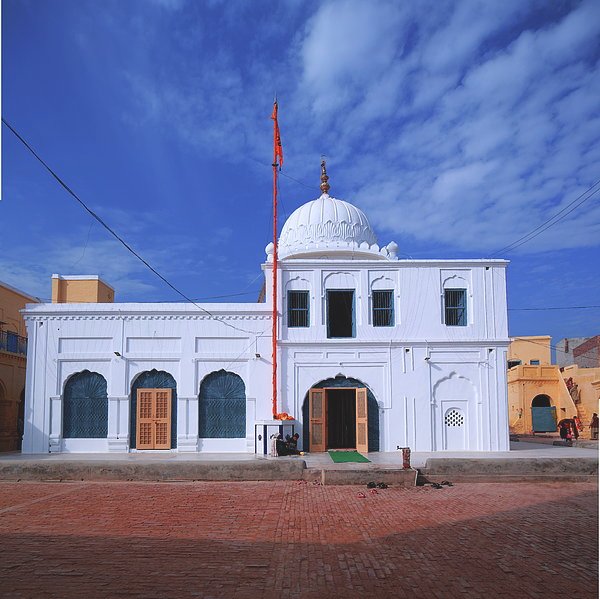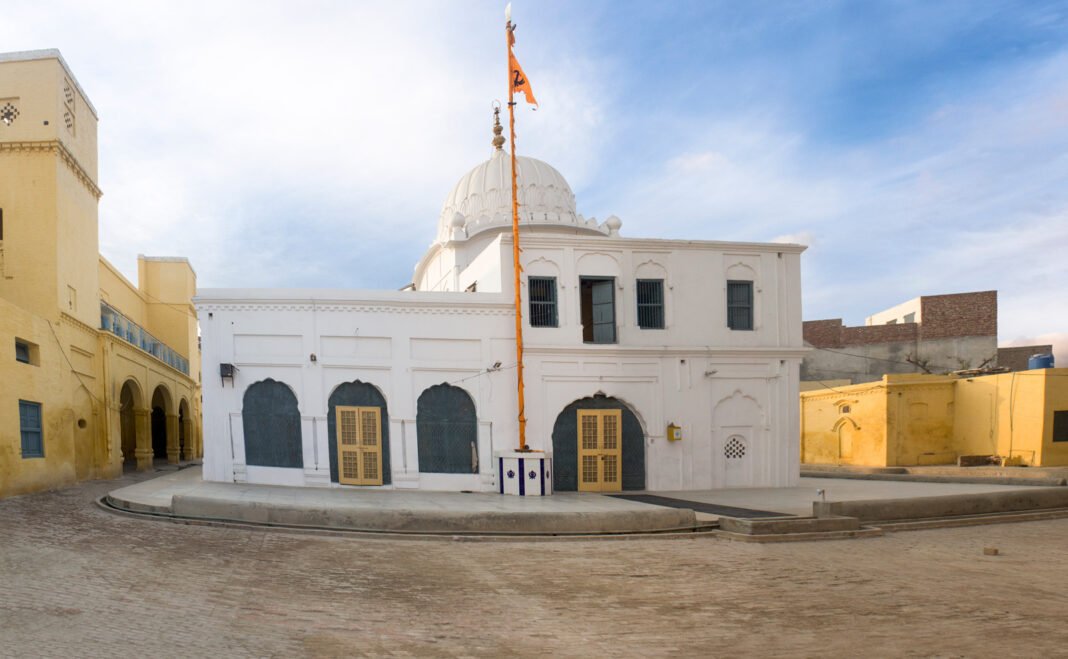
The Gurdwara Panjvin Patshahi (site) at Chak Ram Das is a vanished shrine with a living story, a quiet corner of Gujranwala district where Sikh heritage survives in memory and landscape. This guide explains what stood here, why it matters, and how to visit.
Quick Facts
- Location: Village Chak Ram Das, Wandhu police station, Gujranwala district, Punjab, Pakistan
- Altitude: around 230 m (low Punjab plains)
- Famous For: The vanished gurdwara marking the visit of the Fifth Sikh Guru, Guru Arjan Dev Ji, who came here for the love of his devotee Bhai Prana
- Nearest City: Eminabad (about 20 km west); Gujranwala district headquarters is close by
- Accessibility: Road-only; the site lies on the Eminabad–Mianwali Bungalow road, reached easily by car or rickshaw from Eminabad
- Known Landmarks: The gurdwara site itself (now vanished), the remembered “Guru da Mahal” chaubara that once stood before it
- Best For: Sikh heritage travelers, history lovers, pilgrims tracing Guru Arjan Dev Ji’s footsteps, and offbeat explorers of rural Punjab
Why Visit Gurdwara Panjvin Patshahi (site), Chak Ram Das
Some destinations pull you in with grand domes and busy bazaars. This one pulls you in with silence. Meanwhile, the Gurdwara Panjvin Patshahi at Chak Ram Das no longer stands — it has vanished into the elements after decades of neglect — yet this quiet corner of Gujranwala district is one of the most moving stops on the Sikh heritage trail of Pakistan. It is the place where Guru Arjan Dev Ji, the Fifth Sikh Guru, once stayed, drawn here not by a royal invitation or a grand durbar, but by something far simpler and far more powerful: the love of a humble devotee named Bhai Prana.
A Story of Simple Devotion
That is really the heart of this destination. When you walk the lanes of Chak Ram Das and stand where the beautiful gurdwara once rose, you are standing inside a story about what devotion looks like at its most uncomplicated. Guru Arjan Dev Ji, the compiler of the Adi Granth and the first Sikh martyr, was so moved by Bhai Prana’s affection that he made the journey to this village. A shrine was later built on the very spot where the Guru had stayed. The people of the village called the chaubara in front of it the “Guru da Mahal” — the Guru’s Palace.
Even today, though the building is gone, the land still belongs to the gurdwara’s memory, its 40 ghumaon of revenue-free land held in the custody of the Auqaf Department.
This is a destination for a particular kind of traveler. If you are a pilgrim from India, Canada, the UK, or anywhere in the Sikh diaspora tracing the Guru’s path through Pakistan, Chak Ram Das belongs on your route between Eminabad and Gujranwala. If you are a Pakistani heritage traveler, it belongs on your list too — because this is your shared Punjab. The vanishing of this gurdwara after the Partition tells a story every Punjabi should know. And if you simply love places that make you feel something rather than photograph something, this one will stay with you longer than a dozen busy monuments.
Go in the cool months, go slowly, and pair it with the living gurdwaras of Eminabad. The visit is short, but the feeling it leaves behind is not.
History of Gurdwara Panjvin Patshahi (site), Chak Ram Das
The story of this shrine begins with Guru Arjan Dev Ji (1563–1606), the fifth Guru of Sikhism. Also, Guru Arjan is one of the most towering figures in Sikh history: he compiled the Adi Granth, the principal part of the Sikh scriptures, in 1604. In fact, he completed the Harmandir Sahib (Golden Temple) at Amritsar. And in 1606 he became the first Sikh martyr, dying in Lahore on 30 May 1606 after the tortures ordered by the Mughal authorities of his time.
His life was one of constant travel, teaching, and community-building, and his journeys through the villages of Punjab left behind a trail of shrines — among them, this one.
The Guru’s Palace
According to the histories recorded by researchers such as Iqbal Qaiser in Historical Sikh Shrines in Pakistan, Guru Arjan Dev Ji was drawn to the village of Chak Ram Das by the love and affection of a local devotee, Bhai Prana. The Guru’s visits were often like this — responding to the devotion of ordinary followers rather than the summons of the powerful. On the spot where Guru Ji had stayed, the sangat later built a beautiful gurdwara in his memory.
In front of the gurdwara stood a chaubara — an upper room or chamber — which the local people lovingly called the “Guru da Mahal,” the Guru’s Palace, preserving the memory that the Guru himself had rested here.
The shrine’s endowment tells its own story. Also, the Sikh rulers granted 40 ghumaon of land to this gurdwara, and no land revenue was owed on it. In fact, a mark of the shrine’s recognized importance. But 1947 changed everything. The communal violence that erupted after the Partition of the Punjab forced the local Sikh sangat to flee to the Indian side of Punjab for safety. Without its worshippers — and without the seva (voluntary service) by which every gurdwara survives — the building could not hold back time and weather.
Year by year, the beautiful gurdwara of Chak Ram Das disintegrated, slowly returning, as the old histories put it, “to the elements from which it had been lovingly assembled.”
Today the site is a study in contrasts. The gurdwara has vanished, but the legal memory of it survives: the 40 ghumaon of land remain revenue-free, in the custody of the Auqaf Department. This administers religious endowments in Pakistan. Villagers still point out where the shrine stood and still call the old chaubara the Guru da Mahal. For the heritage traveler, this makes Chak Ram Das something rarer than a well-kept monument. It is a living lesson in how history is remembered even when its buildings are gone.
Top Things to Do in Gurdwara Panjvin Patshahi (site), Chak Ram Das
Stand on the gurdwara site and read its story
The main “activity” here is contemplation, and it is worth taking seriously. Stand where the gurdwara stood — the villagers will happily point out the spot — and read the history of Guru Arjan Dev Ji’s visit and Bhai Prana’s devotion before you come. Also, the silence of the place has context. There is no ticket, no gate, no guard; there is only a field of memory. They tell the truest story of 1947.. As a result, travelers who have done the great Sikh circuits of Pakistan often say the vanished shrines move them more than the famous ones,
Ask the villagers about the Guru da Mahal
The people of Chak Ram Das have kept this story alive for generations. Also, ask the elders where the chaubara stood — the “Guru da Mahal,” the Guru’s Palace — and listen. In fact, In rural Punjab, oral history is a living archive. The villagers’ accounts of the shrine, its land. The families who once served it add layers no plaque ever could. A little Punjabi (or Urdu) goes a long way here. This is not a tourist site, so nobody is performing for you, and that is exactly the charm.
Trace the land — 40 ghumaon of living endowment
One of the most remarkable facts about this place is the survival of its endowment: 40 ghumaon of land granted by the Sikh rulers, still revenue-free and in the custody of the Auqaf Department. Walking the village’s edges with a local guide and seeing how this historic grant is remembered — even centuries later and across a Partition — is a small education in how religious land endowments worked in the Punjab. Heritage researchers will find this genuinely fascinating.
Combine with the living gurdwaras of Eminabad
Chak Ram Das lies only about 20 km east of Eminabad. Also, Eminabad itself is one of the great Sikh heritage towns of the region — home to the famous Gurdwara Rori Sahib and Gurdwara Khui Bhai Lalo, both of which have their own guides in our Explore Pakistan series. The contrast is the point: visit the vanished shrine in the morning, then drive to Eminabad and step into living shrines where the sangat still gathers. Together they tell the full story of the Punjab’s Sikh heritage — what survived, what was lost, and what is remembered.
Famous Places In and Around Gurdwara Panjvin Patshahi (site), Chak Ram Das
- Gurdwara Rori Sahib, Eminabad: The great shrine of Eminabad town, about 20 km west — a living contrast to the vanished gurdwara of Chak Ram Das.
- Gurdwara Khui Bhai Lalo, Eminabad: Another famous Eminabad shrine tied to Guru Nanak Dev Ji — see our full guide for route details.
- Gujranwala city: The district headquarters, known for its food culture and wrestling (pehlwan) tradition, a short drive from Chak Ram Das.
- Lahore: The Mughal-era capital and home of Gurdwara Dera Sahib, where Guru Arjan Dev Ji was martyred in 1606 — the natural bookend to this trip.
How to Reach Gurdwara Panjvin Patshahi (site), Chak Ram Das
Chak Ram Das is in Wandhu police station of Gujranwala district. Also, it lies about 20 km east of Eminabad on the Eminabad–Mianwali Bungalow road. In fact, the whole journey is by road, on flat Punjab plains, and the roads are in good condition year-round.
From Lahore
Take the GT Road (N-5) northwest toward Gujranwala. Also, Lahore to Eminabad is roughly 55 km, about 1 to 1.5 hours depending on traffic. In fact, From Eminabad, turn east onto the Eminabad–Mianwali Bungalow road and drive about 20 km to Chak Ram Das. Total from Lahore: roughly 75 km, 1.5 to 2 hours.
From Islamabad
Take the M-2 motorway to Lahore, then continue as above — total roughly 355 km, 5 to 6 hours. Alternatively, exit the motorway toward Gujranwala and approach Eminabad from the north via Gujranwala city.
From Karachi
The practical option is to fly to Lahore (Allama Iqbal International Airport) and drive from there. Also, the drive from Karachi would be over 1,200 km. In fact, Lahore’s airport is the nearest international airport to this destination.
Nearest Airport
Allama Iqbal International Airport, Lahore — about 90–100 km by road, roughly 2 to 2.5 hours.
Road Conditions by Season
The GT Road and the Eminabad–Mianwali Bungalow road are paved and usable all year. Also, the monsoon months (July–September) can bring heavy rain and some waterlogging on village link roads. Winter brings fog in December–January, so plan daytime driving. Spring and autumn offer the easiest driving.
Transport Options
A private car or rented car with driver is the most comfortable option. The village is easy to miss without local knowledge, so a driver who knows the area is worth it. Also, buses and wagons run between Lahore, Gujranwala, and Eminabad. From Eminabad, hire a rickshaw or qingqi for the final 20 km. Tour vans organized by heritage travel groups are the best bet for foreign pilgrims.
Route Details
- Lahore → GT Road (N-5) northwest → Eminabad (approx. 55 km, 1–1.5 hrs)
- Eminabad → turn east onto the Eminabad–Mianwali Bungalow road → Chak Ram Das village (approx. 20 km, 30–40 min)
- Ask in the village for the old gurdwara site — locals know it well
- Optional: continue to Gujranwala city or return to Eminabad for the living gurdwaras
Where to Stay in Gurdwara Panjvin Patshahi (site), Chak Ram Das
Chak Ram Das is a small village with no hotels. That is part of its character — you visit, you absorb, and you sleep elsewhere. Also, the good news is that the area around it has solid options at every level.
Mid-range hotels: Gujranwala city, the district headquarters, has the best mid-range hotel scene in the area — comfortable air-conditioned rooms, in-house restaurants, and easy booking, all at prices well below Lahore’s. Also, this is the natural base for a Chak Ram Das trip.
Budget guesthouses: Eminabad and the GT Road corridor have simple guesthouses and highway motels that are perfectly fine for an overnight stop. Also, expect basic clean rooms with fans or AC and attached baths.
Luxury: For a genuinely comfortable base, stay in Lahore. Also, the city’s five-star and boutique hotels are 1.5 to 2 hours away, making this an easy day trip.
Camping: Not applicable here — this is settled agricultural Punjab, not wilderness. Also, stick to town stays.
A tip for pilgrims: if you are traveling in a group, your tour operator will normally arrange the stay in Lahore or Gujranwala with the village visit as a day excursion.
Where to Eat: Local Foods of Gurdwara Panjvin Patshahi (site), Chak Ram Das
You will not find a food street in Chak Ram Das. But you will find the real thing in the towns around it, and that is arguably better. Also, this is central Punjab, the land of tandoors, desi ghee, and unapologetically generous portions.
Dishes to look for: In Gujranwala, the wrestling capital of Pakistan, food is serious business. Also, try the famous chanay (chickpea curry) breakfast with hot tandoori kulchay, halwa puri, and frothy lassi served in tall glasses. In fact, For lunch, saag with makki di roti in winter, daal, karahi chicken, and seekh kebabs are everywhere. Gujranwala’s barfi and gulab jamun are local legends — buy a box for the road.
Where to eat: The dhabas along the GT Road between Lahore and Gujranwala are an experience in themselves — fresh tandoori rotis, bubbling karahis, and chai that never stops coming. Also, In Eminabad’s bazaar you will find small local eateries serving village-style food. In fact, meals at dhabas are very budget-friendly; a full meal typically costs just a few hundred rupees per person.
Pilgrim note: If you are visiting Eminabad’s gurdwaras the same day, the langar (community kitchen) at living shrines serves free meals to all. A meal shared sitting on the floor with hundreds of others is one of the most memorable food experiences in Punjab.
Weather in Gurdwara Panjvin Patshahi (site), Chak Ram Das
Chak Ram Das sits on the low Punjab plains. Also, its weather is the classic central-Punjab cycle: a short, cool, pleasant winter. In fact, a fierce summer; and two shoulder seasons that are the sweet spot for travel. Ranges below are approximate for the Gujranwala plains.
| Season | Temperature Range | Conditions |
|---|---|---|
| Winter (Dec–Feb) | 5–18°C | Cool and crisp; dense morning fog common in December–January; the best season for heritage travel |
| Spring (Mar–Apr) | 18–32°C | Pleasant; wheat fields turn golden before harvest; excellent for village visits |
| Summer (May–Jul) | 30–45°C | Very hot and dry; avoid midday outdoor visits; dust storms possible in June |
| Monsoon/Autumn (Aug–Nov) | 25–38°C, cooling later | Humid with heavy showers July–September; October–November pleasant again with clear skies |
Language and Culture of Gurdwara Panjvin Patshahi (site), Chak Ram Das
The language of Chak Ram Das is Punjabi — specifically the Majhi dialect of central Punjab — with Urdu widely understood. If you speak either, you will have no trouble. If you speak only English, bring a guide or a driver who can translate, because this is a working village, not a tourist stop.
Culturally, you are in the heart of rural Muslim Punjab with a deep Sikh past. Also, and that layering is exactly what makes the visit meaningful. The villagers remember the gurdwara and its story with genuine respect. Sikh heritage is part of their own village’s history, not something foreign. That said, this is a quiet residential village, so visit with the manners of a guest: dress modestly, keep your voice down near homes, and always ask before photographing people.
For Sikh visitors, this is a place of asthan — a sacred spot sanctified by the Guru’s presence — even without a standing building. Covering the head and removing shoes when approaching a remembered sacred spot is customary and appreciated. If you meet Muslim villagers who point out the site, receive their help graciously. The shared care of Punjab’s heritage across communities is one of the trip’s quiet rewards.
Shopping in Gurdwara Panjvin Patshahi (site), Chak Ram Das
There is no shopping in Chak Ram Das itself, but the surrounding towns reward a browse. Also, Gujranwala’s bazaars are famous for brass and steel utensils. Eminabad’s small bazaar has the everyday Punjab shopping mix — khussa shoes, cotton cloth, and local sweets. If you are passing through Gujranwala, pick up the city’s famous barfi and murabba (preserved fruits) — they travel well and make excellent gifts. For handicrafts and dry fruits in a bigger selection, Lahore’s Ichhra and Anarkali bazaars are on your route home. There is no shopping mall in or near the village, and none is needed for this trip.
Travel Tips for Gurdwara Panjvin Patshahi (site), Chak Ram Das
Packing Essentials
For a winter visit (the recommended season), pack a warm jacket — mornings on the plains can be genuinely cold, and fog makes it feel colder. A head covering is respectful for the sacred site and practical against the sun. Carry water and snacks; there are no shops at the site itself. A fully charged phone with offline maps helps, since village lanes are not signposted. If you are a photographer, the golden light of late afternoon on the village fields is beautiful — but always ask before photographing residents.
Safety Tips
This is a peaceful agricultural village, and visitors — including foreign pilgrims — are generally welcomed warmly. Travel in daylight; the roads are fine but unlit at night. Keep valuables out of sight in parked vehicles. As with all religious heritage sites in Pakistan, Sikh pilgrims traveling in organized groups should coordinate with their tour operator and the Evacuee Trust Property Board where required.
Money & Connectivity
Carry cash — there are no ATMs in Chak Ram Das, and the nearest ones are in Eminabad and Gujranwala. Mobile signals from all major networks (Jazz, Telenor, Zong, Ufone) work in the area, and 4G is generally available. Fuel up before leaving the GT Road; village petrol availability is patchy.
Best Time to Visit Gurdwara Panjvin Patshahi (site), Chak Ram Das
Winter (November–March): The Ideal Season
This is the season to come. Also, cool, clear days, green or golden fields depending on the month, and comfortable walking weather make November through March the perfect window for a heritage trip. In fact, heritage guides consistently recommend these months for the Eminabad–Gujranwala belt.
Spring (March–April): Beautiful but Brief
Pleasant temperatures and the wheat harvest season give the countryside a special energy. A good second choice if winter does not work.
Summer (May–July): Avoid
The plains bake at 40°C and above. If you must travel in summer, visit at dawn and retreat to air conditioning by noon.
Monsoon/Autumn (August–October): Mixed
July–September brings humidity and downpours; by October the weather clears and November is glorious again. Also, early autumn can work for a quick stop.
Final Thoughts
Gurdwara Panjvin Patshahi at Chak Ram Das will not give you a postcard. It will give you something rarer: a place where history is held entirely in memory — in a village’s stories, in a revenue-free land grant that survived a Partition, in the name “Guru da Mahal” still spoken by people who never saw the chaubara. In a country full of magnificent standing monuments, this vanished shrine reminds you that the sacred is not only in buildings.
Pair it with Eminabad’s living gurdwaras, come in the cool months, and give it an unhurried hour. Also, you will leave with a deeper understanding of Guru Arjan Dev Ji, of Bhai Prana’s devotion, and of the Punjab that both of them belonged to. In fact, For more journeys through the province’s heritage, browse our Explore Pakistan collection.
FAQs
Where is Gurdwara Panjvin Patshahi, Chak Ram Das?
It is in the village of Chak Ram Das, Wandhu police station, Gujranwala district, Punjab — about 20 km east of Eminabad on the Eminabad–Mianwali Bungalow road.
Does the gurdwara building still exist?
no. The gurdwara has vanished due to decades of neglect after the Partition. Also, the local sangat migrated to Indian Punjab. Only the site, its memory, and its land endowment survive.
Why is this site sacred in Sikhism?
Guru Arjan Dev Ji, the Fifth Sikh Guru, stayed here, drawn by the love and devotion of his follower Bhai Prana. A beautiful gurdwara was later built on the spot where the Guru stayed.
What was the Guru da Mahal?
It was the chaubara (upper chamber) that stood in front of the gurdwara. Also, villagers called it the “Guru da Mahal” — the Guru’s Palace — in memory of the Guru’s stay.
What is the best time to visit?
November to March. Also, the weather on the Punjab plains is cool and pleasant. In fact, avoid the extreme heat of May–July.
How do I reach Chak Ram Das?
Drive the GT Road from Lahore to Eminabad (about 55 km), then take the Eminabad–Mianwali Bungalow road east for about 20 km. A car or rickshaw from Eminabad is the easiest final leg.
Is it safe for foreign and Sikh pilgrims?
Yes — the area is peaceful and visitors are welcomed. Also, organized pilgrim groups should travel with their tour operator, and it is best to visit in daylight.
Where should I stay?
There are no hotels in the village. Also, base yourself in Gujranwala (mid-range hotels) or Lahore (full luxury options, 1.5–2 hours away) and visit as a day trip.