Some journeys are measured in kilometres. Others are measured in the weight of the stories they carry home with you. A trip to Gurdwara Khui Bhai Lalo in Eminabad belongs firmly to the second kind. This is not a grand, marble-clad monument with crowds and queues. It is a quiet, humble shrine in a small Punjab town, marking the house of a carpenter whose simple bread taught one of the most quoted moral lessons in Sikh history — that honest labour is worth more than a king’s feast. If you have ever wanted to stand in the exact spot where a world-changing idea was born, this gurdwara travel guide will show you why Eminabad deserves a place on your Pakistan itinerary.
Quick Facts
- Location: Eminabad town, Gujranwala district, Punjab, Pakistan — about 1 km from Gurdwara Rori Sahib
- Altitude: Around 220 metres (Eminabad sits on the flat Punjab plain)
- Famous For: The house and well (khuhi) of Bhai Lalo, the carpenter with whom Guru Nanak Dev Ji stayed; the lesson of honest earnings (the bread of blood and milk)
- Nearest City: Gujranwala, about 15 km away; Lahore is about 63 km to the south
- Accessibility: Easy — Eminabad sits just off the historic Grand Trunk Road, reachable by car from Lahore in around 1.5 hours
- Known Landmarks: The intact narrow well in front of the gurdwara, the dharmsal building, nearby Gurdwara Rori Sahib and Gurdwara Chakki Sahib
- Best For: History lovers, Sikh heritage travellers, spiritual seekers, photographers of old Punjab towns, and families on a Lahore–Gujranwala day trip
Why Visit Gurdwara Khui Bhai Lalo, Eminabad
Most travellers speed past Eminabad on the Grand Trunk Road without a second glance. That is exactly why you should stop. This small town — once called Saidpur — holds one of the most human stories in all of Sikh heritage, and it lives on in a shrine that has never tried to be grand. Gurdwara Khui Bhai Lalo marks the house of a poor carpenter whom Guru Nanak, the founder of Sikhism, chose over a rich nobleman’s feast. The story is told to Sikh children everywhere, but very few people stand where it actually happened. You can.
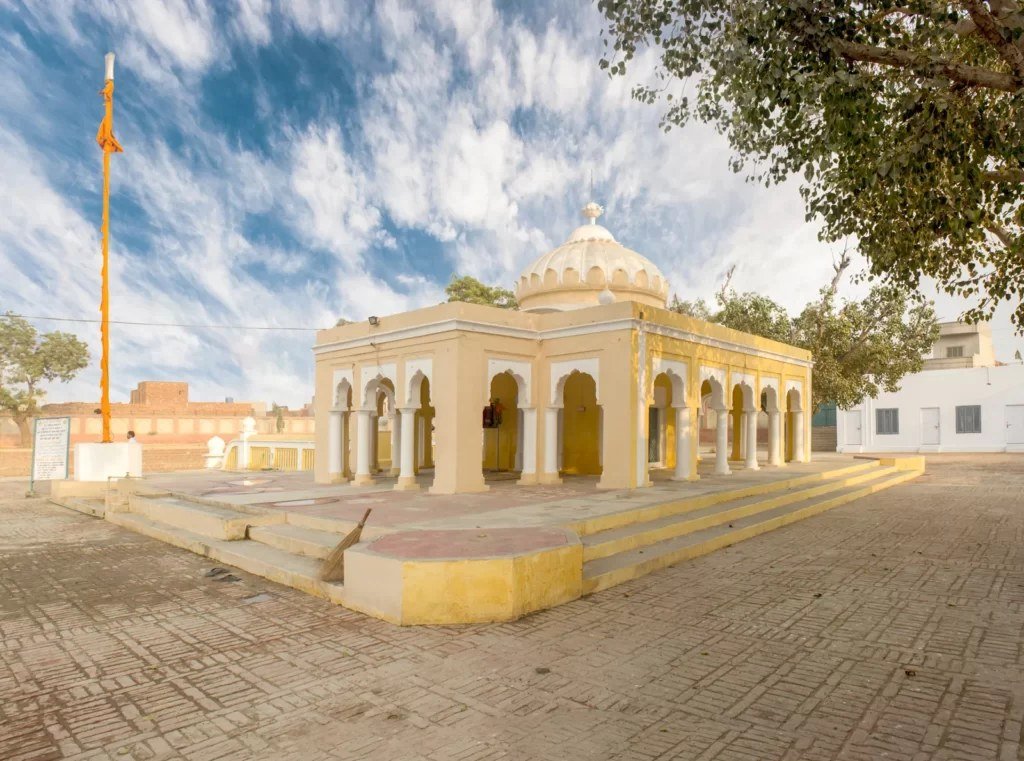
What makes this place special is its honesty, which mirrors its own lesson. There is no glittering dome here, no marble courtyard, no commercial buzz. The gurdwara is a simple building, and in front of it sits the narrow well — the khuhi — that gave the shrine its name. The well is still intact and its water is still drinkable, nearly five centuries after Bhai Lalo drew from it. Drinking from it, or simply standing beside it, connects you to the early 1500s in a way no museum panel can. For Sikh pilgrims, it is a place of deep reverence; for everyone else, it is a powerful reminder that integrity has always mattered more than wealth.
Eminabad itself rewards the curious. The town is a treasure chest of old Punjab: crumbling havelis, forgotten temples turned into homes, and the grand Gurdwara Rori Sahib just a kilometre away. Combine Khui Bhai Lalo with Rori Sahib and you get a half-day walk through the Eminabad of Guru Nanak’s time — the town he visited during Babar’s invasion of 1521, the town whose destruction moved him to compose some of his most famous hymns. It is one of the most underrated Explore Pakistan heritage stops, and it is barely an hour and a half from Lahore.
This trip is perfect for you if you love history that you can touch, if you travel to understand people rather than to collect photographs, or if you are a Sikh heritage traveller tracing Guru Nanak’s footsteps across Pakistan. It is also ideal for families: the town is safe, the distances are short, and the story of Bhai Lalo is one children remember for life.
History of Gurdwara Khui Bhai Lalo, Eminabad
To understand this gurdwara, you have to know Bhai Lalo. Born in 1452 in Saidpur — the town now called Eminabad — Lalo belonged to the Ghataura carpenter clan. His father was Bhai Jagat Ram. Lalo was a simple, God-fearing craftsman who earned his living with his hands, and when Guru Nanak Dev Ji came to Eminabad in the early 1500s, he stayed at Lalo’s house — not once, but on several occasions. Lalo’s home became a dharmsal, a meeting place where local followers gathered to learn from the Guru. Over time, as the old house crumbled, the narrow well (khuhi) beside it survived, and the shrine built on the site took its name from that well: Gurdwara Khuhi Bhai Lalo Ji, the gurdwara at Lalo’s well.
The most famous event connected to this place is the story of Malik Bhago. Bhago was a minor official of the ruler of Eminabad, a wealthy man who arranged a grand feast (Brahm Bhoj) for Brahmins and invited Guru Nanak as well. The Guru declined. Angered, Bhago summoned the Guru through official command. Guru Nanak went — and took Bhai Lalo with him. In front of the assembled court, he took Bhago’s buttered bread in one hand and Bhai Lalo’s plain dry bread in the other, and squeezed both. Blood trickled from the rich man’s bread; milk oozed from the carpenter’s. The Guru explained that Bhago’s wealth was sucked from the blood of the poor, while Lalo’s simple bread carried the milk of honest labour. That, he said, was why he had chosen the carpenter’s food over the feast. It is one of the most retold episodes in Sikh tradition, and tradition holds that it happened here in Eminabad. It was also here that Guru Nanak composed hymns in the Tilang raag.
Eminabad’s larger history is inseparable from this story. When Babar’s armies swept into Punjab in 1521, Guru Nanak was present in Eminabad and witnessed the town’s capture and destruction. Many locals, including the Guru himself, were arrested. The Guru was taken while sitting in prayer on a bed of pebbles (rori) — the spot now marked by the imposing Gurdwara Rori Sahib, about a kilometre from Bhai Lalo’s house. The suffering he saw at Saidpur moved Guru Nanak to compose the Babarvani hymns, among the most powerful verses in the Sikh scripture. So this small town is not just the setting of one story; it is where some of Sikhism’s foundational poetry was born.
In later centuries, Eminabad’s gurdwaras received endowments — Rori Sahib held a large estate and agricultural land from the era of Maharaja Ranjit Singh — and Vaisakhi and Kattak Puranmashi festivals were celebrated here. After 1947, the shrines came under the care of Pakistan’s Evacuee Trust Property Board. Khui Bhai Lalo itself has remained what it always was: a quiet, modest shrine. Travellers note that no formal parkash (ceremonial opening of the scripture) takes place here now; the gurdwara opens for visitors and yatrees, and its sanctity rests in its story rather than its size.
Top Things to Do in Gurdwara Khui Bhai Lalo, Eminabad
Stand at the Well of Bhai Lalo
The khuhi — the narrow well in front of the gurdwara — is the heart of this place. It is the reason the shrine is called “Khui Bhai Lalo,” and it is still intact, still giving drinking water. Take a moment here. This is the well of the carpenter whose bread, in the famous telling, gave milk when squeezed. Whether you come as a pilgrim or a curious traveller, standing at this well is the single most moving thing to do in Eminabad. Ask the caretaker about it; local keepers of these small shrines often share details no book contains.
Visit the Dharmsal Hall
Step inside the gurdwara building that stands where Bhai Lalo’s house once was. It was first a dharmsal — a teaching and meeting place for Guru Nanak’s early followers — and the current structure, though modest, continues that quiet purpose. Cover your head, remove your shoes, and sit for a while. The stillness here is the point: unlike the great pilgrimage gurdwaras, Khui Bhai Lalo asks nothing of you except attention.
Walk to Gurdwara Rori Sahib
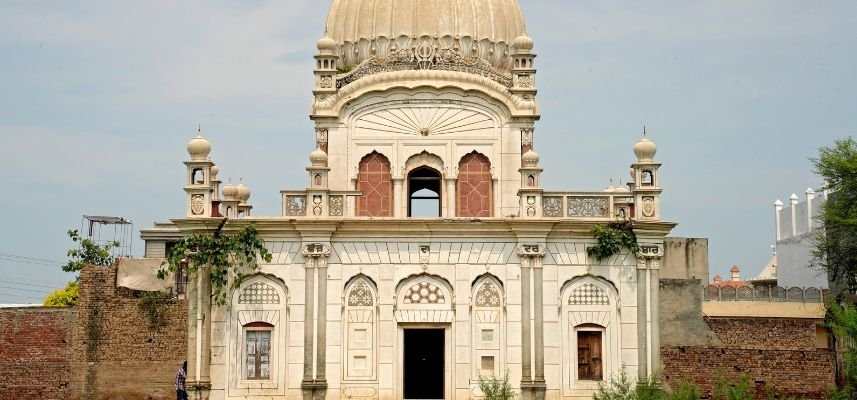
About a kilometre away stands one of the most architecturally striking gurdwaras in Punjab. Rori Sahib marks the pebbled spot where Guru Nanak was sitting in prayer when Babar’s soldiers arrested him in 1521. The complex has an imposing three-storey central building of cut brickwork topped with domes and chhatris, a large sarovar (sacred pool), and at the rear, a room with a ribbed white lotus dome covering the actual pebbled ground. The contrast is wonderful: the grandeur of Rori Sahib against the humility of Bhai Lalo’s well, both telling chapters of the same story.
Explore Old Eminabad on Foot
Eminabad is a living museum of old Punjab. Wander its lanes and you will find exquisite old havelis, the mansions of nobles who once lived here, and several old temples now converted into houses. One of these havelis belonged to Malik Bhago himself — the nobleman of the bread story. A gentle walk through the old town, with its carved wooden balconies and fading frescoes, is a photographer’s delight and a history lover’s dream. Go in the morning when the light is soft and the lanes are quiet.
Pay Respects at Gurdwara Chakki Sahib
Eminabad holds more than two shrines. Gurdwara Chakki Sahib, also in the town, is another stop on the local Sikh heritage circuit. Travellers who have documented Eminabad describe its Nishan Sahib rising above the courtyard even when the shrine itself is locked. Ask locally about access — small-town caretakers are usually happy to open these places for respectful visitors.
Famous Places In and Around Gurdwara Khui Bhai Lalo, Eminabad
- Gurdwara Rori Sahib (1 km): The grand shrine on the pebbles where Guru Nanak was arrested in 1521.
- Gurdwara Chakki Sahib (in town): Another historic Eminabad shrine on the Sikh heritage trail.
- Malik Bhago’s Haveli (old town): The historic mansion of the nobleman from the famous bread story.
- Gujranwala city (15 km): The nearest big city, famous across Pakistan for its food.
- Gurdwara Bhai Lalo Ji, Tatliali: Another shrine honouring Bhai Lalo — read our Gurdwara Bhai Lalo Ji, Tatliali travel guide to complete the story.
How to Reach Gurdwara Khui Bhai Lalo, Eminabad
Reaching Eminabad is straightforward, which is part of its charm as a day trip. The town sits just off the Grand Trunk Road in Gujranwala district, and the gurdwara is inside the town, about a kilometre from Rori Sahib — any local can point you to “Bhai Lalo di Khoi.”
From Lahore: About 63 km, roughly 1.5 hours by car. Take the Grand Trunk Road (N-5) north past Gujranwala, or the Lahore–Islamabad motorway exiting toward Gujranwala/Eminabad. This is the easiest route and makes a perfect day trip.
From Islamabad: About 218 km, roughly 3.5 to 4 hours via the M-2 motorway to the Gujranwala/Eminabad interchange, then local roads into town.
From Karachi: Over 1,000 km — flying is the only sensible option. Fly to Lahore (Allama Iqbal International Airport), then drive the 63 km to Eminabad.
Nearest airport: Allama Iqbal International Airport, Lahore, about 70 km away. Sialkot International Airport is also within reasonable distance to the northeast.
Road conditions: Excellent year-round. The GT Road and motorway are well maintained; town streets in Eminabad are narrow but navigable. Monsoon rains (July–September) can make old-town lanes muddy — wear suitable shoes.
Transport options: A private car or hired van is ideal and gives you flexibility to combine Eminabad with Gujranwala. Public vans and coasters run frequently between Lahore and Gujranwala; from Gujranwala, local transport reaches Eminabad in about 30 minutes. For Sikh yatree groups, tour operators in Lahore routinely include Eminabad in heritage itineraries.
Route Details
Lahore → Eminabad: Leave Lahore on the N-5 Grand Trunk Road heading north (or take the M-2 motorway and exit at the Gujranwala interchange). Pass through or bypass Gujranwala city, continue about 15 km north on the GT Road, and turn off for Eminabad town. Inside the town, ask for Gurdwara Rori Sahib first — it is the best-known landmark — then continue about 1 km to Bhai Lalo di Khoi. Total driving time: 1.5 to 2 hours depending on traffic.
Where to Stay in Gurdwara Khui Bhai Lalo, Eminabad
Eminabad is a small town, so think of it as a day trip rather than an overnight stay — and that is perfectly fine, because your sleeping options are close by. Most visitors base themselves in Gujranwala, just 15 km away, where mid-range hotels cluster along the GT Road and near the city centre, offering comfortable air-conditioned rooms, restaurants, and easy parking. Gujranwala also suits travellers who want to explore the city’s famous food streets in the evening after a day in Eminabad.
Lahore, 63 km south, gives you the full range — from budget guesthouses to luxury hotels — and works well if Eminabad is one stop on a longer Punjab heritage tour. If you prefer to stay very close to the shrines, ask locally in Eminabad about simple guest rooms; small towns often have basic, clean lodgings near the main bazaar, though they are not listed online. For Sikh yatree groups, the larger gurdwara complexes in the region (such as Rori Sahib) have traditionally accommodated pilgrims, so check with your tour organiser in advance.
Where to Eat: Local Foods of Eminabad
You are in the heart of Punjab, and more specifically next door to Gujranwala — a city whose love of food is legendary across Pakistan. Eating here is a pleasure, not a logistics problem. Start your morning the Punjabi way: a desi-ghee paratha with a tall glass of sweet or salted lassi from a dhaba near the Eminabad bazaar. For lunch, look for saag with makki di roti in winter, or daal, sabzi, and fresh tandoori roti year-round. The dhabas along the GT Road serve generous, honest meals — exactly the kind of food the story of Bhai Lalo celebrates.
If you drive into Gujranwala for the evening, you are in one of Pakistan’s great food cities: locals swear by its barbecued meats, chanay, and rich desi-ghee dishes. A full dhaba meal in this region is budget-friendly — expect to eat very well for a few hundred rupees per person. Carry water, especially in summer, and if you are offered langar (the free community meal) at any gurdwara during your visit, accept it graciously — it is served to all, regardless of faith, and it is delicious.
Weather in Gurdwara Khui Bhai Lalo, Eminabad
Eminabad sits on the Punjab plain at around 220 metres, so its weather follows the classic central-Punjab pattern: pleasant winters, a brief glorious spring, fierce summers, and a humid monsoon. The comfortable season for sightseeing and walking the old town is November to March. Here is what to expect across the year:
| Season | Temperature Range | Conditions |
|---|---|---|
| Winter (Dec–Feb) | 4°C – 20°C | Cool, often foggy mornings; crisp sunny afternoons. Best for walking tours. |
| Spring (Mar–Apr) | 15°C – 32°C | Pleasant and green; Vaisakhi season brings festive energy to nearby Rori Sahib. |
| Summer (May–Jun) | 30°C – 45°C | Very hot and dry; sightsee only early morning or late evening. |
| Autumn (Oct–Nov) | 15°C – 32°C | Comfortable and clear; an excellent time for heritage visits. |
Note: July to September brings the monsoon — humid, with heavy showers that can flood old-town lanes. The gurdwara itself is visitable year-round, but plan old-town walks for the dry months.
Language and Culture of Gurdwara Khui Bhai Lalo, Eminabad
Punjabi is the language of Eminabad’s streets, spoken in its warm central-Punjab dialect; Urdu is widely understood and works fine for visitors. The town’s culture is classic Punjabi small-town: hospitable, food-loving, and deeply respectful of guests. You will notice the layered history in everyday life — Muslim, Sikh, and Hindu heritage sharing the same lanes, the same wells, the same stories.
As a visitor to the gurdwara, observe simple etiquette: cover your head (carry a scarf or handkerchief; caps are usually available at the entrance), remove your shoes before entering the prayer hall, dress modestly, and avoid alcohol and tobacco on the premises. Photography inside the prayer hall should be discreet — ask the caretaker first. When walking through the old town, greet shopkeepers; a smile and a little Punjabi (“Sat Sri Akal” is warmly received at Sikh sites) opens doors, sometimes literally.
Shopping in Gurdwara Khui Bhai Lalo, Eminabad
Eminabad’s bazaars are traditional rather than touristy, which is their appeal. The main bazaar sells everyday Punjabi goods — cloth, utensils, sweets, and fresh produce — and browsing it gives you an unfiltered look at small-town Punjab life. Look out for khussas (traditional embroidered shoes), phulkari-style embroidered fabrics, and local sweets from the mithai shops; these make genuine, inexpensive souvenirs.
For a wider selection, Gujranwala city (15 km) has large markets with everything from ceramics — the region is known for its pottery — to Sikh religious items and books near the gurdwara areas. There are no shopping malls in Eminabad itself, and that is fine: the shopping here is about the bazaar experience, bargaining politely, and taking home something made by hand.
Local Events and Festivals
Vaisakhi (13–14 April): The great Sikh harvest festival is celebrated with enthusiasm at nearby Gurdwara Rori Sahib, where people from Gujranwala and adjoining areas gather with fanfare. In the past, both Vaisakhi and Kattak Puranmashi festivals were held at Rori Sahib; today Vaisakhi remains the big annual gathering. If you visit Eminabad in mid-April, time your trip to catch it — and stop at Khui Bhai Lalo on the same day, since the two shrines are barely a kilometre apart.
Travel Tips for Gurdwara Khui Bhai Lalo, Eminabad
Packing Essentials
Bring a head covering (a light scarf works for everyone), comfortable walking shoes for the old town’s uneven lanes, sunscreen and a hat for summer, and a warm layer for December–January mornings when fog can make it genuinely cold. Carry drinking water; the well water at the gurdwara is traditional and symbolic, but bottled water is the practical choice for a day of walking.
Safety Tips
Eminabad is a safe, welcoming small town and this is a low-key day trip. The usual sense applies: keep valuables out of sight in bazaars, agree on transport fares before setting off, and if you are a foreign visitor, carry your passport or a copy. At the gurdwara, follow the caretaker’s guidance — these small shrines are sometimes locked between visits, so a polite request opens them.
Money & Connectivity
Carry cash — small-town shops and dhabas do not take cards. ATMs are available in Gujranwala (15 km) and at points along the GT Road; withdraw before entering Eminabad. Mobile signals from all major networks (Jazz, Telenor, Zong, Ufone) work well in the town, and 4G data is generally reliable.
Best Time to Visit Gurdwara Khui Bhai Lalo, Eminabad
Winter (November to February) — The Best Season
Cool, clear days made for walking. Morning fog adds atmosphere to the old havelis, and by midday the sun is gentle. This is when the gurdwara and the old town show their best, and when Sikh yatree groups most often pass through the region.
Spring (March to April) — Festive and Green
Punjab is at its prettiest, the wheat fields around Eminabad turn golden, and mid-April brings Vaisakhi celebrations at Rori Sahib. A wonderful time to combine heritage with festivity — book transport early around the festival.
Summer (May to June) — For the Determined
Fiercely hot. Visit only if your schedule demands it, and plan shrine visits for early morning (before 9 am) or after 5 pm. The gurdwara’s shaded interior offers respite, but old-town walks are punishing at midday.
Monsoon and Autumn (July to November) — Mixed
July–September is humid with heavy showers; October–November turns pleasant again. Late autumn is arguably the sweet spot — clear skies, comfortable temperatures, and fewer visitors than spring.
Final Thoughts
Gurdwara Khui Bhai Lalo will not impress you with size, and that is precisely its power. In a world of grand monuments competing for your attention, this quiet shrine in Eminabad offers something rarer: a story that has shaped millions of lives, told at the exact spot where it happened, beside a well that still gives water. The lesson of Bhai Lalo’s bread — that honest work outranks corrupt wealth — is as urgent today as it was five hundred years ago.
So take the short drive from Lahore or Gujranwala. Walk the kilometre from Rori Sahib’s domes to Lalo’s well. Drink in the old town’s fading grandeur, eat a dhaba lunch, and carry home a story worth retelling. For more heritage journeys across the country, keep exploring our Explore Pakistan guides — and if the mountains call next, our Malam Jabba travel guide is a very different, equally rewarding Pakistan.
FAQs
Where is Gurdwara Khui Bhai Lalo located?
It is in Eminabad town, Gujranwala district, Punjab, Pakistan — about 1 km from Gurdwara Rori Sahib, just off the Grand Trunk Road.
What is the best time to visit Gurdwara Khui Bhai Lalo?
November to March offers the most comfortable weather. Mid-April is special because of Vaisakhi celebrations at nearby Rori Sahib.
How do I reach Eminabad from Lahore?
Drive about 63 km north on the GT Road or motorway via Gujranwala — roughly 1.5 hours. Local transport from Gujranwala (15 km) is also available.
Is Gurdwara Khui Bhai Lalo safe for families and foreign visitors?
Yes. Eminabad is a peaceful small town, and the shrine welcomes all visitors. Follow standard gurdwara etiquette — cover your head and remove shoes.
Who was Bhai Lalo?
Bhai Lalo (born 1452) was a carpenter of Eminabad (then Saidpur) with whom Guru Nanak Dev Ji stayed on several visits in the early 1500s. His house became a dharmsal and later this gurdwara.
What is the story of the well (khuhi)?
The gurdwara is named after the narrow well beside Bhai Lalo’s house, which survived even after the house crumbled. The well is still intact and its water is still drinkable.
Where can I stay near Eminabad?
Most visitors stay in Gujranwala (15 km, mid-range hotels) or Lahore (63 km, full range of options) and visit Eminabad as a day trip.
What local food should I try?
Desi-ghee parathas with lassi for breakfast, saag with makki di roti in winter, and hearty dhaba meals along the GT Road — plus Gujranwala’s famous food streets in the evening.