Quick Facts
- Location: Sheikhupura, Punjab, Pakistan — about 40 km northwest of Lahore, near Sheikhupura Fort
- Altitude: The flat, fertile plains of central Punjab
- Famous For: Emperor Jahangir’s 17th-century memorial to his pet antelope Mansraj; a 30-metre tower, a huge square water tank, and an octagonal baradari on a causeway
- Nearest City: Lahore (40 km); Sheikhupura city is minutes away
- Accessibility: Excellent road access via the M-2 motorway and Hafizabad Road; 45–60 minutes from Lahore
- Known Landmarks: The minaret (tower), the water tank, the central baradari (Daulat Khana), Sheikhupura Fort
- Best For: Families, picnickers, history lovers, photographers, and anyone wanting Mughal grandeur without leaving the plains
Why Visit Hiran Minar & Tank
Every emperor builds monuments to power. Only one built a monument to love — for a deer. Hiran Minar, the “Deer Tower,” rises 30 metres over the Punjab plains near Sheikhupura. Its story is the most tender in all of Mughal architecture: the Emperor Jahangir, one of history’s great hunters, was so devoted to his pet antelope Mansraj that when the animal died, he raised a tower over its grave, turned the hunting ground into a protected sanctuary where no hunting was allowed, and gave the place his own childhood nickname’s city — Sheikhupura.
Four hundred years later, the tower still stands, ringed by water, visited by families, and photographed at every sunset.
The Tower and the Floating Baradari
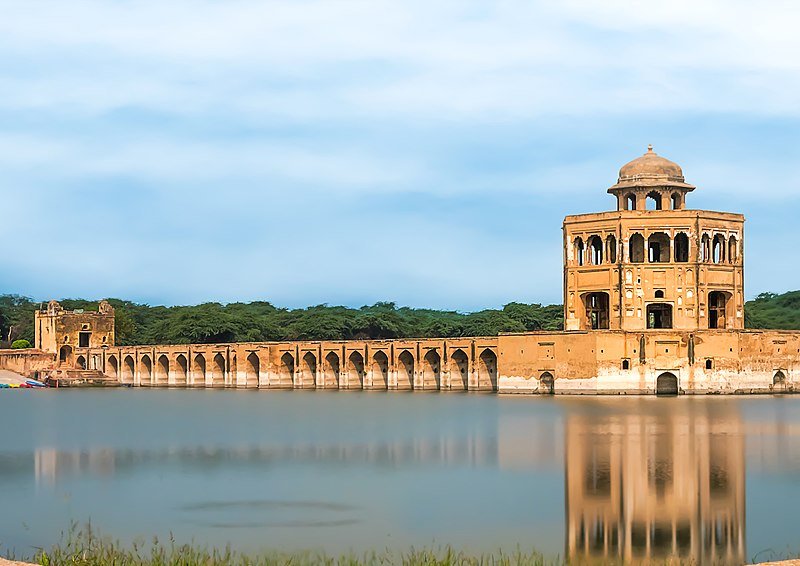
This is Mughal heritage at its most human and its most photogenic. Also, the complex is a perfect composition: the tapering tower with its 210 bird-holes on one side, and on the other a vast square tank with an elegant two-storey octagonal pavilion — the baradari — floating at its centre, joined to the shore by a causeway on arched pillars. At golden hour, the whole scene doubles itself in the water. In fact, you understand why film crews, wedding photographers, and drama directors keep coming back. It is, quite simply, one of the most beautiful man-made landscapes in Punjab.
It is also one of the easiest great Mughal sites to visit. Also, no mountain roads, no permits, no strenuous treks — just a smooth 45-minute drive from Lahore on the motorway, a nominal entry ticket. In fact, a full afternoon of gardens, water, birds, and history. The complex has long been Lahore’s favourite picnic spot, and on winter weekends the lawns fill with families who have been coming for generations. You can climb the tower’s spiral staircase for a panoramic view of the plains, stroll the causeway to the baradari, try your hand at fishing in the tank (with a license).
It be back in Lahore for dinner.
Who should come? Everyone, honestly — but especially families looking for a perfect day trip, history lovers tracing the Mughals beyond Lahore Fort and the Badshahi Mosque, photographers chasing reflections, and travelers who want to see the softer side of empire: a monument not to conquest, but to affection. Also, come between October and March. The light is kind and the gardens are at their greenest, and let a 400-year-old love story do the rest.
History of Hiran Minar & Tank
The story begins with a hunt — as so many Mughal stories do. In the early 1600s, the Emperor Jahangir (reigned 1605–1627) maintained a game reserve in the scrub forest near what is now Sheikhupura, then a hunting ground within easy reach of Lahore. Here he captured a wild antelope and, within a month, the animal had shed its wild nature so completely that it became the emperor’s beloved pet. Jahangir named him Mansraj — also rendered Mansiraj, “Light of the Mind” — and the antelope was trained to lure wild game toward the royal hunters, soon becoming the leader of all the royal antelopes.
The emperor, famous for his deep interest in the natural world (his memoirs, the Tuzk-e-Jahangiri, are full of careful observations of animals and birds), spent much of his time with Mansraj.
Jahangir’s Grief in Stone
When Mansraj died, Jahangir’s grief took an extraordinary form. In 1606 (some accounts say 1607), he ordered a monument raised over the antelope’s grave: a tall, tapering minaret on a flat platform, in the ancient Persian tradition of building tomb-markers over the remains of honoured animals. The hunting ground itself was converted into a protected sanctuary and hunting was prohibited there. The emperor then developed the surrounding settlement — recording it in his autobiography as Jehangirabad — which grew into the city of Sheikhupura, named for “Shekhu,” Jahangir’s own childhood nickname given by his mother.
Founded in 1607, the city remains one of Punjab’s major industrial centres today.
The complex did not stop with the tower. A few decades later, during the reign of Jahangir’s son Shah Jahan, the site gained its most picturesque features: a huge square water tank and, at its centre, a two-storey octagonal pavilion known as the baradari (also called Daulat Khana), connected to the mainland by a causeway carried on arched pillars, with its own gateway. Brick ramps slope into the water at the centre of each side of the tank — built, it is said, to let royal animals and wild game walk down to drink. Later, Jahangir gifted the entire area to the noble Sikandar Moin.
The British colonial administration declared Hiran Minar a protected monument under the Ancient Monuments Preservation Act of 1904. In 1975 it came under Pakistan’s Antiquities Act, and today the complex is recognised on Pakistan’s tentative list for UNESCO World Heritage status. Four centuries on, the deer tower still watches over the plains — a love letter in brick and stone.
Top Things to Do in Hiran Minar & Tank
Climb the 30-Metre Tower
The minaret itself is the soul of the complex: a circular tower tapering toward the top, studded with 210 square holes that once — and still do — house the birds of the surrounding gardens. Also, inside, a spiral staircase of over a hundred steps winds to the summit. The climb is the reward: from 30 metres (about 100 feet) up, the whole geometry of the complex reveals itself — the square tank, the floating baradari, the causeway, the gardens — spread across the flat Punjab plain that was once Jahangir’s forested hunting ground. Go early to have the staircase to yourself.
Walk the Causeway to the Baradari
The two-storey octagonal pavilion at the centre of the tank is reached by a long causeway with its own gateway, carried over the water on arched pillars. Walking it is the complex’s signature experience: water on both sides, the baradari growing larger ahead, ducks and waterbirds drifting below. Also, the pavilion’s arched openings frame perfect views back toward the tower. In fact, Take your time — this is the shot every photographer comes for, and it never disappoints.
Circle the Great Tank
The square water tank is enormous, and a full circuit of its embankment is a lovely 20-minute stroll. Also, look for the brick ramps sloping into the water at the middle of each side — the Mughal-era “animal stairs” — and the small square pavilions at the corners. In winter the tank hosts migratory waterbirds. In fact, year-round, the reflections of tower and baradari make every angle a photograph.
Picnic in the Mughal Gardens
Hiran Minar has been Lahore’s beloved picnic spot for generations. Also, the lawns around the complex are made for it: bring a full picnic, spread out under the trees, and let the kids run. Winter weekends are festive and crowded — part of the charm — while weekday mornings are serene. There are refreshment shops near the entrance for tea, pakoras, and cold drinks.
Try Fishing in the Tank
The tank is a popular fishing spot, and visitors can fish with a rod on obtaining a license. Also, a delightfully old-fashioned pleasure. Even if you don’t fish, watching the local anglers at work along the embankment is a peaceful way to pass an hour.
Photograph the Golden Hour
Arrive 90 minutes before sunset and stay until the light dies. Also, the low sun ignites the tower’s brickwork, the tank turns to hammered gold. The baradari’s silhouette doubles in the water. Hiran Minar is a favourite of wedding and fashion photographers for good reason — and your phone camera will do just fine.
Visit Sheikhupura Fort
A short drive away stands the early-17th-century Sheikhupura Fort, also from Jahangir’s founding of the city — a reminder that the emperor didn’t just mourn his deer here, he built a whole city around the memory. Pair it with the minar for a full Sheikhupura heritage day.
Famous Places In and Around Hiran Minar & Tank
- The Minaret — Jahangir’s 1606 tower over Mansraj’s grave; climbable, with panoramic views.
- The Water Tank — the vast square tank with animal ramps and corner pavilions.
- The Baradari (Daulat Khana) — the two-storey octagonal pavilion floating at the tank’s centre.
- Connecting them is the Causeway — the arched-pillar walkway with its gateway linking pavilion to shore.
- Sheikhupura Fort — the early-17th-century fort of Jahangir’s founded city, minutes away.
- Lahore — 40 km away: the Badshahi Mosque, Lahore Fort, and Jahangir’s own tomb complete the Mughal circuit.
How to Reach Hiran Minar & Tank
Hiran Minar is one of the easiest major heritage sites in Pakistan to reach — a straight, smooth drive from Lahore on excellent roads, with no mountain passes or rough tracks involved.
From Lahore: about 40 km northwest, 45–60 minutes. Also, Take the M-2 motorway toward Islamabad and exit at the Sheikhupura interchange, or drive the old GT Road / Hafizabad Road directly into Sheikhupura. In fact, the complex sits about 5 km from Sheikhupura railway station, signposted off Hafizabad Road. From Islamabad: roughly 300 km via the M-2 south, about 3.5–4 hours — an easy day trip or a stop on the way to Lahore. From Karachi: fly to Lahore (under 2 hours) and drive from there. The road journey is over 1,200 km.
Nearest airport: Allama Iqbal International Airport, Lahore. Road conditions: superb — motorway and city roads all the way, fine for any vehicle in every season. Transport options: a private car or a Careem/InDrive ride from Lahore is simplest. Public vans and buses run constantly between Lahore’s Badami Bagh / Shahdara stands and Sheikhupura. Also, From Sheikhupura city, a rickshaw reaches the complex in minutes. In fact, tour operators in Lahore offer half-day Hiran Minar trips, often bundled with Sheikhupura Fort.
Route Details
Step 1: From Lahore, join the M-2 motorway (Islamabad bound). Next, exit at the Sheikhupura interchange and follow signs toward the city. Step 3: Take Hafizabad Road. Also, the Hiran Minar complex is signposted about 5 km from the railway station. Step 4: Park at the entrance, buy the nominal entry ticket, and walk in. In fact, the tower is to one side, the tank and causeway straight ahead.
Where to Stay in Hiran Minar & Tank
Hiran Minar is a classic day trip — almost everyone sleeps in Lahore, 45 minutes away. Also, this offers the full spectrum from luxury five-stars on the Mall and in DHA to mid-range hotels and budget guesthouses. If you want to linger, Sheikhupura city has mid-range hotels and simple guesthouses aimed at business travelers. Standards are modest but perfectly serviceable for a night. Luxury travelers should base in Lahore without hesitation. Camping is not a thing at Hiran Minar. This is a manicured heritage park, not wilderness. For a two-day Mughal circuit, stay in Lahore and pair Hiran Minar with Jahangir’s tomb at Shahdara the next day.
Where to Eat: Local Foods of Hiran Minar & Tank
Come hungry: a Hiran Minar picnic is a Lahori tradition. Also, the refreshment shops at the entrance sell tea, pakoras, samosas, and cold drinks — fine for a quick bite. But the real move is bringing your own feast or eating in Sheikhupura city afterward. The region’s Punjabi staples shine here: chicken or mutton karahi, daal makhani with tandoori naan, seekh kebabs, and for the sweet tooth, kulfi falooda and jalebi from the city’s sweet shops. Sheikhupura’s bazaars fry excellent fish in winter. A dhaba meal is genuinely budget-friendly; restaurant karahi in the city costs a little more but feeds a family.
Carry drinking water, and in summer, carry lots of it.
Weather in Hiran Minar & Tank
Sheikhupura sits on the central Punjab plains: hot summers, a short but real winter, and the monsoon in between. The complex is entirely outdoors with limited shade around the tank embankment. The season shapes your visit more than you might expect — winter’s soft light and green lawns are the prize.
| Season | Temperature Range | Conditions |
|---|---|---|
| Winter (Dec–Feb) | 5–20°C | Cool, sunny, occasionally foggy mornings. Peak picnic season; lawns at their greenest. |
| Spring (Mar–Apr) | 18–32°C | Warm and pleasant; flowers in the gardens. Lovely for photography before the heat builds. |
| Summer (May–Jul) | 30–45°C | Intensely hot with the monsoon humidity from July. Visit at dawn or after 4 p.m. only. |
| Autumn (Aug–Nov) | 20–35°C | Humidity easing; October–November brings clear, golden days and thin crowds. |
Language and Culture of Hiran Minar & Tank
Sheikhupura is Punjabi-speaking heartland, with Urdu understood everywhere and English common in Lahore’s tourism circles. The culture is warm, food-loving, unpretentious Punjab: expect picnicking families to offer you a samosa, and don’t be surprised if a stranger explains the Mansraj story with visible emotion — locals are genuinely proud of it. Dress is casual but modest swimwear-style clothing is obviously out; the tank is for looking at, not swimming in. Keep the gardens clean, don’t feed the birds junk food, and supervise children on the causeway and tower stairs. Friday afternoons can be busy with local visitors. The atmosphere is festive and family-friendly.
Shopping in Hiran Minar & Tank
There are no souvenir shops inside the complex — bring your camera, not your wallet. Sheikhupura city’s bazaars, however, are worth a stroll: look for traditional Punjabi juttis (embroidered shoes), phulkari-style embroidery. Also, the city’s sweet shops for barfi and fresh jalebi to take home. For serious shopping, Lahore — 40 km away — has everything from Anarkali’s centuries-old bazaars to modern malls like Emporium and Packages. There is no shopping mall at Hiran Minar itself, and none is needed: the monument is the attraction.
Travel Tips for Hiran Minar & Tank
Packing Essentials
Comfortable walking shoes (the tank circuit and tower stairs), sun protection, drinking water. A picnic blanket if you’re doing it properly. Also, a camera or charged phone is essential — the reflections demand it. In winter, bring a light jacket for breezy evenings on the causeway.
Safety Tips
The complex is a well-managed public park and very safe in visiting hours. Supervise children near the water and on the tower’s spiral staircase. Also, don’t climb on the baradari’s outer ledges or the tank’s ramps. In fact, visit in daylight; the site closes in the evening. Park only in the designated area and keep valuables with you.
Money & Connectivity
Entry is by nominal ticket (a small fee at the gate — confirm current rates on arrival). Also, carry some cash for the ticket, refreshments, and rickshaws; ATMs are plentiful in Sheikhupura city and Lahore. In fact, mobile signals from all networks are strong across the site.
Best Time to Visit Hiran Minar & Tank
Winter (December–February) — Perfect
The undisputed best season: cool air, green lawns, migratory birds on the tank, and golden light that photographers dream about. Also, weekends are lively with picnicking families — join them.
Spring (March–April) — Beautiful
Warm days, flowering gardens, and thinner crowds than winter. An excellent time for a relaxed, unhurried visit.
Autumn (October–November) — The Quiet Gem
Clear skies, mild temperatures, and the complex almost to yourself on weekdays. Also, superb for photography.
Summer (May–September) — Go Early or Late
The plains bake, but the site is still visitable at dawn or after 4 p.m. Monsoon clouds can make for dramatic skies — just carry water and a hat.
Final Thoughts
Of all the Mughal monuments in Pakistan, Hiran Minar may be the most human. Also, it wasn’t built to intimidate enemies or impress courtiers. It was built because an emperor loved his deer and couldn’t bear to let the memory fade. That tenderness — set in brick, ringed by water, crowned by a pavilion — is what has kept families picnicking on these lawns for generations. In an age of grand narratives, there is something quietly radical about a 400-year-old monument to affection.
It is also the easiest great day trip in Punjab: 45 minutes from Lahore, a few rupees at the gate. An afternoon you will talk about for weeks. Climb the tower, walk the causeway, watch the sun drop behind the baradari, and drive home with the Mansraj story in your pocket. For more Mughal wonders, browse our Explore Pakistan collection — and when you’re ready for mountains, Malam Jabba, the Hunza Valley. Islamabad’s sights are all waiting.
FAQs
Where is Hiran Minar & Tank located?
In Sheikhupura, Punjab — about 40 km northwest of Lahore, off Hafizabad Road, roughly 5 km from Sheikhupura railway station.
What is the best time to visit Hiran Minar?
October to March, with December–February the peak: cool weather, green lawns, and perfect light. Also, summer visits are best at dawn or late afternoon.
How do I reach Hiran Minar from Lahore?
Drive the M-2 motorway to the Sheikhupura interchange (45–60 minutes), or take a public van to Sheikhupura and a rickshaw to the complex. Also, ride-hailing from Lahore is easy.
Is Hiran Minar safe to visit?
Yes — it’s a well-managed public heritage park. Also, visit in daylight, supervise children near water and on the stairs, and use the designated parking.
Is it suitable for families?
Wonderfully so — it’s Lahore’s classic family picnic spot, with lawns, water, birds, and easy walking. Elderly visitors may skip the tower’s spiral staircase.
Where can I stay near Hiran Minar?
Most visitors day-trip from Lahore (all hotel tiers). Also, Sheikhupura city has mid-range hotels and guesthouses for an overnight stay.
What food is available?
Refreshment shops at the entrance (tea, pakoras, samosas). Also, bring a picnic for the full experience; Sheikhupura city has karahi restaurants and sweet shops.
Why did Jahangir build a tower for a deer?
Mansraj was his beloved pet antelope, trained to lure game and constant companion. Following the ancient Persian custom of raising tomb-markers over honoured animals, Jahangir built the minaret over its grave in 1606 and made the hunting ground a protected sanctuary.