There are places in Pakistan that impress you, and then there are places that rearrange the way you think about the planet. Hispar Glacier belongs firmly in the second group. A 49-kilometre river of ice grinding its way through the Karakoram mountains of Gilgit-Baltistan, it forms one half of the longest glacial system anywhere on Earth outside the polar regions. This is not a glacier you admire from a car window for ten minutes. It is a world of its own — turquoise meltwater lakes, ice walls taller than apartment blocks, and silence so complete it feels like a physical thing.
If you have ever dreamed of walking through the true heart of the Karakoram, where 7,000-metre peaks crowd the horizon in every direction and no road has ever reached, Hispar Glacier is calling you. This hispar glacier travel guide will help you decide whether this is the adventure for you. To attempt it, and how to get there safely.
Quick Facts
- Location: Nagar District, Gilgit-Baltistan, Pakistan — in the Karakoram range, flowing down from Hispar Pass toward Hispar village.
- Length: Around 49 km (30 miles), one of the longest glaciers in Pakistan.
- Famous For: Forming, together with the 67-km Biafo Glacier, the world’s longest glacial system outside the polar regions — a highway of ice roughly 100 km long connecting the ancient kingdoms of Nagar and Baltistan.
- Nearest City: Gilgit (around 100 km by road to the Karakoram Highway turnoff for Nagar); the gateway village is Hispar in Nagar Valley.
- Accessibility: Reachable by jeep road to Hispar village; the glacier itself is reached only on foot, always with a licensed guide. The classic Biafo–Hispar–Snow Lake trek takes about three weeks.
- Known Landmarks: Hispar La (Hispar Pass, around 5,128 m), Snow Lake, the peaks of Kunyang Chhish and Pumari Chhish, views of Baintha Brakk (The Ogre).
- Best For: Serious trekkers, mountaineers, and seasoned adventurers — this is not a family picnic destination.
Why Visit Hispar Glacier
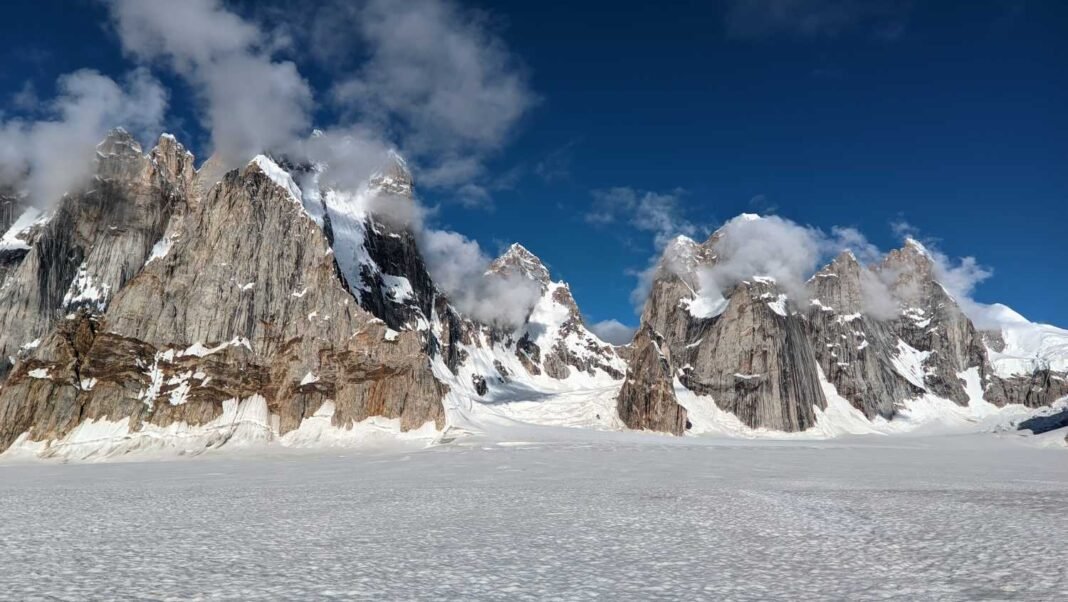
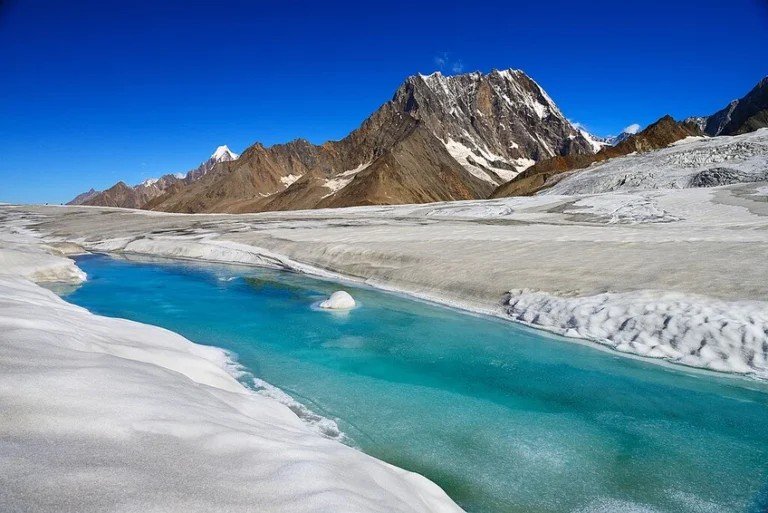
Walk on the Hispar Glacier and you are walking on a landscape that behaves like a living creature. Also, the ice shifts, groans, and rearranges itself day by day. For example, supraglacial streams — rivers of milky-turquoise meltwater — cut channels across the surface and plunge into vertical shafts with a sound like thunder trapped underground. In addition, seracs lean at impossible angles. Around you rise some of the most dramatic mountains in the Karakoram: Kunyang Chhish at 7,852 metres, Pumari Chhish at 7,492 metres, Golden Peak, Miar Peak, and Malubiting. On clear days the view stretches across a frozen wilderness that few humans have ever entered.
The Old High Road to Snow Lake
Hispar Glacier also carries a romance that no other glacier in Pakistan quite matches. This is the historic high road of the mountains. For centuries it linked the mountain kingdom of Nagar in the west with Baltistan in the east — traders, pilgrims, and raiders crossed this ice when there were no other roads. When you stand on the glacier at Hispar La, you are standing on a pass that English explorer H. W. Tilman crossed in 1937, the same pass the legendary Eric Shipton mapped during his pioneering central Karakoram expeditions. The sense of walking through history is inescapable.
Then there is Snow Lake — one of the largest high-altitude snow basins on Earth outside the polar regions, roughly 16 kilometres wide, sitting at nearly 4,900 metres at the head of the Biafo and Hispar glaciers. Reaching it is the dream of trekkers across the world. The Biafo–Hispar traverse is one of the most celebrated long-distance mountain journeys anywhere. If your soul is built for wilderness, silence, and scale, few places on the planet will reward you like this one.
Hispar is also perfect for a specific kind of traveller: the one who has already done the K2 base camp trek or Gondogoro La and wants what comes next. This is the graduate school of Karakoram trekking — longer, remoter, and quieter than Concordia, with a cultural dimension the Balti side of the traverse adds as you descend into the Shigar and Skardu valleys. Come here when you are ready for a real expedition, not a sightseeing trip.
History of Hispar Glacier
Long before it appeared on any map, the Hispar Glacier was a working road. Also, the people of Nagar and the people of Baltistan lived on opposite sides of a wall of ice. They did not let that stop them. The route over Hispar La connected the Silk Road world of the north with the Indian subcontinent, China, and Tibet. Caravans carried goods across it. The people of Hunza and Nagar used the pass to reach the Balti village of Askole — at first for raiding, and later, in happier times, for friendly polo matches between the two sides.
The polo ground at “Kesar’s playground,” a flat area near the Biafo side of the traverse, is said by local legend to have been a giant’s polo field.
Explorers and the Working Glacier
The modern history of the glacier begins with the great age of Karakoram exploration. Also, in 1937 and 1939, Eric Shipton led pioneering expeditions that explored and mapped the central Karakoram, opening up this region to the outside world’s imagination. In fact, in 1937, the English adventurer H. W. Tilman trekked the area and famously claimed to have seen the footprints of the yeti on the glacier. A story that has attached itself to the Biafo–Hispar traverse ever since and still gets retold around campfires on the ice.
In 1940, Shipton, Tilman, and their companions continued exploring the surrounding ranges, cementing the Karakoram’s reputation as the wildest mountain country on Earth.
For the local people of Nagar, the glacier has always been part of daily life and livelihood. Hispar village, the last settlement before the ice, was the staging ground for every crossing — porters, guides, and traders gathered here. The Nagar state, ruled by its Mirs until 1974, controlled this side of the pass. The crossing was both an economic artery and a strategic route. Today the glacier lies within the Central Karakoram National Park, Pakistan’s largest national park, which protects its wildlife — ibex, snow leopards, Himalayan brown bears, markhor, and marmots — along with the peaks and glaciers themselves.
Modern trekking on Hispar began in earnest in the second half of the 20th century as international expeditions started attempting the full Biafo–Hispar–Snow Lake traverse. Today it is a well-established but still genuinely remote expedition trek, run by licensed Pakistani trekking companies with trained local guides and porters. Also, it remains one of the great unfinished-business items on many mountaineers’ life lists.
Top Things to Do in Hispar Glacier
Trek the Biafo–Hispar–Snow Lake Traverse
This is the main event: a roughly three-week expedition covering around 120 kilometres of glacier and moraine from Askole in Baltistan to Hispar village in Nagar, or the reverse. Also, you will spend 9 to 11 days on the ice itself, cross four major tributary glaciers, and stand on Snow Lake, the vast high basin at the head of the glaciers. The campsites along the way — Mango, Namla, Baintha, Marpogoro — are among the most dramatic in the Karakoram, with Baintha’s green meadow and nearby waterfall a famous rest-day stop.
In fact, this trek requires glacier-travel skills or, at minimum, a fully supported expedition with ropes, crevasse rescue equipment. It experienced high-altitude porters. It is not for beginners.
Stand on Snow Lake
Snow Lake (Lukpe Lawo in the local language) is the emotional climax of the traverse: a 16-kilometre-wide basin of ice and snow at around 4,877 metres, one of the largest snow basins outside the polar regions. Also, glaciologists have estimated the ice here to be extraordinarily deep — some surveys suggest over a kilometre and a half in places. Walking across its silent white expanse, ringed by unnamed peaks, is an experience trekkers describe as stepping onto another planet.
Cross Hispar La
The high point of the journey, Hispar La (around 5,128 metres), is where the Hispar and Biafo glaciers meet. Also, trekkers typically camp on or near the pass. In fact, the sunset and sunrise views across the whole Biafo–Hispar ice system are legendary. From the pass you can pick out the Latok peaks and Baintha Brakk, known as The Ogre — one of the hardest mountains in the world to climb.
Spot Karakoram Wildlife
The glacier and its surroundings lie within the Central Karakoram National Park, home to Himalayan ibex, snow leopards, Himalayan brown bears, markhor, marmots, and occasionally Marco Polo sheep. Dawn and dusk at the lateral-moraine campsites are the best times to watch for ibex silhouetted on the ridges.
Visit Hispar Village
The last village before the glacier, Hispar is a small settlement of around 150 houses where you can see the glacier from the village itself. It is the traditional jumping-off point for the traverse from the Nagar side, and spending a night here gives you a glimpse of mountain village life — terraced fields, apricot orchards, and famously hospitable Burusho people.
Photograph the Ice
The Hispar Glacier is a photographer’s dream: turquoise supraglacial lakes, pressure ridges, ice caves, and moraine patterns that look abstract from above. Also, the light at dawn on the upper glacier is extraordinary.
Famous Places In and Around Hispar Glacier
- Snow Lake: The vast ice basin at the head of the Biafo and Hispar glaciers — the highlight of the traverse.
- Hispar La: The 5,128-metre pass where the two glaciers meet.
- Hispar Village: The last settlement before the glacier, base for the Nagar-side approach.
- Biafo Glacier: The 67-km Balti-side glacier you cross on the full traverse.
- Askole: The thousand-year-old Balti village where the traverse traditionally begins.
- Baintha Camp: The famous green meadow campsite on the Biafo side.
- Kunyang Chhish (7,852 m) and Pumari Chhish (7,492 m): The great peaks towering over the Hispar side.
How to Reach Hispar Glacier
Getting to Hispar Glacier is an expedition in itself. The glacier has no road access and no nearby airport — you reach the trailhead at Hispar village by road, then continue entirely on foot. Also, the nearest major town is Gilgit, the capital of Gilgit-Baltistan.
From Islamabad: The standard route is the Karakoram Highway (KKH) from Islamabad to Gilgit — a long, spectacular drive of roughly 500–600 km that typically takes 12–16 hours depending on road conditions, with an overnight stop in Chilas or Naran often recommended. Also, alternatively, take the roughly one-hour flight from Islamabad to Gilgit (weather permitting — flights are frequently cancelled in bad weather). In fact, From Gilgit, the KKH continues east to the Nagar/Hunza turnoff. The jeep road to Hispar village branches off from the Nagar side and takes several hours by 4×4.
From Lahore: Drive or fly to Islamabad first, then follow the Islamabad route above. Also, there are no direct flights from Lahore to Gilgit. The journey is Islamabad plus the KKH drive or the Gilgit flight.
Airports, the KKH and Transport Options
From Karachi: Fly to Islamabad (around 2 hours), then continue by road or air to Gilgit as above. Some travellers fly Karachi to Skardu and approach the traverse from the Baltistan side, starting at Askole — a longer overall journey but the classic direction for the full Biafo–Hispar trek.
Nearest airport: Gilgit Airport (domestic, weather-dependent) for the Nagar/Hispar side; Skardu International Airport for the Askole/Biafo side. Also, both connect to Islamabad.
Road conditions by season: The KKH is open year-round but can be blocked by landslides, especially during the monsoon (July–August). Also, the jeep track to Hispar village is rough, narrow, and only reliably passable from late May to October. In winter the village is largely cut off by snow.
Transport options: Coaster/van services and NATCO buses run Islamabad–Gilgit; private cars and hired 4x4s are the flexible option. Also, From Gilgit or Karimabad, hire a jeep for the Hispar village road. On the glacier itself, you travel on foot with a licensed trekking company, high-altitude porters. A full expedition camp — independent travel on the ice is extremely dangerous due to crevasses.
Route Details
- Fly or drive to Gilgit (Islamabad → KKH → Gilgit, or Islamabad → Gilgit flight).
- Drive the KKH east to the Nagar Valley turnoff (the same road that serves Karimabad/Hunza, branching toward Nagar Khas).
- Take a hired 4×4 from Nagar Khas/Hopar area to Hispar village (around 28 km from Nagar Khas, several hours on a rough track).
- Acclimatise in Hispar village, meet your guide and porters, and begin the trek up the Hispar Glacier toward Hispar La.
- For the full traverse: continue over Hispar La, down the Biafo Glacier, and out to Askole, then drive to Skardu.
Where to Stay in Hispar Glacier
There are no hotels on the glacier — you sleep in expedition tents at established campsites on the lateral moraines. But the approach offers real options at several tiers.
In Hispar village: Simple village guesthouses and homestays offer basic rooms with local meals — book through your trekking company. Also, this will arrange everything. Camping in the village is also common on the night before the trek begins.
In Karimabad and Hunza (base for the approach): This is where the comfortable options are. Also, Karimabad has mid-range hotels with terraces facing Rakaposhi and Ultar Sar. Hunza as a whole offers everything from budget guesthouses to well-reviewed boutique hotels. Most trekkers spend 2–3 nights here acclimatising and organising before heading to Hispar.
In Gilgit: Mid-range hotels cluster near the city centre and the KKH. Also, Gilgit is the natural overnight stop between Islamabad and the mountains.
On the trek: Full expedition camping — your trekking company provides high-altitude tents, mess tents, sleeping arrangements, and a cook. For example, campsites like Baintha, with its meadow and streams, are genuinely pleasant places to spend a rest day.
Where to Eat: Local Foods of Hispar Glacier
The cuisine of Nagar and Hunza is mountain food at its most wholesome — built on apricots, buckwheat, barley, and dairy. Also, In Hispar village and along the approach, expect simple, filling local meals: fresh chapattis, daal, seasonal vegetables, and rice, often served with butter and salt tea in the Balti/Nagar style.
Nagar and Hunza are famous across Pakistan for their dried apricots and apricot oil — buy them in Karimabad’s bazaar before heading up. Also, they are the perfect high-energy trekking snack. Local specialities of the wider region include chapshuro (a savoury meat-filled flatbread of Hunza and Nagar), diram fiti (a hearty buckwheat bread), and soups made with local barley. In the villages you may be offered freshly churned butter and buttermilk — accept. Hospitality here is a point of honour.
On the glacier itself, your expedition cook prepares the meals — typically a mix of Pakistani staples (daal, rice, chicken curry, pasta) adapted for high altitude, with plenty of hot drinks. Also, carry your own high-energy snacks (nuts, chocolate, dried fruit) for the long glacier days. In fact, a village meal in Hispar or Karimabad is budget-friendly; expedition costs are bundled into your trek package.
Weather in Hispar Glacier
Hispar Glacier sits at extreme altitude, and the weather makes its own rules. Even in midsummer, nights on the ice drop well below freezing, and storms can arrive with little warning at any time of year. The village of Hispar (around 3,000 m) is far milder than the upper glacier. These are approximate ranges — always check a mountain forecast before committing to dates.
| Season | Temperature Range (village / upper glacier) | Conditions |
|---|---|---|
| Winter (Dec–Feb) | -15 to -5°C / -30 to -15°C | Deep snow, extreme cold, roads to Hispar village closed. No trekking. |
| Spring (Mar–May) | 5 to 18°C / -20 to -5°C | Snowmelt begins; jeep road opens late in the season. Trekking starts late May. |
| Summer (Jun–Aug) | 15 to 28°C / -10 to 5°C | Prime trekking season. Long days, but afternoon storms and crevasse danger peak with melt. |
| Autumn (Sep–Nov) | 5 to 20°C / -18 to -2°C | Stable, clear weather early; very good for trekking. Snow returns by November. |
Language and Culture of Hispar Glacier
The people of the Hispar Valley are Burusho, speakers of Burushaski — one of the world’s most fascinating language isolates, unrelated to any other known language. Shina and Urdu are also widely understood, and English is spoken by guides and anyone involved in trekking. Also, In Baltistan, on the far side of the traverse, the people are Balti and speak Balti, a Tibetic language.
Nagar and Hunza are known across Pakistan for their progressive, education-focused culture and legendary hospitality. Visitors are genuinely welcomed — but respect the norms: dress modestly (cover shoulders and knees, especially for women), ask permission before photographing people, and accept offered tea when you can. Also, the region is predominantly Ismaili Muslim, known for a moderate and tolerant outlook. On the glacier, cultural etiquette extends to the environment: this is a pristine national park — carry out all waste, use established campsites, and never contaminate water sources.
Shopping in Hispar Glacier
There is no shopping on the glacier, but the approach valleys offer some of the best souvenir hunting in Gilgit-Baltistan. In Karimabad’s bazaar, stock up on dried apricots, apricot oil, walnuts, and almonds — the region’s famous produce. Handicrafts include traditional Hunza/Nagar woollen shawls and caps, woodwork, and gemstone jewellery. In Skardu (if you exit via the Balti side), look for Balti handicrafts and pashmina. There are no shopping malls anywhere near Hispar — this is village-bazaar territory, and all the better for it.
Local Events and Festivals
Hispar village itself is too small for major festivals. Also, the wider Nagar and Hunza valleys celebrate one of Gilgit-Baltistan’s most beautiful traditions: Ginani, the harvest thanksgiving festival held on the summer solstice, 21 June. For ten days beforehand, traditional musicians play the hareep tunes, and on the day itself communities gather for prayers, music, dancing. The sharing of the first wheat cooked into diltar, a buttermilk drink. If your trek timing allows, spending Ginani in Nagar or Hunza before heading to the glacier is unforgettable. Polo matches — the region’s beloved sport — are also held in the valleys through the summer.
Travel Tips for Hispar Glacier
Packing Essentials
This is a full expedition: four-season sleeping bag, down jacket, waterproof shell layers, glacier glasses, high-SPF sunscreen, sturdy mountaineering boots, gaiters, headlamp, and personal medications. Also, your trekking company provides group gear (ropes, tents, cooking equipment). In fact, bring a water purification method and a power bank — there is no electricity on the glacier.
Safety Tips
Never attempt the Hispar Glacier without a licensed guide and proper glacier equipment — crevasses here can be over 100 metres deep. Acclimatise properly: spend at least 2–3 nights around Karimabad/Hunza before ascending. Altitude sickness is the main risk; know the symptoms and descend if they worsen. Register with your trekking company and share your itinerary with someone at home. Travel insurance covering helicopter evacuation above 5,000 metres is strongly advised.
Money & Connectivity
Carry all cash in Pakistani rupees — there are no ATMs beyond Gilgit/Karimabad, and none at all in Hispar village. Mobile signals (SCO, Telenor, Zong) work in the valleys but disappear entirely once you are on the glacier. Also, a satellite communicator is worth considering for a three-week expedition.
Best Time to Visit Hispar Glacier
June to August — Peak Season
The classic window for the full traverse. Also, Snow bridges are passable, days are long, and the high camps are (relatively) comfortable. This is when almost all expeditions run. Book your trekking company months ahead.
September to Early October — The Quiet Window
Often the finest weather of the year — stable, clear, with fewer expeditions on the ice. Colder nights, but spectacularly crisp views. Also, a great choice for experienced trekkers who prefer solitude.
November to May — Not Recommended
Winter closes the jeep road and buries the glacier in snow. Also, only highly specialised winter expeditions attempt the region, and the traverse is not run commercially.
Final Thoughts
Hispar Glacier is not a destination you tick off a list. Also, it is a journey that becomes part of who you are. The days are long and hard, the nights are cold, and the scale of the place will humble you daily. But walking that hundred-kilometre highway of ice between two ancient kingdoms, sleeping under more stars than you thought existed, and standing on Snow Lake at the roof of the Karakoram is the kind of experience that divides a travelling life into “before” and “after.”
If you are an experienced trekker looking for the next great challenge in Pakistan, start planning now: choose a reputable licensed operator, train hard, and give yourself the full three weeks. Also, Hispar Glacier has waited thousands of years. It can wait for you to be ready. And it will be worth it.
FAQs
Where is Hispar Glacier located?
Hispar Glacier is in Nagar District, Gilgit-Baltistan, in Pakistan’s Karakoram range. Also, it flows from Hispar Pass down toward Hispar village in the Nagar Valley.
How long is Hispar Glacier?
The glacier is around 49 km long. Together with the 67-km Biafo Glacier, which it meets at Hispar La, it forms the longest glacial system outside the polar regions — roughly 100 km of continuous ice.
What is the best time to visit Hispar Glacier?
June to August is the peak season for the Biafo–Hispar–Snow Lake traverse. Also, September to early October offers stable, clear weather with fewer trekkers. November to May is not feasible.
How do I reach Hispar Glacier?
Travel to Gilgit by road (KKH) or flight from Islamabad, drive to Nagar Valley, take a 4×4 to Hispar village, and continue on foot with a licensed trekking company. Also, the glacier is only accessible by trekking.
Safety, Stays and Snow Lake
Is Hispar Glacier safe for tourists?
It is safe with a licensed guide, proper equipment, and acclimatisation. But it is a serious high-altitude expedition, not casual tourism. Also, crevasse danger, altitude, and weather are real risks. Independent travel on the ice is not advised.
Is Hispar Glacier suitable for families?
no. This is an expedition-grade destination for fit, experienced trekkers. Families can, however, visit Hispar village and the Nagar Valley. This are beautiful and welcoming.
Where can I stay near Hispar Glacier?
In Hispar village (simple guesthouses), in Karimabad/Hunza (mid-range hotels, good for acclimatisation), and in expedition tents on the glacier itself during the trek.
What food is available around Hispar Glacier?
Simple local mountain food in the villages — chapattis, daal. Also, the region’s famous apricots and apricot oil. In fact, on the trek, your expedition cook prepares full meals at camp.
What is Snow Lake?
Snow Lake (Lukpe Lawo) is a vast high-altitude ice basin, roughly 16 km wide and sitting at nearly 4,900 metres, at the head of the Biafo and Hispar glaciers — one of the largest snow basins outside the polar regions and the highlight of the traverse.
For more northern Pakistan inspiration, explore our Explore Pakistan collection, compare with our Batura Glacier travel guide, read about the classic approach from Askole, or meet the fearsome peak that guards the route in our Baintha Brakk (The Ogre) guide.