


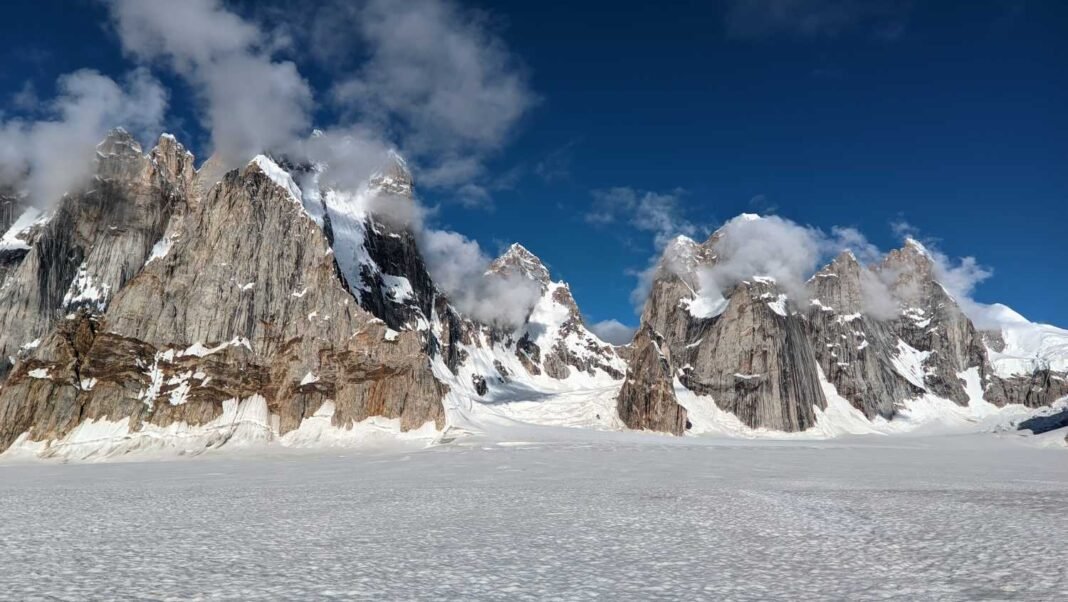
Every great mountain range has one crossing that defines it. Also, the pass that travellers talk about in hushed tones for the rest of their lives. In fact, in the Karakoram, that pass is Hispar La. In addition, sitting at around 5,128 metres (16,824 feet), it is the high saddle where two of the world’s great glaciers meet: the 49-kilometre Hispar Glacier on the Nagar side and the 67-kilometre Biafo Glacier on the Baltistan side. Stand on Hispar La and you are standing at the midpoint of the longest glacial traverse outside the polar regions. A hundred kilometres of ice in either direction.
A panorama of 7,000-metre peaks that simply does not exist anywhere else.
Hispar Pass is not a place you drive to, photograph, and leave. Also, it is a place you earn, usually around the two-week mark of the legendary Biafo–Hispar–Snow Lake trek. For example, this hispar pass (hispar la) travel guide will help you understand what the crossing involves, why it rewards the effort like nothing else in Pakistan, and how to plan it.
Quick Facts
- Location: On the Karakoram watershed between Nagar District (west) and Shigar District, Baltistan (east), Gilgit-Baltistan, Pakistan.
- Altitude: Around 5,128 m (16,824 ft) — some surveys give 5,151 m.
- Famous For: The meeting point of the Hispar and Biafo glaciers; the highest point of one of the world’s great long-distance treks.
- Nearest City: Gilgit (for the Nagar-side approach) or Skardu (for the Baltistan-side approach).
- Accessibility: On foot only, as part of a supported expedition with licensed guides — typically 10–14 days of trekking to reach the pass from either side.
- Known Landmarks: Snow Lake, Baintha Brakk (The Ogre, 7,285 m), the Latok peaks, Kunyang Chhish (7,852 m).
- Best For: Experienced high-altitude trekkers and mountaineers on the full Biafo–Hispar traverse.
Why Visit Hispar Pass (Hispar La)
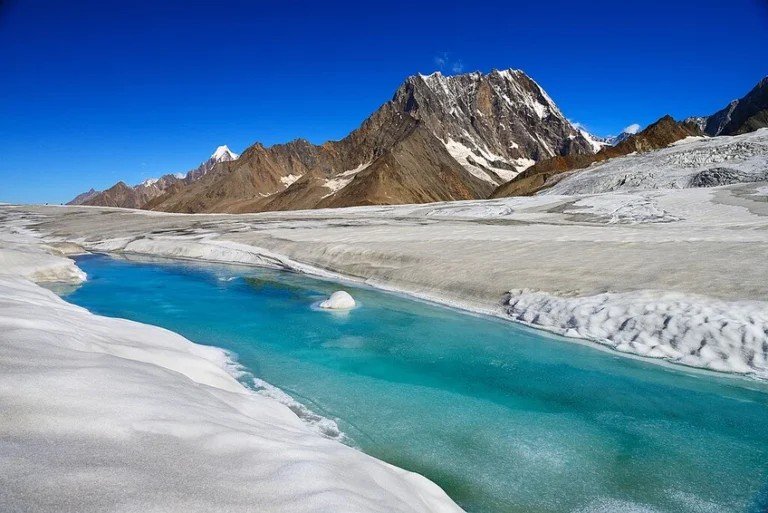
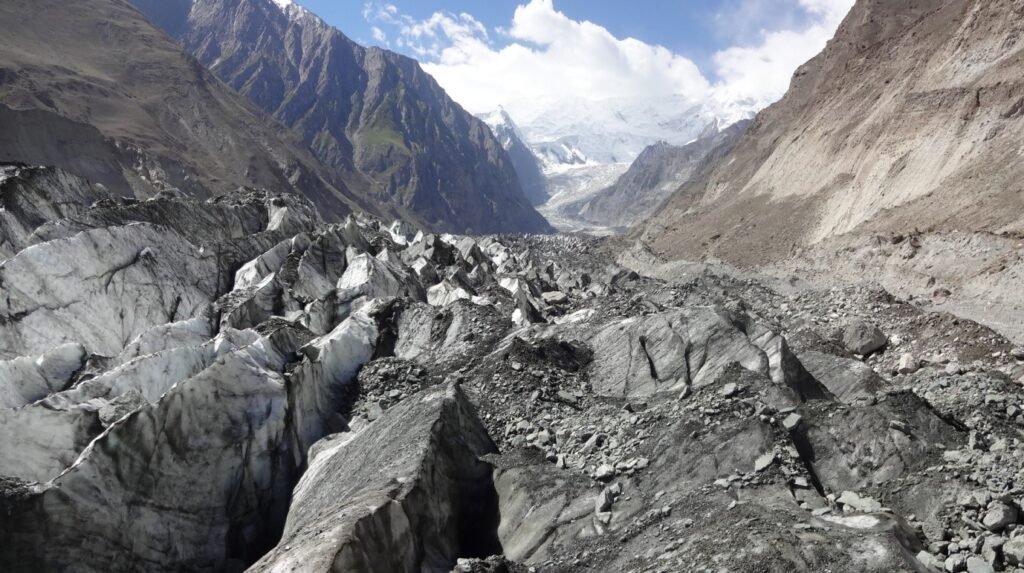
There is a moment on every great trek when the journey stops being about distance and starts being about meaning. On the Biafo–Hispar traverse, that moment is Hispar La. You climb for days through a chaos of ice pinnacles, moraine ridges, and supraglacial lakes, and then the ground levels, the ice smooths into a broad white saddle, and suddenly you can see both worlds at once: the Biafo Glacier falling away behind you toward Baltistan and the Hispar Glacier dropping ahead toward Nagar, with Snow Lake gleaming to one side. Trekkers who have crossed it describe the pass day as the single most beautiful day of walking in the Karakoram.
What makes Hispar La special is not just its height — though at over 5,100 metres it is higher than any point in Europe or the Rockies — but what it represents. Also, this pass has been a highway between civilisations for centuries. In fact, the people of Hunza and Nagar crossed it to reach Askole in Baltistan. Traders moved between the Silk Road and the subcontinent over this ice. And the pass you cross today is the same one H. W. Tilman crossed in 1937 when he reported those famous “yeti footprints,” and that Eric Shipton mapped during his pioneering 1937 and 1939 central Karakoram expeditions.
Crossing Hispar La is walking directly through the golden age of exploration.
Facing The Ogre
The views from the pass are almost absurd in their generosity. To the north and east rise the great walls of the Panmah Muztagh, including Baintha Brakk — The Ogre — one of the most notoriously difficult mountains ever climbed, summited only a handful of times despite decades of attempts by the world’s best climbers. The Latok group, Kunyang Chhish. Also, a forest of unnamed 7,000-metre spires complete a panorama that mountaineers cross the world to see. Trekkers often camp on or just below the pass. The sunset and sunrise over the entire Biafo–Hispar ice system are the stuff of expedition legend.
Finally, Hispar La is perfect for the trekker who wants the ultimate Karakoram credential. Concordia and K2 base camp are magnificent, but they are increasingly busy. The Hispar La crossing remains genuinely remote — you may go days without seeing another trekking party. If you want wilderness in its purest form, measured in weeks rather than days, this pass is your destination.
History of Hispar Pass (Hispar La)
Hispar La’s history is the history of movement through the Karakoram. Before roads, before maps, the pass was the link between two worlds. Also, to the west lay the mountain states of Hunza and Nagar. To the east, Baltistan — the “Little Tibet” of Askole, Shigar, and Skardu. The pass served traders carrying goods between the Silk Road, China, Tibet, and the Indian subcontinent. It also served raiders: the people of Hunza famously crossed the glacier to attack Askole, and over time the route softened into something friendlier.
The people of Hunza would cross to Askole to play polo, the beloved sport of the mountains, on grounds like the legendary “Kesar’s playground” near the Biafo side.
The pass entered the Western imagination with the great Karakoram explorers of the 1930s. Also, H. In fact, W. Tilman, the English adventurer, crossed the region in 1937 and claimed to have seen yeti footprints in the snow near the glacier. A tale that has clung to Hispar La ever since. Eric Shipton’s 1937 and 1939 expeditions explored and mapped the central Karakoram, turning this blank space on the map into one of the most romantic regions in mountaineering literature.
In the decades that followed, the Biafo–Hispar traverse via Hispar La became established as one of the classic long walks of the greater ranges, attempted by serious expeditions from around the world.
Politically, the pass sat on the frontier between the former princely states of Nagar (ruled by its Mir until 1974) and the Balti territories of the Shigar valley. Also, today both sides lie within Gilgit-Baltistan, and the entire route is protected within the Central Karakoram National Park. The crossing remains what it has always been: a serious undertaking that demands respect, preparation, and local knowledge.
Top Things to Do in Hispar Pass (Hispar La)
Cross the Pass on the Biafo–Hispar Traverse
The traverse is the reason the pass exists in the trekking imagination. Whether you walk it west-to-east (Hispar village → Askole) or east-to-west (Askole → Hispar), the pass day is the climax: a long, steady climb up the upper glacier to the broad saddle, then the descent begins. Most itineraries allow a high camp near the pass so you can watch sunset and sunrise over the ice. The crossing typically falls around day 10–14 of a 20–23-day expedition.
Camp at the High Saddle
Trekkers often camp on or just below Hispar La, at over 5,000 metres. Also, it is one of the highest campsites on any commercial trek in Pakistan — cold, stark, and utterly unforgettable. In fact, On a clear evening the alpenglow on Baintha Brakk and the Latok peaks is something you will describe for the rest of your life.
Visit Snow Lake
Just below the pass on the Biafo side lies Snow Lake (Lukpe Lawo), the vast 16-kilometre-wide ice basin at around 4,877 metres. Also, most traverse itineraries spend a day here, and some parties make a side excursion across its silent white expanse. In fact, glaciologists have estimated the ice depth here at well over a kilometre. It is one of the largest snow basins outside the polar regions.
Photograph the Ogre and the Latoks
From the pass and the upper camps, the views of Baintha Brakk (The Ogre, 7,285 m) — famous as one of the hardest mountains in the world to climb — and the Latok group’s granite towers are unmatched. Also, this is serious mountain-photography territory: bring spare batteries (cold kills them) and a sturdy tripod.
Experience True Wilderness
Unlike the busier K2 trek, the Hispar La route offers days of complete solitude. Also, between the established campsites you are alone with the ice, the wind, and the peaks. For many trekkers, this silence is the real summit of the journey.
Famous Places In and Around Hispar Pass (Hispar La)
- Snow Lake: The immense ice basin just below the pass on the Biafo side.
- Hispar Glacier: The 49-km Nagar-side glacier descending from the pass.
- Biafo Glacier: The 67-km Baltistan-side glacier rising to the pass.
- Baintha Brakk (The Ogre, 7,285 m): The legendary peak visible from the upper route.
- Askole: The ancient Balti village at the eastern end of the traverse.
- Hispar Village: The Nagar-side trailhead at the western end.
- Baintha Camp: The celebrated meadow campsite on the Biafo side.
How to Reach Hispar Pass (Hispar La)
Hispar La cannot be reached by any road or day hike. Also, it is a high-altitude pass deep in the Karakoram, accessible only as part of a multi-week supported trek from one of two trailheads: Hispar village in Nagar (west) or Askole in Baltistan (east).
Western approach (from Nagar): Travel from Islamabad to Gilgit by the Karakoram Highway (a long 12–16-hour drive) or by the roughly one-hour flight to Gilgit. Drive the KKH to Nagar Valley, then take a hired 4×4 on the rough jeep track to Hispar village (around 28 km from Nagar Khas). Also, from the village, the trek up the Hispar Glacier to the pass takes roughly 8–10 days of glacier travel.
Eastern approach (from Baltistan): Travel from Islamabad to Skardu — by air (about an hour, weather permitting) or by road via the KKH and the Skardu road (a full day or more). Also, From Skardu, drive to Askole village (around 3,090 m), the classic start of the K2 trek. In fact, the trek up the Biafo Glacier to Hispar La takes roughly 9–11 days, passing the famous camps of Mango, Namla, Baintha, and Marpogoro.
From Lahore: Fly or drive to Islamabad, then follow either approach above.
Reaching the Pass from Karachi
From Karachi: Fly to Islamabad (around 2 hours), then continue to Gilgit or Skardu by air or road.
Nearest airports: Gilgit Airport for the western approach; Skardu International Airport for the eastern approach. Also, both are domestic, weather-dependent, and connect via Islamabad.
Road conditions by season: The KKH can be blocked by landslides in the monsoon months (July–August). The jeep tracks to Hispar village and Askole are rough mountain roads, generally passable from late May to October only.
Transport options: This is expedition travel. Also, you go with a licensed trekking company that arranges all transport, porters, food, and equipment. In fact, independent attempts at the crossing are strongly discouraged: the glaciers are heavily crevassed. The route requires ropes, crevasse-rescue skills, and experienced high-altitude porters.
Route Details
- Reach Gilgit (western approach) or Skardu (eastern approach) from Islamabad.
- Western: 4×4 to Hispar village in Nagar Valley. Eastern: jeep to Askole in the Shigar Valley.
- Spend 2–3 days acclimatising and organising with your guide and porters.
- Trek up your side’s glacier (8–11 days), establishing camps on the lateral moraines.
- Cross Hispar La (around 5,128 m) — the high point and the meeting of the two glaciers.
- Descend the far glacier to the opposite trailhead, then drive out to Skardu or Gilgit.
Where to Stay in Hispar Pass (Hispar La)
On the pass itself there is only one kind of accommodation: an expedition tent at over 5,000 metres, pitched on snow or moraine by your trekking crew. But the journey to and from the pass offers real beds at both ends.
Western side: Simple guesthouses in Hispar village. Comfortable mid-range hotels in Karimabad and the wider Hunza Valley, where most trekkers acclimatise for 2–3 nights before the trek. Also, Gilgit has mid-range hotels for the transit nights.
Eastern side: Basic guesthouses in Askole. Also, a good range of hotels in Skardu from budget guesthouses to comfortable mid-range and a few upscale options. Meanwhile, Skardu is the natural place to recover after the trek with hot showers and real beds.
On the trek: Your expedition company provides all camping equipment — high-altitude tents, mess tents, and sleeping arrangements — at established campsites along both glaciers. No hotel exists. Also, it could exist, anywhere near the pass.
Where to Eat: Local Foods of Hispar Pass (Hispar La)
Nobody eats at Hispar La except from their own pack — at 5,128 metres, your expedition cook’s hot soup at the high camp is the finest restaurant in the Karakoram. But the cultures at the two ends of the pass offer wonderful food before and after the crossing.
On the Nagar/Hunza side, the cuisine is built on apricots, buckwheat, and barley: dried apricots and apricot oil (buy them in Karimabad for the trek), chapshuro (savoury meat flatbread), diram fiti (buckwheat bread), and hearty barley soups. Also, On the Baltistan side, Balti cuisine takes over — try the local breads, apricot-based dishes, and salted butter tea. Meanwhile, In Skardu’s bazaar after the trek, you will find restaurants serving Pakistani staples alongside Balti specialities. After three weeks on expedition rations, a proper chicken karahi tastes like heaven.
On the glacier, your cook prepares high-energy expedition meals — daal, rice, pasta, soups, porridge — with endless hot drinks. Also, carry personal snacks (nuts, dried fruit, chocolate, energy bars) for the long pass day. In fact, budget in the villages is modest; expedition catering is included in your trek package.
Weather in Hispar Pass (Hispar La)
At over 5,100 metres, Hispar La makes its own weather, and it can change in an hour. Also, even in high summer, temperatures at the pass stay below freezing most of the time, and storms can pin expeditions in their tents for days. In fact, the table below gives approximate conditions — treat mountain forecasts as advisory, not promises.
| Season | Temperature Range (at the pass) | Conditions |
|---|---|---|
| Winter (Dec–Feb) | -35 to -20°C | Impossible. Deep snow, hurricane winds, no expeditions. |
| Spring (Mar–May) | -25 to -10°C | Still winter at the pass; approaches open late May. |
| Summer (Jun–Aug) | -12 to 2°C | Prime crossing season. Long days; afternoon storms possible; crevasse bridges at their weakest late in the season. |
| Autumn (Sep–Nov) | -20 to -5°C | Clear and stable early; excellent for experienced parties. Winter storms from November. |
Language and Culture of Hispar Pass (Hispar La)
Hispar La sits on a cultural watershed as well as a glacial one. To the west are the Burusho people of Nagar and Hunza, speakers of the Burushaski language isolate, known across Pakistan for their hospitality, love of education, and moderate Ismaili Muslim tradition. To the east are the Balti people of Shigar and Baltistan, speakers of Balti, a Tibetic language, with a culture shaped by centuries of Tibetan Buddhist and later Islamic influence.
The pass itself has connected these cultures for centuries — through trade, through raiding, and eventually through polo matches and friendship. As a visitor, you move between both worlds on a single journey. This is part of what makes the traverse so rich. Guides and porters typically speak Urdu and English alongside their mother tongues. Dress modestly in the villages, ask before photographing people, and remember that on the ice you are a guest in the Central Karakoram National Park: leave no trace, pack out everything, and respect the porters and crew who make the crossing possible — their skill on this terrain is extraordinary.
Shopping in Hispar Pass (Hispar La)
There is nothing to buy at 5,128 metres, but both ends of the traverse are excellent for souvenirs. On the Nagar/Hunza side, Karimabad’s bazaar offers dried apricots, apricot oil, walnuts, traditional caps and shawls, and woodwork. On the Baltistan side, Skardu’s bazaars sell Balti handicrafts, pashmina shawls, and gemstones from the region’s famous mines. Stock up on trekking snacks — dried fruit and nuts — before leaving the valleys. There are no malls, and no shops of any kind, once you step onto the ice.
Local Events and Festivals
No festival is held at the pass itself — but the valleys at both ends celebrate some of Gilgit-Baltistan’s finest traditions, and timing your expedition around them adds a wonderful cultural dimension. In Nagar and Hunza, Ginani (21 June, the summer solstice) is the traditional harvest thanksgiving, with hareep music, dancing, polo. The sharing of the first wheat cooked into diltar. In Baltistan, the polo season runs through the summer months. Skardu hosts matches and cultural events that are well worth catching before or after your trek. Ask your trekking company what’s on when you book.
Travel Tips for Hispar Pass (Hispar La)
Packing Essentials
Full expedition kit: four-season sleeping bag rated well below freezing, expedition down jacket, hard-shell layers, mountaineering boots, crampons, harness, glacier glasses, high-SPF lip balm and sunscreen, headlamp with spare batteries, and personal medications including altitude medication if prescribed. Also, your company provides ropes, tents, and cooking gear. Pack everything in waterproof dry bags.
Safety Tips
The glaciers around Hispar La are heavily crevassed. Also, this is roped glacier travel throughout, and going without a licensed guide is genuinely life-threatening. Acclimatise carefully (the classic itineraries build this in), learn the symptoms of altitude sickness. It be prepared to turn back if the weather closes in. The pass will still be there next year. Helicopter-evacuation insurance valid above 5,000 metres is essential.
Money & Connectivity
Carry all the cash you will need in Pakistani rupees. There are no ATMs in Hispar village or Askole, and the last reliable ATMs are in Gilgit and Skardu. Also, mobile coverage ends at the trailheads; on the ice there is no signal at all. Satellite communicators are standard on commercial expeditions.
Best Time to Visit Hispar Pass (Hispar La)
June to August — The Classic Season
Almost all commercial traverses run in these months. Also, the glaciers are passable, the high camps are manageable. In fact, the long daylight hours give you margin for the big pass day. July can bring monsoon-influenced storms; June and August are often the most stable.
September to Early October — The Connoisseur’s Window
Clearer, colder, quieter. Also, the crevasses are more open (requiring more careful route-finding). The skies are often a deeper blue than at any other time of year. Best for experienced parties.
November to May — Closed
Winter at 5,128 metres is absolute. Also, No commercial expeditions operate, and the approach roads are snowbound.
Final Thoughts
Hispar La is not the highest pass in the Karakoram. The most famous — but ask the trekkers who have crossed it, and many will tell you it is the greatest. It is the hinge of the longest ice traverse outside the poles, a place where two ancient kingdoms shake hands across a river of ice, and where the golden age of exploration feels close enough to touch.
Crossing it takes weeks of effort, a good team, and a willingness to be uncomfortable. What it gives back is rarer than any summit photo: the memory of standing at the centre of the Karakoram, with a hundred kilometres of ice behind you and a hundred kilometres ahead, in a silence you will never find anywhere else. Also, start training, choose your operator carefully, and go.
FAQs
Where is Hispar Pass (Hispar La)?
Hispar La is in the Karakoram range of Gilgit-Baltistan, Pakistan, on the watershed between Nagar District (west) and Shigar District, Baltistan (east). Also, it is the saddle where the Hispar and Biafo glaciers meet.
How high is Hispar La?
Around 5,128 metres (16,824 feet); some surveys record 5,151 metres. Either way, it is higher than any mountain in Europe.
What is the best time to cross Hispar La?
June to August is the main season for the Biafo–Hispar traverse. Also, September to early October suits experienced parties seeking stable, clear weather. In fact, the pass is effectively closed November to May.
How do I reach Hispar La?
Only on foot, as part of a 20–23-day supported trek from Hispar village (Nagar side) or Askole (Baltistan side), with a licensed trekking company, guides, and porters.
As Safe as Expeditions Get
Is Hispar La safe?
With a licensed operator, proper acclimatisation. It roped glacier travel, it is as safe as any major high-altitude expedition — but crevasses, altitude, and weather are serious hazards. Also, it is not suitable for beginners or independent travellers.
Is Hispar La suitable for families?
no. This is an expedition-grade crossing for fit, experienced trekkers. Families can enjoy the valleys at either end — Nagar/Hunza or Skardu/Shigar — which are welcoming and beautiful.
Where do I stay near Hispar La?
In expedition tents at high camps near the pass. In guesthouses at Hispar village or Askole; and in hotels in Karimabad/Hunza or Skardu before and after the trek.
What is Snow Lake?
Snow Lake (Lukpe Lawo) is the vast ice basin, around 16 km wide and nearly 4,900 m high, just below Hispar La on the Biafo side — one of the largest snow basins outside the polar regions.
For the full story of the ice on the western side, read our Hispar Glacier travel guide, explore the classic eastern approach in our Askole guide, compare with our Batura Glacier guide, or browse the whole Explore Pakistan collection.
, Pakistan? Discover why it deserves your visit, the best time to go, top things to do and how to reach.)