slug: “invictibellatrix-amberina-new-dinosaur-species-isle-of-wight”
category: “World”
wp_category: “World”
headline: “Invictibellatrix Amberina: Tiger-Sized New Dinosaur Identified From 100-Year-Old Fossil”
focus_keyphrase: “Invictibellatrix amberina”
seo_title: “Invictibellatrix Amberina: New Dinosaur Species Found”
meta_description: “Scientists have identified Invictibellatrix amberina, a tiger-sized predator with giant claws, from a fossil kept in a London museum since 1924.”
tags: “Invictibellatrix amberina, dinosaur, megaraptoran, UCL, Natural History Museum, Isle of Wight, palaeontology, new species”
original_element: “Explainer context built across four independent outlets (ProPakistani, SciTechDaily, Discover Wildlife, The Brighter Side of News) — the megaraptoran family background, the biogeography debate, and verified quotes from both lead and senior authors; no single-source rewrite.”
source: “https://propakistani.pk/2026/10/17/forgotten-fossil-reveals-never-seen-before-dinosaur-species/”
image_file: “hourly-2232-invictibellatrix-dinosaur-new-species.webp”
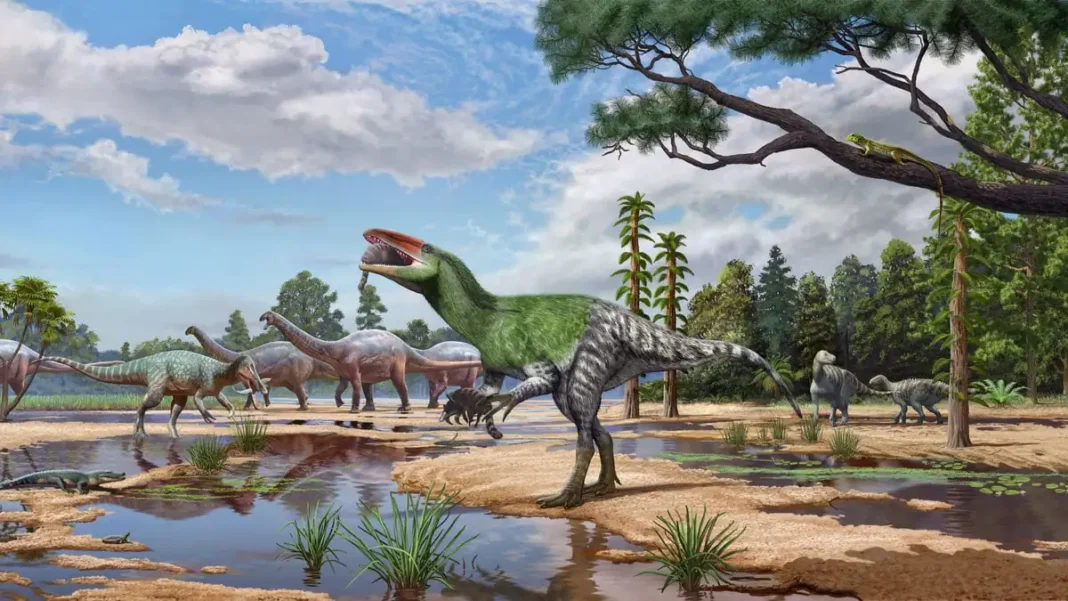
image_title: “Artist’s illustration of Invictibellatrix amberina”
image_alt: “Invictibellatrix amberina — an artist’s illustration of the newly identified megaraptoran dinosaur in its Early Cretaceous habitat”
image_caption: “An artist’s illustration of Invictibellatrix amberina, the newly identified megaraptoran dinosaur, in its Early Cretaceous habitat. Illustration by Sergey Krasovskiy and Pedro Salas. Image: ProPakistani”
image_credit: “ProPakistani”
original_date: “2026-10-17”
word_count: “~700”
—
Invictibellatrix Amberina: Tiger-Sized New Dinosaur Identified From 100-Year-Old Fossil
A dinosaur fossil that sat largely unnoticed in a museum collection for nearly a century has been identified as a previously unknown meat-eating species with large curved claws. Named *Invictibellatrix amberina*, the predator lived in what is now Britain around 120 million years ago and was roughly the size of a large tiger.
Researchers led by University College London (UCL) studied a fragment from the back of the animal’s skull, originally found on the Isle of Wight. Their findings, published in the journal *Royal Society Open Science*, recognise the animal as the first known European member of the megaraptorans — a poorly understood group of two-legged carnivorous dinosaurs related to tyrannosaurs.
What Invictibellatrix amberina looked like
Lead author Dr Cassius Morrison of UCL Earth Sciences estimated that the dinosaur measured around three to four metres long and stood slightly more than 1.5 metres tall. It likely had feathers and carried curved claws measuring roughly 10cm to 20cm.
Unlike *Tyrannosaurus rex*, which relied heavily on its powerful jaws, megaraptorans had narrower heads, muscular arms and large curved claws that they likely used to capture prey. Researchers believe *Invictibellatrix* preyed on small dinosaurs, mammals and lizards, occupying a role in its ecosystem comparable to that of a modern hyena.
Morrison noted that although humans never lived alongside the dinosaur, a human-sized animal would have been suitable prey. “They definitely would have chased us,” he said. “A *T. rex* would not have bothered, as we would have been too small.”
A fossil overlooked since 1924
The discovery came from a skull fragment that entered London’s Natural History Museum collection in 1924 and remained largely overlooked for almost 100 years. The fossil was originally collected by amateur palaeontologist Reginald Walter Tooley near the base of a cliff on the southwestern coast of the Isle of Wight. Tooley collected more than 1,000 fossils that later became part of the museum’s collection.
The UCL team used computed tomography scans to study the fragment without damaging it, creating a detailed 3D reconstruction of the fossil and digitally examining the space that once contained the dinosaur’s brain. They compared its anatomy with skulls and braincases from tyrannosaurs, spinosaurs, raptors and other meat-eating dinosaurs.
Several unusual features helped distinguish it from known species, including an oval opening where the spinal cord connected to the brain and a distinctive hourglass-shaped crest. Computer-based comparisons repeatedly placed the fossil within the megaraptoran group.
Professor Paul Barrett, the study’s senior author from the Natural History Museum, said the find showed that historically collected museum specimens could still contain important scientific discoveries even after decades of study. “Despite over 200 years of collecting, the Isle of Wight continues to surprise us with new dinosaur species,” he said.
Why the discovery matters
*Invictibellatrix* fills a conspicuous gap in the fossil record. Megaraptoran fossils are rare, and until now none had been identified in Europe — leaving scientists uncertain about where the group originated and how it spread across the ancient world.
One theory proposes that megaraptorans first evolved in Asia, moved through Europe and later reached Gondwana, the southern landmass that included modern-day Africa, South America and Antarctica. The British discovery provides the first evidence that megaraptorans were present in Europe and supports the idea that they reached Gondwana through this route.
The group later produced enormous apex predators. One example, *Maip macrothorax* from present-day Argentina, is estimated to have reached nine to ten metres in length and weighed about as much as an elephant, with curved claws reaching around 35cm. *Invictibellatrix*, by contrast, was one of the earliest and smallest known megaraptorans.
Its name translates to “unconquered female warrior”, referring to the group’s later rise as major predators. The species name *amberina* refers both to amber found in the rocks where the fossil originated and to a female given name. The researchers said the genus name was also intended to offer encouragement to people facing bullying, discrimination, victimisation and oppression.
How big was Invictibellatrix amberina?
About three to four metres long and just over 1.5 metres tall — roughly the size of a large tiger.
Where was the fossil found?
On the Isle of Wight, off England’s south coast. It was collected by amateur palaeontologist Reginald Walter Tooley and entered London’s Natural History Museum collection in 1924.
What does the name mean?
*Invictibellatrix* translates to “unconquered female warrior”. The species name *amberina* refers to amber found in the fossil’s rocks and to a female given name.
Why is the discovery important?
It is the first megaraptoran ever identified in Europe, filling a major gap in the group’s fossil record and supporting the theory that these predators spread from Asia through Europe to the southern continents.