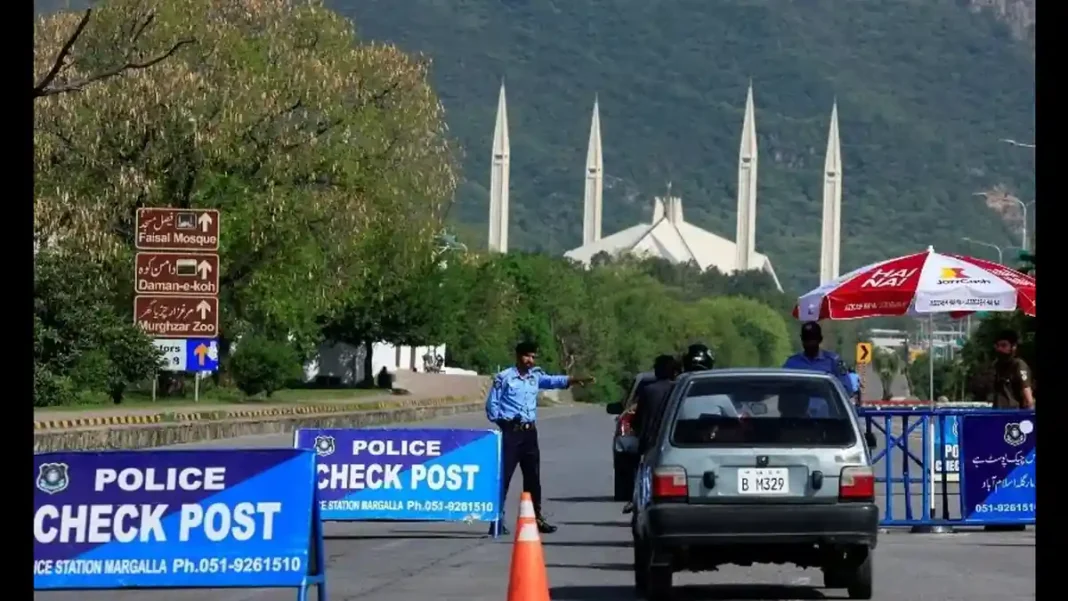
The capital police have halved the number of checkposts on busy roads, cutting them from 24 to 12, and increased mobile patrolling to fight crime and ease traffic. Inspector General of Police (retired) Captain Sohail Chaudhry announced the move on Monday.
Which checkposts were removed
The police chief spoke at a meeting with a delegation of the Islamabad High Court Journalists Association. He said checkposts at E-7, F-7, Daman-i-Koh and the busy Motorway Link Road had been removed.
The remaining checkposts were being streamlined to reduce trouble for commuters while keeping security arrangements effective, he said. Under the new approach, the police will rely more on mobile patrolling than fixed checkpoints to maintain law and order and respond quickly to criminal activity.
The full account was first reported by Dawn.
Containers ordered off the roads
Chaudhry said he had ordered the immediate removal of containers from roads as soon as the situation in the federal capital returned to normal. The move would let routine activities resume and ease the difficulties citizens face, he said.
Containers have been used to block roads during earlier security operations in and around the capital, as seen in our report on how containers piled up at Karachi port as trucks were seized to block Islamabad. The city has faced repeated high-alert situations this year, including the Islamabad Red Zone lockdown for high-stakes talks.
Islamabad checkposts reduced: what commuters gain
Fewer fixed checkpoints should mean shorter queues for daily commuters on some of the capital’s busiest routes. E-7 and F-7 carry heavy residential and office traffic, Daman-i-Koh draws weekend visitors, and the Motorway Link Road connects the city to the highway network.
Mobile patrols, the IGP argued, can respond faster than static posts. Police believe patrolling gives better coverage across sectors without forcing every vehicle through the same bottleneck.
The change follows a period of heightened security in the capital, which had seen a 10-day extension of Rangers deployment until October 15 and earlier road closures.
Softer approach to minor traffic offences
The IGP also announced a shift in how police register First Information Reports for speeding and minor traffic crimes. The aim is to make sure a person with a clean record is not stigmatised, he said.
Vehicles driven by unlicenced drivers will be impounded until the driver obtains a valid licence, he added.
The announcement touches the same traffic-management system the Supreme Court recently ruled on, barring absorbed traffic wardens from being sent back to district police.
He also said an operation against sheesha centres was under way under the directions of the Islamabad High Court and the Supreme Court.
Police and media agree closer coordination
The meeting also covered coordination between the police and court reporters. Both sides stressed professional cooperation and the timely sharing of accurate, verified information with the public.
Chaudhry said several issues needed attention after his appointment, but the situation was gradually returning to normal. He added that the removal of containers and fewer checkpoints were meant to help citizens without compromising public safety.
The police chief also spoke about the grievances of police personnel. He said resolving their problems was essential to improving the force’s performance. He added that he prioritised meetings with low-ranking staff, including constables, so their voices were heard.
The meeting ended with a commitment to keep working together, improve communication and ensure the public gets accurate information on time.
Frequently Asked Questions
How many checkposts does Islamabad have now?
Twelve. The capital police reduced the number from 24 to 12 and increased mobile patrolling instead.
Which checkposts were removed?
Checkposts at E-7, F-7, Daman-i-Koh and the Motorway Link Road were removed to ease movement for citizens.
Why did police reduce the number of checkposts?
IGP Sohail Chaudhry said the move would counter crime, facilitate commuters and restore normal traffic flow without compromising security.
What happens to unlicenced drivers now?
Vehicles driven by unlicenced drivers will be impounded until the driver obtains a valid licence.