This Ali Baig Gurdwara travel guide covers a little-known chapter of shared Sikh and Muslim heritage: the historic gurdwara of Ali Baig village in Bhimber District, Azad Jammu and Kashmir. Inside you will find its history from the pre-partition village of Kirtan Ghar to the present day, how to reach it from Lahore, Islamabad and Karachi, the best time to visit, nearby places, and practical tips for a respectful heritage trip.
Quick Facts
- Location: Ali Baig village, Bhimber District, Azad Jammu and Kashmir, on the bank of the Upper Jhelum Canal, on the northeastern side of the Mirpur-Jhelum link road
- Former Name: The village was earlier called Kirtan Ghar, after this very gurdwara
- Famous For: A three-storey pre-partition Sikh gurdwara with lotus-decorated domes, now standing in ruins and serving as a girls’ school
- History: Before 1947 the village was home to Muslims, Sikhs and Hindus; the gurdwara later served as a refugee camp, a police station, a soap factory and a primary school
- Present Use: The building houses the Muhammad Yaqoob Shaheed High School for Girls
- Nearest City: Bhimber; Jhelum is about 32 km away and Gujrat about 44 km
- Accessibility: All-weather blacktop roads connect Bhimber with Mirpur and Gujrat; the village is a short drive from Bhimber town
- Known Landmarks Nearby: Baghsar Fort and lake, Jandi Chontra, Mangla Dam, Rohtas Fort
- Best For: Heritage travellers, students of Sikh and partition history, photographers, and offbeat explorers of Azad Kashmir
Why Visit Ali Baig Gurdwara
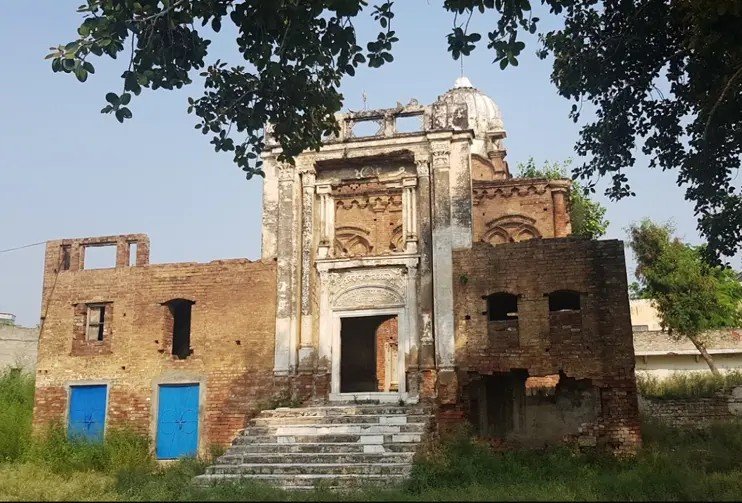
Ali Baig Gurdwara is not a polished tourist attraction, and that is precisely why it matters. This is a place where history has not been restored, repainted or fenced off: a grand three-storey gurdwara, its domes still decorated with lotus flowers and visible from a distance, slowly decaying in a wheat-growing village on the Upper Jhelum Canal. To stand before it is to stand before the shared past of Punjab in its most honest form, beautiful, neglected and still alive in local memory.
The second reason to visit is the story of the village itself. Before 1947, Ali Baig was called Kirtan Ghar, the House of Kirtan, after this gurdwara. Muslims, Sikhs and Hindus lived here together and worked the same fields. The village’s Khalsa Middle School, run by Sant Baba Sunder Singh, drew pupils from Dina, Jhelum, Gora Nakka, Kalri and Kotla to study Persian, Urdu, Punjabi and English. That world ended with partition, but its buildings remain, and walking the village with this history in mind is a quietly powerful experience.
The third reason is urgency. Heritage surveys by Azad Kashmir’s archaeology teams have flagged the gurdwara’s condition: after serving as a refugee camp, a police station, a soap factory and a school, the building is deteriorating. Travellers who care about Sikh heritage in Pakistan often focus on Kartarpur and Nankana Sahib; Ali Baig shows the other side of that heritage, the hundreds of smaller shrines fading in villages. Seeing it now, respectfully and soon, is part of keeping its memory alive.
Finally, the journey itself is rewarding. The Bhimber plains, the canal bank, the farmland and the low hills of the Samahni Valley make for gentle, green countryside, and the area pairs well with Baghsar Fort, Jandi Chontra and Mangla. For travellers who have done the famous sites and want the real Azad Kashmir beyond the postcards, Ali Baig is an excellent day trip.
History of Ali Baig Gurdwara
The village now called Ali Baig, also spelt Alibeg or Ali Beg, sits in Bhimber District at roughly 33.01°N, 73.86°E, on the bank of the Upper Jhelum Canal. Its earlier name, Kirtan Ghar, came directly from the Sikh gurdwara that anchored community life here. Alongside the gurdwara stood the Khalsa Middle School, run by Sant Baba Sunder Singh Ji, where children from surrounding villages, Dina, Gora Nakka, Kalri, Kamotra, Jhelum, Kotla and Chachiya among them, came to study Persian, Urdu, Punjabi and English. Before the partition of 1947, the village’s Muslims, Sikhs and Hindus lived together, engaged in agriculture and pastoralism.
The gurdwara building itself is a substantial three-storey structure, built with high-quality materials of its time and crowned with domes decorated with lotus flowers. Local accounts date its construction to around 1940, and it would have been among the finest buildings in the region up to 1947. Partition changed everything. The Sikh and Hindu families left, and the grand building began a long second life: it served as a refugee camp for about three years, then as a police station, then as a soap factory, and then as a primary school for girls. Today it houses the Muhammad Yaqoob Shaheed High School for Girls, and visitors will see school life continuing inside the historic walls.
That continuous reuse kept the building standing but could not stop its decay. Archaeological surveys of Azad Kashmir, carried out jointly by heritage teams and the AJK Tourism Department, have documented the gurdwara among the region’s neglected monuments, noting that its domes and structure need attention. The village around it has grown into one of the larger settlements of Azad Kashmir, home to around five thousand people, mostly Arain families, growing wheat, maize, sugarcane and vegetables. The local language is Pothwari.
The canal beside the village has its own history. The Upper Jhelum Canal, 142 km long, was designed by the British irrigation engineer Sir John Benton; work began in 1913 and the canal became fully operational in 1916, running from the Jhelum River at Mangla to the Chenab at Khanki. It was severely damaged in the October 2019 Kashmir earthquake and rehabilitated within weeks. Walking its bank at Ali Baig, you are walking beside more than a century of Punjab’s irrigation history.
Top Things to Do in Ali Baig Gurdwara
View the Gurdwara’s Domes and Facade
Approach the building from the village lanes and take in the three-storey facade and the lotus-decorated domes that can be seen from a distance. Because the building functions as a girls’ school, be discreet and respectful: visit outside school hours if possible, ask permission before entering any part of the premises, and do not photograph the students.
Walk the Village of Kirtan Ghar
Ali Baig is a working agricultural village, and a slow walk reveals its layers: the old lanes near the gurdwara, the fields of wheat and sugarcane, and the newer houses of a prosperous settlement. If you speak Urdu or Pothwari, the older residents often share memories of the village’s shared past willingly.
Visit the Upper Jhelum Canal Bank
The canal runs right by the village. Its banks are pleasant for a walk, especially in the late afternoon, and they explain the agricultural prosperity of the whole Bhimber plain. You are looking at a canal completed in 1916 that still waters 1.8 million acres of farmland.
Photograph the Heritage Architecture
The gurdwara’s domes, arched windows and weathered brickwork are evocative subjects, particularly in the soft light of morning. Focus on the architecture rather than the school’s daily activity, and always ask before photographing people.
Reflect at the Khalsa School Site
Ask locally about the old Khalsa Middle School associated with Sant Baba Sunder Singh. Even where buildings have changed, standing where village children once studied four languages is a reminder of what the region’s shared educational culture looked like.
Famous Places In and Around Ali Baig Gurdwara
- Baghsar Fort and Lake: In the Samahni Valley, about 64 km from Gujrat via Bhimber, a four-storey Mughal-era granite fort overlooking a half-kilometre lake, at 975 metres elevation. Emperor Jahangir is said to have died here on his return from Kashmir.
- Jandi Chontra: A scenic spot 17 km from Bhimber, known for its panoramic views and the nearby shrine of Baba Shadi Shaheed, with a tourist rest house for visitors.
- Bhimber Town: The old district headquarters on the Mughal emperors’ route to Kashmir, mentioned by Emperor Jahangir in his memoirs, with all-weather road links to Mirpur and Gujrat.
- Mangla Dam and Lake: The great dam on the Jhelum River, a major landmark of the region.
- Rohtas Fort: Sher Shah Suri’s massive sixteenth-century fort near Jhelum, a UNESCO World Heritage Site and an easy addition from the Jhelum side.
- Mirpur: The divisional city about 36 km west, with broader hotel and transport options.
How to Reach Ali Baig Gurdwara
Ali Baig village is reached via Bhimber town, which sits on all-weather blacktop roads linking Azad Kashmir with Punjab. The nearest railway station is Jhelum, and local buses and vans serve Ali Baig itself.
From Lahore: Take the GT Road north to Gujrat, then continue north toward Bhimber and Ali Baig. The drive to the Bhimber area takes roughly three to three and a half hours depending on traffic. From Bhimber town, Ali Baig village is a short drive along the Mirpur-Jhelum link road toward the Upper Jhelum Canal.
From Islamabad: Take the GT Road east through Gujar Khan and Dina to the Sarai Alamgir/Jhelum area, then turn north onto the Bhimber road. The journey takes roughly three to three and a half hours. The route is straightforward and well signposted once you reach the Jhelum-Sarai Alamgir stretch.
From Karachi: Fly to Islamabad or Lahore and continue by road; the overland journey from Karachi is far too long for a heritage day trip. Islamabad International Airport is the most convenient major airport for this route.
Nearest airport: Islamabad International Airport for the widest flight choice; Sialkot International Airport is also in the broader region. Nearest railway station: Jhelum, on Pakistan Railways’ main line, about 32 km from Bhimber. Road conditions are good year-round; the Bhimber-Gujrat and Bhimber-Mirpur roads are paved and maintained. Transport options include your own car, intercity vans and buses to Bhimber, and local vans, rickshaws and pickups for the last stretch to the village.
Route Details
- Lahore to Ali Baig: Leave Lahore on the GT Road (N-5) north through Gujranwala to Gujrat. Continue north from Gujrat toward Bhimber. At Bhimber, follow the Mirpur-Jhelum link road to Ali Baig village, on the northeastern side of the road near the Upper Jhelum Canal. Ask locally for the gurdwara or the girls’ high school; everyone knows the building.
- Islamabad to Ali Baig: Take the GT Road east past Gujar Khan and Dina to Sarai Alamgir, just across from Jhelum. Turn north onto the Bhimber road and drive to Bhimber town, then on to Ali Baig village.
- By train and road: Take a train to Jhelum station, then a van or hired car east to Bhimber (about 32 km) and on to Ali Baig. This suits travellers who prefer not to drive the full distance.
- Combining the area: From Ali Baig, Baghsar Fort and lake lie further into the Samahni Valley via Bhimber, and Jandi Chontra is 17 km from Bhimber town. The gurdwara itself needs only one to two hours.
Where to Stay in Ali Baig Gurdwara
Ali Baig is a village, so accommodation means the nearby towns. Plan this as a day trip with a night in Bhimber, Gujrat or Jhelum rather than expecting hotels at the site.
Bhimber town has basic hotels and guesthouses catering to local travellers; they are simple, affordable and adequate for a night. A tourist rest house at Jandi Chontra, 17 km from Bhimber, serves visitors to that scenic spot with basic accommodation. Gujrat and Jhelum offer a wider range of mid-range hotels with air-conditioning, restaurants and parking, and both work well as bases for exploring Bhimber district. Mirpur, about 36 km west, has further options.
For heritage trips of this kind, staying in Gujrat or Jhelum and driving out for the day is the most comfortable plan. Book ahead only in peak winter months; outside that, rooms are easy to find. For more ideas across the country, see the Explore Pakistan section.
Where to Eat: Local Foods of Ali Baig Gurdwara
There are no restaurants at the gurdwara itself, so eat in Bhimber town or carry food for the village visit. The Bhimber road has the classic Punjabi roadside dhaba spread: dal fry, chicken karahi, BBQ tikka, fresh tandoori rotis and sweet milky chai. In winter, sarson ka saag with makki di roti and white butter appears on dhaba menus across the region, and a tall glass of lassi is the standard cooler.
Gujrat and Jhelum, your likely base towns, have proper restaurants for breakfast and dinner, from halwa puri and nihari in the morning to BBQ platters at night. A filling dhaba meal costs a few hundred rupees per person. Carry drinking water and snacks for the village itself, since shops near the gurdwara are basic, and note that the area’s produce, wheat, maize, sugarcane and seasonal vegetables, shapes the local table.
Weather in Ali Baig Gurdwara
Ali Baig sits on the Bhimber plains at a low elevation of around 330 metres, so its climate follows the Punjab plains rather than the mountains of Azad Kashmir: hot summers, a humid monsoon, and mild, pleasant winters. Heritage walking is comfortable from October to March and punishing in the May-June heat.
| Season | Temperature Range | Conditions |
|---|---|---|
| Winter (Dec-Feb) | 5°C to 18°C | Mild and sunny; the best season for the gurdwara and canal walks |
| Spring (Mar-Apr) | 15°C to 32°C | Green fields and pleasant mornings; good for photography |
| Summer (May-Jun) | 28°C to 42°C | Very hot on the plains; visit early morning only |
| Monsoon (Jul-Sep) | 28°C to 38°C | Hot and humid with heavy showers; village lanes get muddy |
| Autumn (Oct-Nov) | 15°C to 32°C | Cooling down with clear skies; excellent for sightseeing |
Language and Culture of Ali Baig Gurdwara
The local language of Ali Baig is Pothwari, spoken across this belt of Azad Kashmir and northern Punjab. Urdu is understood by almost everyone and works for all visitor needs. The village is home mainly to Arain families today, and like much of rural Azad Kashmir, it is conservative, hospitable and community-minded.
Cultural sensitivity matters more here than at a polished tourist site. The gurdwara is a working girls’ school, not a museum: visit quietly, seek permission before entering the premises, avoid school hours if you can, and never photograph the students. Dress modestly, with shoulders and knees covered; women should carry a headscarf. Remove footwear if you enter any prayer or shrine space, ask before photographing people, and accept tea if it is offered; in these villages, hospitality to a respectful guest is a point of honour.
Shopping in Ali Baig Gurdwara
Ali Baig is not a shopping destination, and that is part of its charm. The village has basic general stores for daily needs. For anything more, Bhimber’s bazaar covers clothes, shoes, household goods and fresh produce, while Gujrat and Jhelum offer full city shopping.
The meaningful souvenir here is not something you buy but something you carry: photographs of a vanishing heritage, and perhaps a bag of the area’s agricultural produce in season. There are no shopping malls in the vicinity, so plan purchases for your base town and carry cash for the village, where digital payments are rare.
Travel Tips for Ali Baig Gurdwara
Packing Essentials
Winter (October to March) needs only a light jacket or shawl for the cooler mornings and evenings. Summer demands light cotton, a hat and sunscreen. Year-round: sturdy walking shoes for uneven village lanes, a water bottle, a headscarf, a power bank, and a small first-aid kit, since the nearest pharmacy is in Bhimber town.
Safety Tips
The Bhimber area is generally peaceful and safe for visitors, and villagers are welcoming to respectful guests. Carry your CNIC, as there are checkposts on routes into Azad Kashmir. Travel the village lanes in daylight, agree on fares with local transport in advance, and drink bottled or boiled water. If you are driving, fill fuel in Bhimber or Gujrat rather than counting on village pumps.
Money & Connectivity
ATMs are available in Bhimber, Gujrat and Jhelum, but carry cash for Ali Baig village itself. All major mobile networks cover the Bhimber area with 4G in the towns; signals can weaken in low-lying spots along the canal. Download offline maps before leaving your base town.
Best Time to Visit Ali Baig Gurdwara
Winter (October to March): The Best Season
Mild, sunny days make this the ideal window for the gurdwara, the canal walk and village photography. The wheat fields are green, the light is soft, and the school-year rhythm of the village is in full swing.
Spring (March to April): Green and Pleasant
Harvest season brings golden fields and busy village life. Mornings are lovely for photography, though afternoons warm up quickly by April.
Summer (May to September): Avoid the Heat
The plains heat is intense, and the monsoon turns village lanes muddy. If you must come, visit at dawn and retreat to your base town by midday.
Autumn (October to November): Clear Skies
Post-monsoon clarity and moderate temperatures make autumn an excellent choice, with fewer travellers on the roads.
Final Thoughts
Ali Baig Gurdwara will not impress you with restoration or crowds; it will move you with honesty. A grand Sikh shrine turned school, a village that changed its name but kept its memory, and domes with lotus flowers still visible above the wheat fields: this is the heritage that disappears quietly if no one comes to see it. Go respectfully, go soon, and pair it with Baghsar and the canal country around Bhimber.
If this Ali Baig Gurdwara travel guide helped you plan, share it with someone interested in Punjab’s shared heritage, and discover more offbeat destinations in our Explore Pakistan section.
FAQs
Where is Ali Baig Gurdwara located?
In Ali Baig village, Bhimber District, Azad Jammu and Kashmir, on the bank of the Upper Jhelum Canal, a short drive from Bhimber town on the Mirpur-Jhelum link road.
What is the history of Ali Baig Gurdwara?
The village was once called Kirtan Ghar after this gurdwara. Before 1947, Muslims, Sikhs and Hindus lived here together. After partition the three-storey building served as a refugee camp, police station, soap factory and school; it now houses a girls’ high school and stands in need of conservation.
What is the best time to visit Ali Baig Gurdwara?
October to March, when the plains weather is mild and sunny. Summers are very hot and best avoided.
How do I reach Ali Baig Gurdwara from Lahore?
Drive the GT Road north to Gujrat, then continue to Bhimber and on to Ali Baig village (roughly three to three and a half hours). From Islamabad, take the GT Road to Sarai Alamgir/Jhelum, then the Bhimber road north.
Can I go inside the gurdwara?
The building functions as the Muhammad Yaqoob Shaheed High School for Girls, so it is not a walk-in tourist site. View the exterior respectfully, seek permission before entering, avoid school hours, and never photograph students.
Is Ali Baig Gurdwara safe for tourists?
Yes. The Bhimber area is peaceful and villagers are welcoming. Carry your CNIC for checkposts, travel in daylight, and dress modestly.
Where can I stay near Ali Baig Gurdwara?
Basic hotels in Bhimber town, a tourist rest house at Jandi Chontra, or more comfortable mid-range hotels in Gujrat, Jhelum or Mirpur as day-trip bases.
What else is nearby?
Baghsar Fort and lake in the Samahni Valley, Jandi Chontra, Bhimber town, Mangla Dam, and Rohtas Fort near Jhelum all combine well with the visit.