While the tour buses queue up for Hunza and Skardu, one of the most beautiful valleys in Gilgit-Baltistan sits quietly to the side, waiting. Astore Valley is a high alpine world of pine forests, flower-filled meadows, turquoise lakes, and the towering Rupal face of Nanga Parbat, the world’s ninth-highest mountain. It is the gateway to Rama Meadows and Rama Lake, the launching pad for Deosai’s brown bears and wildflower plains, and the starting point of old caravan routes over the Burzil Pass. This Astore travel guide covers everything you need for 2026: the valley’s real history, the best time to visit, the top things to do, and exactly how to reach it from Islamabad, Lahore, Gilgit, or Skardu.
Quick Facts
- Location: Astore District, Gilgit-Baltistan; bordered by Gilgit to the north, Skardu to the east, and Neelum (Azad Kashmir) to the south
- Famous For: Rama Meadows, Rama Lake, Rupal Valley and the Nanga Parbat Rupal face, and access to Deosai National Park
- Nearest City: Gilgit, roughly 100-120 kilometres away, about four to five hours by road
- Accessibility: Road-only; the Astore road from Gilgit via Jaglot is the main route; beyond the town, jeep tracks serve Rama, Deosai, and Minimarg
- Known Landmarks: Rama Lake, Rama Meadows, Nanga Parbat viewpoint, Rupal Valley, Chillum/Chilam, Minimarg, Domel
- Best For: Nature lovers, trekkers, campers, wildlife watchers, photographers, and travellers seeking quieter alternatives to Hunza
Why Visit Astore
Astore is what the northern areas felt like before they became famous. The valley has sweeping mountain views, dense pine and cedar forests, and meadows that bloom with wildflowers in summer, yet it receives a fraction of the visitors that Hunza and Skardu do. If you want alpine Pakistan without the crowds, this is where you come.
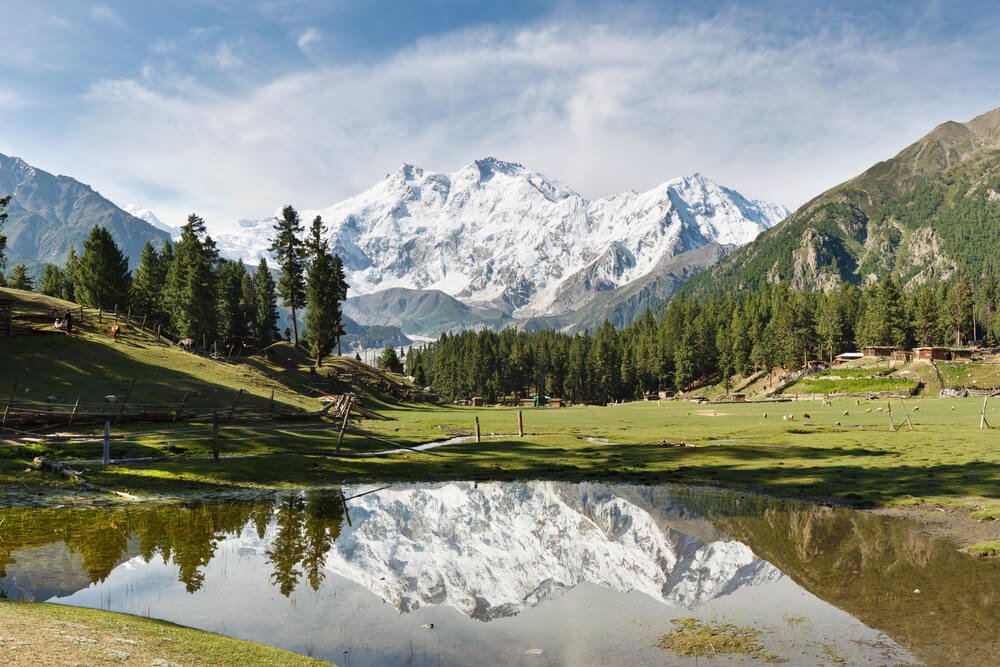
The headline attraction is Rama. About ten to eleven kilometres above Astore town, reached by a thrilling jeep track, Rama Meadows unfold in a great green bowl beneath Nanga Parbat, and Rama Lake sits in it like a turquoise mirror. The meadow is widely considered one of the most beautiful in Gilgit-Baltistan, and the sunrise view of the 8,126-metre Killer Mountain from here is something travellers describe for the rest of their lives.
Astore is also the practical gateway to adventures that are hard to reach any other way. The road from Astore over the Deosai Plains to Skardu is one of the great high-altitude drives of Pakistan, crossing the land of the Himalayan brown bear. The Rupal Valley leads to the base of Nanga Parbat’s mighty Rupal face, the highest mountain face in the world. Treks from Astore reach Minimarg, the Rainbow Lake, and the historic Burzil Pass caravan route toward Kashmir.
Finally, Astore rewards slow travel. The people are known for warm hospitality, the villages of Gorikot and Tarishing have an old-world feel, and the community tourism economy means your spending goes directly to local families, guides, and homestays. Come for the mountains, stay for the meadows, and leave understanding why those who know the north often call Astore its best-kept secret.
History of Astore
The name Astore is believed to come from the Sanskrit word Astara, meaning a place where horses are bred, a hint at the valley’s ancient role as pasture land on the mountain trade routes. The valley’s history is the history of a corridor: for centuries, Astore lay on the strategic passage used by traders travelling between Central Asia and the Indian subcontinent, and the Astore road was a vital link between Gilgit and Kashmir.
Over the centuries, many peoples passed through and settled here. The valley has been home to Dardic tribes, Kashmiris, and later Muslim rulers, each leaving marks on the local culture and language. The Imperial Gazetteer of India records that around 1600, a Persian adventurer named Ghazi Mukhpun married a princess of the ruling family of Skardu, and their sons became the chiefs of Skardu, Astor, Kharmang, and Rondu, with local chiefly families tracing their ancestry to these lineages. The flow of travellers through Astore over generations contributed significantly to the linguistic and cultural diversity of the region.
In the nineteenth century, the valley fell within the orbit of the Dogra-ruled princely state of Jammu and Kashmir, and the old caravan route over the Burzil Pass connected Astore with the Kashmir valley, carrying trade and pilgrims. The Burzil route was one of the historic lifelines of the region before modern roads. Remnants of that era survive in old forts and rest houses scattered through the valley.
Modern Astore is the headquarters town of Astore District in Gilgit-Baltistan. The road from Gilgit via Jaglot made the valley accessible to travellers in the twentieth century, and places like Rama Meadows gradually entered the trekking literature as the classic viewpoint for Nanga Parbat’s Rupal side. Unlike valleys that were transformed by mass tourism, Astore has grown slowly, and its villages, forests, and meadows retain much of their traditional character. The valley’s enormous dimensions contain some of the finest mountain scenery in Pakistan, and it remains, as one trekking guide puts it, the main entrance to several of the region’s greatest natural attractions.
Top Things to Do in Astore
Rama Meadows and Rama Lake
Rama is the single essential excursion in Astore. From Astore town, a jeep track climbs about ten to eleven kilometres to the meadows, a journey of over an hour that is an adventure in itself. The meadows are a vast alpine pasture ringed by pine forest, with Nanga Parbat dominating the skyline. From the meadows, you can trek for about an hour or take a jeep onward to Rama Lake, whose turquoise water reflects the Killer Mountain on calm mornings. The PTDC motel near Rama, along with the old Forest, PWD, and Police rest houses, makes this the best-served tourist spot in the valley. Come at sunrise for the classic view.
Rupal Valley and the Nanga Parbat Base
The Rupal Valley, reached via Tarishing village south of Astore, leads to the base of Nanga Parbat’s Rupal face, the tallest mountain face on earth, rising some 4,600 metres from base to summit. Even if you do not trek to base camp, the drive and walk up the Rupal valley offer staggering close-up views of the 8,126-metre peak, first climbed by the German mountaineer Hermann Buhl in 1953. This is serious mountain country: go with a local guide, carry proper gear, and respect the weather.
Cross the Deosai Plains to Skardu
The jeep road from Astore to Skardu via the Deosai Plains is one of Pakistan’s legendary journeys: roughly 150 kilometres and seven to eight hours across the high plateau known as the Land of Giants. Deosai, at over 4,000 metres, is home to the Himalayan brown bear, marmots, and vast summer wildflower blooms, with Sheosar Lake as its crown jewel. The route is only open from roughly July to September and is strictly a summer expedition; it closes under snow from about November to June.
Minimarg, Rainbow Lake, and Domel
East of Astore, the jeep track to Minimarg passes through some of the valley’s loveliest scenery. Minimarg and the nearby Domel area hold the crystal-clear Rainbow Lake and streams famous for trout. This is also the direction of the historic Burzil Pass. The area requires a full day by jeep from Astore town, and the road is rough in places, but the lakes and meadows are superb.
Wildlife Watching: Markhor and Brown Bear
Astore is one of the few places where you can plausibly see Himalayan brown bear, markhor, and the alpine wildflower bloom on a single trip. The Astore markhor has its habitat in the valleys around the town, and day visits can be arranged with local conservancy guides. In Deosai, dawn and dusk offer the best chances of spotting brown bears. Keep your distance, never feed wildlife, and hire local guides: they know the animals’ habits and your fee supports community conservation.
Trek, Camp, and Fish
Trekkers can choose from gentle day walks around Rama to multi-day routes: Astore town to Rama meadow, Rama to Deosai over three to five nights, or the longer historical caravan route via Chilum to the Burzil Pass. Camping under the stars at Rama or in Deosai is a highlight, and the valley’s streams and lakes offer trout fishing. Anglers should check local rules and go with a guide.
Famous Places In and Around Astore
- Rama Meadows — The great alpine pasture above Astore town, with the classic Nanga Parbat viewpoint.
- Rama Lake — Turquoise lake above the meadows, about an hour’s trek or jeep ride from Rama.
- Rupal Valley — Valley leading to the base of Nanga Parbat’s Rupal face, via Tarishing village.
- Deosai National Park — The high plateau of the brown bear, reached by jeep from Astore in summer.
- Sheosar Lake — The deep blue lake at the heart of Deosai, often visited on the Astore-Skardu crossing.
- Minimarg and Rainbow Lake — Lakes and meadows east of Astore, on the old Burzil route.
- Gorikot — A traditional village known for homestays and local hospitality.
- Chilum (Chillam) Valley — A scenic side valley on the route toward Deosai and Minimarg.
- Burzil Pass — The historic caravan pass on the old trade route toward Kashmir.
How to Reach Astore
Astore is reached by road only. The main route runs from Gilgit, and the valley also connects to Skardu via Deosai in summer. Roads are mountain roads: narrow, winding, and weather-dependent.
From Islamabad: The journey is roughly 500 kilometres and takes twelve to fifteen hours depending on stops and road conditions. Drive the Karakoram Highway (KKH) north via Mansehra, Besham, and Chilas to Gilgit, then continue to Astore via Jaglot. Most travellers break the journey with a night in Chilas or Gilgit. Alternatively, fly from Islamabad to Gilgit (about an hour, weather permitting) and drive the remaining four to five hours to Astore.
From Lahore: Drive or fly to Islamabad first, then follow the Islamabad route. The full road journey from Lahore is very long; flying to Gilgit via Islamabad saves two days.
From Karachi: Fly to Islamabad, then to Gilgit, then drive. There is no practical overland route from Karachi for a single valley trip.
From Gilgit: The standard approach. Astore is about 100-120 kilometres from Gilgit via Jaglot, a four to five hour drive on the Astore road. The road is metalled to the town; beyond it, jeep tracks serve Rama, Rupal, Minimarg, and Deosai.
From Skardu: In summer only, the Deosai route connects Skardu to Astore: about 150 kilometres and seven to eight hours by 4×4. The route is closed by snow from roughly November to June.
Nearest airport: Gilgit Airport, with daily PIA flights from Islamabad (about 45 minutes, frequently cancelled in bad weather). Skardu Airport is the alternative for the Deosai approach.
Road conditions: The Gilgit-Astore road is narrow and winding; a 4×4 or an experienced local driver is strongly recommended. Beyond Astore town, the tracks to Rama (jeep-only past Tarishing), Rupal, Minimarg, and Deosai require high-clearance 4×4 vehicles and are weather-dependent.
Transport options: Hire a private car or jeep with a local driver from Gilgit; this is the standard and safest option. Public vans run Gilgit-Astore, but for the side valleys you will need to hire jeeps locally in Astore town. Tour operators in Gilgit and Islamabad run packaged Astore-Deosai trips in season.
Route Details
- Travel from Islamabad to Gilgit via the Karakoram Highway (12-15 hours by road via Mansehra, Besham, and Chilas), or fly to Gilgit.
- From Gilgit, drive south on the KKH to Jaglot, then turn onto the Astore road.
- Follow the Astore road through the gorge to Astore town (four to five hours from Gilgit).
- For Rama Meadows: hire a jeep in Astore town and drive the jeep track up to Rama (over an hour); continue by jeep or on foot to Rama Lake.
- For Deosai/Skardu (summer only): take the jeep track east from Astore via Chilum onto the Deosai Plains.
Where to Stay in Astore
Astore is less developed than Hunza or Skardu, but there are clean and comfortable options at every level. Book ahead in the June-to-August peak season.
Mid-range hotels: Astore town has several mid-range hotels, including well-known options in the town centre. These offer the basics done well: clean rooms, hot water (usually), and local food. Staying in town keeps you close to the jeep stand for Rama, Rupal, and Minimarg.
PTDC motel at Rama: The PTDC Rama Lake Motel near Rama Meadows is the most established tourist accommodation in the valley, with simple amenities in an unbeatable location. It is also joined by the old Forest, PWD, and Police rest houses in the Rama area; the Forest rest house in particular is prized for its position above the meadows with Nanga Parbat views.
Homestays: Villages like Gorikot offer homestays with local families: the most authentic way to experience Astore’s hospitality, home cooking, and village life. Arrange through local contacts or tour operators.
Camping: Tent camping at Rama Meadows or in Deosai is ideal for adventurers and stargazers. Bring a warm sleeping bag: even summer nights are cold at these altitudes. Operators provide full camping setups on packaged trips.
There are no luxury resorts in Astore. Come expecting mountain simplicity, and you will not be disappointed.
Where to Eat: Local Foods of Astore
Astore’s food is hearty mountain fare, built for cold nights and long treks. Restaurants in Astore town serve standard Pakistani dishes alongside regional specialities; in the villages, homestay cooking is the real treat.
Trout fish: The cold streams around Minimarg, Domel, and the Deosai rivers hold trout, and freshly caught trout fried with local spices is the valley’s signature dish. Order it wherever you see it on a menu.
Buckwheat and barley dishes: Traditional Astore kitchens use buckwheat and barley in pancakes, porridges, and breads. Try them in a homestay for the authentic taste.
Apricots and dry fruits: Like the rest of Gilgit-Baltistan, Astore grows superb apricots, eaten fresh in summer and dried for winter. Dried apricots, apricot oil, walnuts, and almonds are sold in the town bazaar and make excellent trail food and souvenirs.
Chai and qehwa: Salted or milky chai is the social drink of the valley; accept every cup offered. Meals in town dhabas are budget-friendly, while hotel restaurants charge a little more. Carry snacks and water for day trips to Rama and Deosai, where there are no shops.
Weather in Astore
Astore has a classic high-mountain climate: short, pleasant summers and long, snowy winters. The valley town sits at moderate altitude, but Rama Meadows and Deosai are much higher and much colder. Weather changes fast in the mountains, so the ranges below are approximate and you should always carry layers. Available climate data puts the valley’s average annual temperature around 8.4°C with about 427 mm of annual precipitation.
| Season | Temperature Range (valley) | Conditions |
|---|---|---|
| Winter (Nov-Mar) | -5 to 5°C | Heavy snow; many roads closed; the valley is cut off for long stretches |
| Spring (Apr-May) | 5-18°C | Snowmelt; blossoms in the lower villages; roads reopening; cool and fresh |
| Summer (Jun-Aug) | 8-25°C | Pleasant days, cool nights; peak season; Rama at its greenest in June-July |
| Autumn (Sep-Oct) | 2-18°C | Golden foliage; clear skies; fewer tourists; nights turn cold |
At Rama Meadows and on the Deosai Plains, subtract roughly 5-10 degrees from the valley figures, and expect snow possible even in early summer on Deosai.
Language and Culture of Astore
The people of Astore are predominantly Shina-speaking, part of the Dardic peoples of the Karakoram and western Himalaya. Shina is an Indo-Aryan language of the Dardic group, spoken across Gilgit, Hunza, the Astore Valley, Chilas, and into Kashmir. Urdu is the lingua franca and is widely understood; many locals also speak some English. The valley’s culture blends Dardic, Kashmiri, and Islamic influences shaped by centuries on the trade routes.
Music and hospitality are central to Astore life. Locals hold music and art in high regard, performing on instruments such as the sitar, rabab, duff, damal, and surnai at weddings, festivals, and celebrations. Because Shina has historically been a spoken rather than written language, folk songs and stories are passed down orally by local singers, and an evening of traditional music in a village is an unforgettable experience if you are lucky enough to be invited.
Family and community ties are strong, with the joint family system common. Visitors are treated as honoured guests: accept offers of chai, dress modestly (long trousers and covered shoulders; women may prefer a shawl in villages), and ask before photographing people. The traditional dress includes shalwar kameez with the distinctive Gilgiti cap for men, and embroidered shalwar kameez with silver jewellery for women.
Shopping in Astore
Shopping in Astore means the town bazaar and village markets, not malls. Dry fruits are the classic buy: dried apricots, apricot kernels, walnuts, and almonds from the valley’s orchards, sold loose in the bazaar at good prices. Apricot oil, pressed locally and used for cooking and massage, is another authentic souvenir.
Look for woollen handicrafts: hand-knitted socks, gloves, caps, and shawls made for mountain winters. Local embroidery on shawls and clothing reflects the valley’s craft traditions. There are no shopping malls in Astore; carry cash, as cards are rarely accepted outside the main hotels.
Travel Tips for Astore
Packing Essentials
Layers are everything: even in summer, carry a warm jacket, because Rama and Deosai are cold after sunset. Sturdy walking shoes or light trekking boots, sunscreen and sunglasses (mountain sun is fierce), a hat, and a reusable water bottle. Power bank, headlamp, basic first aid kit, and any personal medication. If camping, a proper sleeping bag rated for cold nights. Snacks for the jeep rides: there are no shops beyond the town.
Safety Tips
Astore is generally safe for tourists, and locals are famously helpful. The real risks are mountain ones: altitude, weather, and roads. Do not attempt the Deosai or Minimarg tracks without a local driver who knows them. Acclimatise before strenuous treks, watch for signs of altitude sickness above 3,500 metres, and never trek alone in remote valleys. Keep to daylight driving; mountain roads are unforgiving after dark.
Money & Connectivity
Carry cash: ATMs are limited and unreliable in Astore, and fuel stations, like ATMs, are few. Fill up in Gilgit. Mobile signal works in Astore town but is intermittent above it; Telenor and SCOM provide the best coverage in the valley, while other networks may not work at all. Download offline maps before leaving Gilgit.
Best Time to Visit Astore
Summer (June to August) — Best Season
Summer is the peak and the practical season for this Astore travel guide’s top recommendation. Roads to Rama, Minimarg, and Deosai are open, the meadows are at their greenest (Rama is at its best in June and July), wildflowers bloom, and all treks are possible. Book accommodation ahead.
Spring (May) and Autumn (September to October) — Excellent
May brings blossoms and rushing streams as the snow melts; September and October bring golden foliage, crystal-clear mountain views, and far fewer visitors. Some high routes may still be closed in early May or closing by late October, so check locally.
Winter (November to March) — For the Hardy Only
Winter buries Astore in snow and closes the Deosai route and most side valleys. The valley is beautiful but largely cut off, with landlines sometimes the only communication. Only experienced winter travellers should consider it.
Final Thoughts
Astore is the valley for travellers who have seen the famous places and want something deeper. It has the meadows, the lakes, the wildlife, and the mountain views to match anywhere in Gilgit-Baltistan, but it asks a little more of you: a longer drive, a rougher jeep track, a willingness to do without luxury. What it gives back is proportionate: silence in the pine forests, sunrise on Nanga Parbat with no crowd, and the feeling that you have found a Pakistan that mass tourism has not yet touched.
In 2026, as the northern areas get busier every year, Astore’s quiet is its greatest asset. Go in summer, take the jeep to Rama, walk to the lake, and spend at least one night under those stars. You will understand why the people who know these mountains keep coming back to this valley above all others.
FAQs
Where is Astore Valley located?
Astore Valley is in Astore District, Gilgit-Baltistan, bordered by Gilgit to the north, Skardu to the east, and Neelum (Azad Kashmir) to the south. Astore town is about 100-120 kilometres from Gilgit.
What is the best time to visit Astore?
May to October, with June to August the peak season when all roads and treks, including Deosai, are open. Rama Meadows is at its best in June and July.
How do I reach Astore from Islamabad?
Drive the Karakoram Highway to Gilgit (12-15 hours) or fly to Gilgit, then drive four to five hours to Astore via Jaglot. From Skardu, the summer-only Deosai route takes seven to eight hours by 4×4.
Is Astore safe for tourists?
Yes, Astore is generally safe and locals are welcoming. Take normal mountain precautions: use local drivers on jeep tracks, acclimatise for high treks, and avoid driving mountain roads after dark.
Is Astore suitable for families?
Yes. Rama Meadows, Rama Lake, and the town area offer easy walks and comfortable stays suitable for families. The rougher expeditions (Deosai crossing, Rupal base camp trek) suit older children and fit adults.
Where should I stay in Astore?
Astore town has mid-range hotels, the PTDC motel serves Rama Meadows, village homestays (e.g. Gorikot) offer local hospitality, and camping is possible at Rama and in Deosai.
What food is Astore known for?
Fresh trout from the mountain streams, buckwheat and barley dishes, apricots and dry fruits, and hearty mountain chai. Homestay cooking is the most authentic way to eat.
Can I see Nanga Parbat from Astore?
Yes, and these are among the best views anywhere. Rama Meadows offers the classic sunrise view, and the Rupal Valley leads to the base of the Rupal face, the highest mountain face in the world.
For more northern adventures, explore our Explore Pakistan section, compare with our Hunza Valley guide, or read about the slopes of Malam Jabba.