Quick Facts
- Location: Grand Trunk Road, Rawalpindi, Punjab, near the old Army House, inside the Rawalpindi cantonment area.
- Altitude: Around 500 metres above sea level, on the Punjab plain.
- Famous For: The largest public park in the twin cities, three boating lakes, Jungle World zoo and amusement area, and 126 years of history going back to the British era.
- Nearest City: It is inside Rawalpindi itself; central Islamabad is about 30 minutes away by car.
- Accessibility: Very easy by road from anywhere in Rawalpindi or Islamabad. The nearest airport is Islamabad International Airport.
- Known Landmarks: The three lakes, the 1959 Baradari, Jungle World, the open-air theatre, and the Miracle Garden.
- Best For: Families with children, picnics, school trips, morning walkers and joggers, and anyone wanting a full day out without leaving the city.
Why Visit Ayub National Park, Rawalpindi
Every big city needs one great park, and for Rawalpindi and Islamabad that park is Ayub National Park. Spread over 313 acres on the Grand Trunk Road, it is the largest green space in the twin cities and the only park in the area with three large lakes, all offering boating. Generations of Rawalpindi families have grown up on its lawns, its rides and its picnic spots, and a visit here is as much a part of local life as it is a tourist outing. This Ayub National Park Rawalpindi travel guide covers the park’s long history and everything you can do in it.
The park’s appeal is its range. In a single day, children can ride the giant wheel and the mono train, spot Bengal tigers and lions at Jungle World, paddle a boat on the lake, and run themselves tired on the sports grounds, while their parents walk the shaded jogging tracks or sit under the old trees. Few public parks in Pakistan pack this many different experiences into one ticketed entry.
There is also genuine heritage here. This was a picnic ground before Pakistan existed: the British knew it as Topi Rakh, and its open-air theatre hosted the city’s cultural life for seventy years. The Baradari pavilion from 1959 still overlooks the gardens. Visiting is a way of touching Rawalpindi’s social history, not just its present.
Finally, it is effortless. No long drive, no mountain road, no special gear. You can decide at breakfast to spend the day at Ayub Park and be on a paddle boat by late morning. For families based in the twin cities, for school groups, and for visitors with a free day in Rawalpindi, it is the obvious choice.
History of Ayub National Park, Rawalpindi
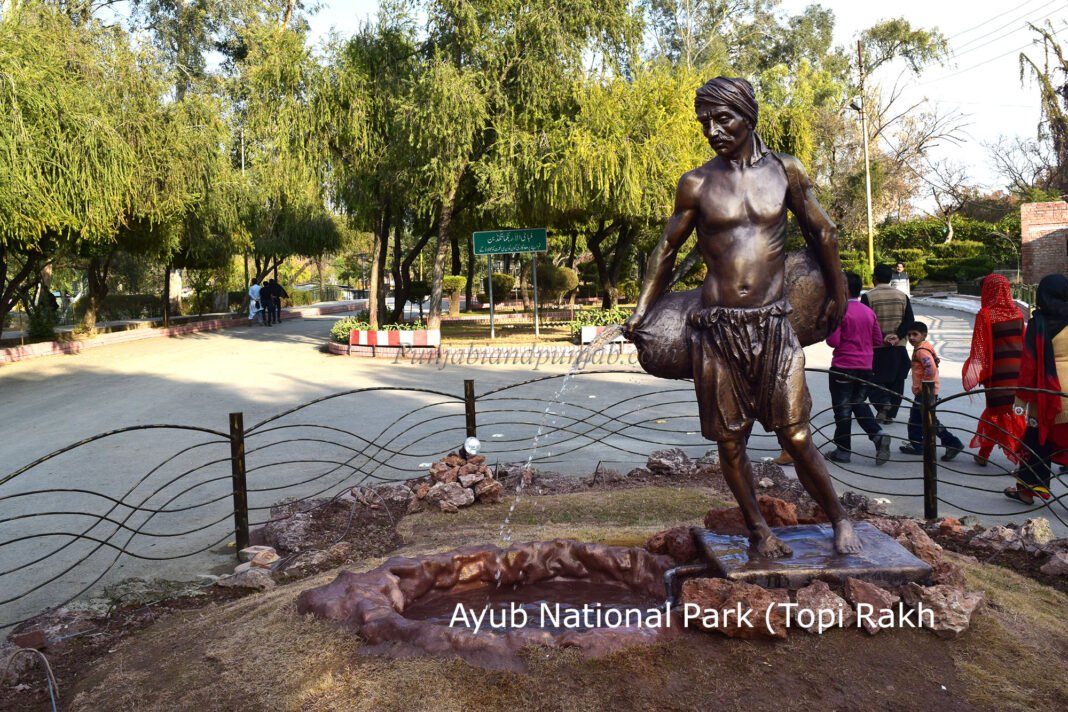
The history of Ayub National Park goes back 126 years to the British colonial era. Long before it was a park in the modern sense, the area was a dense forest known as Topi Rakh, “rakh” being the Potohari word for jungle or forest reserve. It served as a popular picnic point for British families and military officers stationed in Rawalpindi, one of the most important garrison towns of the Raj.
In 1899 the British formally designated the area as a picnic spot and handed it over to the Cantonment Committee, which developed jogging and walking tracks and began upgrading the grounds. After independence, the park kept its civic role: in 1951 the Cantonment Board renamed it from Topi Rakh Park to National Park, and on 5 March 1958 it was renamed Ayub Park in honour of Field Marshal Muhammad Ayub Khan, who inaugurated it the same day. The Baradari pavilion, built in 1959 and inaugurated by the president, still stands as the architectural signature of that era.
For its first seventy years the park’s open-air theatre was one of Rawalpindi’s principal cultural venues, hosting major social and cultural gatherings. Between 1959 and 2001 the Rawalpindi Cantonment Board managed the park, a period during which it grew increasingly neglected. In 2001 control was handed to the Army Heritage Foundation, which carried out extensive development: landscaped gardens, sports facilities, the amusement areas, the zoo’s expansion, and newer additions like the Miracle Garden established in 2021. What had been a fading colonial picnic ground became the modern family destination visitors see today, a blend of heritage structures and contemporary recreation.
Top Things to Do in Ayub National Park, Rawalpindi
Buy your entry ticket at the gate (rides and the zoo are ticketed separately inside) and plan on four to six hours. The park is big enough that comfortable shoes matter.
Boating on the Three Lakes
Ayub Park is the only park in the twin cities with three large lakes, and boating is the signature activity. Paddle boats are the family favourite, slow enough for small children and a genuinely relaxing way to see the park from the water. The lakes are landscaped with lotus plants, hold fish, and attract water birds, so even a short ride feels like a small escape from the city. Go in the morning or late afternoon to avoid the midday sun reflecting off the water.
Jungle World: Zoo and Wildlife
The Jungle World complex combines a zoological garden with amusement rides across about 50 acres. The zoo houses Bengal tigers, lions, deer, monkeys and a large bird collection, reportedly over 500 birds including pheasants, peacocks, parrots, ostriches and swans. The enclosures are a hit with children, and the complex is designed around wildlife awareness as well as entertainment. Visit the big cats early in the day when they are most active.
Amusement Rides for All Ages
The amusement area runs the full catalogue of family rides: a giant wheel with views across the park, dodgem cars, tea cups, the mono train that loops the grounds, a haunted house (the “Bhoot Bangla”, popular with thrill-seeking teenagers), and gentler rides for small children. An 18-hole mini golf course offers something for adults who want a slower pace. Rides are individually ticketed and priced to be affordable for families; buy a wristband-style package if you plan to ride a lot.
The Baradari and Gardens
The 1959 Baradari pavilion overlooks the formal gardens and is the park’s most photographed heritage structure. The surrounding lawns, which host women’s yoga classes in the mornings, are ideal for a quiet walk away from the ride areas. Gardeners keep the beds colourful through most of the year, and the Miracle Garden, established in 2021, adds a concentrated display of flowers and landscaping.
Jogging Tracks and Sports Grounds
Long before the rides arrived, this was a walking and jogging ground, and the shaded tracks are still one of the park’s best features. Cricket and football grounds host local matches on weekends, and newer additions include zip-line facilities and quad-bike trails for the adventurous. Morning is the walkers’ hour; the tracks are at their most pleasant before 9 am.
Picnics on the Lawns
The vast lawns are made for picnics, and on public holidays they fill with families who have been coming for generations. Bring a sheet, bring food, and claim a spot under the old trees. The park’s snack homes cover tea, cold drinks and basic fast food if you travel light. Take your litter with you; the park’s cleanliness depends on its visitors.
The Open-Air Theatre
The historic open-air theatre that hosted Rawalpindi’s cultural life for seventy years still stands. Check whether any event is scheduled during your visit; even without a performance, it is worth a look as a piece of the city’s social history.
Famous Places In and Around Ayub National Park, Rawalpindi
Raja Bazaar: Rawalpindi’s famous old market, a short drive away, for shopping and street food.
Liaquat Bagh: The historic public garden and political landmark of Rawalpindi.
Taxila: The UNESCO World Heritage archaeological site, about 40 kilometres away, for a history-filled second day.
Islamabad’s Margalla Hills: The Trail 3 and Daman-e-Koh viewpoints, roughly 30 minutes away, pair naturally with a park day.
Saddar, Rawalpindi: The cantonment’s commercial heart, good for an evening stroll and dinner after the park.
How to Reach Ayub National Park, Rawalpindi
The park sits on the Grand Trunk Road in Rawalpindi, near the old Army House, and is one of the easiest major attractions in Pakistan to reach.
From Islamabad
Drive from central Islamabad takes about 30 minutes depending on traffic. Take the Islamabad Expressway or Murree Road into Rawalpindi and follow signs for the Grand Trunk Road and Ayub Park. Ride-hailing cars and taxis make the trip cheaply; agree the fare in advance for street taxis.
From Lahore
The M2 motorway brings you to Rawalpindi in about 4 to 5 hours (roughly 380 kilometres). From the motorway terminus the park is a short drive into the city. It works as a stop on the way into the capital or as part of a Rawalpindi weekend.
From Karachi
Fly to Islamabad International Airport and drive about an hour into Rawalpindi. The road journey from Karachi is around 1,400 kilometres and only makes sense inside a longer northern tour.
Nearest Airport
Islamabad International Airport is the nearest airport, roughly an hour from the park by car. Taxis, ride-hailing services and airport shuttles all serve Rawalpindi.
By Public Transport
Rawalpindi’s local buses, wagons and Qingqi rickshaws all run along the Grand Trunk Road past the park; ask for “Ayub Park” and every driver will know it. From Rawalpindi’s main bus stands it is a short, cheap ride. The park has parking for private cars, which fills up on Sundays and public holidays, so arrive before noon on busy days.
Route Details
The simplest route from Islamabad: take the Expressway south to Rawalpindi, continue onto the Grand Trunk Road (N-5) heading east, and follow the brown tourist signs to Ayub National Park near the old Army House. The entrance is well marked and hard to miss. Roads are good in all seasons; the only seasonal caution is the July-August monsoon, when sudden downpours can flood low-lying paths inside the park for an hour or two.
Where to Stay in Ayub National Park, Rawalpindi
You do not need to stay at the park, but you might want to stay near it. The old Jungle Barracks inside the park complex have been converted into resort-style guest rooms where visitors can stay overnight, a unusual option for families who want the park to themselves in the early morning. Book these in advance, as availability is limited.
Otherwise, Rawalpindi offers the full range. Mid-range hotels and guesthouses cluster in the cantonment and Saddar areas, minutes from the park, and are budget-friendly by twin-city standards. Travellers wanting more polish can stay in Islamabad’s hotel districts, Blue Area, F-6 and the Margalla foothills, and drive the 30 minutes to the park. For a family weekend, the practical choice is a mid-range Rawalpindi hotel near the GT Road: cheaper than Islamabad, closer to the park, and surrounded by the city’s food streets.
Where to Eat: Local Foods of Ayub National Park, Rawalpindi
Inside the park, the snack homes and canteen areas serve the standard family-day-out menu: pakoras, samosas, fries, shawarma, ice cream, tea and cold drinks, all at budget-friendly prices. It is honest park food, fine for a day, but the real eating starts when you leave the gates, because Rawalpindi is one of Pakistan’s great food cities.
Within a short drive you are in the middle of it: the Raja Bazaar and Saddar food streets, famous for halwa puri breakfasts, paye, nihari, chapli kebabs, and the city’s beloved lassi. The old-city dhabas around Banni and College Road do katwa-style slow cooking and tandoori nights that draw crowds from Islamabad. A filling dhaba meal costs a few hundred rupees per person; a comfortable restaurant dinner for a family stays modest by capital standards. If you picnic in the park, you can also pack food from the city; many families stop at a Saddar bakery or nihari house on the way in.
Weather in Ayub National Park, Rawalpindi
Rawalpindi sits on the Punjab plain with a classic hot-summer, cool-winter climate. The park is open year-round, but the experience changes sharply with the season: winter afternoons on the lawns are glorious, while June midday is a test of endurance. Monsoon rain in July and August can be heavy but usually passes quickly.
| Season | Temperature Range | Conditions |
|---|---|---|
| Winter (Dec-Feb) | 5 to 15°C | Cool, dry and sunny; the best season for full days in the park. Foggy mornings in January. |
| Spring (Mar-Apr) | 15 to 30°C | Pleasant and green; flowers at their best in the gardens. Excellent all-round. |
| Summer (May-Jun) | 30 to 42°C | Very hot midday; come before 10 am or after 4 pm, and use the shaded tracks and indoor rides. |
| Monsoon/Autumn (Jul-Nov) | 20 to 35°C | Heavy showers July-August; the park is lush. October-November are dry, clear and comfortable. |
Language and Culture of Ayub National Park, Rawalpindi
The everyday language is Punjabi in its Potohari dialect, with Urdu spoken and understood by everyone and Hindko common in the old city. As a public family park, the culture is relaxed and mixed: you will see morning walkers, school groups, wedding-photography shoots and extended families on picnics. Modest dress is the norm, and courtesy toward other families’ space on the lawns is expected. The park is busiest on Sundays and public holidays, when the atmosphere is festive; weekday mornings are the quietest and arguably the nicest time to experience the gardens properly.
Shopping in Ayub National Park, Rawalpindi
Inside the park, gift shops near the amusement areas sell toys, souvenirs and snacks aimed at children; prices are tourist-level but not extreme. For real shopping, leave the park and head to Raja Bazaar, Rawalpindi’s historic market, where cloth, crockery, dried fruits, spices and everyday goods sell at genuine bazaar prices with bargaining expected. Moti Bazaar nearby is known for traditional embroidery and wedding shopping. Saddar’s shops cover books, electronics and branded goods. This guide makes no claim about malls at the destination itself; the twin cities’ large shopping centres are a short drive away in Islamabad and Rawalpindi’s newer sectors.
Travel Tips for Ayub National Park, Rawalpindi
Packing Essentials
Comfortable walking shoes are non-negotiable; the park is 313 acres and you will cover ground. Bring a cap, sunscreen and water in summer, a light jacket in winter, and a picnic sheet if you plan to use the lawns. A small daypack keeps tickets, snacks and a camera together.
Safety Tips
The park is a managed, family-oriented space and is generally very safe. Supervise small children on rides and near the lakes, agree on a meeting point in case anyone gets separated, and keep valuables in a front pocket or daypack in crowds. Do not feed the zoo animals; it disturbs their diet and can get you fined.
Money & Connectivity
Carry cash in small notes: entry, rides, boating and food stalls are largely cash-based, though the situation is gradually changing. ATMs are plentiful on the Grand Trunk Road outside the park. Mobile signals from all major networks are strong throughout the park. Ticket prices are modest, entry plus a few rides typically costs a few hundred rupees per person, and full-day family budgets stay comfortable.
Best Time to Visit Ayub National Park, Rawalpindi
October to March: The Ideal Season
Cool, dry days between 5 and 20°C make this the best time to visit Ayub National Park. You can comfortably do the zoo, the lakes, the rides and a long lawn picnic in one day. December and January bring crisp air and clear skies; the gardens are at their most inviting.
March-April and November: Shoulder Months
Spring flowers and autumn clarity make these excellent months with thinner crowds than winter weekends. School groups are fewer on weekdays, so the rides have shorter queues.
May to September: Hot and Wet
Summer heat pushes the sensible visiting hours to early morning and late afternoon. The monsoon months bring dramatic skies and green lawns but also sudden downpours; carry a rain cover and have an indoor-ride backup plan. Evening visits in summer, when the park is lit and cooler, are a local tradition.
Final Thoughts
Ayub National Park is not a wilderness and does not pretend to be one. It is something rarer in its own way: a 126-year-old public park that has grown up with its city, from a colonial picnic ground called Topi Rakh to the buzzing family destination of today. The lakes, the zoo, the rides and the old Baradari add up to a day out that works for toddlers and grandparents alike.
If you live in the twin cities, it is the easiest good day you can have. If you are visiting Rawalpindi, pair it with Raja Bazaar’s food streets and, for contrast, the mountain air of our Malam Jabba guide. More city ideas are in places to visit in Islamabad and the Explore Pakistan section.
FAQs
Where is Ayub National Park located?
On the Grand Trunk Road in Rawalpindi, near the old Army House, about 30 minutes from central Islamabad.
What is Ayub National Park famous for?
Its 313 acres of lawns and gardens, three boating lakes, the Jungle World zoo and amusement area, the 1959 Baradari, and a history stretching back to the British-era Topi Rakh picnic ground.
What is the best time to visit Ayub National Park?
October to March for cool, dry weather. Summer visits are best in the early morning or evening.
How do I reach Ayub National Park from Islamabad?
About a 30-minute drive via the Expressway and Murree Road into Rawalpindi, then the Grand Trunk Road. Taxis, ride-hailing cars and local wagons all serve it.
Is Ayub National Park good for families with small children?
Excellent. Gentle rides, paddle boats, the zoo, playgrounds and big safe lawns make it one of the most family-friendly outings in the twin cities.
Are there restaurants inside Ayub National Park?
Yes: snack homes and canteen areas serve fast food, tea and cold drinks. For a proper meal, Rawalpindi’s Raja Bazaar and Saddar food streets are minutes away.
Can you stay overnight at Ayub National Park?
The converted Jungle Barracks offer limited resort-style rooms inside the complex. Otherwise, mid-range hotels in Rawalpindi’s cantonment and Saddar are minutes away.
How much time do I need for Ayub National Park?
Four to six hours covers the lakes, zoo, rides and gardens comfortably. A full day lets you add a long picnic and the sports areas.