Quick Facts
- Location: Right beside the N-5 Grand Trunk Road at Attock Khurd, Attock District, Punjab, about a kilometre before the Attock Bridge over the Indus.
- Altitude: Around 350 metres above sea level, on the plain above the Indus gorge.
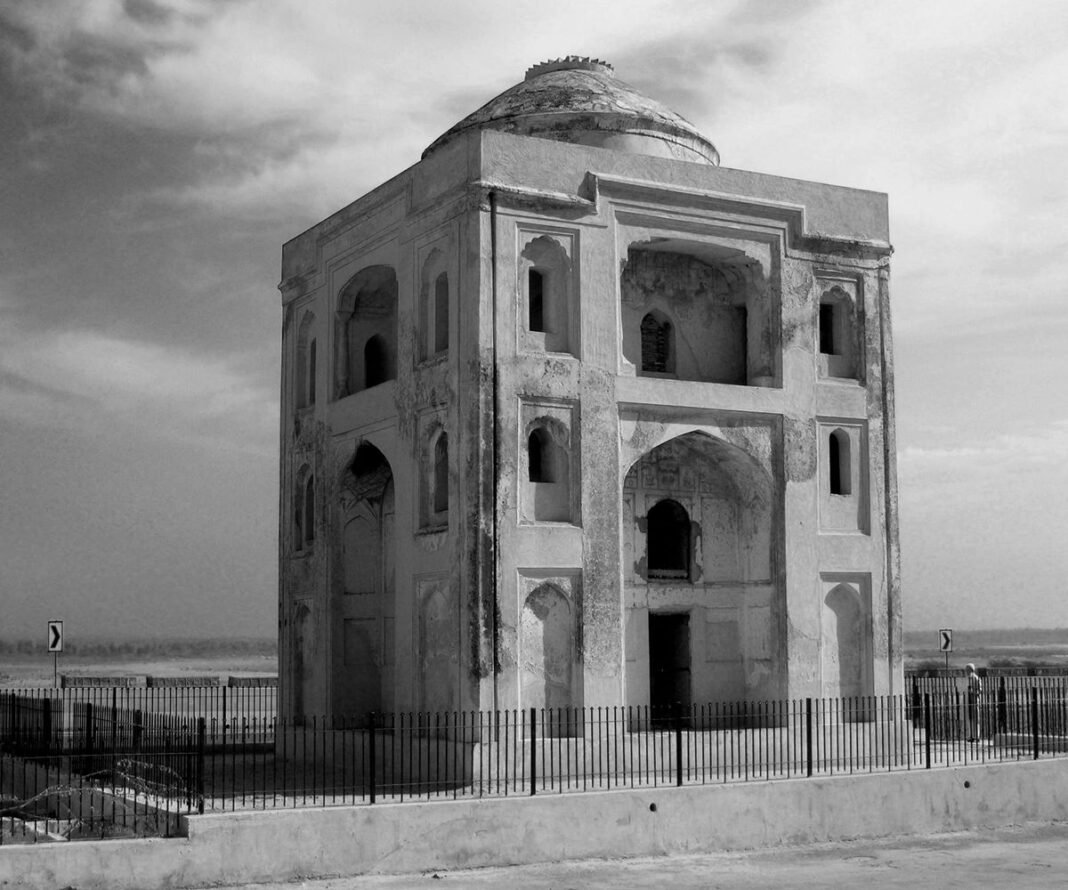
- Famous For: A 16th-century Mughal-era tomb whose occupant is unknown, locally called the “Kanjri ka Maqbara”.
- Nearest City: Attock city, a few kilometres east; Islamabad is about 80 kilometres away.
- Accessibility: Very easy. It stands directly on the Grand Trunk Road and can be seen from a passing car. Nearest airport: Islamabad International Airport.
- Known Landmarks: The tomb itself, Behram ki Baradari next door, Attock Fort, the Old Attock Railway Bridge (1883), and the Indus-Kabul confluence.
- Best For: History buffs, photographers, and Grand Trunk Road travellers who like their monuments with a mystery attached.
Why Visit Attock Tomb
Pakistan’s Grand Trunk Road is lined with monuments, but few are as quietly puzzling as the Attock Tomb. You will pass it without planning to: a domed Mughal-era maqbara standing right beside the highway about a kilometre before the Indus bridge at Attock Khurd. There is no plaque that settles its story, no confirmed record of who lies inside, and that is precisely what makes it worth the stop. This Attock Tomb travel guide gives you the honest version of what is known, which turns out to be more interesting than a tidy legend.
The tomb matters because of where it stands and when it was built. Its construction style and materials point to the Mughal period of Emperor Akbar, the same era that raised Attock Fort a short distance away and the tombs of Hasan Abdal down the road. Standing in front of it, you are looking at the work of the same world that built an empire’s frontier, and you can see in its brickwork and dome the architectural language of the late 16th century.
It is also the most accessible piece of Mughal heritage on this entire stretch of the highway. Unlike Attock Fort, which is a closed military installation, the tomb can be approached on foot, walked around, and photographed freely. It takes twenty minutes to see properly, and it sits at the centre of a cluster of other sites, the baradari next door, the fort, the old railway bridge, the river confluence, that fill out a full day.
Finally, the tomb is a reminder of how much of Pakistan’s history is still unresolved. Local people call it the “Kanjri ka Maqbara”, the dancer’s tomb, after one of several unverified stories about its occupant. Historians will tell you there is no evidence for any of them. Visiting with that honesty, enjoying the building for what it is rather than what legend claims, is the right way to see it.
History of Attock Tomb
The honest history of the Attock Tomb begins with an admission: there is no confirmed historical record of who built it or who is buried in it. No inscription on the building names an occupant, and no Mughal chronicle so far connected to it settles the question. What can be said with reasonable confidence comes from the building itself. The construction style, the brickwork, and the materials used all indicate a Mughal-era structure, and local architectural assessment places it in the period of Emperor Akbar, the late 16th century, the same generation of building that produced Attock Fort (1581-1583) and the early monuments of Hasan Abdal.
The tomb stands where the Grand Trunk Road runs closest to the Indus crossing, about a kilometre before the Attock Bridge. In the Mughal era this was one of the most travelled and most watched points in the empire: the imperial highway crossed the river here, the fort guarded the ford, and nobles, officials and armies passed constantly. A tomb raised at this spot in that period would have belonged to someone of consequence, which makes the absence of any record all the more striking.
Into that gap have stepped the local stories. The most repeated one gives the tomb its popular name, “Kanjri ka Maqbara”, claiming a dancer or courtesan is buried here. Other versions link it vaguely to the Mughal court. None of these stories has any documentary support, and visitors should treat them as folklore rather than history. The name itself is descriptive of the location’s mystery rather than evidence of anything.
What is verifiable is the tomb’s context. It stands next to Behram ki Baradari, another Mughal-era structure, and within sight of Attock Fort and the Indus crossing that defined this region’s history for two millennia. The Grand Trunk Road tombs of this belt, including the far better documented Hakim’s Tomb and the Tomb of Lala Rukh at Hasan Abdal, show how the Mughals marked this frontier corridor with funerary architecture. The Attock Tomb belongs to that family of buildings even if its own chapter is missing. Today it stands as a protected piece of the roadside heritage of Attock Khurd, visited by travellers who stop for the view and stay for the question.
Top Things to Do in Attock Tomb
The tomb itself is a short stop, so plan it as the centrepiece of the Attock Khurd heritage cluster. Everything below is within a few kilometres.
Walk Around the Tomb and Read Its Architecture
Park safely off the highway and approach on foot. Walk a full circuit of the building and look at the dome, the arched openings, and the brickwork up close. The proportions and the dome profile are what place it in the Mughal 16th century: compare it in your mind with the tombs you may later see at Hasan Abdal. Morning light is kindest for photographs, and the building photographs well against the open sky. There is no entry ticket and no formal opening hour; it is a roadside monument you visit on your own terms.
Step Next Door to Behram ki Baradari
Right beside the tomb stands Behram ki Baradari, a Mughal-era pillared pavilion. Baradaris were pleasure pavilions, open on all sides, built for rest and for viewing the landscape. Seen together, the tomb and the baradari give you a small, complete picture of Mughal roadside architecture: one building for the dead, one for the living, both serving the great highway.
Drive On to the Indus Viewpoints
A kilometre past the tomb, the road reaches the Indus. Pull over at the viewpoints near Attock Khurd for the classic Attock panorama: the fort’s walls on the cliff, the 1883 railway bridge spanning the gorge, and the point where the Kabul River joins the Indus. The tomb stop and the river stop belong together; one gives you the Mughal road, the other the reason the road was here.
Photograph the Grand Trunk Road Heritage
This short stretch of the N-5 is one of the most photogenic heritage corridors in Punjab. From the tomb you can frame the highway itself running toward the river, with the baradari in the foreground and the hills beyond. Late afternoon gives the warmest light on the brickwork.
Combine It with Attock Fort’s Outer Views
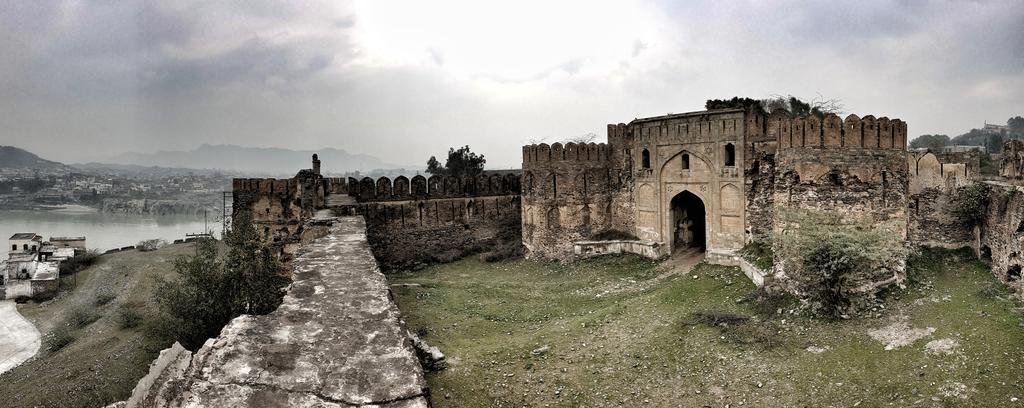
You cannot enter Attock Fort, it is an active military installation, but the approach road from the tomb passes viewpoints where the fort’s long walls and bastions are clearly visible above the gorge. Read our Explore Pakistan coverage for more on the fort’s history before you go, so the walls mean something when you see them.
Explore Attock Khurd Railway Station
The old settlement below the fort keeps its railway character. Attock Khurd station, on the Karachi-Peshawar main line, and the lanes around it make a pleasant half-hour wander, with small shops and tea stalls that have served travellers for generations.
Famous Places In and Around Attock Tomb
Attock Fort: Akbar’s 1581-1583 fortress above the Indus, viewable from the road but closed to visitors.
Old Attock Railway Bridge (1883): The Victorian iron bridge across the Indus gorge.
Indus-Kabul Confluence: The meeting of the two rivers below the fort.
Hakim’s Tomb, Hasan Abdal: The documented 16th-century octagonal tomb of two Mughal court physicians, built under Khawaja Shamsuddin Khawafi.
Tomb of Lala Rukh, Hasan Abdal: The Mughal-era tomb in the same complex, traditionally linked to a Mughal princess.
Gurdwara Panja Sahib, Hasan Abdal: One of Sikhism’s holiest shrines, across the road from the tombs.
Begum ki Sarai: The Mughal caravan sarai of the Grand Trunk Road near Attock Khurd.
Taxila: The UNESCO-listed Gandharan ruins, about an hour east.
How to Reach Attock Tomb
The tomb could hardly be easier to find: it stands directly beside the N-5 Grand Trunk Road at Attock Khurd, roughly a kilometre before the Attock Bridge over the Indus when coming from Islamabad.
From Islamabad
Drive the Grand Trunk Road west for 80 to 90 kilometres, about 1.5 to 2 hours, through Tarnol, Taxila, Wah and Hasan Abdal to Attock Khurd. Watch the right side of the road as you approach the river; the tomb and the baradari appear just before the bridge. Slow down in time, the highway moves fast here.
From Lahore
The distance is roughly 420 to 450 kilometres, about 6 to 7 hours via the M2 motorway to the twin cities and then the Grand Trunk Road west. Most Lahore visitors combine the tomb with the fort viewpoints, Hasan Abdal and Taxila in a two-day trip.
From Karachi
At around 1,450 kilometres by road, this is a two-day drive and only practical within a longer northern itinerary. Fly to Islamabad and drive the last 80 kilometres instead.
Nearest Airport
Islamabad International Airport, roughly 90 kilometres away, is the nearest airport, with taxis and app-based cars available for the onward drive.
By Train and Public Transport
Attock Khurd station on the Karachi-Peshawar main line is minutes from the tomb, with services from Rawalpindi taking under two hours. Coasters and wagons run frequently from Rawalpindi to Attock city and Attock Khurd. Ask the driver to drop you at the maqbara before the bridge; everyone local knows it.
Route Details
From Islamabad: take the Grand Trunk Road west past Tarnol, Taxila and Wah Cantt, through Hasan Abdal and Khairabad into Attock Khurd. The tomb sits on the highway shoulder just before the Indus bridge. The road is in good condition year-round; in the July-August monsoon, the river runs high and the shoulder can be muddy, so park fully off the carriageway and wear sturdy shoes.
Where to Stay in Attock Tomb
The tomb is a roadside stop, not an overnight destination, so stay where the trip makes sense. Most visitors base themselves in Islamabad or Rawalpindi, do Attock as a day trip, and sleep in the twin cities’ full range of hotels. If you are touring the Grand Trunk Road slowly, Attock city offers simple, budget-friendly mid-range hotels and guesthouses near the cantonment and bazaar. There is no accommodation at the tomb itself and no reason to need any; the whole Attock Khurd cluster is comfortably covered in a day.
Where to Eat: Local Foods of Attock Tomb
Eat the way the highway eats. The dhabas strung along the Grand Trunk Road between Hasan Abdal and Attock Khurd serve the food this corridor is known for: chicken karahi bubbling in the wok, dal fry, mixed vegetables, and naan slapped fresh onto the tandoor wall. The Chach plain’s speciality is katwa gosht, mutton slow-cooked in a clay pot, worth asking for at the better-established dhabas. Breakfast at the old tea houses runs to halwa puri, paye and doodh patti.
There are no restaurants at the tomb itself, only roadside tea stalls, so plan your main meal in Attock city or Hasan Abdal. A dhaba meal for one is budget-friendly at a few hundred rupees; a family dinner at a mid-range restaurant in town costs modestly more. Eat where the trucks and coaches stop; high turnover means fresh food. Carry drinking water for the roadside stops.
Weather in Attock Tomb
The tomb stands on the hot Punjab plain, and the climate is the same as Attock Fort’s: hot summers, pleasant winters, heavy monsoon rain in July and August, and no snow. Because the visit is entirely outdoors and mostly on foot along the highway shoulder, the weather matters more here than at an indoor attraction.
| Season | Temperature Range | Conditions |
|---|---|---|
| Winter (Dec-Feb) | 5 to 15°C | Cool, dry and clear; ideal for walking around the monument. January mornings can be foggy. |
| Spring (Mar-Apr) | 15 to 30°C | Pleasant; occasional rain. Very good for photography and combining with nearby sites. |
| Summer (May-Jun) | 30 to 42°C | Very hot; visit early morning or late evening, and carry water and sun protection. |
| Monsoon/Autumn (Jul-Nov) | 20 to 35°C | Heavy rain July-August; October-November turn dry and comfortable again. |
Language and Culture of Attock Tomb
Punjabi in the local Chachi dialect is the everyday language, with Hindko widely spoken and Pashto common toward the Khyber Pakhtunkhwa border; Urdu works everywhere. The area is culturally conservative, so modest dress is expected, and women will be most comfortable in shalwar kameez. The tomb is an old Muslim funerary monument; treat it with the quiet respect you would give any grave. Do not climb on the structure, do not leave graffiti, and keep the surroundings clean. As with the fort nearby, never photograph military installations or personnel; the tomb itself and the baradari are fine to photograph.
Shopping in Attock Tomb
There is no shopping at the tomb, and that is part of its charm. For souvenirs and local goods, stop in Attock city’s bazaar on the way back: dried fruits and nuts, spices, cotton and khaddar cloth, and everyday embroidered items at bazaar prices, with polite bargaining expected. There is no shopping mall at the destination; the twin cities’ malls are about 80 kilometres east. Carry cash, as the roadside stalls and small bazaar shops do not take cards.
Travel Tips for Attock Tomb
Packing Essentials
Sun protection is essential: cap, sunglasses and sunscreen, since there is no shade at the monument. Bring drinking water, sturdy shoes for the uneven ground around the building, and a camera with a wide-angle lens for the tomb-and-highway compositions. A light jacket covers you from November to February.
Safety Tips
The tomb stands on a fast highway. Park completely off the carriageway, watch for traffic when crossing or walking the shoulder, and keep children close. Do not climb the monument; old brickwork can be unstable. The Indus viewpoints a kilometre on are beautiful but the current is dangerous; never swim, and keep back from the bank in monsoon season.
Money & Connectivity
There are no ATMs at the tomb; the nearest are in Attock city, so carry cash. Mobile coverage from the major networks is good along the Grand Trunk Road, with occasional weak patches near the river gorge. A few hundred rupees in small notes covers tea, snacks and parking tips for the day.
Best Time to Visit Attock Tomb
October to March: The Ideal Season
Cool, dry weather between 5 and 25°C makes this the best time to visit the Attock Tomb and walk the whole Attock Khurd cluster comfortably. The light is clear, the river views are sharp, and the dhabas are in full swing.
April and November: Shoulder Months
Warm days, cool evenings, thin crowds. Good months for photographers who want the monument without weekend visitors in the frame.
May to September: Hot and Wet
Visit at dawn or dusk to avoid the fierce midday heat, and be cautious in July and August when monsoon rain makes the highway shoulder slippery. The monument has no shelter, so a sudden downpour will send you back to the car.
Final Thoughts
The Attock Tomb is a small monument with a large question mark, and that is exactly why it deserves a stop. In a country where every old building seems to come with a confident legend, here is one that refuses to be pinned down, a Mughal-era tomb on the empire’s great highway whose occupant history has simply forgotten. Walk around it, look at the brickwork, and enjoy the mystery for what it is.
Then drive the last kilometre to the Indus, look up at the fort on the cliff, and put the tomb back into its context: one quiet building on the road that carried emperors. For more of the region’s heritage, see our Explore Pakistan section, and for a complete change of scenery, the Hunza Valley guide and places to visit in Islamabad cover the mountains and the capital.
FAQs
Where is the Attock Tomb located?
Beside the N-5 Grand Trunk Road at Attock Khurd, about a kilometre before the Attock Bridge over the Indus, roughly 80 kilometres west of Islamabad.
Who is buried in the Attock Tomb?
Nobody knows for certain. There is no inscription and no confirmed record; the popular name “Kanjri ka Maqbara” comes from unverified local folklore. Its style points to the Mughal era of Emperor Akbar.
Is there an entry ticket for the Attock Tomb?
No. It is a roadside monument you can approach and walk around freely.
What is the best time to visit the Attock Tomb?
October to March, when the weather is cool and dry. Summer visits are best at early morning or late evening.
How do I reach the Attock Tomb from Islamabad?
Drive the Grand Trunk Road west for 80 to 90 kilometres (1.5 to 2 hours) to Attock Khurd; the tomb stands on the highway just before the Indus bridge. Coasters and trains from Rawalpindi also serve the area.
Can I combine the tomb with Attock Fort?
Yes, and you should. The fort viewpoints, the old railway bridge and the river confluence are all within a few kilometres, though the fort’s interior is closed to civilians.
Is the Attock Tomb safe for families?
Yes. Park off the highway, supervise children near the road and the river, and carry water. The site itself is a peaceful roadside stop.
What food should I try near the Attock Tomb?
The area’s katwa gosht (clay-pot mutton), highway dhaba chicken karahi and dal fry, and Punjabi breakfasts of halwa puri and paye in Attock city.