Bagh-e-Jinnah — formerly Lawrence Gardens — is Lahore’s most historic park: 141 acres of Victorian landscaping on Lawrence Road off The Mall, next to the Lahore Zoo and opposite the Governor’s House. Established in the 1860s as a botanical garden modelled on Kew Gardens in England, it holds the Quaid-e-Azam Library, the Gymkhana Cricket Ground (since 1885), the Masjid Dar-ul-Islam, an open-air theatre, and trees estimated to be 150 years old. Entry is free. This bagh-e-jinnah lahore travel guide covers its history, what to see, the best time to visit, and how to get there.
Quick Facts
- Location: Lawrence Road off The Mall, Lahore, Punjab — next to Lahore Zoo, opposite the Governor’s House.
- Altitude: Around 215 metres above sea level.
- Famous For: Colonial-era botanical garden, Quaid-e-Azam Library, Gymkhana Cricket Ground, 150-year-old trees.
- Nearest City: Lahore itself (central); Islamabad is about 370 km to the north-west.
- Accessibility: Central Lahore, easy by car, taxi, ride-hailing apps and local buses; free entry.
- Known Landmarks: Quaid-e-Azam Library, Lahore Zoo, Masjid Dar-ul-Islam, open-air theatre, Governor’s House.
- Best For: Families, morning walkers, students, history lovers, photographers, and picnics.
Why Visit Bagh-e-Jinnah, Lahore
Lahore calls itself the city of gardens, and Bagh-e-Jinnah is the garden that started it all. Walk its Victorian pathways at dawn and you are walking through 160 years of the city’s history: banyan trees planted when the British ran the Punjab, a cricket ground that has hosted the game since 1885, and a library whose halls once echoed with colonial assembly debates. Few parks anywhere pack this much history into a morning walk.
The star attraction is the Quaid-e-Azam Library, housed in the Victorian-era Lawrence and Montgomery Halls — one of the largest public libraries in Pakistan with a collection of some 150,000 books in English, Urdu, Arabic and Persian. Even if you never open a book, the building itself, with its covered corridor linking the two halls and its 19th-century reading rooms, is worth the visit. Students gather under the trees with their notes; the whole park has the feel of an open-air university.
Then there is the sheer botanical richness. The garden holds around 150 varieties of trees, 140 types of shrubs, dozens of palms and creepers, and a celebrated chrysanthemum collection — the garden was the first institution in the region to grow chrysanthemums at scale. A banyan tree estimated at 150 years old spreads its branches 60 to 70 feet, and at dusk a colony of fruit bats takes to the sky. It is a living museum of horticulture in the middle of a megacity.
And it is effortlessly easy. The park is free, open from early morning to late evening, sits in the centre of Lahore, and pairs perfectly with the Lahore Zoo next door and The Mall’s colonial architecture. Whether you want a serious walk, a family picnic, or an hour of quiet under old trees, Bagh-e-Jinnah delivers.
History of Bagh-e-Jinnah, Lahore
The garden was established in the early 1860s during British rule and named Lawrence Gardens after John Lawrence — first the Lieutenant Governor of the Punjab and then Viceroy of India (1864-1869). It was conceived as a botanical garden modelled on Kew Gardens in England, designed for British officials and the colonial elite of Lahore. Lawrence Hall and Montgomery Hall were built in 1861-62 to commemorate Lawrence’s association with the Punjab; Montgomery Hall followed in 1866, funded by donations from the native chiefs of the Punjab in honour of Sir Robert Montgomery. The two halls were joined by a covered corridor, and the complex served as an assembly room for public meetings, theatrical and musical performances — the social heart of colonial Lahore’s evenings.
Originally the garden covered about 176 acres, but portions were later given over to the Lahore Zoo (established 1872) and to surrounding roads, leaving today’s 141 acres. From 1904 the Department of Agriculture managed the gardens, and from 1912 about seven acres were looked after by Government College University. The Gymkhana Cricket Ground has hosted cricket since 1885, making it one of the oldest cricket venues in the subcontinent. The garden was also the first institute in the region to cultivate chrysanthemums seriously, building a reputation in flower shows that endures.
After independence in 1947, Lawrence Gardens was renamed Bagh-e-Jinnah — the Garden of Jinnah — in honour of Muhammad Ali Jinnah, the founder of Pakistan. The old Gymkhana Club shifted to Upper Mall in 1972, and the historic halls took on new life: on 17 May 1981 renovation began to convert them into a public library, and on 25 December 1984 President General Zia-ul-Haq inaugurated the Quaid-e-Azam Library. In 2013 the government added two basements with 20,000 square metres of reading space. The garden also holds the Masjid Dar-ul-Islam, an open-air theatre, tennis courts, and the tomb of the saint Peer Sakhi Abul Faiz ul Rehman, which draws devotees. Today the park is administered by the Parks and Horticulture Authority and remains one of Lahore’s most beloved public spaces.
Top Things to Do in Bagh-e-Jinnah, Lahore
Allow one to two hours for a relaxed visit, longer if you combine it with the zoo.
Walk the Victorian Pathways at Dawn
The park opens early (around 5-6 AM), and the morning walk here is a Lahore institution. Curved Victorian pathways wind past 150-year-old banyans, palm avenues and the hillocks, with birdsong and the first light through the canopy. The 2.5-kilometre walking and jogging track is popular with the city’s fitness crowd.
See the Quaid-e-Azam Library
The library’s Victorian building — Lawrence and Montgomery Halls linked by their covered corridor — is an architectural attraction in its own right. The reading rooms hold some 150,000 books; visitors can usually see the building and, with registration, use the reading facilities. The library is typically open from morning to evening (hours vary).
Find the 150-Year-Old Banyan Tree
Ask the gardeners to point you to the famous banyan, estimated at about 150 years old, whose branches sprawl 60 to 70 feet. Remarkably, half its branches are banyan and half are karnikar (kanaka champa) — two species grown into one tree. It is one of the garden’s most photographed spots.
Watch Cricket at the Gymkhana Ground
The cricket ground has been in use since 1885. Local matches are played here regularly, and watching a game from the boundary with the old trees as a backdrop is a fine way to spend an afternoon.
Visit the Masjid Dar-ul-Islam
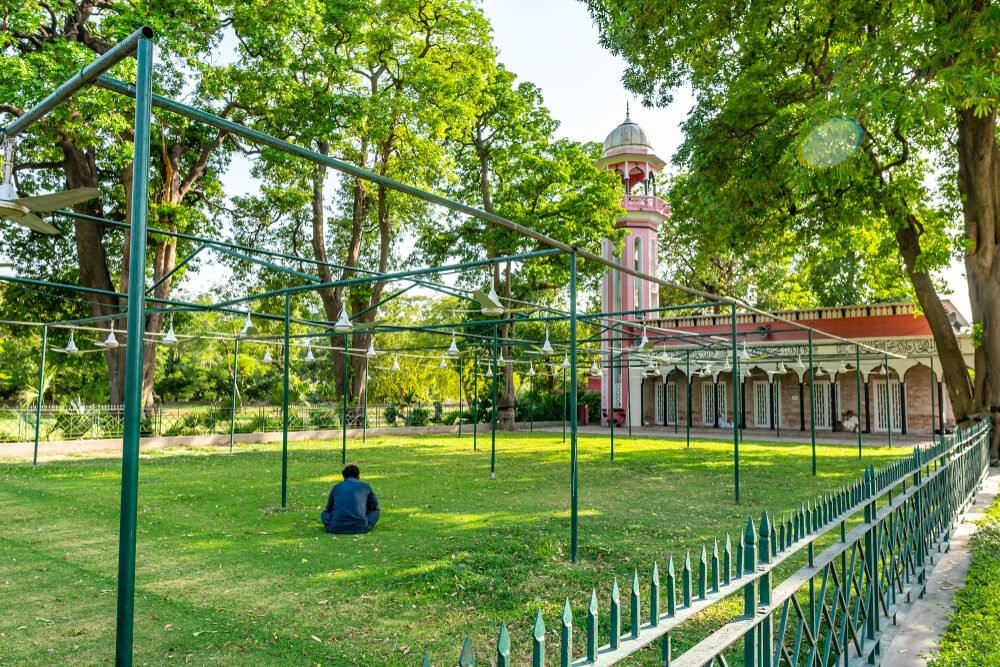
The beautiful mosque inside the park, surrounded by greenery, is worth a look for its architecture and its peaceful setting. Prayer facilities make the park practical for a full-day visit.
Picnic and Photograph the Gardens
The lawns, the Gulshan-e-Fatima section, the botanical collections and the seasonal flower beds — especially the chrysanthemums — make the park ideal for picnics and photography. At dusk, watch the colony of fruit bats stream out over the trees.
Combine with Lahore Zoo
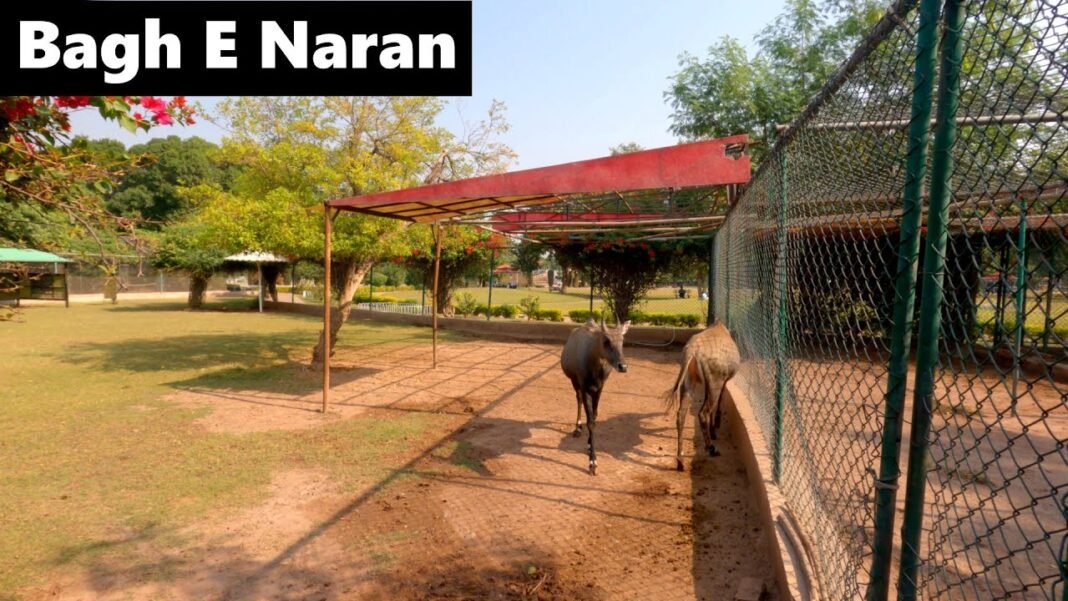
The zoo sits directly beside the park and shares its history — the land was originally part of Lawrence Gardens. A combined park-and-zoo day is the classic Lahore family outing (the zoo has its own entry ticket).
Famous Places In and Around Bagh-e-Jinnah, Lahore
- Lahore Zoo — established 1872, directly adjacent; separate entry ticket.
- The Mall Road — Lahore’s grand colonial avenue with historic buildings, minutes away.
- Governor’s House — the colonial-era residence directly opposite the park.
- Anarkali Bazaar — one of South Asia’s oldest markets, a short drive away.
- Lahore Museum — the great 19th-century museum on The Mall.
- GPO Chowk & Regal Chowk — classic Mall Road landmarks.
- Jilani (Race Course) Park — another major Lahore park, nearby.
How to Reach Bagh-e-Jinnah, Lahore
The park is on Lawrence Road off The Mall in central Lahore, next to the Lahore Zoo and directly opposite the Governor’s House — one of the easiest landmarks in the city to reach.
From Islamabad: about 370 km via the M-2 motorway, roughly 4 to 5 hours by car. From Karachi: about 1,215 km — fly to Lahore (around 1 hour 45 minutes) and drive 30 minutes from the airport. Within Lahore: the park is 10-15 minutes from Gulberg and DHA by car or taxi. Ride-hailing apps (Uber, Careem) work well; local buses pass along The Mall; auto-rickshaws handle short hops. Free public parking is available at the park’s entrances.
The nearest airport is Allama Iqbal International Airport, Lahore (about 20 km). Lahore Junction railway station is the nearest major rail terminal. Roads are paved and usable year-round. Cycling to the park is popular with locals, and the park’s own tracks are good for cycling.
Route Details
- From Allama Iqbal International Airport, take the airport road towards the city (about 20 km, 30 minutes).
- Head for The Mall (Mall Road), Lahore’s main colonial avenue.
- Turn onto Lawrence Road; the park’s gates are signposted, next to the Lahore Zoo and opposite the Governor’s House.
- Use the free parking at the entrances; enter on foot.
- Plan 1-2 hours for the park; add the zoo (separate ticket) for a half-day outing.
Where to Stay in Bagh-e-Jinnah, Lahore
The park is in central Lahore, so the full range of the city’s accommodation is within a short drive. Luxury travellers choose the established five-star hotels of central Lahore — well-known names like Pearl Continental and Avari are 10-15 minutes away. Mid-range business hotels and boutique guesthouses cluster in Gulberg and on The Mall itself, putting you within minutes of the park gates.
Budget travellers find simple hotels and hostels around Lahore Junction railway station and in Anarkali, both a short rickshaw ride from the park. Many visitors stay with family in Lahore — the park’s central location makes it an easy morning outing from almost anywhere in the city. Camping is not an option in a city park. Book ahead during the winter tourist season (October-March), when Lahore’s hotels are busiest.
Where to Eat: Local Foods of Bagh-e-Jinnah, Lahore
The park has a restaurant and snack shops serving light refreshments — parathas, kebabs and quick bites — and picnics on the lawns are popular and encouraged. But the real eating is on The Mall and in the surrounding old city. Within minutes of the park gates you will find restaurants serving the full Lahori spread: payas, nihari, chargha, seekh kebabs, mutton karahi and fresh kulfi.
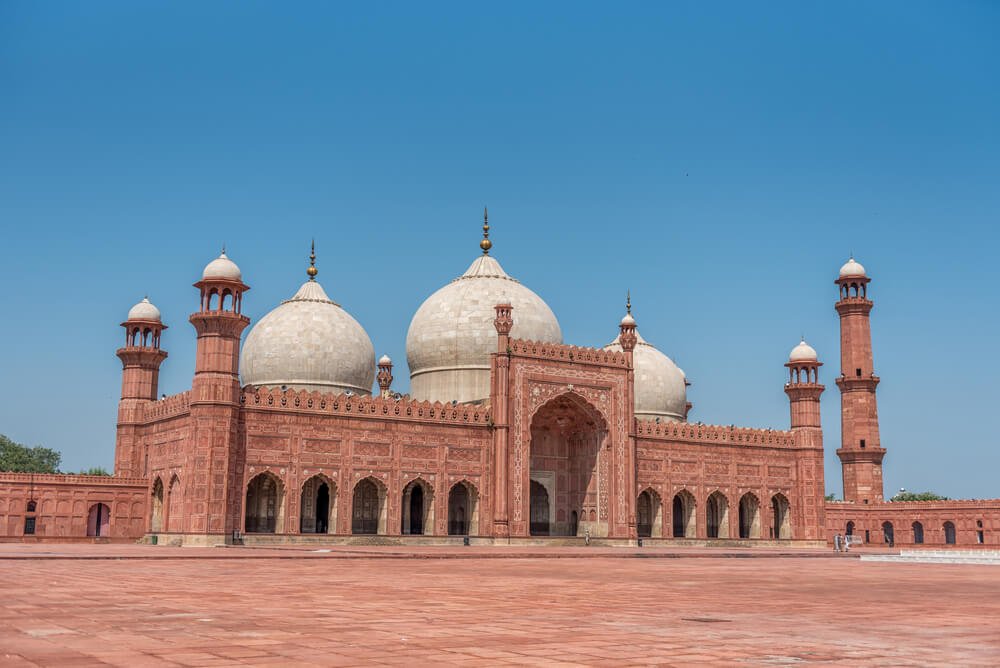
For breakfast, the old city’s halwa puri shops near Anarkali are legendary; for an evening out, the Fort Road Food Street (about 15 minutes away) pairs dinner with views of the floodlit Badshahi Mosque. Mall Road’s cafes and the bakeries of Gulberg cover continental and fast-food cravings. A dhaba meal is budget-friendly; mid-range Mall Road restaurants are moderately priced. Carry cash for the small stalls; larger restaurants accept cards.
Weather in Bagh-e-Jinnah, Lahore
Lahore’s climate shapes the park experience directly: summers are fierce, winters are cool and foggy, and the garden is at its best from October to March. In summer, come early in the morning or near sunset.
| Season | Temperature Range | Conditions |
|---|---|---|
| Winter (Dec-Feb) | Around 5-22°C | Cool, often foggy mornings; crisp afternoons; peak season for the park. |
| Spring (Feb-Apr) | Around 12-32°C | The most beautiful season — flowering trees and the famous floral displays. |
| Summer (May-Aug) | Around 28-42°C | Very hot, especially June; monsoon rain July-August; visit at dawn or dusk. |
| Autumn (Oct-Nov) | Around 18-32°C | Warm days, pleasant evenings, clear skies; excellent for the park. |
Language and Culture of Bagh-e-Jinnah, Lahore
Punjabi is the everyday language of Lahore, Urdu is understood by everyone, and English is widely spoken around The Mall’s hotels, restaurants and institutions. The park’s crowd is a cross-section of the city — morning walkers, students with books, families on weekends — and the atmosphere is relaxed and welcoming.
Lahore is culturally conservative but famously hospitable. Modest dress is the respectful default in public parks, though the norms here are relaxed compared to religious sites. Keep the gardens clean, stay on the paths in the botanical sections, and do not damage plants or climb the historic trees. Photography for personal use is allowed and encouraged; commercial shoots and drones may need permission. The mosque inside the park follows standard mosque etiquette.
Shopping in Bagh-e-Jinnah, Lahore
The park itself has no shopping beyond snack stalls, but its central location puts Lahore’s great markets within easy reach. Anarkali Bazaar — one of South Asia’s oldest markets — is minutes away, selling traditional clothing, jewellery, books, electronics and street food. The Mall Road shops sell handicrafts, and Ichhra Bazaar is the go-to for affordable fashion and fabrics.
For souvenirs — blue Multani pottery, camel-skin lamps, embroidered shawls, khussay — the craft shops around Anarkali and the Fort Road area are reliable. Books from the secondhand shops near the park (fitting, given the library) make good mementoes. Modern malls like Emporium and Packages are a short drive away for branded shopping. Bargaining is expected in the bazaars.
Travel Tips for Bagh-e-Jinnah, Lahore
Packing Essentials
Comfortable walking shoes, a hat and sunscreen, drinking water, and a camera. A book or a picnic blanket suits the park’s mood perfectly. A light jacket is useful on winter mornings; an umbrella helps during the monsoon.
Safety Tips
The park is family-friendly and generally safe, with the usual big-city common sense applying: keep valuables secure, stay in populated areas after dark, and drink bottled water. Weekends are crowded — weekday mornings are calmer. The surrounding Mall Road area is well-policed and busy.
Money & Connectivity
Entry is free; carry small cash (Pakistani rupees) for snacks, the zoo ticket and rickshaws. ATMs are plentiful on The Mall. All major networks (Jazz, Zong, Telenor, Ufone) have strong 4G coverage, and the area’s cafes offer Wi-Fi.
Best Time to Visit Bagh-e-Jinnah, Lahore
Winter (December-February): The Best Season
Cool, dry and sunny — winter is the classic season for the park. Morning walkers are out in force, the light is beautiful, and the gardens are green. Foggy mornings usually clear by mid-morning.
Spring (February-April): The Prettiest Season
Flowering trees, the chrysanthemum legacy in full display, and perfect temperatures make spring arguably the most beautiful time in the garden. Photographers should not miss it.
Summer (May-August): Early or Late Only
Lahore’s summer is punishing, but the park’s old trees give real shade and the dawn walk remains pleasant. Come at 5-6 AM or after 6 PM, and avoid the midday heat entirely.
Autumn (October-November): Very Good
Post-monsoon clarity, warm days and cool evenings make autumn a fine time for long walks and picnics. The park is at its most comfortable.
Final Thoughts
Bagh-e-Jinnah is Lahore’s living room — 141 acres where Victorian garden design, a 19th-century library, a 140-year-old cricket ground and 150-year-old banyans share space with students, walkers and picnicking families. It has been the city’s green heart since the 1860s, through colonial rule, partition and the modern megacity, and it still does what great parks do: give everyone, free of charge, a place to breathe.
Come at dawn for the walk, stay for the library, and finish at the zoo next door. Few places in Pakistan compress this much history, nature and everyday life into a single morning. For first-time visitors to Lahore and lifelong Lahoris alike, Bagh-e-Jinnah is essential.
FAQs
Where is Bagh-e-Jinnah located?
On Lawrence Road off The Mall in central Lahore — next to the Lahore Zoo and opposite the Governor’s House.
What is the best time to visit Bagh-e-Jinnah?
October to March is ideal; spring (February-April) has the best floral displays. In summer, visit early morning or near sunset.
How do I reach Bagh-e-Jinnah?
It is in central Lahore, 10-15 minutes from Gulberg/DHA by taxi or ride-hailing, about 30 minutes from the airport. Buses run along The Mall.
Is entry to Bagh-e-Jinnah free?
Yes, entry to the park is free. The adjacent Lahore Zoo has a separate ticket.
What are the park timings?
Generally from early morning (around 5-6 AM) to late evening (around 9-10 PM); the Quaid-e-Azam Library has its own hours, typically morning to evening.
Can I visit the Quaid-e-Azam Library inside?
Yes — the Victorian building can be visited, and the reading rooms are accessible with registration. It holds around 150,000 books.
Is Bagh-e-Jinnah good for families?
Excellent — lawns for picnics, play areas, the zoo next door, and plenty of space for children to run safely.
What food is available nearby?
Snack shops and a restaurant in the park; the full Lahori spread — nihari, kebabs, halwa puri — on The Mall, in Anarkali and at Fort Road Food Street.
What else can I see nearby?
Lahore Zoo, The Mall’s colonial buildings, Anarkali Bazaar, Lahore Museum, the Governor’s House and Jilani Park are all close.
Related reading: explore more destinations on our Explore Pakistan page, and see our guides to Malam Jabba, Hunza Valley, and places to visit in Islamabad.