Quick Facts
- Location: Samahni Valley, Bhimber District, Azad Jammu and Kashmir, near the village of Baghsar
- Altitude: The lake sits at 975 metres (3,199 ft) above sea level; the fort crowns the hill above at around 3,353 ft
- Famous For: A pine-fringed lake with water lilies and migratory birds, and a four-storey Mughal-era granite fort tied to Emperor Jahangir’s final journey
- Nearest City: Bhimber (district headquarters), about 50 km from Mirpur and 166 km from Rawalpindi
- Accessibility: All-weather blacktop road from Gujrat via Bhimber (about 64 km to Baghsar); the fort involves a hill climb on foot
- Known Landmarks: Baghsar Lake, Baghsar Fort, Saraa-e-Saadabad, Jandi Chontra, Ali Baig Gurdwara
- Best For: History lovers, photographers, birdwatchers, families on a weekend drive, and offbeat Azad Kashmir explorers
Why Visit Baghsar Lake & Fort
Most travelers racing toward the famous valleys of Azad Kashmir drive straight past Bhimber district without a second glance — and that is exactly why Baghsar rewards the curious. Here, within an easy day’s drive of Islamabad, a quiet lake mirrors pine-covered hills while a 400-year-old fort watches over it from a granite height. It is one of those rare Pakistani destinations where nature and history sit side by side in a single frame: water lilies below, cannon-era ramparts above.
The lake itself is the gentler half of the pair. Roughly half a kilometre long and fringed with cheerh pine, Baghsar Lake is a habitat for water lilies and a seasonal home to ducks, geese and other migratory birds. On a calm morning the water turns glassy, the surrounding hills double themselves in the reflection, and the only sounds are bird calls and the wind in the pines. It is a picnic-scale lake rather than an expedition-scale one — you come to sit, to photograph, to breathe — and for families from Gujrat, Bhimber and Mirpur it has long been the default weekend escape.
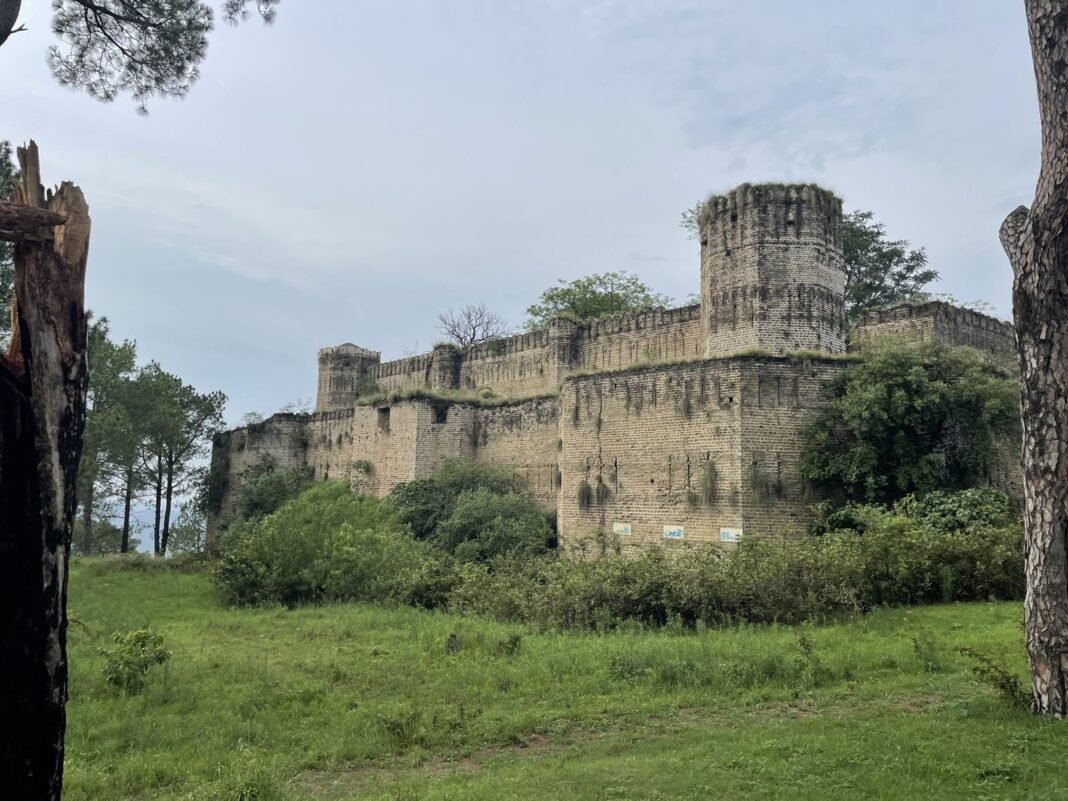
The fort is the dramatic half. Baghsar Fort is a massive four-storey structure of granite and sandstone, square-planned with bastions, arrow slits, a darbar hall, a stepped water pond, a mosque and dozens of cells and rooms. Its stones have seen Mughal emperors, Sikh governors and Dogra rajas pass through, and local tradition holds that Emperor Jahangir himself died near here in 1627 on his way back from Kashmir. Standing on its ramparts, looking down at the lake and across toward the Line of Control, you feel the strategic logic of the place in your bones.
What makes Baghsar special in 2026 is that it remains genuinely uncrowded. There are no tour-bus queues, no commercial strips, no inflated prices — just a historic valley, a beautiful lake and a fort that most Pakistanis have never heard of. This baghsar lake fort travel guide will help you plan the trip properly, because a place this good deserves to be visited well.
History of Baghsar Lake & Fort
The history of Baghsar is the history of a road — the old imperial road from Lahore to the Kashmir Valley, which passed through Bhimber and the Samahni Valley. Whoever controlled this route controlled the gateway to Kashmir, and the fort on the hill above Baghsar Lake was built to do exactly that.
The fort’s exact origins are honestly uncertain, and the archaeology department of Azad Kashmir says so plainly. Its tentative dating places it in the 16th century CE. Local tradition and several historians attribute the construction to the Mughals, whose architects and builders gave it its Indo-Islamic character — the arched mosque, the symmetrical bastions, the dressed granite masonry. An older theory holds that the fort may first have been raised in the 15th century under the local chieftain Jasrat, who built a chain of forts across the region, and was later rebuilt or refortified under the Chibh kings of Chibhal with Mughal help.
Later chapters are better documented. Some accounts hold that the Sikhs rebuilt the fort after defeating Raja Sultan Khan, the last ruler of the Bhimber state, in 1812. The English traveller Godfrey Vigne, who walked this route between Lahore and Kashmir in the 1830s, recorded it as “Bagh Sar castle” and reported that it was built by Deyhon Singh — brother of Gulab Singh — who became Raja of Bhimber in 1826. The four-storey granite mass went on to play roles in the eras of Shah Jahan, Aurangzeb and Ahmad Shah Abdali, a testament to how long this gateway mattered.
The most poignant story attached to Baghsar concerns the Mughal emperor Jahangir. In 1627, returning from Kashmir, Jahangir fell ill on this route and died near Sarai Saadabad in the Samahni Valley. To preserve the body for the long journey to Lahore, his entrails were removed and buried here; the emperor’s body was carried on to Lahore, where his great tomb stands today at Shahdara. Whether he died inside the fort itself or at the nearby sarai is debated in local accounts, but the association has clung to Baghsar for four centuries.
The lake’s recorded history is simpler: it has always been here, a natural sheet of water at 975 metres, roughly half a kilometre long and only about 115 metres wide, averaging 10 to 12 feet deep. Generations of travellers on the imperial road would have watered their animals and rested their caravans at its shore — the 16th-century Saraa-e-Saadabad, built on the orders of the Mughal governor Ghulam Saad-ullah as a caravan sarai on the Lahore–Kashmir route, stands as proof of how busy this valley once was. Today the lake is protected by its setting as much as its beauty, and the fort — parts of which remain closed to visitors because it stands close to the Line of Control — endures as one of Azad Kashmir’s most atmospheric ruins.
Top Things to Do in Baghsar Lake & Fort
Walk the Shores of Baghsar Lake
The lake rewards slow exploration. A walk along its banks takes you past water-lily beds, pine-shaded stretches and open viewpoints across the water to the Bandala Valley beyond. Early morning is magical: mist often hangs over the surface, and the resident and migratory birds — ducks, geese and waders — are at their most active. Bring binoculars if you have them; even without, the birdlife is visible and noisy enough to enjoy. The lake is shallow (10 to 12 feet on average), so the colours shift beautifully through the day, from steel blue at dawn to turquoise at noon.
Climb to Baghsar Fort
The fort sits on its hill at about 3,353 feet, and reaching it means a proper uphill walk — wear proper shoes and carry water. What awaits is one of the most evocative fort interiors in Azad Kashmir: an outer perimeter of boundary wall with thirty-eight small rooms, three entrances (the main northern gate, a south-eastern entrance and the inner perimeter gate), an inner enclosure with four bastions, a darbar hall where the ruler once received courtiers, a stepped water pond, forty-three inner rooms, and a mosque showing Indo-Islamic architecture. The observation point on the south-eastern corner and the firing bay on the western wall give sweeping views over the Samahni Valley. Note that some sections are closed to visitors because of the fort’s proximity to the Line of Control — respect all barriers and any guidance from local authorities.
Photograph the Lake-and-Fort Panorama
The classic Baghsar photograph frames the lake in the foreground with the fort’s silhouette on the hill above — best captured from the higher ground on the lake’s eastern side in the late afternoon, when the fort catches warm light. The pine forests around the lake also make excellent subjects, especially when mist threads through them after rain. Drone users should be extremely cautious here: this is a sensitive border-adjacent area, and flying a drone near the Line of Control can land you in serious trouble. When in doubt, keep the drone packed.
Visit Saraa-e-Saadabad
A short distance away in the Samahni Valley stands Saraa-e-Saadabad, the 16th-century caravan sarai built under the Mughal governor Ghulam Saad-ullah. This was a working inn on the imperial highway — caravans moving between Lahore and Kashmir rested here, and it is also associated with Jahangir’s final journey in 1627. Its weathered walls are a quieter, more contemplative stop than the fort, and they complete the story of the valley as a corridor of empires.
Picnic Under the Pines
The pine-covered slopes around the lake are natural picnic grounds, and local families have used them as such for generations. There are no restaurants at the lake itself, so pack food from Bhimber or Samahni town. Carry all litter back out with you — the valley’s beauty is its lack of commercial clutter, and keeping it that way is every visitor’s job.
Famous Places In and Around Baghsar Lake & Fort
- Samahni town — the valley’s market town and the natural base for the Baghsar excursion, about 16 km north-west of the fort.
- Jandi Chontra — a scenic spot 17 km from Bhimber (67 km from Mirpur), known for its panoramic views and the nearby shrine of Baba Shadi Shaheed; a Tourist Rest House offers accommodation.
- Ali Baig Gurdwara — a historic Sikh-era gurdwara in the nearby village of Ali Baig, of interest to heritage travelers.
- Bhimber town — the district headquarters, an old historic town mentioned by Emperor Jahangir in his memoirs (Tuzk-e-Jahangiri), with bazaars and basic amenities.
- Mirpur and Mangla Dam — about 50 km from Bhimber, for travelers combining Baghsar with Azad Kashmir’s lake city.
How to Reach Baghsar Lake & Fort
Baghsar lies in the Samahni Valley of Bhimber district, and the standard approach is from the Punjab side via Gujrat and Bhimber on all-weather blacktop roads. The whole journey from Islamabad is very doable as a long day trip, though an overnight stay in Bhimber or at Jandi Chontra makes it far more relaxed.
From Islamabad: Drive to Bhimber — about 166 km via Rawalpindi, roughly 3.5 to 4 hours. From Bhimber, continue toward Samahni town and then on to Baghsar village; the total Gujrat–Bhimber–Baghsar road journey is about 64 km from Gujrat. The roads are metalled throughout, but the final stretch into the valley is winding, so allow extra time and drive carefully.
From Lahore: The most convenient route runs via Gujrat — Lahore to Gujrat is roughly 130 km on the GT Road/motorway network, then Gujrat to Bhimber to Baghsar adds about 64 km more. Total driving time is around 4 to 5 hours depending on traffic. Alternatively, travel via Islamabad and Rawalpindi if that suits your starting point.
From Karachi: This is a two-stage journey. Fly to Islamabad, then drive as above; or take the train to Rawalpindi or Gujrat and continue by road. There are no airports in Bhimber district — Islamabad International Airport is the nearest practical air gateway.
Local transport: Public vans and coasters run between Gujrat, Bhimber and Samahni from the respective bus stands. From Samahni town you will need a private vehicle or a hired jeep/taxi for the last stretch to Baghsar village and the lake, as public transport thins out. Hiring a car with a driver from Bhimber for the day is the most comfortable option, and drivers know the Baghsar turnoff well.
Route Details
Step 1: Reach Bhimber from Islamabad (via Rawalpindi, ~166 km) or from Lahore (via Gujrat, ~64 km Gujrat–Bhimber).
Step 2: From Bhimber town, take the Samahni road south-east — the road is blacktop and well signposted.
Step 3: Pass through Samahni town (stock up on food, water and fuel here) and continue about 16 km south-east to Baghsar village.
Step 4: The lake lies below the village; the fort crowns the hill above it — park at the lake and climb to the fort on foot.
Step 5: For the return, retrace to Bhimber the same day, or overnight at the Tourist Rest House near Jandi Chontra.
Where to Stay in Baghsar Lake & Fort
There is no hotel at the lake itself, so plan your night around Bhimber or Jandi Chontra. Bhimber town, the district headquarters, has the best selection in the immediate area — mid-range hotels and guest houses with basic modern amenities, all within easy reach of the bazaar and restaurants. As an old administrative town, it has reliable electricity, mobile coverage and transport links, making it the sensible base for most visitors.
For a more scenic overnight, the Tourist Rest House near Jandi Chontra (about 17 km from Bhimber) offers government-run accommodation in a beautiful setting with panoramic views; book ahead through the tourism department channels, as rooms are limited. Mirpur, 50 km away, has a wider range of hotels including better mid-range options, and works well if you are combining Baghsar with a broader Azad Kashmir itinerary. Samahni town has a few very basic guest houses for travelers who want to be closest to the lake at dawn. Camping near the lake is not an established or recommended option — stick to proper accommodation. For more northern itineraries, browse our Explore Pakistan guides.
Where to Eat: Local Foods of Baghsar Lake & Fort
Eat in Bhimber or Samahni town before heading to the lake, because there are no restaurants at Baghsar itself — pack a full picnic. The food of this region reflects its Pahari and Kashmiri character: hearty, desi-ghee-rich mountain fare built around wheat, maize, rice, lentils and seasonal vegetables, with meat dishes for special occasions.
Dishes you will commonly find in the area’s dhabas and restaurants include Kashmiri chai (the famous pink salted tea, served at every self-respecting gathering), makki ki roti with saag in the winter months, rajma (kidney-bean curry) with rice, dal preparations, and standard Pakistani grill items — chicken tikka, seekh kebab and malai boti — at the roadside restaurants of Bhimber and Gujrat. Fresh trout or local fish appears on some menus closer to the hill streams. A dhaba meal in Bhimber or Samahni is very budget-friendly; even a generous family dinner costs modestly by city standards. Carry drinking water and snacks for the fort climb, and if you picnic by the lake, bring everything back out with you.
Weather in Baghsar Lake & Fort
At 975 metres, Baghsar sits in a transitional zone — warmer than the high valleys of Azad Kashmir but noticeably cooler and greener than the Punjab plains below. Summers are warm rather than scorching, winters are cool with chilly nights, and the monsoon brings the hills alive. Approximate conditions:
| Season | Temperature Range | Conditions |
|---|---|---|
| Winter (Dec–Feb) | 3–16°C | Cool, crisp days; cold nights; occasional frost on the hills. Clear views, few visitors. |
| Spring (Mar–Apr) | 15–28°C | Mild and green; wildflowers on the slopes; excellent for the fort climb. |
| Summer (May–Aug) | 25–38°C | Warm days, cooler than the plains; monsoon showers July–August make the valley lush but roads slippery. |
| Autumn (Sep–Nov) | 12–30°C | Pleasant and settled; clear skies; arguably the most comfortable season overall. |
Monsoon rain can make the unpaved final approaches muddy — check conditions locally before setting out in July and August.
Language and Culture of Baghsar Lake & Fort
The Samahni Valley speaks Pahari as its mother tongue, with Gojri also heard in Gujjar communities and Urdu understood universally — you will have no communication problems as a visitor. The people of Bhimber district are known for a straightforward, hospitable mountain-plain culture: guests are treated with genuine warmth, and it is common to be offered tea by shopkeepers and even strangers.
Cultural norms are conservative and traditional. Dress modestly — loose clothing covering arms and legs for both men and women — and greet elders with respect. If you are offered food or tea in a village home or shop, accepting is polite; a small compliment to the host goes a long way. Ask permission before photographing people, particularly women. One special sensitivity applies here: parts of the fort area are closed because of proximity to the Line of Control. Treat all military or restricted signage as absolute, do not photograph security installations, and follow any instructions from local authorities without argument.
Shopping in Baghsar Lake & Fort
Shopping is a Bhimber-and-Samahni affair rather than a lakeside one. Bhimber’s bazaar is a proper old district-town market where you can buy everyday goods, fresh produce and regional specialities. Look out for dry fruits and walnuts from the surrounding hills, desi ghee from village producers, and Kashmiri-style shawls and embroidered fabrics in the cloth shops — the region’s textile traditions run deep.
Samahni town’s smaller market covers basics and makes a good stop for picnic supplies: bread, fruit, biscuits and cold drinks for the lake. Do not expect souvenir shops at Baghsar itself; the area is refreshingly uncommercialised. Prices in these local bazaars are honest and bargaining is gentle rather than aggressive.
Travel Tips for Baghsar Lake & Fort
Packing Essentials
Sturdy walking shoes are non-negotiable — the fort climb is steep and the stones are uneven. Pack drinking water, sun protection and a hat, a light rain jacket in monsoon season, and a warm layer for winter visits when the wind bites on the ramparts. Binoculars will transform the birdwatching, and a picnic set (sheet, food, rubbish bags) is essential since there are no eateries at the lake. Carry a power bank; there are no charging points in the valley.
Safety Tips
Baghsar is a peaceful tourist area, but its location near the Line of Control demands extra awareness. Stay on established paths, respect every restricted-area sign, and never approach or photograph military installations. Keep your CNIC (or passport for foreign visitors) with you, as there may be checkpoints on the route. The fort’s old masonry is unstable in places — do not climb walls or lean on parapets, and supervise children closely on the ramparts. Mobile signals are generally available, but let someone know your plans before the fort climb.
Money & Connectivity
Carry all the cash you will need — there are no ATMs at the lake or in Baghsar village. ATMs exist in Bhimber town and Samahni, so withdraw before the final leg. Small vendors and dhaba owners operate on cash only. Mobile coverage from the major networks reaches the valley, though signals can dip inside the fort’s thick walls and in hollows around the lake. Buy any supplies in Bhimber or Samahni; beyond that, you are on your own provisions.
Best Time to Visit Baghsar Lake & Fort
Autumn (September–November): The Sweet Spot
Clear skies, comfortable temperatures and settled weather make autumn the finest season for Baghsar. The fort climb is pleasant, the lake is calm, and the hills hold their late-monsoon green. Photographers get the sharpest light of the year.
Spring (March–April): Green and Mild
Spring brings wildflowers to the slopes and comfortable climbing weather. The valley feels fresh and alive, migratory birds are still around, and the crowds of summer have not yet arrived. An excellent second choice.
Winter (December–February): Quiet and Crisp
Winter is for the solitude seekers. Days are cool and often brilliantly clear, the lake is at its most mirror-like, and you may have the fort entirely to yourself. Nights are cold, so day-trip from Bhimber rather than camping, and start the climb late morning after the frost lifts.
Summer and Monsoon (May–August): Lush but Tricky
Early summer is fine and the valley is at its greenest, but July and August bring monsoon rain that can make the approach roads slippery and the fort steps treacherous. If you visit then, go on a clear day, wear grippy shoes, and be prepared to turn back if the weather closes in.
Final Thoughts
Baghsar Lake and Fort is the kind of destination that reminds you why you travel in Pakistan in the first place: a lake you have never seen on a postcard, a fort whose stones remember emperors, and a valley that has not yet learned to perform for tourists. It asks a little effort — the drive from Bhimber, the climb to the ramparts — and repays it many times over in quiet beauty and genuine history.
Come for the Jahangir story and stay for the water lilies; come for the photographs and stay for the pine-scented silence. And when you stand on the fort’s south-eastern bastion looking down at the lake, remember that Mughal caravans, Sikh governors and Dogra rajas all stood roughly where you stand, watching the same water. Few places in Azad Kashmir compress that much history into one view. If Baghsar has whetted your appetite for the region, our Hunza Valley guide continues the journey north.
FAQs
Where is Baghsar Lake and Fort located?
Baghsar Lake and Fort are in the Samahni Valley of Bhimber District, Azad Jammu and Kashmir. The lake sits at 975 metres above sea level, and the fort crowns the hill above it at about 3,353 feet, roughly 16 km south-east of Samahni town and 64 km from Gujrat via Bhimber.
What is the best time to visit Baghsar?
Autumn (September to November) is ideal — clear skies and comfortable temperatures. Spring (March–April) is also excellent. Winter is quiet and crisp; summer is green but the monsoon months of July and August can make roads and the fort climb slippery.
How do I reach Baghsar from Islamabad?
Drive about 166 km via Rawalpindi to Bhimber (3.5 to 4 hours), then continue through Samahni town to Baghsar village. From Lahore, the route via Gujrat is about 64 km from Gujrat to Baghsar via Bhimber. Hire a car with a driver from Bhimber for the most comfortable trip.
What is the history of Baghsar Fort?
The fort is tentatively dated to the 16th century and attributed to Mughal-era construction, possibly rebuilt under later rulers including the Sikhs and Dogras. It guarded the imperial Lahore–Kashmir route, and tradition holds that Emperor Jahangir died nearby in 1627 on his return from Kashmir.
Is Baghsar safe for tourists?
Yes, it is a peaceful tourist area, but it lies near the Line of Control, so respect all restricted-area signage, carry identification, avoid photographing security installations, and follow local authorities’ guidance. Some sections of the fort are closed to visitors for this reason.
Can families visit Baghsar Lake?
Absolutely — the lake is ideal for family picnics, with shallow banks, pine shade and birdlife to enjoy. The fort climb is moderately strenuous, so families with very young children or elderly members may prefer to enjoy the lake and view the fort from below.
Where can I stay near Baghsar?
Bhimber town has the best nearby hotels and guest houses. The Tourist Rest House near Jandi Chontra offers scenic government accommodation (book ahead), and Mirpur — 50 km away — has a wider range of options.
What should I eat around Baghsar?
There are no restaurants at the lake, so pack a picnic. In Bhimber and Samahni towns you will find Pahari-Kashmiri fare — Kashmiri pink chai, makki ki roti with saag in winter, rajma, dals and standard grill items at roadside dhabas, all very budget-friendly.