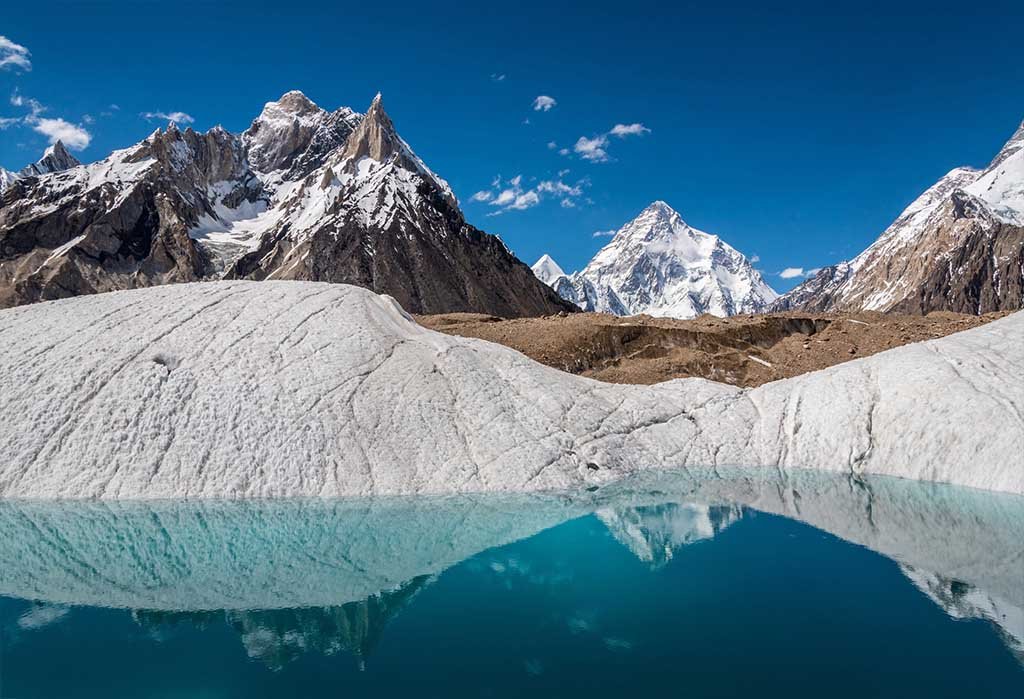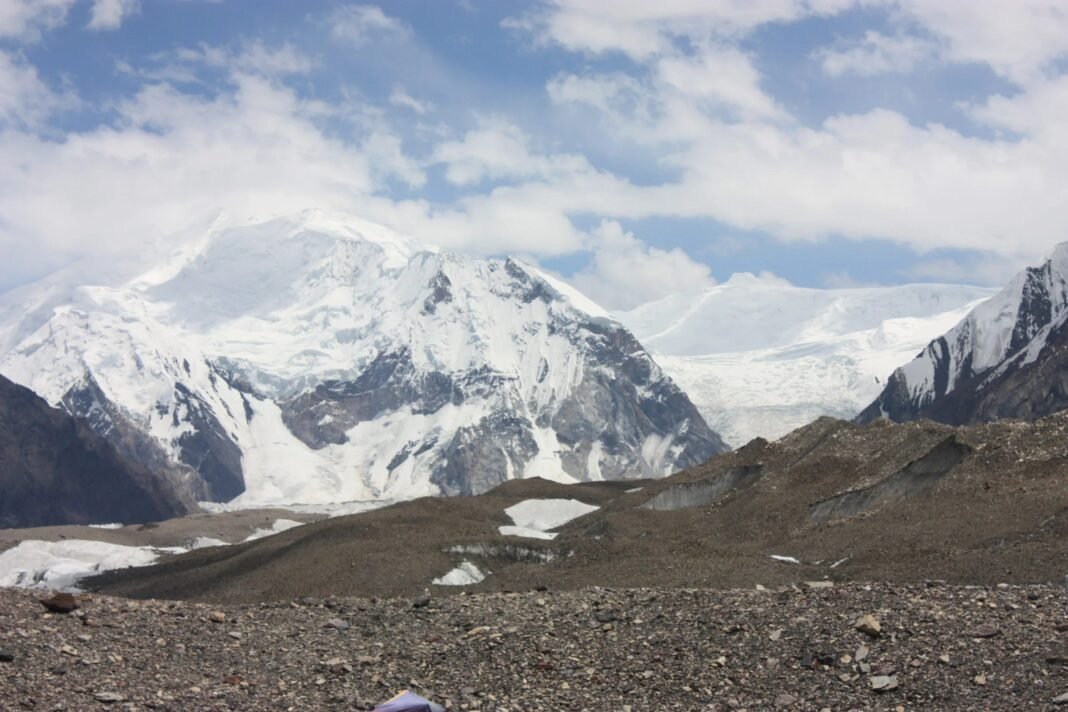
Rising to 7,312 metres at the very foot of the Baltoro Glacier, Baltoro Kangri is one of the great independent peaks of the Karakoram, known to early explorers as the Golden Throne. It stands south of the Gasherbrums and east of Chogolisa, a huge pyramid of ice and rock that dominates the approach to Concordia. This Baltoro Kangri travel guide covers the peak’s history, its famous first ascent in 1963, how mountaineers reach it, and what trekkers can see of it from the Baltoro Glacier trek.
Quick Facts
- Location: Baltoro Muztagh, Karakoram range, Gilgit-Baltistan, Pakistan
- Altitude: 7,312 metres (23,990 feet); the 82nd highest mountain in the world
- Famous For: The “Golden Throne” of the Karakoram; first climbed in 1963 by a Japanese expedition; the peak at whose foot the Baltoro Glacier begins
- Nearest City: Skardu, the gateway town of Baltistan
- Accessibility: Reached only by expedition; the approach is the Baltoro Glacier trek from Askole to Concordia; climbing requires a government permit and a licensed operator
- Known Landmarks: The Golden Throne summit pyramid, the Abruzzi Glacier on its northern side, Concordia, the Gasherbrum massif
- Best For: Experienced mountaineers, high-altitude photographers, and trekkers on the Concordia route
Why Visit Baltoro Kangri
Baltoro Kangri is one of those mountains that rewards anyone who looks closely at the Karakoram. While K2 and the Gasherbrums take the headlines, the Golden Throne stands apart as a complete mountain in its own right: a massive, symmetrical pyramid rising directly from the head of the Baltoro Glacier. For mountaineers, it is a serious 7,000-metre objective with far less traffic than the famous 8,000-metre peaks, offering a genuine wilderness experience in the highest mountain range outside the Himalaya.
For trekkers who do not climb, the peak is still one of the great sights of the Baltoro Glacier trek. The mountain dominates the skyline as you approach Concordia from the east, and its golden evening light, the reason for its English name, is one of the classic photographs of the Karakoram. Standing at Concordia and looking up at the Golden Throne with K2 behind you is to see the architecture of the range laid out in a single view.
The mountain also carries a fine climbing history. Its first ascent in 1963 by the Tokyo University Ski Alpine Club, led by Dr. Seihei Kato, was one of the landmark Japanese achievements in the Karakoram, made in an era when these ranges were still being explored peak by peak. To visit the region is to walk through that history.
Finally, the approach to Baltoro Kangri is the Baltoro Glacier trek itself, Pakistan’s greatest trekking journey. Even if you never set foot on the peak’s slopes, the expedition to reach its base takes you through Askole, Paiyu, Urdukas, and Concordia, past the Trango Towers and the great 8,000-metre peaks. The mountain is the perfect excuse for the finest trek in the country.
History of Baltoro Kangri
Baltoro Kangri lies in the Baltoro Muztagh, the subrange of the Karakoram that holds four of the world’s fourteen 8,000-metre peaks. The peak stands to the south of the Gasherbrums and east of Chogolisa (7,665 m). The great Baltoro Glacier, one of the longest glaciers outside the polar regions, rises from the foot of the mountain, while on its northern side lies the Abruzzi Glacier. Early European explorers and surveyors of the Karakoram, working in the first decades of the 20th century, knew the peak as the Golden Throne, a name that captures how the summit catches the light above the glacier.
The mountain’s recorded climbing history began with reconnaissance by the early expeditions that mapped the Baltoro region, including the Duke of the Abruzzi’s 1909 expedition, which photographed and surveyed the surrounding peaks. But Baltoro Kangri itself waited more than half a century for its first ascent. In 1963, a Japanese expedition from the Tokyo University Ski Alpine Club, led by Dr. Seihei Kato with nine members, made the first successful climb, reaching the summit on the morning of 4 August 1963. The ascent was reported in the American Alpine Journal the following year and remains the defining event in the peak’s history.
Since then, Baltoro Kangri has remained a rarely climbed mountain. Unlike K2 or the Gasherbrums, it has never become a commercial objective, and ascents are few. The peak sits in the restricted zone of the Baltoro region, and climbing it requires a permit from the Government of Pakistan, arranged through a licensed tour operator, along with the full logistics of a Karakoram expedition: the trek to Concordia, high camps on the mountain, and a team of experienced high-altitude porters from the Balti villages of the Braldu Valley.
For the wider world, the mountain’s fame rests on its position. It is the great pyramid that closes the view to the east from Concordia, the meeting place of the Baltoro and Godwin-Austen glaciers. Generations of trekkers and climbers heading for K2 have photographed the Golden Throne glowing at sunset, and it has become one of the signature images of the Karakoram.
Top Things to Do in Baltoro Kangri
View the Golden Throne from Concordia
The classic Baltoro Kangri experience for non-climbers is the view from Concordia, the great glacial confluence at about 4,600 metres. The peak rises to the east of the campsite, and in the evening light its summit pyramid turns gold, the sight that gave the mountain its English name. Bring a good zoom lens and a tripod: this is one of the most photographed peaks of the Karakoram.
Attempt the Summit (Expedition Climbers Only)
Baltoro Kangri is a full expedition objective at 7,312 metres. The climb requires a government climbing permit, a licensed operator, high-altitude porters, and fixed camps on the mountain. It is suitable only for experienced mountaineers with previous 6,000 or 7,000-metre summits. The climbing season is the same as the Baltoro trekking season, June to September.
Trek the Baltoro to the Peak’s Base
The approach to the mountain follows the great Baltoro Glacier trek from Askole: Jhola, Paiyu, Urdukas, Goro I and II, and Concordia. The walk takes about eight days one way and passes the Trango Towers, Uli Biaho, Masherbrum, and the Muztagh Tower before the Golden Throne comes into full view. It is one of the world’s great treks in its own right.
Photograph the Karakoram Giants
From the upper Baltoro and Concordia, the panorama includes K2 (8,611 m), Broad Peak (8,047 m), the Gasherbrums, and Chogolisa alongside Baltoro Kangri itself. The concentration of great peaks in one view is unmatched anywhere on earth, and the clear air of the Karakoram gives photographs a sharpness that lower ranges cannot match.
Explore the Abruzzi Glacier Side
The northern side of Baltoro Kangri is drained by the Abruzzi Glacier. Experienced parties sometimes explore this quieter side of the massif, far from the main trekking route. This is serious mountaineering terrain and should only be attempted with proper permits, guides, and equipment.
Famous Places In and Around Baltoro Kangri
- Concordia: The glacial confluence below the peak, the best viewpoint of the Golden Throne.
- K2 (8,611 m): The world’s second highest mountain, west of the peak.
- Gasherbrum I (8,080 m) and Gasherbrum II (8,035 m): The great massif north of Baltoro Kangri.
- Chogolisa (7,665 m): The peak to the west of Baltoro Kangri.
- Broad Peak (8,047 m): Another 8,000-metre giant of the upper Baltoro.
- K2 Base Camp: At around 5,100 metres on the Godwin-Austen Glacier, reached from Concordia.
- Trango Towers: The famous granite towers of the lower Baltoro, passed on the approach trek.
- Askole: The last village of the Braldu Valley and the start of the trek.
- Skardu: The gateway town of Baltistan for all Karakoram expeditions.
How to Reach Baltoro Kangri
Baltoro Kangri has no road access and no tourist infrastructure: it is reached by expedition, following the Baltoro Glacier trek to Concordia. All travel starts in Skardu. From Skardu, jeeps cover the rough track to Askole, the last village of the Braldu Valley, and the trek to Concordia takes about eight days. Climbing the peak additionally requires a climbing permit from the Government of Pakistan, arranged through a licensed tour operator, and the services of high-altitude porters. The region is a restricted zone, and independent unpermitted travel is not allowed.
From Islamabad: Fly from Islamabad to Skardu in about an hour, subject to weather, or drive the roughly 630 km via the Karakoram Highway and the Jaglot-Skardu road, a 10 to 12-hour journey usually done with an overnight stop. From Skardu, the jeep road to Askole is about 120 km of rough mountain track and takes a full day.
From Lahore: Drive to Islamabad on the M-2 motorway, about 375 km and 4 to 5 hours, then continue to Skardu by air or road.
From Karachi: Fly from Karachi to Islamabad and connect onward to Skardu; the overland journey from Karachi to the Karakoram is a multi-day undertaking.
Nearest airport: Skardu International Airport, with scheduled flights from Islamabad. Transport options: scheduled flights, private cars and tour vans to Skardu, 4×4 jeeps from Skardu to Askole, and then trekking on foot with porters and guides.
Route Details
The approach route is the standard Baltoro trek. From Skardu, drive by jeep up the Braldu Valley to Askole. Trek in stages: Askole to Jhola, Jhola to Paiyu, Paiyu to Urdukas, Urdukas to Goro I, Goro I to Goro II, and Goro II to Concordia, at the foot of the great peaks. Baltoro Kangri rises to the east of Concordia, with the Baltoro Glacier flowing from its base. Expedition teams establish base camp near Concordia or on the glacier below the peak and then place higher camps on the mountain itself. The round trip from Askole, including the climb, typically takes three to four weeks or more.
Where to Stay in Baltoro Kangri
There is no accommodation on the mountain: climbers and trekkers stay in expedition tents. On the approach trek, the established camps are Jhola, Paiyu, Urdukas, Goro I, Goro II, and Concordia, all with tent sites near water. Expedition base camps are set up on the glacier near Concordia, with higher camps placed on the mountain during the ascent. All camping equipment, food, and kitchen arrangements are handled by the expedition operator.
Before and after the expedition, Skardu is the base. The town has a range of mid-range hotels and guesthouses, and two well-known properties in the wider gateway area are the Serena Shigar Fort, a restored 17th-century fort in Shigar Valley, and the Shangrila Resort at Lower Kachura Lake. Because expeditions run in the short June to September season, book Skardu accommodation well in advance.
Where to Eat: Local Foods of Baltoro Kangri
On the mountain and the trek, all meals are prepared by expedition cooks: hearty Pakistani and trekking fare such as lentils, rice, chapattis, soups, and eggs, with fresh supplies brought up from Skardu. At altitude, appetite drops, so cooks focus on warm, energy-rich food. Discuss dietary requirements with your operator before departure.
In Skardu and the surrounding valleys, the food is Balti. Do not miss prapu (hand-made wheat noodles with walnut and apricot-oil sauce), mamtu (steamed meat dumplings), zaan (butter porridge), and hoilo garma (greens with flatbread). The region’s dried apricots, known as pharing, with almonds and walnuts, are the traditional energy food of the mountains and ideal for the trail. To drink, the local namkeen chai (salty pink tea) and tumoro herbal tea are both worth trying. Restaurant meals in Skardu are generally budget-friendly.
Weather in Baltoro Kangri
Baltoro Kangri is a 7,312-metre peak in the high Karakoram, and its weather is severe. Even in summer, temperatures at high camps are far below freezing, and storms can arrive with little warning at any time of year. The climbing and trekking season is June to September; outside these months the region is snowbound and inaccessible. The table gives approximate conditions for the trek and climbing altitudes.
| Season | Temperature Range | Conditions |
|---|---|---|
| Winter (Dec-Feb) | -30°C to -10°C | Extreme cold and deep snow; no climbing or trekking possible |
| Spring (Mar-May) | -20°C to 5°C | Heavy snow; approach routes blocked; not a climbing season |
| Summer (Jun-Sep) | -15°C to 15°C | Climbing season; milder at base camp, severe cold on the upper mountain; changeable weather |
| Autumn (Oct-Nov) | -25°C to 0°C | Rapidly deteriorating; season ends as winter storms arrive |
Language and Culture of Baltoro Kangri
The region around Baltoro Kangri is the homeland of the Balti people, who speak Balti, a language related to Tibetan, along with Urdu. In Skardu you will manage with Urdu and some English; on the expedition, guides and porters speak Balti among themselves. A few words of greeting in the local language go a long way.
The Baltis are Muslim, with Shia, Noorbakhsh Sufi, and Sunni communities, and hospitality to travellers is a deep cultural value. The high-altitude porters of the Braldu Valley, whose families have worked these glaciers for generations, are the backbone of every Karakoram expedition. Visitors should dress modestly in villages, ask permission before taking photographs of people, respect prayer times and religious sites, and treat porters and staff with fairness and courtesy.
Shopping in Baltoro Kangri
There are no shops beyond Skardu, so buy everything you need there. Skardu’s bazaars are famous for dried apricots (pharing), apricot oil, almonds, and walnuts, the classic high-energy foods of the Karakoram. You will also find pashmina and woollen shawls, traditional Balti caps, hand-woven carpets, wood carvings, and gemstones. Stock up on dried fruit and nuts before heading to Askole: they are invaluable on the long trek in.
Travel Tips for Baltoro Kangri
Packing Essentials
For the trek: a four-season sleeping bag, insulated and waterproof layers, broken-in mountaineering or trekking boots, gaiters, glacier glasses, high-SPF sunscreen, headlamp, trekking poles, and water purification. For the climb: full high-altitude mountaineering kit, including down suit, double boots, harness, helmet, and personal climbing hardware, coordinated with your operator. Confirm exactly what the expedition provides versus what you must bring.
Safety Tips
This is one of the most remote mountain regions on earth, days from the nearest hospital. Acclimatise carefully, stay with your guide on the glacier, and never travel on the ice unroped or alone. Build contingency days into the schedule for weather delays. Helicopter evacuation insurance covering high-altitude rescue is essential, and the climb should only be attempted with an experienced, licensed operator and proper permits.
Money & Connectivity
Take all the cash you need in Pakistani rupees from Skardu: there are no ATMs or banks beyond the town, and staff and porters are paid in cash. Mobile coverage is limited on the trek; the SCO network works best in Gilgit-Baltistan, but expect long stretches with no signal. Leave a detailed itinerary and expected return date with someone reliable, and carry a satellite communicator for emergencies on the mountain.
Best Time to Visit Baltoro Kangri
Summer (June to September)
The only season for climbing and trekking. July and August bring the most stable weather and the warmest temperatures at base camp, with the full expedition season in swing. June and September are quieter but colder, with a higher chance of snow. All permits, porters, and logistics are geared to these months.
Winter (December to February)
Extreme cold and deep snow close the region entirely. No trekking or climbing is possible for ordinary expeditions.
Spring (March to May)
The valleys below bloom in April and May, a lovely time to see Skardu, but the high mountains remain snowbound and the approach to Concordia is not open.
Autumn (October to November)
The season winds down quickly; October can still be clear in the valleys, but the high camps are already in winter conditions and expeditions have left.
Final Thoughts
Baltoro Kangri, the Golden Throne, is one of the Karakoram’s great unsung mountains: a 7,312-metre pyramid with a distinguished first ascent, far less crowded than its famous neighbours, set at the head of the world’s most spectacular glacier trek. For mountaineers it is a serious and rewarding objective; for trekkers it is the glowing eastern wall of Concordia, the sight that closes the greatest mountain panorama on earth.
Whatever your aim, the journey runs through the heart of Baltistan and the history of Karakoram exploration, from Askole’s barley fields to the ice of Concordia. Go well prepared, go with a licensed operator, and give the mountains the respect they demand. For more on Pakistan’s great ranges, see our Explore Pakistan section, our Hunza Valley guide, and our Malam Jabba guide.
FAQs
Where is Baltoro Kangri located?
Baltoro Kangri is in the Baltoro Muztagh of the Karakoram range in Gilgit-Baltistan, Pakistan, south of the Gasherbrums and east of Chogolisa. The Baltoro Glacier rises from its foot.
How high is Baltoro Kangri?
The peak is 7,312 metres (23,990 feet) high, making it the 82nd highest mountain in the world. It is also known as the Golden Throne.
Who first climbed Baltoro Kangri?
A Japanese expedition from the Tokyo University Ski Alpine Club, led by Dr. Seihei Kato, made the first ascent on the morning of 4 August 1963.
Can trekkers visit Baltoro Kangri without climbing?
Yes. The peak dominates the view east from Concordia on the Baltoro Glacier trek, and most visitors experience it as the glowing “Golden Throne” at sunset rather than as a climb.
What is the best time to visit Baltoro Kangri?
June to September is the climbing and trekking season. July and August have the most stable weather.
How do I reach Baltoro Kangri from Islamabad?
Fly or drive from Islamabad to Skardu, take a jeep to Askole, and trek about eight days up the Baltoro Glacier to Concordia. Climbing requires a government permit and a licensed operator.
Is Baltoro Kangri suitable for beginners?
No. The trek to its base is demanding and suited to experienced trekkers; the climb itself is a full high-altitude expedition for seasoned mountaineers only.
Where can I stay near Baltoro Kangri?
Accommodation is in expedition tents at established camps from Askole to Concordia. Before and after, Skardu offers hotels and guesthouses, with Balti dishes like prapu and mamtu to try in town.