High above a green valley in Kotli district, on a pointed cliff of bare rock, stands a small fort that most Pakistanis have never heard of. Bhrund Fort is not a grand palace-fortress — it is a watchtower fort from the Sikh era, protected today as an antiquity of Azad Jammu and Kashmir, with a secret exit, a central well, and medieval Hindu temples scattered in the valley below. This Bhrund Fort travel guide covers its documented history, how to reach it from Islamabad and beyond, the best season to go, and what to know before you set out.
Quick Facts
- Location: Near Bhrund village, on the Bhrund-Sehnsa road, Kotli District, Azad Jammu and Kashmir, Pakistan
- Altitude: Around 700-800 metres (the surrounding Kotli hills); the fort itself sits on a cliff 15-20 metres high
- Famous For: A small Sikh-era (1799-1849 CE) watchtower-like fort with a secret exit, defence slits, and a protected-monument status
- Nearest City: Kotli (district headquarters); Sehnsa town lies a short drive away
- Accessibility: Metalled road to near the site; the fort is reached by a staircase up the cliff, approached via Hotart Bridge, about 3 km from Bhrund village
- Known Landmarks: The fort’s multi-storey walls, central well, walled cells with niches and arches, and medieval-period Hindu temples in the surrounding valley
- Best For: History buffs, offbeat explorers, photographers, and hikers who enjoy quiet heritage sites
Why Visit Bhrund Fort
Bhrund Fort is worth visiting precisely because it is not famous. Pakistan’s celebrated forts — Lahore, Rohtas, Derawar — draw crowds, guides, and souvenir stalls. Bhrund offers the opposite: a documented, protected monument that you may have entirely to yourself, standing on its rock in a lush valley, with the wind and the view for company. For travelers who collect quiet places, that solitude is the attraction.
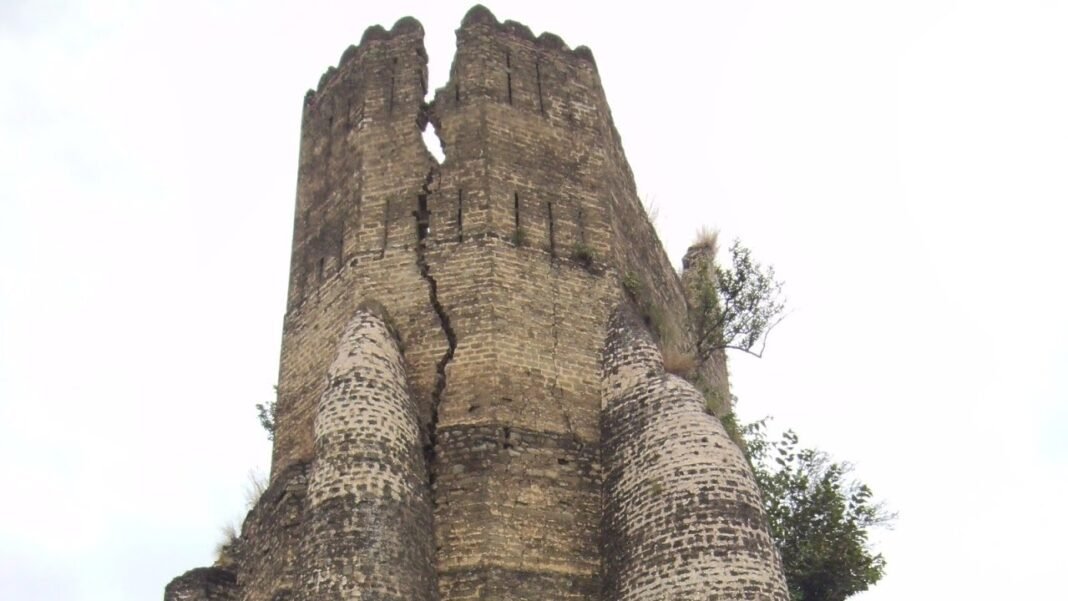
The fort is also architecturally unusual. The official archaeological record describes it as “a small watch tower like fort” whose plan is irregular and multi-faceted, “unique in its erection, architecture, and appearance from all other contemporary forts.” It is built of limestone, bricks, and river-rolled pebbles, lime-plastered inside and out, with multiple stories, a staircase, cells along the fortified wall, rows of niches and arches, and slits in the parapets for defence. There is a secret exit and the remains of a well in the center. You will not see another fort quite like it.
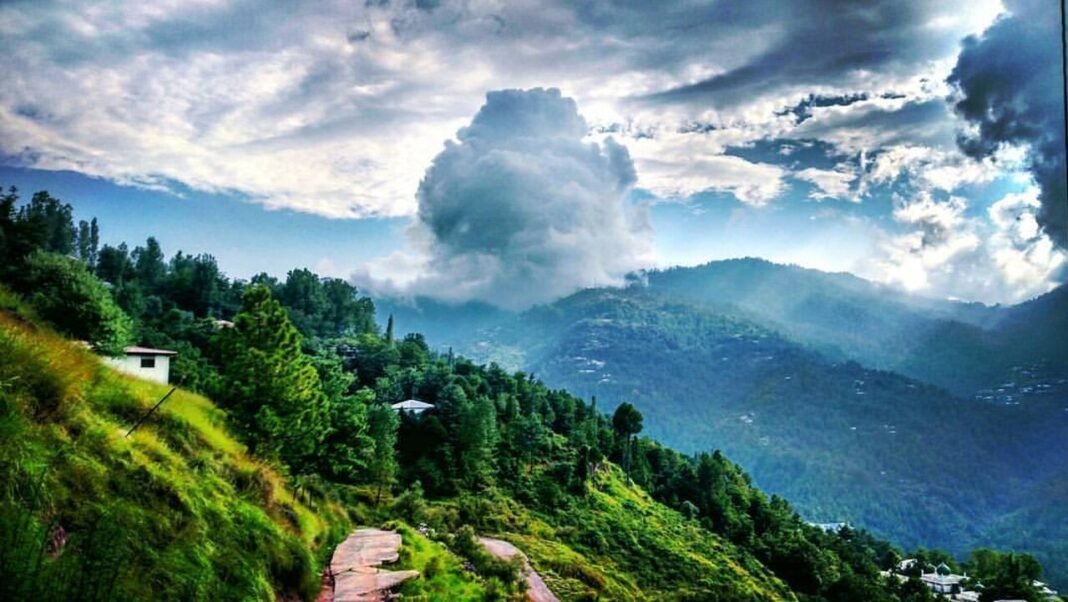
The setting adds a third reason. The fort is surrounded by a green valley that holds medieval-period Hindu temples and modern settlements — layers of history visible in a single panorama. From the cliff top, the strategic logic of the site is immediately clear: whoever held this rock could watch the valley and the road to Sehnsa. Standing there, the 19th-century frontier politics of the region suddenly make sense.
Finally, a trip to Bhrund Fort opens up Kotli district, one of the least-visited parts of Azad Kashmir. Combine the fort with the sulphur springs of Tattapani, the viewpoint at Teenda, and the Poonch river, and you have a two-day itinerary through a region that most tourists skip on their way to better-known valleys.
History of Bhrund Fort
Bhrund Fort is documented in the official survey of Azad Jammu and Kashmir’s heritage, published by the Taxila Institute of Asian Civilizations at Quaid-i-Azam University, Islamabad, in 2020. The fort stands near Bharang Bata Bazar, southwest of Bhrund village, on the left side of the Bhrund road leading to Sehnsa, at a distance of 3 km, and is approached by Hotart Bridge. It is dated to the historic period of 1799-1849 CE — the Sikh era in this region — and is protected under the Azad Jammu and Kashmir Preservation and Protection of Antiquities Act, 1986. Ownership rests with the Government of Azad Jammu and Kashmir.
The survey’s description is the most reliable account we have. The fort sits on a pointed cliff or bedrock at a height of 15 to 20 metres, surrounded by a lush green valley containing medieval-period Hindu temples alongside modern settlements. Its plan is irregular and multi-faceted, and it functioned essentially as a watchtower fort: a small, elevated strongpoint whose strategic location mattered more than its size. It is built of limestone, bricks, and river-rolled pebbles, plastered with lime on both the inner and outer faces.
Inside, the fort has multiple stories and a secret exit — the classic features of a frontier watchpost that might need to be abandoned in a hurry. The remains of a well stand in the center, with cells along the fortified wall and several niches and arches in a row. Slits in the parapets of the fortification served for defence, and a staircase leads up to the fort. The survey notes that the fort is abandoned but in a good state of preservation, though fresh cracks have developed in a side wall, probably due to recent tectonic movements in this seismically active region.
What the record does not give us is a founder’s name or a founding inscription — the fort’s makers left no written trace, which is true of many small frontier forts of the period. The 1799-1849 dating places it in the decades when Sikh power extended across the Punjab and into the Kashmir hills, and small strongpoints like this guarded roads, passes, and tax routes. Visitors should treat local stories about the fort as folklore unless they can be tied to this documented record, and should respect the site’s protected status: it is an antiquity under law, not an open ruin.
Top Things to Do in Bhrund Fort
Climb to the fort and walk the walls
The approach itself is part of the experience: cross by Hotart Bridge, follow the Bhrund-Sehnsa road about 3 km from Bhrund village, and climb the staircase to the cliff top. Once up, walk the fortification and look for the defence slits in the parapets, the rows of niches and arches along the cells, and the remains of the central well. The irregular, multi-faceted plan is best appreciated on foot.
Find the secret exit
The archaeological survey records a secret exit in the fort — a feature that fires the imagination of every visitor. Ask a local guide or caretaker to point out where it lies, and consider what it says about the life of a 19th-century garrison: this was a post meant to be held, watched from, and, if necessary, slipped away from unseen.
Photograph the valley and the temples
The fort’s cliff-top position gives sweeping views over the green valley, with medieval-period Hindu temples visible among the settlements below. Morning light is best for photography, and the contrast of the weathered lime-plastered walls against the valley green makes for striking images. A wide-angle lens helps capture the fort’s perch on its rock.
Explore the medieval temples below
The valley around the fort holds Hindu temples of the medieval period, a reminder that this region’s history long predates the Sikh era. They are best visited on the same trip as the fort; go with a local guide, dress respectfully, and do not disturb any stones or carvings.
Combine with Tattapani’s sulphur springs
About 26 km from Kotli by a fair-weather road, the sulphur water springs at Tattapani are the district’s best-known natural attraction. A Bhrund Fort morning followed by an afternoon at the springs makes a full and varied day.
Famous Places In and Around Bhrund Fort
- Tattapani (sulphur springs): Natural hot sulphur springs about 26 km from Kotli, reached by a fair-weather road currently being improved.
- Sehnsa: The historic town on whose road the fort stands; the route between Kotli and Sehnsa links the district to the rest of Pakistan.
- Teenda: A viewpoint 6 km from Kotli with a Tourism Department rest house, good for sunset views over the hills.
- Khoi Ratta: A high point at 2,570 metres elevation, 78 km from Kotli, with a tourism rest house and remarkable scenery.
- Poonch River: The river on whose brim Kotli town sits, with riverside spots near the town for picnics and photography.
- Mirpur and Mangla: The neighbouring district to the south, with the Mangla reservoir and its lakeside scenery, reachable by metalled road.
How to Reach Bhrund Fort
The gateway to Bhrund Fort is Kotli, the district headquarters of Kotli District in Azad Jammu and Kashmir. According to the AJK tourism authorities, Kotli lies about 141 km from Islamabad and is linked with Rawalpindi and Islamabad via Sensa, Holar, and Kahuta; the drive takes roughly three to four hours. Kotli is also connected with Mirpur by two metalled roads, one via Rajdhani and one via Charhoi. From Kotli town, take the road toward Sehnsa; Bhrund village lies on this route, and the fort stands about 3 km beyond the village on the left side of the road, approached by Hotart Bridge and then a staircase up the cliff.
From Islamabad: Drive via Kahuta, Holar, and Sensa to Kotli — about 141 km, roughly three to four hours on metalled roads. Public vans and coasters run from Rawalpindi and Islamabad to Kotli throughout the day. From Kotli, hire a local taxi or jeep for the onward trip to Bhrund and Sehnsa.
From Lahore: Take the motorway to Islamabad or Rawalpindi, then continue via Kahuta and Holar to Kotli. It is a full day’s journey; most travelers overnight in Islamabad or Rawalpindi, or push straight through to Kotli. Intercity buses connect Lahore with Rawalpindi, from where AJK-bound transport departs.
From Karachi: The practical route is to fly to Islamabad and continue by road to Kotli, or take the train to Rawalpindi and then AJK transport. The overland journey from Karachi is very long and best broken into stages.
The nearest airport is Islamabad International Airport. Within Azad Kashmir, travel is by road: private car, hired jeep, or public coasters and vans. The road from Kotli toward Sehnsa is metalled, and the final approach to the fort is on foot up the staircase. Road conditions are best from October to May; during the July-September monsoon, heavy rain can make hill roads slippery and prone to landslides, so check conditions before setting out.
Route Details
Islamabad → Kahuta → Holar → Sensa → Kotli (about 141 km). From Kotli town, head for Sehnsa; at Bhrund village, continue about 3 km on the Bhrund road, watching for the fort on the left on its pointed cliff. Cross by Hotart Bridge and climb the staircase to the fort. The whole onward leg from Kotli takes under an hour. Start early so you can explore the fort in the morning light and still have the afternoon for Tattapani or Teenda.
Where to Stay in Bhrund Fort
There is no accommodation at the fort itself — stay in Kotli town. According to the AJK tourism department, Kotli has a PWD rest house, a Tourism Department rest house, and a few middle-standard hotels, along with the basic facilities of a district headquarters: bazaar, banks, hospital, and telephone services. Rest houses generally require advance booking through the relevant department, so arrange this before you travel. The town’s small hotels are simple and budget-friendly. Because no specific hotel at Kotli has been verified for this guide, book through a reputable platform and read recent reviews. For a more comfortable base, some travelers stay in Mirpur — which has a wider range of hotels — and visit Kotli and Bhrund as a long day trip, though that makes for a very full day.
Where to Eat: Local Foods of Bhrund Fort
Kotli’s food is the hearty Pahari cooking of Azad Kashmir: maize (makki) roti, pulses, rice, seasonal vegetables, and dairy, with desi ghee featuring proudly. In Kotli town’s bazaar you will find dhabas serving dal, sabzi, chicken karahi, and fresh tandoori roti at budget-friendly prices, plus the usual Pakistani staples of biryani and kebabs. River fish appears on menus when in season. Tea houses serve doodh patti through the day. Carry snacks and drinking water for the fort itself, as there are no eateries at the site — eat in Kotli or Sehnsa before or after your visit. A full dhaba meal in this region is inexpensive, and the hospitality is generous: accept what is offered with thanks.
Weather in Bhrund Fort
The Kotli region has a humid subtropical, sub-mountainous climate: hot and humid summers, a heavy monsoon, and cool winters. The fort sits on an exposed cliff, so sun and wind are both factors — carry water and sun protection even in the cooler months.
| Season | Temperature Range | Conditions |
|---|---|---|
| Winter (Dec-Feb) | 5-20°C | Cool to chilly, nights near freezing; clear days, good for sightseeing |
| Spring (Mar-Apr) | 10-25°C | Mild and pleasant; one of the best seasons to visit |
| Summer (May-Jun) | 25-40°C | Hot and humid; visit the fort early morning |
| Monsoon (Jul-Sep) | 25-35°C | Heavy rainfall; risk of slippery roads and landslides — check conditions |
| Autumn (Oct-Nov) | 15-30°C | Mild and pleasant; the other best season to visit |
Language and Culture of Bhrund Fort
The main language of Kotli district is Pahari, with Urdu widely understood and Gojri spoken in Gujjar communities. The culture is that of the Azad Kashmir hills: conservative, hospitable, and community-minded. Dress modestly — this matters especially around villages and any religious site — and ask permission before photographing people. The population includes Rajputs, Jats, Gujjars, and other long-settled communities, many with family links to the UK diaspora, which is why Kotli town has a slightly more outward-looking feel than its size suggests. Respect the fort’s protected status: do not remove stones, deface walls, or light fires within the monument. If you visit the medieval temples in the valley, treat them with the same care you would any place of worship.
Shopping in Bhrund Fort
There is no shopping at the fort; Kotli town’s bazaar is the place for supplies and souvenirs. The bazaar sells everyday goods, dry fruits, and the Kashmiri-style shawls, caps, and handicrafts common across Azad Kashmir. Look for locally made woolens in winter and simple, sturdy souvenirs rather than expecting a craft market. For a wider selection, Mirpur’s bazaars are larger. There are no shopping malls in the area — come for the heritage, not the retail.
Travel Tips for Bhrund Fort
Packing Essentials
Sturdy walking shoes with grip are essential for the cliff staircase. Carry drinking water, sun protection, and a light rain jacket in monsoon season. A warm layer is needed for winter mornings and evenings. Bring a fully charged phone and a power bank — you will want the camera, and charging points are scarce at the site.
Safety Tips
The cliff edges at the fort have no railings: keep a safe distance, supervise children closely, and do not attempt the staircase in rain. Azad Kashmir is generally peaceful for tourists, but travel in daylight, inform your hotel of your plans, and hire a local guide if you are unsure of the route. Note the survey’s warning about fresh cracks in the fort’s side wall — admire the structure but do not lean on or climb unstable masonry.
Money & Connectivity
Carry cash: small towns and villages around Bhrund may have no ATMs or card facilities. Withdraw in Kotli town, which has banks and ATMs. Mobile signals from major Pakistani networks cover Kotli and the main roads, though coverage can dip in the valleys. Download offline maps before leaving Kotli.
Best Time to Visit Bhrund Fort
Spring (March to April) — best season
Mild temperatures of 10-25°C, clear skies, and green hillsides make spring ideal for climbing to the fort and exploring the valley. This is the most comfortable window.
Autumn (October to November) — also excellent
Similar to spring: mild, dry, and pleasant, with good visibility for photography from the cliff top.
Winter (December to February) — good, with care
Cool days are fine for sightseeing, but nights are chilly and higher roads can be affected by rain. Carry warm clothing.
Summer and monsoon (May to September) — least ideal
May and June are hot and humid; July to September brings heavy monsoon rain with a real risk of landslides on hill roads. If you must travel then, check road conditions and go with a local driver.
Final Thoughts
Bhrund Fort will never be a mass-tourism destination, and that is exactly its charm. It is a genuine, documented piece of 19th-century frontier history — a watchtower fort on a rock, with a secret exit and a well, protected by law and surrounded by older temples and a living valley. Visitors who make the effort are rewarded with solitude, views, and a story most travelers miss.
Pair it with Tattapani’s springs and a night in Kotli, travel in spring or autumn, and treat the monument with the respect a protected antiquity deserves. For more offbeat heritage across the country, explore Explore Pakistan, or contrast the quiet hills of Kotli with the high mountains of the Hunza Valley and the slopes of Malam Jabba.
FAQs
Where is Bhrund Fort located?
Near Bhrund village in Kotli District, Azad Jammu and Kashmir — about 3 km from the village on the Bhrund-Sehnsa road, on a 15-20 metre cliff approached by Hotart Bridge.
What is the history of Bhrund Fort?
It is a Sikh-era (1799-1849 CE) watchtower-like fort, documented in the official 2020 heritage survey of Azad Kashmir and protected under the AJK antiquities act. Its exact founder is not recorded.
How do I reach Bhrund Fort from Islamabad?
Drive via Kahuta, Holar, and Sensa to Kotli (about 141 km, 3-4 hours), then take the Sehnsa road to Bhrund village and continue 3 km to the fort. Public vans run from Rawalpindi/Islamabad to Kotli.
What is the best time to visit Bhrund Fort?
March-April and October-November, when temperatures are mild (10-30°C) and skies are clear. Avoid the July-September monsoon, when hill roads can be dangerous.
Is Bhrund Fort safe to visit?
The area is generally peaceful, but the cliff has no railings and the old masonry has cracks — keep to safe paths, supervise children, travel in daylight, and consider a local guide.
Where can I stay near Bhrund Fort?
In Kotli town, which has a PWD rest house, a Tourism Department rest house, and small mid-range hotels. Book rest houses in advance through the relevant department.
What food is available near Bhrund Fort?
Pahari staples in Kotli’s bazaar — makki roti, dal, sabzi, chicken karahi, and tandoori roti at inexpensive dhabas. Carry water and snacks for the fort itself, as there are no eateries at the site.
What else can I see near Bhrund Fort?
The medieval Hindu temples in the valley below, the sulphur springs at Tattapani (26 km from Kotli), the Teenda viewpoint, Khoi Ratta, and the town of Sehnsa.