Quick Facts
- Location: On the boulders and rock faces along the Indus River and the Karakoram Highway, around the town of Chilas in Diamer district, Gilgit-Baltistan, Pakistan.
- Altitude: Around 1,200 metres (3,900 feet) above sea level at Chilas, where most carving sites are found.
- Famous For: Ancient rock carvings and inscriptions that span roughly 5,000 years — from prehistoric hunting scenes to Buddhist stupas, bodhisattvas, and inscriptions in Kharoshthi, Brahmi, and Sogdian scripts.
- Nearest City: Gilgit, roughly 130 kilometres to the northeast on the Karakoram Highway.
- Accessibility: Road access only. The carvings sit right beside the Karakoram Highway, so any journey between Islamabad and Gilgit-Hunza passes them. The main sites are reachable in an ordinary car; some spots need a short walk over rocky ground.
- Known Landmarks: The Chilas II rock art site near Chilas Gate, the Thalpan carvings across the Indus, and the Shatial rock inscriptions further west on the highway.
- Best For: History lovers, archaeology enthusiasts, photographers, and anyone driving the Karakoram Highway who wants to add one of Pakistan’s greatest open-air museums to their trip.
Why Visit Chilas Rock Carvings
Imagine standing on the bank of the Indus River and looking at a rock face where someone carved a picture of an ibex five thousand years ago. Then you look at the next boulder and find a Buddhist stupa, carved with a sharp chisel sometime in the first few centuries AD. Then, a few steps away, an inscription in a script no living person speaks. The Chilas rock carvings are not one monument but a whole gallery of human history, spread across the rocks of the Indus gorge, left by the countless traders, pilgrims, invaders, and local people who travelled the ancient route between South Asia and Central Asia.
This is one of the greatest concentrations of rock art anywhere in the world. More than 50,000 petroglyphs and inscriptions have been recorded along the Karakoram Highway in Gilgit-Baltistan, grouped at ten major sites between Hunza and Shatial — and Chilas is the beating heart of it. No museum visit can match the feeling of finding these carvings in the open air, with the Indus roaring below and the gorge walls rising around you. It is history you can touch — though, of course, you should never actually touch them, since oils from human hands damage the stone.
There is also a reason to visit sooner rather than later. The Chilas rock carvings face a real threat of submersion from the Diamer-Bhasha Dam project, and heritage experts have warned for years that this irreplaceable gallery could be lost. Every year you delay is a year closer to a future where some of these rocks may sit underwater. If this place is on your list, move it to the top.
This Chilas Rock Carvings travel guide gives you everything you need: the real history with dates and researchers’ names, how to reach the sites from Islamabad, Lahore, and Karachi, the best time to visit, where to stay and eat in Chilas, and practical tips for reading the rocks like an archaeologist. Most travellers race past Chilas on their way to Gilgit and Hunza. This guide will make you want to stop.
History of Chilas Rock Carvings
The story of the Chilas rock carvings begins long before any of the great religions of the region. The earliest carvings date back to somewhere between 5000 and 1000 BC, and they were made by pecking designs into the rock with stone tools. You can still see the thick dark patina covering these images, which is one of the ways archaeologists prove their great age. These oldest pictures show single animals — especially the ibex, the wild mountain goat that remains the symbol of the region — along with strange triangular human figures and hunting scenes in which the animals are sometimes shown larger than the hunters.
Around the first century AD, the character of the carvings changed completely. This was the era when Buddhism was spreading along the Silk Road, and the Indus gorge at Chilas sat squarely on one of the great trade and pilgrimage routes between the Indian subcontinent and Central Asia. The later carvings — most of them made between the 1st and 8th centuries AD — are mostly Buddhist. They were executed with sharp chisels rather than stone tools, and they show stupas, meditating Buddhas, bodhisattvas, and scenes from the Jataka tales, the stories of the Buddha’s previous lives. Alongside the pictures, travellers and monks carved inscriptions in Kharoshthi, Brahmi, and Sogdian scripts, leaving behind names, prayers, and travel records.
The modern study of these carvings is largely the work of the ethnologist Karl Jettmar, who spent years piecing together the history of the region from its inscriptions and published his findings in “Rockcarvings and Inscriptions in the Northern Areas of Pakistan” and the later “Between Gandhara and the Silk Roads: Rock Carvings along the Karakoram Highway.” One of the most fascinating discoveries is a short Kharoshthi inscription from Chilas containing the term “Kaboa” or “Kamboa,” which the great Pakistani archaeologist Ahmad Hasan Dani interpreted as the Kharoshthi form of the Sanskrit “Kamboja” — suggesting that this area once formed part of the ancient Kamboja kingdom.
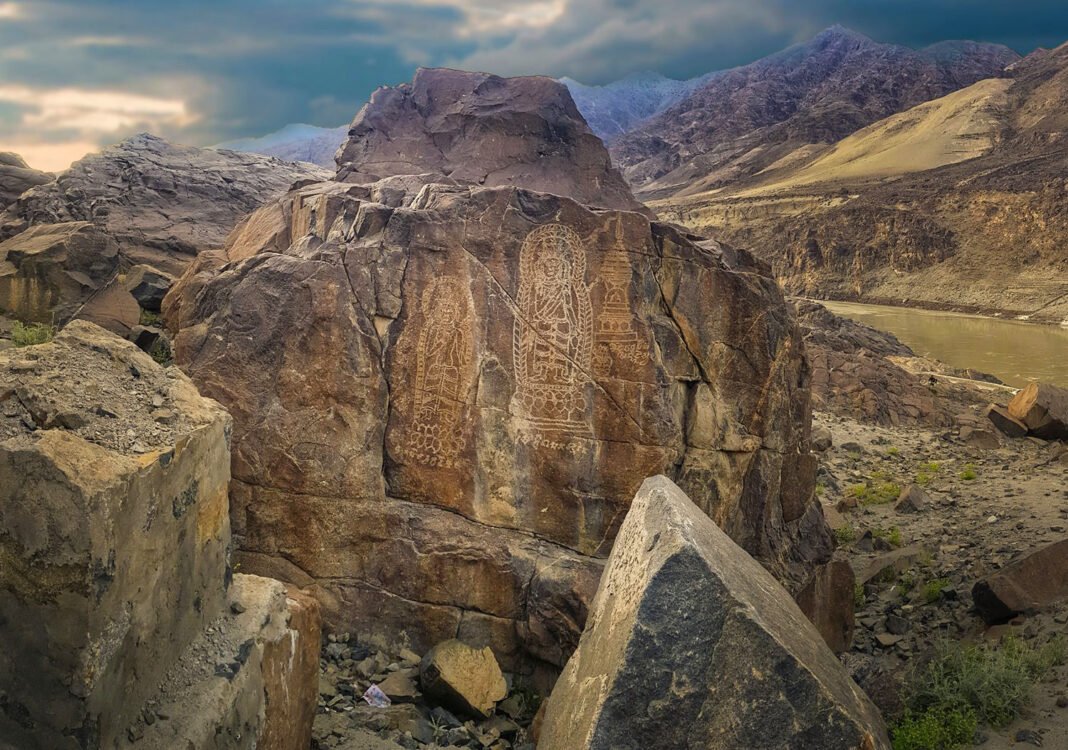
The most concentrated and accessible site is known as Chilas II, located about two kilometres from Chilas Gate on the Karakoram Highway, overlooking the left bank of the Indus. Here you can find some of the finest depictions of stupa adoration, each with its own features, some engraved alongside monks. One of the best specimens sits very close to the Indus itself: on the southern face of a rock, a Buddhist monk is shown before a stupa. Across the river at Thalpan, another great field of carvings stretches over the boulders, and about 60 kilometres west at Shatial, more than a thousand inscriptions crowd the rocks beside the highway where traders once crossed between the routes to Swat, Gilgit, Chilas, and Chitral.
Today these carvings are watched over, at least nominally, by the Gilgit-Baltistan Archaeology Department, but heritage writers have repeatedly warned that documentation and protection efforts are far too slow for the scale of the threat. The Diamer-Bhasha Dam will flood large parts of the gorge, and once the water rises, thousands of carvings could vanish from human sight forever. Visiting the Chilas rock carvings now is not just a pleasure — it is a small act of witness to one of humanity’s oldest art galleries.
Top Things to Do in Chilas Rock Carvings
Visit the Chilas II site at the Indus bank
Chilas II is the single best place to start. It lies about two kilometres from Chilas Gate on the Karakoram Highway, on boulders overlooking the left bank of the Indus. Walk slowly among the rocks and you will find the famous depictions of stupa adoration, some of them accompanied by monks. The finest pieces are close to the river itself. Go in the soft light of early morning or late afternoon, when the low sun rakes across the rock and the carved lines throw shadows — the details jump out at you in a way they never do at midday.
Read the ibex and hunting scenes of the prehistoric era
The oldest images are also some of the most moving. Look for the ibex with their great curved horns, single animals standing in profile, and the triangular human figures from the 5000–1000 BC layer. The hunting scenes are remarkable: tiny hunters with spears pursuing animals that loom larger than they are. These were pecked into the stone with stone tools by people who lived here thousands of years before the Silk Road had a name.
Find the stupas, Buddhas, and bodhisattvas
The Buddhist-era carvings are finer and more detailed, cut with sharp chisels between the 1st and 8th centuries AD. Keep your eyes open for stupas with their characteristic domes and spires, meditating Buddha figures, and bodhisattvas. The famous boulder showing a Buddhist monk before a stupa, very close to the Indus, is one of the most photographed images of the whole complex. Spend time with it — every line was cut by hand, one patient tap at a time.
Look for the inscriptions in three ancient scripts
Not every carving is a picture. Many rocks carry inscriptions in Kharoshthi, Brahmi, and Sogdian — the languages of the traders, pilgrims, and monks who passed through. You will not be able to read them, but a local guide can point out where the scripts change and explain who would have written what. These short texts are the ancient equivalent of travel diaries: names, prayers, and the routes people were following.
Cross to Thalpan, the carving field across the Indus
On the far bank of the Indus from Chilas lies Thalpan, another enormous spread of petroglyphs, including Jataka tale scenes and stupas carved on the boulders. Be aware that the Thalpan site is on private land and is not formally protected, so visitors should ask permission from local landowners before wandering in. The carvings here are just as fine as those at Chilas II, and because fewer tourists come, you will often have the rocks to yourself.
Take the side trip to the Shatial inscriptions
If your itinerary allows, continue about 60 kilometres west of Chilas on the Karakoram Highway to Shatial, where more than a thousand inscriptions line the rocks beside the Indus. Shatial was the great crossroads where routes to Swat, Gilgit, Chilas, and Chitral met, and the Sogdian inscriptions here are among the most studied in the region. Like the other sites, these too face submersion from a dam — the Dasu Dam in this case — so see them while you can.
Famous Places In and Around Chilas Rock Carvings
Chilas town and bazaar — the headquarters of Diamer district, with its bazaar, hotels, and the starting point for all the carving sites. Thalpan — the carving field across the Indus, reached by local tracks; ask landowners for permission. Shatial — about 60 km west on the KKH, with over a thousand rock inscriptions at the old trade crossroads. Babusar Top — the 4,170-metre pass connecting Chilas to Kaghan Valley, open in summer. Nanga Parbat viewpoints — the ninth-highest mountain in the world rises to the east of the gorge. For more northern adventures, see our Hunza Valley travel guide and browse the Explore Pakistan section for the full collection.
How to Reach Chilas Rock Carvings
The Chilas rock carvings sit right on the Karakoram Highway, so reaching them is simply a matter of getting to Chilas. From Islamabad, the classic route follows the Karakoram Highway north through Hassan Abdal, Mansehra, Besham, and Dasu to Chilas — a drive of roughly 470 kilometres that takes 10 to 12 hours depending on road conditions and stops. In summer, there is a shorter and far more scenic alternative: from Islamabad take the Hazara Motorway to Naran, continue up the Kaghan Valley to Babusar Top at 4,170 metres, and descend the 45-kilometre Thak Nallah gorge to join the Karakoram Highway about 5 kilometres north of Chilas. This route is only open from roughly early June to early November, and it turns the journey into one of the great mountain drives of Pakistan.
From Lahore, add the roughly 375-kilometre motorway stretch to Islamabad first, making the total journey to Chilas around 850 kilometres — plan for 14 to 17 hours of driving, and most travellers break the trip overnight in Mansehra, Naran, or Besham. From Karachi, the sensible option is to fly to Islamabad and continue by road, since the road journey from Karachi is far too long for comfort. Alternatively, fly to Gilgit from Islamabad and drive south to Chilas, which is about 130 kilometres and takes around 3 hours.
The nearest airport to the carvings themselves is Gilgit Airport, about 130 kilometres up the Karakoram Highway, with scheduled flights from Islamabad. Road conditions on the KKH are generally good but can be affected by landslides after rain, especially around Dasu and the Indus gorge sections. Public transport options include the NATCO and private coach services that run daily from Islamabad (Pirwadhai) and Gilgit to Chilas. Most visitors, however, travel by private car, hired jeep, or tour van, which also makes it easy to stop at the roadside carving sites. Once you are in Chilas, the Chilas II site is only a couple of kilometres from the town gate, and any local driver knows the way.
Route Details
Islamabad to Chilas via the Karakoram Highway: Islamabad — Hassan Abdal (N-35) — Mansehra — Thakot — Besham — Pattan — Dasu — Shatial — Chilas. This is the all-weather route and passes the Shatial rock inscriptions on the way in. Islamabad to Chilas via Babusar (summer only): Islamabad — Hazara Motorway (M-15) — Mansehra — Balakot — Naran — Babusar Top (4,170 m) — descend the Thak Nallah gorge — Karakoram Highway 5 km north of Chilas. The Babusar route is shorter in kilometres and far more scenic, but it closes with the first heavy snow, usually by early November, and reopens around June.
Where to Stay in Chilas Rock Carvings
Chilas is a highway town rather than a resort, so accommodation here is practical and budget-friendly. Mid-range hotels cluster along and near the Karakoram Highway, offering clean rooms, attached baths, hot water, and meals. Guesthouses run by local families are another good option and often give you the warmest welcome and the best local advice about which carving sites are easiest to reach that day. For travellers heading on to Gilgit or Hunza, Chilas is a natural overnight stop, so rooms fill up during the summer peak season from June to September — booking ahead is wise if you are arriving late in the day.
There are no luxury resorts at the carving sites themselves, and most visitors are happy with that, since the sites are best seen at dawn and dusk anyway. If you want a more comfortable base, consider staying in Naran and doing the Babusar crossing, or push on to Gilgit for a wider choice of hotels. Camping is possible in the valleys around Chilas with the permission of local landowners, but be aware that the Indus gorge at Chilas gets very hot in summer, so carry plenty of water and shade.
Where to Eat: Local Foods of Chilas Rock Carvings
Food in Chilas is the plain, hearty fare of the northern highway towns. The roadside hotels and dhabas along the Karakoram Highway serve daal, mixed vegetables, rice, fresh tandoori roti, omelettes, and strong milky chai — simple cooking that tastes wonderful after a dusty walk among the rocks. The people of Chilas are Shina speakers, and in local homes you may be offered traditional dishes of the region, which visitors should accept with gratitude, as hospitality here is a point of pride.
In the bazaar you will find fruit, dry fruits, and snacks for the road, and the usual Pakistani fast food has arrived along the highway in the form of small restaurants serving chicken karahi and barbecued meats. Carry water with you to the carving sites, especially in summer, when the bare rock radiates heat and there is no shade. A full day’s simple eating in Chilas remains budget-friendly by Pakistani travel standards.
Weather in Chilas Rock Carvings
Chilas sits in the Indus gorge, and its climate is famously hot and dry in summer and dry and cold in winter. Summer days on the bare rock beside the river can reach the mid-30s Celsius and feel hotter in the direct sun, while winter brings cool, crisp days and cold nights. The air is dry all year round, and rain is rare — the gorge is in the rain shadow of the high mountains.
| Season | Temperature Range | Conditions |
|---|---|---|
| Winter (Dec–Feb) | Around 0–10°C | Dry and cold; clear days, chilly nights; the gorge is quiet and the carvings are easy to visit in the warm midday sun. |
| Spring (Mar–May) | Around 15–28°C | Pleasant and clear; one of the best times for the carvings, before the summer heat builds up. |
| Summer (Jun–Aug) | Around 30–40°C | Hot and dry; the bare rock radiates heat. Visit the carvings early in the morning or late in the afternoon and carry water. |
| Autumn (Sep–Nov) | Around 15–28°C | Cooling down with clear skies; September and October are ideal for photography and long walks among the rocks. |
Language and Culture of Chilas Rock Carvings
The people of Chilas are Shina speakers, with some Pashtun settlers speaking Pashto; Urdu is widely understood and some English is spoken in the bazaar and hotels. Diamer district has a conservative culture, and visitors should dress modestly — long trousers or shalwar kameez, and covered shoulders for everyone. Women travellers will be most comfortable in local-style dress.
Hospitality is deeply valued here. If you are offered tea or a meal, it is polite to accept at least a cup. Always ask before photographing people, especially women. At the carving sites themselves, the key rule of culture is also the key rule of conservation: never touch, chalk, or trace the carvings. The oils on your hands and any chalk or paint cause permanent damage. Look, photograph, and leave the stones exactly as the ancient artists left them.
Shopping in Chilas Rock Carvings
The Chilas bazaar is a working highway-town market rather than a tourist bazaar, which is part of its charm. You will find dry fruits — apricots, almonds, and walnuts from the valleys further north — along with local honey, handicrafts, and everyday goods. Woollen shawls and caps from Gilgit-Baltistan make good, light souvenirs. There are no shopping malls anywhere near Chilas, and you should not expect one; buy what you need in Gilgit or Islamabad if you want anything beyond the bazaar’s honest basics. Haggling is gentle and good-natured — treat it as a conversation, not a battle.
Travel Tips for Chilas Rock Carvings
Packing Essentials
Sun protection is the number-one priority: a wide-brimmed hat, sunglasses, and sunscreen, because the gorge reflects heat and light. Carry more drinking water than you think you need, plus sturdy shoes with good grip for walking on rocky ground. A camera with a decent zoom helps you capture fine carved details from a respectful distance. In winter, bring warm layers for the cold nights; in summer, light cotton clothing and a refillable water bottle.
Safety Tips
The carving sites are on uneven rocky ground above the Indus — watch your footing, keep children close, and never climb the carved boulders themselves. The river current below is powerful, so stay back from the water’s edge. Diamer district has seen security concerns in the past; check the current travel situation before you go, travel in daylight, and follow any guidance from local authorities. Most visitors experience a safe, welcoming trip.
Money and Connectivity
Chilas town has banks and ATMs, but machines can run dry or go offline, so carry enough cash for your whole visit. Mobile signals from the major networks work in Chilas town and along the highway, though coverage drops in the deeper gorge stretches. Download offline maps before you leave Islamabad or Gilgit, and let your hotel know your plans if you are heading out to the more remote rocks.
Best Time to Visit Chilas Rock Carvings
Spring (April–May)
The sweet spot. Temperatures are pleasant, the skies are clear, and the Babusar route is usually open by late spring, giving you the scenic approach through Kaghan Valley. This is the best season for long, unhurried walks among the carving fields.
Summer (June–August)
Hot, but fully accessible. All routes are open, including Babusar, and Chilas hums with highway traffic heading to Gilgit and Hunza. Visit the carvings at dawn and dusk, rest in the middle of the day, and you will be fine. This is also the season when the most fellow travellers are on the road.
Autumn (September–October)
Arguably the finest season for the rock carvings. The heat breaks, the light turns golden, and the crowds thin out. The Babusar route stays open until the first heavy snow, usually into October or early November. Photographers should aim for these months.
Winter (November–March)
Cold but peaceful. The Babusar route closes, so you must come via the Karakoram Highway, and nights are chilly. The reward is having the ancient gallery almost entirely to yourself, with the low winter sun raking beautifully across the carved faces.
Final Thoughts
The Chilas rock carvings are one of those rare places where the superlatives are actually earned. Five thousand years of art, three ancient scripts, Buddhist stupas and prehistoric hunters, all scattered across the rocks of one of the world’s great river gorges. And yet most travellers drive straight past. Those who stop find something they will talk about for years — the moment a carved ibex from the Stone Age looked back at them across the millennia.
Go with respect, go with water, and go soon. The dam that threatens these rocks is not a rumour; it is a project, and the water will rise. Visit the Chilas rock carvings while they are still there to be visited, walk quietly among the boulders, and take your photographs home as your small part of the record of this extraordinary place.
FAQs
Where are the Chilas rock carvings located? The carvings are spread along the Indus River and the Karakoram Highway around Chilas, the headquarters of Diamer district in Gilgit-Baltistan, with the main Chilas II site about 2 kilometres from Chilas Gate.
What is the best time to visit the Chilas rock carvings? April–May and September–October are ideal, with pleasant temperatures and clear skies. Summer is hot but fully accessible; winter is cold and quiet.
How do I reach the Chilas rock carvings? Drive the Karakoram Highway from Islamabad (roughly 470 km, 10–12 hours) or from Gilgit (roughly 130 km, 3 hours). In summer you can also come via Babusar Top from Naran. The sites sit beside the highway, and any local driver knows them.
Are the Chilas rock carvings safe to visit? Yes, with normal precautions. Watch your footing on the rocky ground, keep away from the river’s edge, carry water, and check the current security situation for Diamer district before travelling.
Are the Chilas rock carvings suitable for families? Yes. The main sites need only short walks over rocky ground, making them manageable for children and older travellers. Keep children close near the river and on uneven rocks.
Where can I stay near the Chilas rock carvings? Chilas town has mid-range hotels, guesthouses, and highway lodges along the Karakoram Highway. Book ahead in the summer peak season (June–September).
What local food can I try in Chilas? Roadside hotels serve daal, vegetables, rice, fresh tandoori roti, and milky chai. The bazaar has dry fruits and local snacks for the road.
Why are the Chilas rock carvings in danger? The Diamer-Bhasha Dam project will flood parts of the Indus gorge where the carvings are located, potentially submerging thousands of petroglyphs. Heritage experts have urged faster documentation and protection.