Most travellers racing from Karachi to Thatta have one destination in mind: the great Shah Jahan Mosque, with its hundred domes. But the old city of Thatta hides an older secret — the Dabgir Masjid, a small Mughal-era mosque built in 1588 that is thought to be the oldest surviving monument in the city, and quite possibly the very mosque where a young Shah Jahan once prayed. This Dabgir Masjid travel guide will show you why this weathered little masterpiece deserves your detour — and how to reach it.
History lovers, this one is for you. If the grand, perfect monuments leave you cold and the wounded, half-forgotten ones move you, the Dabgir Masjid will speak to you. Its central dome fell two centuries ago. Its tiles are fading. And yet its stone mihrab — carved with tracery so delicate it looks like sandalwood — remains one of the finest pieces of craftsmanship in Sindh. Come here to meet Thatta before it became famous.
Quick Facts
- Location: Thatta, Sindh, Pakistan — in the old town, near the historic centre
- Nearest City: Karachi, about 98 km west via the N-5 National Highway
- Famous For: One of the oldest mosques in Thatta (1588); among the earliest examples of Thatta’s blue tilework; an exquisitely carved stone mihrab
- Accessibility: Road — about 2 hours from Karachi by car; the mosque sits on a high platform in the old town
- Known Landmarks: The 1588 mosque of Amir Khusrau Khan Charkas; three bays under one large and two small domes
- Best For: History lovers, architecture students, heritage photographers, and travellers exploring Thatta’s old city
Why Visit Dabgir Masjid
Let us be honest: the Dabgir Masjid will not impress you the way the Shah Jahan Mosque does. There is no forest of domes, no courtyard the size of a football field. What there is, is something rarer — age. Built in 1588, when Elizabeth I sat on the English throne and Akbar ruled Hindustan, this mosque has watched Thatta grow from a river port into a capital of learning and then into the quiet historic town it is today. To stand inside it is to stand at the very beginning of Thatta’s architectural story.
The craftsmanship is the second reason, and it is a powerful one. The mosque’s mihrab — the prayer niche that orients the faithful toward Makkah — is carved from stone with a delicacy of tracery that early writers described as superb, a piece of work so fine it seems to belong to woodcarving rather than masonry. Around it, the surviving tilework glows in the blues and greens that would become the signature of all Sindh: this is where the great Thatta tile tradition began, centuries before it covered the Shah Jahan Mosque. For anyone who loves Islamic art, the Dabgir Masjid is a pilgrimage to the source.
Then there is the Shah Jahan connection, which gives the little mosque its romance. Local historical tradition holds that this may have been the older Jamia Masjid of Thatta — the mosque in which Shah Jahan himself worshipped during his time in the city, decades before he built his own great mosque here. Whether or not the tradition is literally true, it captures something real: this building was already ancient and venerated when the Mughal emperors were still making their mark on Sindh.
Finally, visit because it needs you. The Dabgir Masjid has suffered from neglect — its central dome collapsed in the 19th century, and recent visitor accounts describe periods of closure for repairs and damage from careless upkeep. Heritage survives when people care about it. Your visit, your photographs, and your voice add to the quiet chorus saying this 400-year-old treasure matters. Come now, while its tiles still catch the morning light.
History of Dabgir Masjid
The Dabgir Masjid was built in AH 997 — 1588 CE — by Amir Khusrau Khan Charkas, a nobleman of striking lineage who claimed descent from Changez Khan. Just two years later, in 1590, when the Mughals brought Sindh under direct rule, Khusrau Khan was made governor of Thatta. He proved an extraordinary builder: tradition credits him with more than 360 public works in Thatta alone — mosques, tombs, bridges, inns, wells, and madrasahs — a one-man building programme that shaped the city for centuries.
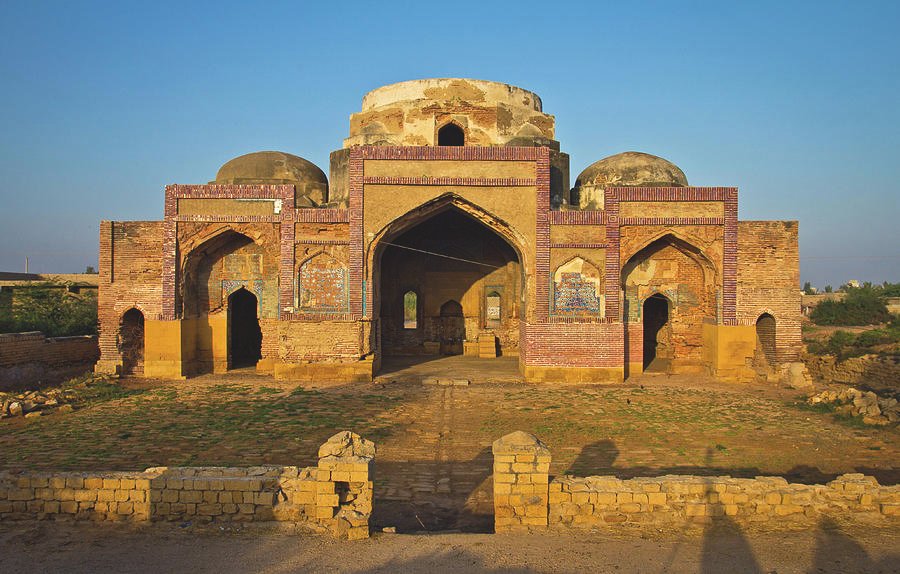
The mosque he built for the Dabgir quarter measures about 83 by 36 and a half feet, raised on a high platform with four minarets at its corners — a distinctive Mughal touch. It was designed with three bays, each crowned by its own dome: two smaller domes flanking one large central dome. The interior was fully decorated with fresco painting, and the walls carried some of the finest early coloured tilework in lower Sindh — the first flowering of the glazed-tile tradition that would later make Thatta famous across the Muslim world.
The centuries that followed were eventful. Thatta rose and fell as a capital; the Indus shifted its course; empires came and went. Through it all the little mosque endured, and by the time the British began documenting Sindh’s monuments, it was already regarded as perhaps the oldest mosque in the city — and very likely its oldest surviving monument outright. The great central dome, however, did not survive: it fell in the 19th century, leaving the mosque’s silhouette forever altered, a wound that gives the building its poignant character today.
In modern times the mosque has faced the quieter enemies of neglect and poor maintenance. Visitor accounts in recent years describe damage from careless upkeep and periods when the site was closed to the public for repairs. It remains listed among the protected heritage of Sindh, under the care of the archaeology and Auqaf authorities. For the thoughtful traveller, that fragility is part of the experience — you are visiting a monument that is still fighting for its future, and your attention is a small act of preservation.
Top Things to Do in Dabgir Masjid
The Dabgir Masjid is a compact site — plan for an hour, ideally in the soft light of morning — but look closely and it repays every minute.
Study the Stone Mihrab
Make the mihrab your first stop. Carved from stone with extraordinarily delicate tracery, it is the artistic crown of the mosque — early architectural writers called it a superb piece of work, and standing before it you will understand why. Trace the patterns with your eyes (not your hands) and notice how the carver made stone behave like lace. This single niche justifies the whole journey from Karachi.
Read the Early Tilework
Look up at the surviving domes and walls for the coloured tilework — among the earliest examples of the Thatta tile tradition. The floral motifs and geometric patterns inside the domes, imprinted with exceptional refinement, are the ancestors of the tilework that would later cover the Shah Jahan Mosque. For students of Islamic art, this is a rare chance to see the tradition at its source.
Walk the High Platform
The mosque stands raised on a high platform, with minarets at its corners — climb up (carefully) and take in the view over Thatta’s old town. From this height you can read the city’s layers: the dense old quarters, the minarets of later mosques, and on a clear day the green thread of the Indus valley beyond.
Photograph a Wounded Beauty
Heritage photographers: the fallen central dome is not a flaw but a feature. Frame the two surviving smaller domes against the sky, shoot the tile details in raking morning light, and capture the contrast between the mosque’s refined craftsmanship and its weathered state. These are photographs with a story — and a quiet argument for conservation.
Combine with Thatta’s Great Monuments
The Dabgir Masjid sits within easy reach of Thatta’s headline sights. Pair it with the Shah Jahan Mosque to see the tile tradition at its beginning and its peak in a single day, then continue to the Makli Necropolis — one of the world’s great funerary landscapes — for the full Thatta experience.
Famous Places In and Around Dabgir Masjid
- Shah Jahan Mosque, Thatta: The 17th-century masterpiece with 93 domes — the essential companion visit.
- Makli Necropolis: The vast UNESCO-listed city of the dead, one of the largest necropolises in the world.
- Keenjhar Lake: Sindh’s great freshwater lake, beloved for picnics and birdwatching.
- Banbhore: The ancient port-city ruins on the Indus delta, for archaeology lovers.
- Sonda: The riverside town about 40 km away, famous for its centuries-old graveyard and its legendary halwa.
How to Reach Dabgir Masjid
The Dabgir Masjid is in Thatta’s old town, and Thatta is one of the easiest heritage day-trips in Pakistan: about 98 km east of Karachi along the N-5 National Highway, roughly a 2-hour drive. The mosque itself sits on a high platform in the old quarter — ask locals for the “Dabgir Masjid” and they will point you to it.
From Karachi: Drive east on Shahrah-e-Faisal, merge onto the N-5, and follow it straight to Thatta — about 98 km, roughly 2 hours. Buses and vans also run regularly from Karachi to Thatta. For a charming alternative, the Dhabeji Express local train runs from Karachi’s Cantt Station to Dhabeji Station in district Thatta for a nominal fare — from Dhabeji it is about a 40-minute drive to Thatta’s monuments.
From Lahore: Around 1,300 km by road, so fly to Karachi (about 1 hour 45 minutes) and drive to Thatta from there. Many travellers combine Thatta with a Karachi trip — it makes a perfect day excursion from the city.
From Islamabad: Fly to Karachi (about 2 hours) and continue by road to Thatta. The total journey is easily done in a day if you start early.
The nearest airport is Jinnah International Airport, Karachi. Road conditions on the N-5 to Thatta are generally good, though monsoon rains can cause local flooding — check conditions in July and August. Note that visitor accounts have described the mosque as periodically closed for repairs, so confirm locally before making the trip, and be prepared for the possibility that interior access may be restricted on a given day.
Route Details
- Reach Karachi by air, rail, or road.
- Take Shahrah-e-Faisal east out of Karachi and merge onto the N-5 National Highway toward Thatta.
- Follow the N-5 for about 98 km (roughly 2 hours) into Thatta town.
- In the old town, ask for the Dabgir Masjid — it stands on its high platform near the historic centre.
- Combine with the Shah Jahan Mosque and Makli Necropolis for a full day, returning to Karachi by evening.
Where to Stay in Dabgir Masjid
Most visitors see the Dabgir Masjid as a day trip from Karachi, where the full range of accommodation awaits. But if you want to linger in Thatta — and the town rewards lingering — there are options.
Karachi base (recommended): Stay in Karachi — from budget guesthouses in Saddar to five-star hotels on Shahrah-e-Faisal and Clifton — and drive to Thatta for the day. This gives you the city’s restaurants and comforts with the monuments just 2 hours away.
Thatta town: Thatta has modest hotels and guesthouses catering to domestic travellers and tour groups visiting Makli. They are simple but serviceable, and staying overnight lets you see the Shah Jahan Mosque at dawn before the day-trippers arrive.
Keenjhar Lake resorts: The lake area has picnic resorts and a few rest-house style accommodations — a pleasant base if you want to combine heritage with the lakeside.
For most travellers, the smart play is a Karachi hotel plus an early start: you can cover the Dabgir Masjid, the Shah Jahan Mosque, and Makli in one long, glorious day.
Where to Eat: Local Foods of Dabgir Masjid
Thatta’s cuisine is classic Sindhi — hearty, spiced, and deeply satisfying after a morning among the monuments. The town’s eateries serve Sindhi biryani, fragrant and fiery; sai bhaji, the beloved spinach-and-lentil dish eaten with rice; Sindhi curry; and fresh tandoori roti and Thatta khaboos, the local bread. Meals are very budget-friendly — a full lunch at a local hotel costs little.
Do not leave the district without tasting Sonda halwa. Sonda, a small town about 40 km from Thatta on the banks of the Indus, is famous across Sindh for this traditional sweet, made to a decades-old recipe with desi ghee — travellers have long made the stopover specially for it, and many send it to loved ones abroad. It is the edible souvenir of a Thatta trip. Wash your meal down with lassi or chai, and if you are in Thatta in winter, ask for kheer kharkoon, the slow-cooked date-and-milk dessert of the season.
Weather in Dabgir Masjid
Thatta sits on Sindh’s coastal plain, and its climate runs close to Karachi’s — hot for much of the year, with a brief, delightful winter. The mosque is best explored on foot in the cool months.
| Season | Temperature Range | Conditions |
|---|---|---|
| Winter (Dec–Feb) | 12°C – 28°C | Mild and dry; the ideal season for walking Thatta’s monuments. |
| Spring (Mar–Apr) | 20°C – 36°C | Warming fast; pleasant mornings, hot afternoons. |
| Summer (May–Jun) | 28°C – 40°C+ | Intensely hot; visit at dawn and retreat indoors by midday. |
| Monsoon (Jul–Sep) | 28°C – 36°C | Humid with monsoon showers; the N-5 can flood locally — check road conditions. |
| Autumn (Oct–Nov) | 18°C – 36°C | Cooling and dry; November is excellent for heritage touring. |
Language and Culture of Dabgir Masjid
Thatta is a Sindhi-speaking town to its core — Sindhi is the language of the bazaar, the home, and the shrine, though Urdu is widely understood. The culture is deeply rooted in Sindh’s Sufi and scholarly traditions; Thatta was once called a city of learning, and its people remain proud of that heritage.
As a mosque, the Dabgir Masjid asks for the visitor’s respect: dress modestly (cover shoulders and knees; women should carry a scarf), remove your shoes before stepping onto the prayer platform, keep your voice low, and avoid visiting during prayer times unless you are there to pray. Ask permission before photographing worshippers. A greeting of “Assalam-o-Alaikum” and a few words of admiration for the old building will warm every heart in the neighbourhood — Thatta’s people love visitors who love their history.
Shopping in Dabgir Masjid
Thatta’s bazaars are a treasure chest of Sindhi handicrafts. The town is famous for ajrak — the magnificent block-printed shawl of Sindh in deep indigo and crimson — and for rilli, the vibrant patchwork quilts pieced together by Sindhi women. Skilled artisans also produce pottery, woodwork, and embroidery, all reflecting centuries of craft tradition.
Buy directly from the bazaar shops near the old town: prices are honest, bargaining is gentle and expected, and your purchase supports the artisan families who keep these traditions alive. A piece of ajrak from Thatta is not just a souvenir — it is a fragment of Sindh’s soul, and it makes a far better memento than anything in an airport shop.
Travel Tips for Dabgir Masjid
Packing Essentials
Comfortable walking shoes, a sun hat, sunscreen, and plenty of water — Thatta’s sun is fierce outside winter. Carry a scarf (for mosque visits and dust), a camera, and a power bank. If you are combining Makli and the Shah Jahan Mosque, pack a full day’s supplies: Thatta’s monument zone is spread out.
Safety Tips
Thatta is a quiet, welcoming town and the monument circuit is well-travelled. Visit during daylight, keep valuables discreet, and hire a local guide if you want the deeper stories — Thatta’s guides are knowledgeable and inexpensive. The mosque’s old structure demands care: do not climb on fragile sections or the damaged dome area.
Money & Connectivity
ATMs exist in Thatta town but are fewer than in Karachi — withdraw cash in Karachi before the day trip. Mobile signals are generally good in Thatta on all major networks, though data can be patchy around Makli’s remoter corners. Monument-area vendors are cash-only.
Best Time to Visit Dabgir Masjid
Winter (November to February) — The Ideal Season
Cool, dry, and perfect. This is the best time to visit the Dabgir Masjid and all of Thatta’s monuments — comfortable walking weather, clear skies, and the Indus valley at its most pleasant. Plan your trip for these months if you can.
Spring (March to April) — Good Mornings
March is still enjoyable; by April the heat is building. Start at dawn with the Dabgir Masjid, move to the Shah Jahan Mosque, and finish at Makli before the afternoon sun peaks.
Summer and Monsoon (May to September) — For the Determined
Sindh’s summer is brutal and the monsoon brings humidity and the risk of road flooding. If you travel then, go at dawn, carry ample water, and check N-5 conditions before setting out.
Autumn (October to November) — The Sweet Spot
October and November offer warm days, cool evenings, and dry roads — an excellent shoulder season for Thatta, with fewer day-trippers than winter.
Final Thoughts
The Dabgir Masjid is not the biggest, the grandest, or the most perfect monument in Sindh — and that is precisely its power. In its fallen dome and fading tiles you can read four centuries of Thatta’s story: the ambition of a governor who built 360 monuments, the piety of the worshippers who filled its three bays, and the long, slow battle of a small masterpiece against time. The great Shah Jahan Mosque will take your breath away; the Dabgir Masjid will quietly steal your heart.
So when you plan your Thatta day, leave an hour for the old soldier of the Dabgir quarter. Stand before the stone mihrab, look up at the tiles where Sindh’s great ceramic tradition began, and remember that you are standing in what may be the oldest surviving monument of the city. For more journeys into Pakistan’s hidden heritage, explore our Explore Pakistan collection — and when the mountains call, our Hunza Valley guide awaits.
FAQs
Where is Dabgir Masjid located?
In the old town of Thatta, Sindh — about 98 km east of Karachi via the N-5 National Highway.
What is Dabgir Masjid famous for?
Built in 1588 by Amir Khusrau Khan Charkas, it is thought to be Thatta’s oldest surviving monument, with early blue tilework and a superbly carved stone mihrab.
When is the best time to visit Dabgir Masjid?
November to February, when Sindh’s weather is cool and dry — ideal for exploring on foot.
How do I reach Dabgir Masjid?
Drive from Karachi to Thatta (about 2 hours via N-5), then ask locals in the old town for the Dabgir Masjid. From Lahore or Islamabad, fly to Karachi first.
Is Dabgir Masjid open to visitors?
Visitor accounts describe periodic closures for repairs, so confirm locally before visiting. When open, dress modestly and respect prayer times.
Is it safe for families?
Yes. Thatta’s monument circuit is well-travelled and welcoming; visit during daylight hours as with any heritage site.
What else should I see in Thatta?
The Shah Jahan Mosque, the Makli Necropolis, Keenjhar Lake, and the riverside town of Sonda.
What food is Thatta famous for?
Sindhi biryani, sai bhaji, and above all the legendary Sonda halwa from the nearby town of Sonda.
Did Shah Jahan really pray at Dabgir Masjid?
Local historical tradition holds that it may have been the older Jamia Masjid where Shah Jahan worshipped during his time in Thatta — one of the romantic stories that cling to this ancient building.