Quick Facts
- Location: Hilltop above Jaulian village, near the Khanpur–Taxila road, Taxila, Punjab (Haripur district boundary)
- Altitude: The hill rises about 100 metres above the surrounding village
- Famous For: 2nd-century CE Buddhist monastery and stupa complex; one of the ancient world’s great seats of learning; the “Healing Buddha” statue; part of the UNESCO World Heritage Ruins of Taxila
- Nearest City: Taxila (~a few km); Rawalpindi (~35 km); Islamabad (~45 km)
- Accessibility: Reached by a climb of roughly 250 steps with handrails up the hill
- Known Landmarks: Main central stupa, 27 smaller stupas, 59 chapels with Buddha life scenes, two monastic quadrangles
- Best For: History lovers, students, Buddhist pilgrims, photographers, families on an educational day trip from Islamabad
Why Visit Jaulian Buddhist Monastery, Taxila
Most people who visit Taxila never climb the hill — and that is exactly why you should. Jaulian sits on a high, windy hilltop above a quiet Punjabi village, and it is one of the most atmospheric ruins in Pakistan: a 2nd-century Buddhist monastery where monks once studied, debated and prayed, with views that stretch for miles across the Taxila valley. While the crowds gather at the Taxila Museum and the Dharmarajika Stupa below, Jaulian waits for the travellers who want the full story — a complete monastic world, frozen at the moment the ancient city fell.
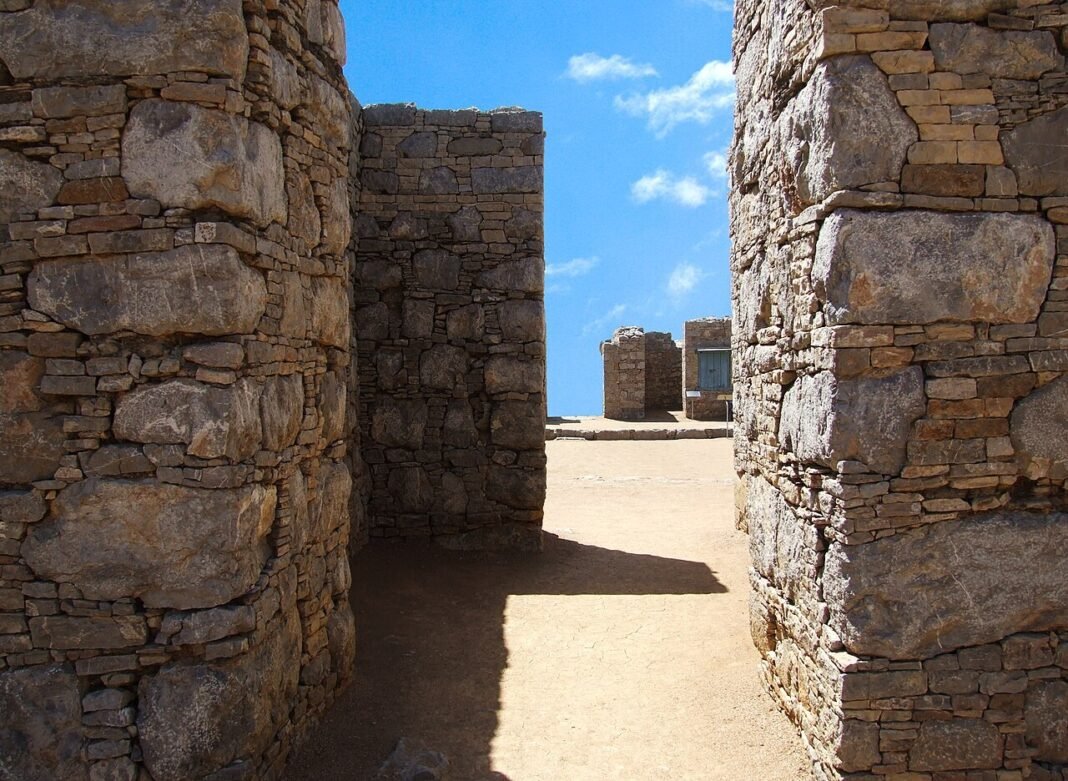
What makes Jaulian extraordinary is how much of monastic life survives here. This was not just a stupa; it was a university. Some 56 student rooms arranged around two quadrangles, an assembly hall, a kitchen, store rooms, a pool for ritual washing, even a workshop where Buddhist manuscripts were produced on birch bark. Walk the upper court and you can read the daily routine in the stones: prayer, study, meals, debate. The 59 small chapels around the main stupa still carry scenes from the life of the Buddha in stucco relief, and among the 21 votive stupas stands one of the site’s most beloved figures — the “Healing Buddha,” a statue with a hole in its navel where, for centuries, pilgrims placed their fingers and prayed for cures.
And then there is the view. The climb of roughly 250 steps (with handrails) is the price of admission, and it pays off at the top: clear air, the whole sweep of Taxila’s archaeological landscape below, and a silence that makes the 1,800-year-old stones feel startlingly present. For anyone interested in Pakistan’s Buddhist heritage, for students of Gandhara art, and for families who want a day trip that is genuinely educational without being dull, Jaulian is one of the finest heritage sites in the country — and one of the easiest to reach from Islamabad.
History of Jaulian Buddhist Monastery, Taxila
Jaulian was built in the 2nd century CE, during the Kushan period — the golden age of Buddhism in Gandhara, when the Kushan emperors (most famously Kanishka) turned Taxila into one of the ancient world’s great centres of learning. It was constructed around the same time as the nearby Mohra Muradu monastery, and the two complexes share the same architectural DNA. This was the era when Gandharan art — the great fusion of Greek, Persian and Indian styles — reached its peak, and Jaulian’s stucco-coated stupas and chapels are textbook examples of it.
For three centuries, Jaulian thrived as a seat of learning. Scholars came from India, Afghanistan, China, Persia and Greece to study here; the site’s Kharosthi-script inscriptions still preserve the names of donors and monks. Coins recovered from the ruins tell the story of its cosmopolitan world in miniature: Kushan royal portraits on one side, Greek lettering and Buddhist symbols on the other. The monastery’s two levels housed 56 student rooms, and one section was devoted to producing Buddhist manuscripts on birch bark — Jaulian was, in every meaningful sense, a university.
The end came in the 450s CE, when the White Huns invaded and devastated ancient Taxila. Jaulian was destroyed along with the rest of the city, and the persecution of Buddhists by the Hun king Mihirakula ensured it never recovered. The monks left, the roofs collapsed, and the stucco Buddhas stood open to sixteen centuries of weather. The site slept until the early 20th century, when the Archaeological Survey of India, under Sir John Marshall, excavated Taxila’s ruins and brought Jaulian back to light. In 1980, the Ruins of Taxila — including Jaulian — were inscribed as a UNESCO World Heritage Site, and today the complex is managed as part of Pakistan’s most important Buddhist heritage landscape.
Top Things to Do in Jaulian Buddhist Monastery, Taxila
Explore the Main Stupa Court
The heart of Jaulian is its upper court, dominated by the main central stupa — once coated in stucco plaster and crowned with the ceremonial umbrella symbolizing the Buddha’s sovereignty. Around it stand 21 smaller votive stupas, many with their Buddha statues still in place. The main stupa is smaller than Taxila’s Dharmarajika or Mohra Muradu examples and badly damaged, but the surviving plaster work and the forest of surrounding stupas make this one of the most photogenic archaeological scenes in Punjab.
Meet the Healing Buddha
Among the votive stupas sits the site’s most famous figure: a Buddha statue with a hole in its navel, known as the Healing Buddha. For centuries, pilgrims placed their fingers in the hole and prayed for cures to their ailments — a 5th-century inscription beneath the statue records that it was donated by a friar named Budhamitra Dharmanandin. It is a moving, human detail in an ancient ruin: faith you can literally touch.
Read the Chapels’ Buddha Life Scenes
Jaulian’s 59 small chapels once displayed a pictorial biography of the Buddha in stucco relief — birth, enlightenment, first sermon, death. Much has weathered away, but enough survives to follow the story around the complex. Bring a guidebook or a good guide and the chapels become a 1,800-year-old comic strip of the Buddha’s life.
Walk the Monastic Quadrangles
The two quadrangles of Jaulian preserve the monks’ daily world: individual cells, the assembly hall for lectures and debates, the kitchen and store rooms, the washing pool, and the grinding stones that milled the monastery’s grain. This is where Jaulian stops being a monument and becomes a place people lived — look for the niches for lamps and the windows designed to keep out wild animals, and the ancient routine comes alive.
Combine With Mohra Muradu and the Taxila Museum
Jaulian’s twin, Mohra Muradu, stands nearby and was built in the same period — visit both to see how a Kushan monastery was laid out. Then descend to the Taxila Museum, which houses many of the finest sculptures recovered from Jaulian and the other sites, including stucco Buddhas too fragile to leave in the open. A full Taxila day easily covers Jaulian, Mohra Muradu and the museum.
Take In the Hilltop Views
The 250-step climb is worth it for the panorama alone. From the top of the hill, on a clear day you can see across the entire Taxila valley — the archaeological sites, the modern town, the Margalla Hills in the distance. Early morning light is the best, and the air is clearest in winter.
Famous Places In and Around Jaulian Buddhist Monastery, Taxila
- Mohra Muradu Monastery: Jaulian’s contemporary twin, a few kilometres away — the other great 2nd-century monastery of Taxila.
- Taxila Museum: Houses the finest Gandharan sculptures excavated from Jaulian, including stucco Buddhas and Kharosthi-inscribed finds.
- Dharmarajika Stupa: One of the largest stupas in the Taxila region, traditionally associated with the Mauryan emperor Ashoka.
- Bhir Mound: The oldest of Taxila’s ruined cities, dating to the 6th century BCE — see our Bhir Mound travel guide.
- Giri Buddhist Remains: Another Buddhist complex in the Taxila landscape — see our Giri Buddhist Remains travel guide.
- Sirsukh & Sirkap: The later walled cities of ancient Taxila, with streets and stupas you can walk.
- Khanpur Dam: The popular picnic and boating spot on the Khanpur–Taxila road, handy for a relaxed afternoon after the ruins.
- Margalla Hills, Islamabad: Pair your Taxila day with the capital’s trails and viewpoints — see our Islamabad travel guide.
How to Reach Jaulian Buddhist Monastery, Taxila
Jaulian is one of the most accessible major archaeological sites in Pakistan. It sits on a hilltop near the Khanpur–Taxila road, a short drive from Taxila town. From Islamabad it is roughly 35–45 km (about an hour to 1.5 hours depending on traffic); from Rawalpindi about 35 km. The route is straightforward: GT Road west from Islamabad/Rawalpindi toward Taxila, then local roads to the village of Jaulian, where the signed stairway of about 250 steps climbs the hill. Go early in the day, especially in warmer months — the climb is punishing in May and June heat.
From Lahore, Taxila is about 310 km via the GT Road (or motorway to Islamabad, then GT Road), roughly 5 to 6 hours of driving. From Karachi, fly to Islamabad and continue by road — the site makes an easy day trip from the capital. Public transport options include vans and buses from Rawalpindi’s Pirwadhai stand to Taxila town, from where a rickshaw or local van can take you to the Jaulian village turn-off; the last stretch is best done in a hired rickshaw or car.
Jaulian is open to visitors as part of the active Taxila archaeological complex, managed by the Punjab Department of Archaeology. There is a large site map at the entrance to help orient yourself, and local guides are often available at the Taxila sites.
Route Details
- Islamabad → Taxila: Take the GT Road (N-5) west toward Taxila; roughly 35–45 km, 1–1.5 hours.
- Taxila town → Jaulian village: Follow the Khanpur–Taxila road to the Jaulian turn-off; local rickshaws know the site.
- Jaulian village → monastery: Climb the signed stairway of roughly 250 steps with handrails to the hilltop ruins.
- Combining sites: Jaulian → Mohra Muradu → Taxila Museum makes the classic half-day Taxila circuit.
Where to Stay in Jaulian Buddhist Monastery, Taxila
Most visitors do Jaulian as a day trip from Islamabad or Rawalpindi, which have the full range of accommodation — from budget guesthouses to comfortable mid-range hotels and luxury options in the capital. Staying in Islamabad also lets you combine Taxila with the Margalla Hills and the city’s museums over a weekend.
If you prefer to stay closer, Taxila town has basic hotels and guesthouses at budget-friendly rates — fine for a night, though comfort levels are modest. For a heritage-focused trip, some travellers stay in the Taxila–Hassanabdal area and cover Jaulian, the Taxila Museum, and the other ruins across two unhurried days. There is no accommodation at the site itself, and camping is not appropriate at a protected archaeological complex.
Where to Eat: Local Foods of Jaulian Buddhist Monastery, Taxila
There are no restaurants at the hilltop — eat in Taxila town or bring snacks and water for the climb. Taxila and nearby Hassanabdal run on classic Potohari-Punjabi dhaba food: daal, sabzi and roti platters, grilled kebabs, chana and rice, washed down with sweet lassi or doodh patti. Prices are genuinely budget-friendly — a full dhaba meal for two costs very little by city standards.
For a wider choice, Islamabad and Rawalpindi are under an hour away, with everything from Food Street-style desi restaurants to cafes. If you are doing the full Taxila circuit, a good plan is breakfast in the capital, the ruins through the morning, lunch at a Taxila dhaba, and the museum in the afternoon.
Weather in Jaulian Buddhist Monastery, Taxila
Jaulian sits on the Potohar plateau, sharing the climate of Taxila and Islamabad: hot summers, mild winters, and a monsoon that greens the valley between July and September. The hilltop is exposed — there is almost no shade on the ruins — so timing matters more here than at most sites. October to March is the comfortable season; in May and June the stair climb in midday heat is genuinely punishing. Winter mornings can be misty and magical, with the stupas emerging from the fog.
| Season | Temperature Range | Conditions |
|---|---|---|
| Winter (Dec–Feb) | 5°C to 15°C | Mild, clear days; misty mornings; ideal sightseeing weather |
| Spring (Mar–Apr) | 18°C to 30°C | Pleasant; wildflowers around the ruins; great for the climb |
| Summer (May–Jul) | 30°C to 42°C | Very hot and exposed; visit at dawn or skip until autumn |
| Monsoon (Jul–Sep) | 28°C to 36°C | Humid with rain showers; slippery steps; lush green surroundings |
| Autumn (Oct–Nov) | 15°C to 28°C | Clear, comfortable — the best all-round season |
Language and Culture of Jaulian Buddhist Monastery, Taxila
The villages around Taxila speak Punjabi in its Potohari dialect, with Urdu understood everywhere and English common among guides and museum staff. This is the agricultural Potohar — a culture of wheat fields, village hospitality and deep historical awareness; locals grow up with the ruins on their horizon and many are quietly proud of them.
Jaulian is a place of worship for Buddhist visitors, so treat it with the respect of a sacred site: do not climb on the stupas or sculptures, do not remove stones or plaster fragments, and keep voices low in the chapel areas. Modest dress is appreciated (covered shoulders and knees), and Buddhist pilgrims sometimes circumambulate the main stupa clockwise — you are welcome to follow, quietly. Photography for personal use is fine; ask before photographing other visitors.
Shopping in Jaulian Buddhist Monastery, Taxila
There is no shopping at the hilltop itself. The Taxila Museum area has book and souvenir stalls selling Gandhara-art replicas, postcards, and books on Taxila’s history — the replicas of stucco Buddhas make meaningful souvenirs. Taxila town’s bazaars sell everyday goods at local prices, and for serious Gandhara-art books and crafts, Islamabad’s markets and museum shops are the better bet. There are no shopping malls in the immediate area; Taxila is a heritage town, not a retail destination.
Travel Tips for Jaulian Buddhist Monastery, Taxila
Packing Essentials
Comfortable walking shoes with grip (the 250 steps are uneven), a hat and sunscreen (almost no shade on the ruins), at least a litre of water per person, snacks, a camera with a charged battery, and a guidebook or printout of the site plan. In winter, bring a warm layer for the windy hilltop.
Safety Tips
The site is safe and regularly visited, but take the climb slowly — the steps are steep in places. Avoid midday visits in summer; heatstroke on an exposed hill is the real risk here. Do not wander off the marked paths among the ruins, and supervise children near the unrailed edges of the upper court.
Money & Connectivity
Carry cash for entry tickets, guides and dhaba meals — Taxila town has banks and ATMs, but the hilltop has none. Mobile signals from all major networks work fine at the site.
Best Time to Visit Jaulian Buddhist Monastery, Taxila
Autumn (October to November) — The Best Season
Clear skies, comfortable temperatures and the crispest views from the hilltop. This is the season to choose if you can.
Winter (December to February) — Misty and Magical
Mild days, misty mornings that make the stupas look otherworldly, and the fewest visitors. Bring a warm layer for the wind at the top.
Spring (March to April) — Green and Pleasant
Wildflowers around the ruins, mild weather and good climbing conditions before the heat arrives.
Summer (May to September) — Visit at Dawn
Hot and exposed; if summer is your only option, arrive at opening time, climb before the sun builds, and retreat to the museum’s shade by midday. Monsoon showers can make the steps slippery.
Final Thoughts
Jaulian is the Taxila that most travellers miss — and it is the Taxila that stays with you. The museum below has the masterpieces, but the hilltop has the life: the student cells, the kitchen stones, the chapels where monks circled their stupas 1,800 years ago, and the Healing Buddha still receiving the prayers of the faithful. It is a complete world in miniature, and it asks only a 250-step climb and a morning of your time.
If you are choosing between the famous sites of Pakistan’s Buddhist heritage, choose the one you can walk through in an hour from Islamabad. Climb early, stand in the upper court as the mist lifts, and look out over the valley where one of the ancient world’s great universities once taught. For more heritage destinations, explore our Explore Pakistan collection.
FAQs
Where is Jaulian Buddhist Monastery located?
Jaulian is on a hilltop above Jaulian village near the Khanpur–Taxila road, a few kilometres from Taxila town in Punjab — about 35 km from Rawalpindi and 45 km from Islamabad.
How old is Jaulian Monastery?
It was built in the 2nd century CE during the Kushan period, making it around 1,800 years old. It was destroyed in the 450s CE during the White Hun invasion.
Who built Jaulian Monastery?
It was built during the Kushan Empire’s rule over Gandhara, around the same time as the nearby Mohra Muradu monastery. It was excavated in the early 20th century by the Archaeological Survey of India under Sir John Marshall.
What is the Healing Buddha at Jaulian?
A Buddha statue in one of the votive stupas with a hole in its navel, where pilgrims placed their fingers and prayed for cures. A 5th-century inscription beneath it records its donation by a friar named Budhamitra Dharmanandin.
How do I reach Jaulian Monastery?
Drive from Islamabad or Rawalpindi to Taxila (about an hour), then to Jaulian village, and climb the signed stairway of roughly 250 steps with handrails to the hilltop ruins.
What is the best time to visit Jaulian?
October to March, early in the day. The exposed hilltop is punishing in May–June heat, so summer visits should be at dawn.
Is Jaulian suitable for families?
Yes — the climb is manageable for active children, and the site is a wonderful outdoor history lesson. Supervise kids on the steps and near unrailed edges.
Can I combine Jaulian with other Taxila sites?
Easily. Jaulian, Mohra Muradu and the Taxila Museum make a classic half-day circuit, with Dharmarajika Stupa, Bhir Mound and Sirkap available for a full day.