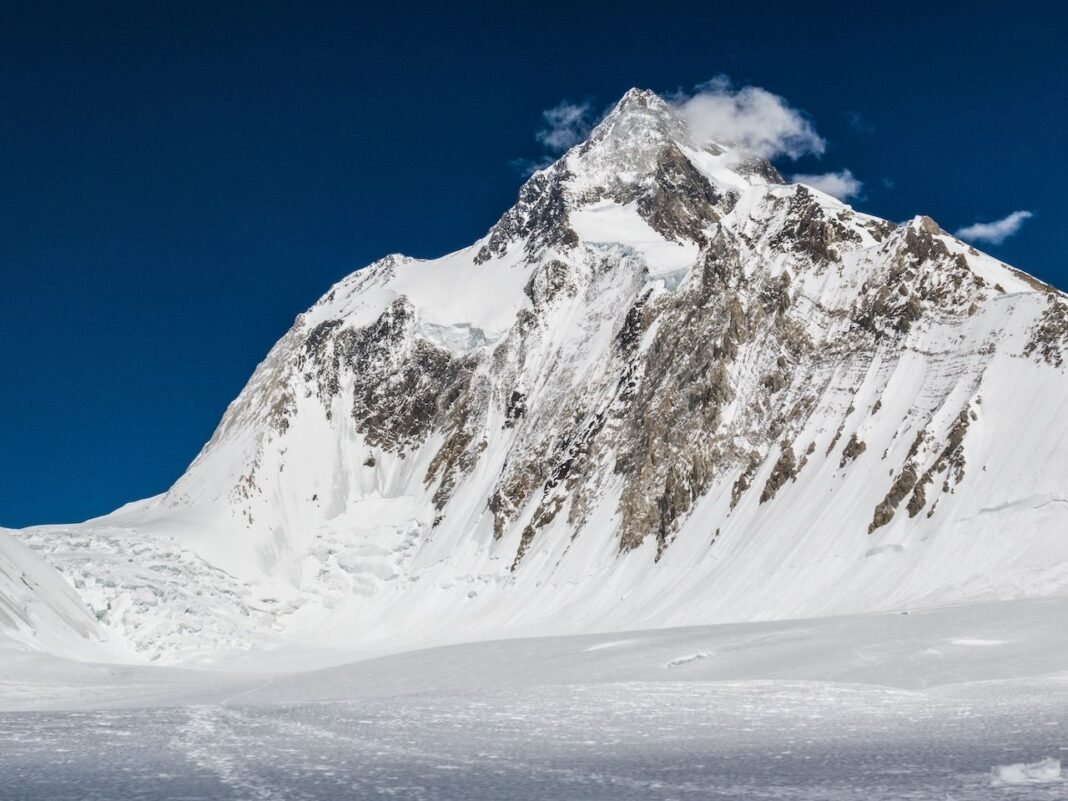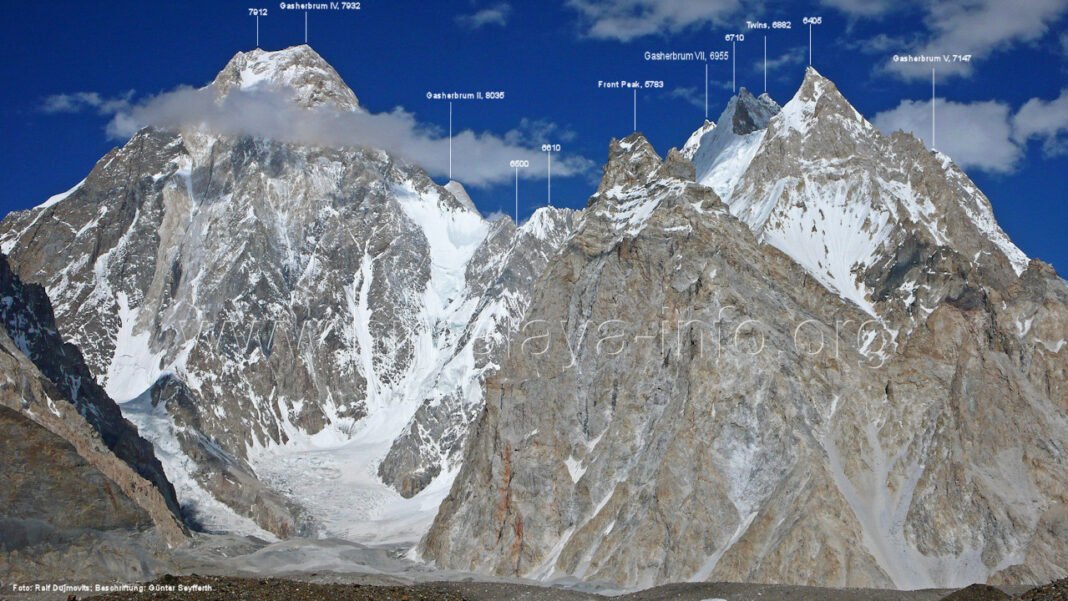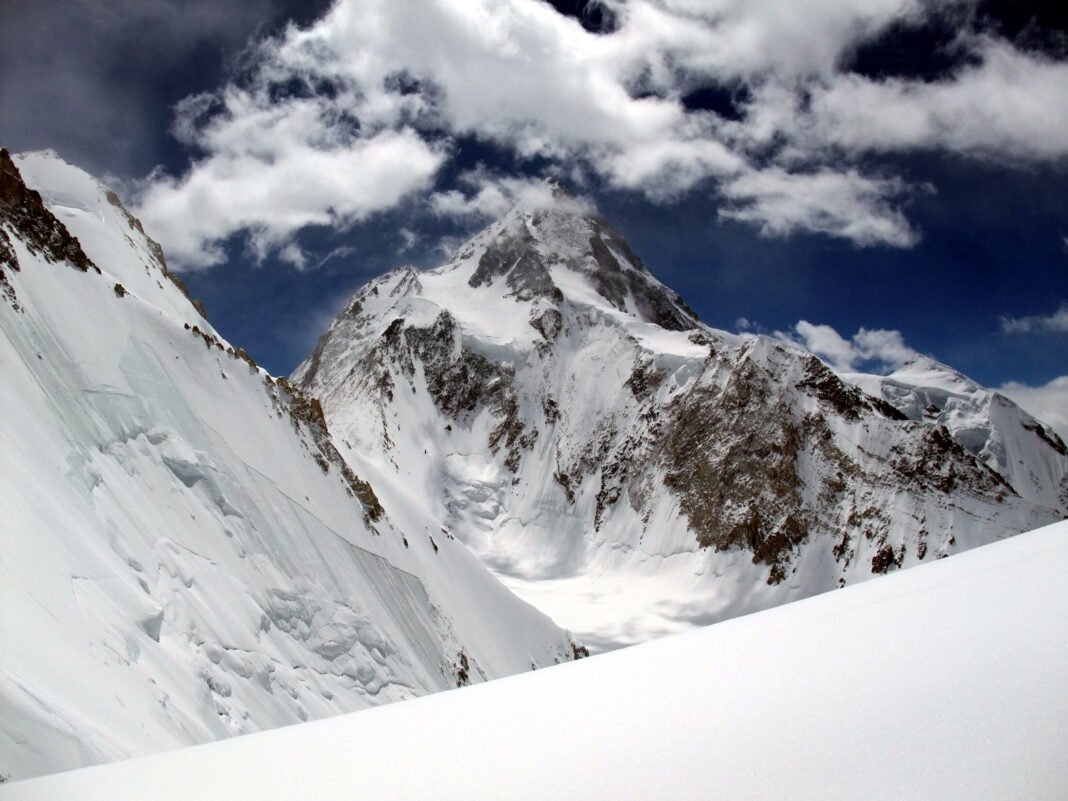
If the Karakoram’s great 8,000-metre peaks were a family, Gasherbrum II would be the welcoming one. At 8,035 metres, the 13th highest mountain in the world, it rises above the Baltoro Glacier in Pakistan’s Gilgit-Baltistan with an elegant, symmetrical pyramid that has drawn climbers for nearly seventy years. Among mountaineers it carries a famous reputation: the most approachable of the great eight-thousanders, the classic first 8,000-metre summit. If you are choosing a serious mountain objective in Pakistan — whether as a climber or as a trekker walking to its base — Gasherbrum II deserves your attention.
This Gasherbrum II travel guide covers why the peak is special, its pioneering history, what the trek and the climb involve, how to reach it from Islamabad, Lahore, or Karachi, and when to plan your journey.
Quick Facts
- Location: Gasherbrum Massif, Baltoro Muztagh, Central Karakoram — on the Pakistan–China border, Gilgit-Baltistan
- Altitude: 8,035 metres (26,362 feet) — the 13th highest mountain in the world
- Famous For: Being one of the “easiest” 8,000-metre peaks, the 1956 Austrian first ascent, and the first winter ascent of a Pakistani 8,000er in 2011
- Nearest City: Skardu (trailhead village: Askole)
- Accessibility: Fly or drive to Skardu, jeep to Askole, then trek via the Baltoro Glacier to Concordia and base camp
- Known Landmarks: Concordia, Baltoro Glacier, Gasherbrum Glacier and icefall, K2 and Broad Peak nearby
- Best For: Aspiring 8,000-metre climbers, serious trekkers, photographers, and mountain-history lovers
Why Visit Gasherbrum II
Gasherbrum II occupies a unique place in the mountaineering imagination. It is a genuine eight-thousander — a member of the most exclusive club in climbing — yet its normal route, the Southwest Ridge, is considered the least technically demanding path to 8,000 metres in the Karakoram. For climbers, that combination makes it the classic stepping stone: the mountain where strong, experienced alpinists test themselves against the death zone for the first time. For trekkers, it means the journey to its base camp follows the same legendary Baltoro route as the K2 trek, delivering one of the world’s great walks with a front-row view of a storied summit.
The mountain itself is beautiful in the way the Balti name promises — Gasherbrum means “beautiful mountain” in Balti. Its snow pyramid rises cleanly above the Gasherbrum Glacier, and from Concordia it forms part of the most famous mountain panorama on Earth, standing alongside K2, Broad Peak, and its bigger sibling Gasherbrum I. There is a particular magic in watching the evening light move across its faces while you sit at 4,650 metres with a cup of tea, knowing that the 1956 Austrians, and later the great winter climbers of 2011, looked up at the same lines.
Choose Gasherbrum II if you want the full Karakoram expedition experience with the best odds the range offers. The infrastructure is mature — licensed operators run the route every summer, the camps are well established, and the mountain’s history is rich enough to fill a library. It is still a deadly serious undertaking that demands elite fitness and high-altitude experience, but among the giants, this is the one that invites you in rather than turning you away.
History of Gasherbrum II
Like its neighbors, Gasherbrum II first appeared on maps in 1856, when T. G. Montgomerie of the Great Trigonometric Survey of India sighted the Karakoram giants from over 200 kilometres away and labeled this peak K4 — the fourth mountain of the Karakoram. Early exploration of the massif followed in the following decades, including the Duke of the Abruzzi’s famous 1909 expedition, which studied possible routes on the Gasherbrum peaks and pushed high on nearby summits.
The first ascent came in the golden summer of 1956. An Austrian expedition led by Fritz Moravec tackled the mountain via the Southwest Spur, establishing their base camp on the Gasherbrum Glacier and fighting through storms — at one point the team was pinned down for ten days and lost a supply store to an avalanche. Pushing on through camps, Moravec, Josef Larch, and Hans Willenpart made their summit bid from a high bivouac, and on July 7, 1956, they stood on the top of Gasherbrum II. It was a triumph of persistence and one of the great post-war Himalayan achievements.
The mountain’s modern legend was written in winter. On February 2, 2011, Simone Moro of Italy, Denis Urubko of Kazakhstan, and Cory Richards of the United States completed the first winter ascent of Gasherbrum II — the first time any Pakistani 8,000-metre peak had been climbed in winter — without bottled oxygen or porters, surviving a terrifying avalanche burial on the descent. Richards documented the climb in the acclaimed film Cold. Today the Southwest Ridge remains the normal route, and Gasherbrum II continues to be the most-climbed of Pakistan’s 8,000-metre peaks after the most popular objectives, a testament to its reputation as the friendliest of the giants.
Top Things to Do in Gasherbrum II
Trek the Baltoro to Concordia
Whether you are climbing or not, the trek is the heart of the Gasherbrum II experience. From Askole, the route runs through Jhola, Paiju, Urdukas, and Goro II along the mighty Baltoro Glacier to Concordia at about 4,650 metres. This is the same celebrated approach used for K2, and most Gasherbrum II trekkers combine the two. Standing at Concordia with Gasherbrum II’s pyramid rising to the northeast is the definitive Karakoram moment.
Visit Gasherbrum II Base Camp
From Concordia, the route to Gasherbrum II base camp (around 5,200 metres) branches up the Gasherbrum Glacier. In summer the base camp is a small international village of brightly colored tents, home to expedition teams from around the world. Walking among the camps, watching climbers prepare for the icefall, and gazing up at the Southwest Ridge gives you a vivid sense of what an 8,000-metre expedition really involves.
Attempt the Summit (for Qualified Climbers)
For mountaineers with serious high-altitude résumés, Gasherbrum II is the classic objective. The normal route climbs the Gasherbrum icefall to Camp 1 (about 5,900 m), continues up snow slopes to Camp 2 at the Gasherbrum La (about 6,400 m), then tackles steeper ice and a couloir to Camp 3 (around 7,200 m), before the diagonal traverse and the summit pyramid. Expeditions typically run 40–55 days including acclimatization. It is “easier” only by the standards of 8,000-metre peaks — it remains a major, dangerous undertaking.
Photograph the Gasherbrum Massif
The Gasherbrum group offers endlessly varied photography: the pyramid of GII at dawn, the icefall’s seracs, the sweep of the Baltoro, and the contrast of tiny human figures against enormous faces. The light at Concordia in the golden hours is something landscape photographers travel across the world to capture.
Explore the Shigar Valley and Askole
Before and after the trek, the Shigar Valley rewards a slower look: the historic Shigar Fort (now a heritage hotel), orchards and villages, and Askole itself — the last settlement before the glacier, where Balti porter culture is a living tradition. Meeting the porters and guides who make Karakoram expeditions possible is one of the journey’s great human experiences.
Famous Places In and Around Gasherbrum II
- Concordia (4,650 m) — the glacial junction with four 8,000-metre peaks in view
- Gasherbrum Glacier and icefall — the route’s dramatic lower section
- K2 (8,611 m) — visible from Concordia and combinable as a base camp trek
- Gasherbrum I / Hidden Peak (8,080 m) — the bigger sibling, sharing the massif
- Gasherbrum IV (7,925 m) — the famous “Shining Wall” peak nearby
- Broad Peak (8,051 m) — the broad-shouldered giant across the glacier
- Baltoro Glacier — the great ice highway of the approach
- Askole and the Shigar Valley — Balti villages, forts, and orchards at the road’s end
How to Reach Gasherbrum II
Gasherbrum II shares its approach with the other great Baltoro peaks: everything goes through Skardu and Askole.
From Islamabad: Fly to Skardu (about 1 hour, with spectacular views but frequent weather cancellations — keep buffer days), or drive the Karakoram Highway via Chilas: Islamabad to Chilas is about 461 km (11–12 hours), then Chilas to Skardu about 290 km (8–9 hours) along the Indus. From Skardu, a 4×4 jeep covers the rough road to Askole in 6–7 hours.
From Lahore: Reach Islamabad by motorway (4–5 hours), then continue as above. Most expeditions assemble in Islamabad for briefings and permit formalities before heading north.
From Karachi: Fly to Islamabad (about 2 hours), then follow the Skardu route. There are no direct connections to the mountains — Islamabad is the staging point for every Gasherbrum expedition.
Nearest airport: Skardu Airport. Beyond Skardu, all travel is by jeep and on foot.
Route Details
- Islamabad → Skardu: by air (~1 hour, weather-dependent) or road via the Karakoram Highway and Chilas (two long driving days).
- Skardu → Askole: 6–7 hours by jeep through the Shigar Valley; porters and final supplies are organized in Askole.
- Askole → Jhola → Paiju → Urdukas → Goro II → Concordia: the classic 7–8 day Baltoro trek, with a rest day at Paiju for acclimatization.
- Concordia → Gasherbrum II Base Camp: up the Gasherbrum Glacier to base camp at about 5,200 metres.
- Permits and logistics: climbing permits are issued by Pakistan’s tourism authorities and arranged through licensed operators with the Alpine Club of Pakistan; expeditions include a liaison officer, certified guides, cooks, and high-altitude porters. Trekkers to base camp should use a registered trekking company.
Where to Stay in Gasherbrum II
On the mountain, you sleep in tents — that is the deal, and it is part of the romance. Base camp at 5,200 metres is a well-organized tented village run by your expedition operator, with sleeping tents, kitchen and dining tents, and communication facilities. Higher camps are progressively simpler: small, storm-worthy tents perched on the ridge. Trekkers use dome tents at the established Baltoro campsites. A sleeping bag rated for extreme cold and a solid sleeping mat are essential personal kit.
In Skardu, the range of accommodation is genuinely good: budget guesthouses, comfortable mid-range hotels, and a few well-known upper-range properties with gardens and mountain views. It is the perfect place to recover after the trek. In Askole, expect only very basic guesthouses and camping — one night is usually enough before the trail. During June–August, Skardu fills with trekkers and climbers, so book ahead.
Where to Eat: Local Foods of Gasherbrum II
At base camp and on the trek, your expedition cooks keep you alive and happy with high-calorie mountain food: rice, lentils, pasta, porridge, eggs, soups, and endless cups of tea. Supplies are carried from Skardu, and experienced operators feed their teams remarkably well even at 5,000 metres. Personal energy bars, nuts, and chocolate are wise additions for long summit-push days.
In Skardu and the Shigar Valley, treat yourself to Balti cuisine before the deprivation begins. Balay — hearty hand-pulled noodle soup — and mamtu — delicate steamed dumplings — are the beloved staples, alongside barley and buckwheat dishes, local dairy, and everything enriched with fragrant apricot oil. Baltistan’s dried apricots, mulberries, and walnuts are the traditional energy food of the Karakoram — buy a generous supply in Skardu’s bazaar. In Askole, meals are simple and home-style: chapati, dal, rice, and milk tea, served with famous Balti hospitality.
Weather in Gasherbrum II
Gasherbrum II’s weather follows the Karakoram’s strict calendar: a short summer of opportunity surrounded by long months of impossible winter. The climbing and trekking season runs June to August, when the jet stream lifts and storms, while still possible, become less frequent. Approximate conditions around base camp (~5,200 m):
| Season | Temperature Range | Conditions |
|---|---|---|
| Winter (Nov–Mar) | -25°C to -40°C | Brutal cold and wind; the historic 2011 winter ascent proved it is survivable only by the world’s best |
| Spring (Apr–May) | -15°C to -5°C | Still full winter at altitude; approach possible late May for strong, prepared teams |
| Summer (Jun–Aug) | -5°C to 12°C (days) | The season: most stable weather, open route, base camp in full swing; nights still below freezing |
| Autumn (Sep–Oct) | -15°C to 5°C | Cooling fast; early September sometimes workable, then the mountain shuts down for winter |
Language and Culture of Gasherbrum II
The approach to Gasherbrum II runs through Baltistan, homeland of the Balti people. The Baltis speak Balti, a Tibetic language that records centuries of connection with Ladakh and Tibet, and they are celebrated worldwide as elite high-altitude porters — the backbone of every Karakoram expedition. Balti culture blends Tibetan roots with Islamic faith, expressed in distinctive music, dance, dress, and architecture.
Trekkers and climbers should honor local customs: modest dress in villages, permission before photographs, and fair, respectful treatment of porters and staff. The traditional send-offs and welcomes in Askole — with music and dancing — are highlights many expeditions remember as fondly as the climb. A few words of Balti greeting will earn you warm smiles all the way up the glacier.
Shopping in Gasherbrum II
Your shopping happens in Skardu, full stop. The bazaar is well stocked for expeditions: dried apricots, apricot oil, walnuts, almonds, and mulberries (trail food and gifts in one), woolen caps, gloves, and socks, and Balti handicrafts including hand-woven rugs, carved woodwork, and traditional daggers. There are no malls or gear shops on the trek — Skardu’s markets are the last real commerce before the mountains, so buy spare batteries, snacks, toiletries, and any forgotten kit there. Askole’s shops carry only bare essentials.
Travel Tips for Gasherbrum II
Packing Essentials
Full high-altitude kit: layered clothing system, expedition down suit or heavy down jacket, double boots, sleeping bag rated to extreme cold, glacier glasses, maximum-protection sunscreen, headlamp, trekking poles, water treatment, and personal medical supplies including altitude medication prescribed by your doctor. Your operator supplies tents, ropes, and group equipment — get their kit list early and do a trial run.
Safety Tips
Gasherbrum II is the “easiest” 8,000er the way the shallow end of the ocean is shallow — the hazards are absolutely real. Altitude illness, the crevassed Gasherbrum icefall, avalanches, and storms have all taken lives here. Go only with a licensed, reputable operator; follow your guides’ calls on turnaround times without argument; acclimatize conservatively; and carry a satellite communicator. Rescue by helicopter is weather-dependent and never guaranteed — high-altitude evacuation insurance is mandatory. The trek to base camp is strenuous but non-technical; the summit is for experienced mountaineers only.
Money & Connectivity
Bring all cash from Skardu onward — no ATMs, no cards, no exceptions beyond the city. Expedition fees are typically handled in foreign currency through your operator; local expenses in rupees. Mobile signal fades after the Shigar Valley; from Askole there is effectively none. Satellite communication is standard on expeditions.
Best Time to Visit Gasherbrum II
Summer (June to August) — The Season
The only practical window for climbing and for the full base camp trek. June offers long days and quieter trails; July is the classic summit month with the most stable weather; August remains good with slightly higher precipitation risk. This is when base camp buzzes with international teams and the Karakoram is at its most alive.
Shoulder Months (May and September)
Possible for strong trekkers in late May or early September, but colder, less supported, and less predictable. Climbers generally avoid these months.
Winter (October to April) — For History Books Only
The mountain in winter is a place of -40°C cold and screaming wind. The 2011 first winter ascent stands as one of mountaineering’s great feats precisely because almost no one can survive up there then. Ordinary visits are out of the question.
Final Thoughts
Gasherbrum II is the Karakoram’s great invitation: an 8,000-metre giant that rewards preparation rather than punishing ambition. Whether you stand on its summit or simply stand at its base camp looking up, you will have touched one of the legendary arenas of mountaineering — the massif of the 1956 Austrians, of Moro, Urubko, and Richards, of the film Cold. Few mountains offer so much history per metre of effort.
If the Karakoram is calling, answer it here first. Plan for summer, choose your operator with care, and give the mountain the respect it deserves. For the full journey, see our Askole travel guide, the Baltoro Glacier travel guide, and the Concordia travel guide — or explore more northern adventures in our Explore Pakistan collection.
FAQs
Where is Gasherbrum II located?
In the Gasherbrum Massif of the Central Karakoram, on the Pakistan–China border in Gilgit-Baltistan, reached via Skardu, Askole, and the Baltoro Glacier trek to Concordia.
How high is Gasherbrum II?
8,035 metres (26,362 feet) — the 13th highest mountain in the world.
Who first climbed Gasherbrum II?
Austrians Fritz Moravec, Josef Larch, and Hans Willenpart, on July 7, 1956, via the Southwest Spur. The first winter ascent was made on February 2, 2011, by Simone Moro, Denis Urubko, and Cory Richards.
Is Gasherbrum II really the easiest 8,000-metre peak?
It has that reputation because its normal route, the Southwest Ridge, is less technically difficult than most 8,000-metre routes — but “easiest” is relative. It still demands elite fitness, high-altitude experience, and acceptance of serious objective danger.
What is the best time to visit Gasherbrum II?
June to August, the Karakoram summer, for both climbing expeditions and the base camp trek.
How do I reach Gasherbrum II base camp?
Fly or drive from Islamabad to Skardu, jeep to Askole, then trek 7–8 days up the Baltoro Glacier via Paiju and Concordia, then up the Gasherbrum Glacier to base camp at about 5,200 metres.
Can beginners trek to Gasherbrum II base camp?
The trek is non-technical but very demanding — high altitude, long days, and total remoteness. It suits fit, experienced trekkers with a guided operator, not beginners or families with children.
What does “Gasherbrum” mean?
In the Balti language it comes from rgasha (beautiful) and brum (mountain) — “beautiful mountain.”