


Quick Facts
- Location: About 20 km north of Bela town, Lasbela District, Balochistan — roughly 218 km from Karachi
- Altitude: Low-lying desert plain; the caves are cut into sandstone cliffs rising above the Lasbela plain
- Famous For: An ancient cave city of hundreds of rock-cut chambers, believed to have been a Buddhist monastic settlement; also called Shehr-e-Roghan, the Cave City of Lasbela, and the House of the Spirits
- Nearest City: Bela (20 km); Karachi is the main gateway (~3.5–4 hours by road)
- Accessibility: Karachi to Bela on the RCD Highway (N-25), then a gravel track to the site; a high-clearance vehicle is strongly recommended. Easily done as a day trip from Karachi.
- Known Landmarks: The multi-level cave dwellings themselves (“Puraney Ghar” — the Old Houses), and the nearby shrine of Mai Gondrani
- Best For: History lovers, photographers, off-the-beaten-path explorers, and anyone who loves a good mystery. Families can visit comfortably as a day trip.
Why Visit Gondrani Caves (Shehr-e-Roghan)
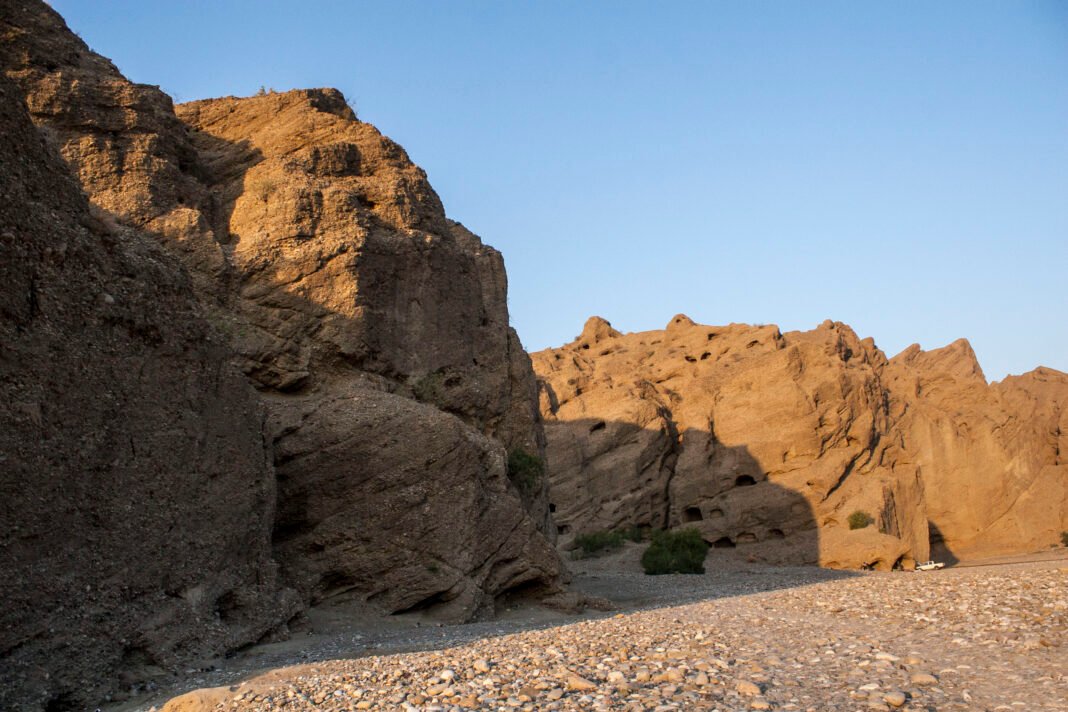
Pakistan has forts, mosques, and mountain valleys in abundance — but it has only one Gondrani. Imagine a cliff face honeycombed with hundreds of dark doorways, stacked on several levels like an apartment block carved by a civilization nobody can fully name. Historians believe this was a Buddhist monastic city some twelve centuries ago; local legend says it was a city of spirits. Standing at its base as the desert light rakes across the chambers, you understand why both stories survive: the place feels ancient, abandoned, and quietly haunted all at once.
Gondrani is perfect for the traveler who has done the obvious circuit and wants the story nobody else is telling. It is one of the least-visited major archaeological sites in the country — no ticket queues, no selfie crowds, no souvenir stalls. You will likely have the cliffs to yourself, with only the wind moving through the empty chambers and a sweeping view over the Lasbela plain. For photographers, the layered facades of doorways and verandas are endlessly photogenic; for history lovers, the mystery of who built the caves and why is genuinely unresolved, which makes every visit feel like field research.
It is also one of the easiest “adventure” destinations in Pakistan. From Karachi it is a straightforward morning drive — no trekking, no altitude, no special fitness needed. Families, school groups, and casual weekend explorers can all manage it. Pair it with the ancient town of Bela, a picnic on the plain, and the legends of Mai Gondrani, and you have a day trip that feels like stepping off the map without ever really leaving the road network. If you are building a Balochistan itinerary, browse Explore Pakistan for more ideas, including our guide to another Lasbela landmark, the ancestral graveyard of the Jam of Lasbela.
Come for the mystery, stay for the silence. Gondrani rewards the curious — the ones who read the plaque, walk the pathways between levels, duck into a chamber, and wonder who last lit a lamp in its wall niche. Twelve hundred years of wind have not erased this city. Go see it before the erosion finishes the job.
History of Gondrani Caves (Shehr-e-Roghan)
The honest history of Gondrani begins with an admission: nobody knows exactly who built it. The site’s exact origins are unknown, and archaeologists have never mounted the kind of sustained excavation that could settle the question. What historians do believe — and this is the consensus view — is that Gondrani was once a large Buddhist monastery dating to around the 8th century, when this stretch of Balochistan lay within a Buddhist kingdom. The British historian André Wink, in his study of early medieval India, wrote that the construction of the caves at Gondrani, near the ruins of an ancient town northwest of Las Bela, shows them to be “undoubtedly Buddhist.” The Geographical Journal agreed that from their construction there is “no room for conjecture” that they are Buddhist. Other scholars are more cautious: the Journal of the Society for South Asian Studies notes that while the complex cannot be irrefutably linked to Buddhist heritage, it shows definite Buddhist characteristics.
That scholarly debate is itself part of the site’s fascination. The caves are cut into solid conglomerate rock at several levels and connected by pathways — small rooms with hearths in the center, wall niches for lamps, and verandas or front porches. The ceilings of many chambers are still blackened from centuries of wood smoke. Locally they are called “Puraney Ghar,” the Old Houses — a name that suggests they were understood as dwellings long after whoever built them was gone.
The numbers tell a story of slow decay. During British rule, around 1,500 caves were reported at the site. Today, roughly 500 survive. The soft sandstone erodes with every monsoon wind and desert storm, and no conservation effort has ever been made to protect the site — partly because of its poor accessibility, and partly because its significance was never properly studied. Gondrani is, in other words, a treasure that is quietly disappearing. The older name, Shehr-e-Roghan, hints at a settlement with a story its founders took with them.
The legends are as layered as the cliffs. One tells of a king’s daughter, Badiul Jamal, tormented by demons in the days of King Solomon, until the prince Saif-ul-Muluk slew them and set her free. Another tells of demons feeding on the people of Gondrani until a holy woman — Mai Gondrani, or Mai Balochani — sacrificed herself to destroy them and free the town. She is buried nearby, and her shrine is still a well-known local place of reverence. Some locals simply call it the city of the jinns. The Persian flavor of these tales hints at how many cultures washed over this ground.
Top Things to Do in Gondrani Caves (Shehr-e-Roghan)
Explore the Cave Levels on Foot
The heart of the visit is the climb through the site itself. Pathways connect the chambers across several levels of the cliff, and you can duck into room after room — each a small cell with its hearth, its lamp niches, its veranda opening onto the plain. Look for the smoke-blackened ceilings and the worn thresholds; these are the details that make the “Old Houses” feel inhabited rather than merely old. Wear sturdy shoes: the rock is uneven and the pathways are unimproved.
Photograph the Cliff Facades
From the base of the cliffs, the stacked rows of doorways and verandas make for extraordinary photographs, especially in the angled light of early morning or late afternoon. A wide-angle lens captures the scale; a telephoto picks out individual chambers and their shadows. Drone photography is popular with visitors, though you should be mindful of the shrine nearby and any local sensitivities.
Visit the Shrine of Mai Gondrani
The burial place of the holy woman of the legends lies near the caves and remains an active local shrine. Visitors are welcome; dress modestly, remove shoes where indicated, and behave as you would at any place of worship. The shrine keepers can sometimes share versions of the legends you will not find in any book.
Take in the View Over the Lasbela Plain
From the upper levels of the caves, the view opens across the flat Lasbela plain toward distant hills — a classic Balochistan panorama of desert, sky, and silence. It is the same view the cave-dwellers would have had, minus the traffic on the RCD Highway.
Explore Bela Town
The ancient town of Bela, 20 km to the south, is worth an hour or two. Bela is one of the oldest settlements in the region, and its bazaar and old quarters give a sense of the living culture around the archaeological site.
Famous Places In and Around Gondrani Caves (Shehr-e-Roghan)
- Bela: Ancient town 20 km south; bazaar, rest houses, and the region’s main settlement.
- Shrine of Mai Gondrani: The revered burial place of the holy woman of local legend, near the caves.
- Uthal: The Lasbela district headquarters town, passed on the road from Karachi.
- Kund Malir Beach: Farther afield on the Makran Coastal Highway — combinable for a two-day Balochistan circuit via Karachi.
- Wadh: A historic town on the N-25 route north of Bela, gateway to the interior of Balochistan.
How to Reach Gondrani Caves (Shehr-e-Roghan)
The journey starts in Karachi. Take the RCD Highway (N-25) northwest out of the city toward Bela — about 218 km, roughly 3.5 to 4 hours of driving on a good highway. From Bela, a gravel track heads north about 20 km to the caves, following toward a small stream whose banks are lined with the cave houses. The final stretch is unpaved and rough in places: a high-clearance vehicle or 4×4 is strongly recommended, and after rain it can get tricky.
From Lahore or Islamabad, fly to Karachi first — this is the only practical routing. The site works beautifully as a day trip from Karachi: leave early morning, reach Bela by mid-morning, explore the caves in the cooler hours, and return by evening. There is no public transport to the site itself; you will need a private car, a rented 4×4, or a seat with a tour group. Several Karachi-based travel groups run day trips to Gondrani and Bela, which is the easiest option if you do not want to drive yourself.
Fuel up and stock water and snacks in Karachi or at Bela — there are no facilities at the caves. Mobile signal is available on the highway but can be patchy near the site.
Route Details
- Karachi → Bela: ~218 km on the RCD Highway (N-25) northwest, about 3.5–4 hours.
- Bela: stock up on water, fuel, and snacks; the bazaar has basic supplies.
- Bela → Gondrani: ~20 km north on the gravel track toward the caves; allow 45 minutes to an hour.
- Explore on foot (2–3 hours is plenty), visit the shrine, then return the same way.
- Optional: overnight in Bela and combine with other Lasbela sites the next day.
Where to Stay in Gondrani Caves (Shehr-e-Roghan)
There is no accommodation at the caves themselves — and that is fine, because almost everyone visits as a day trip from Karachi. If you want to stay over, Bela has basic options: government rest houses and simple private guesthouses with the essentials (a bed, a fan, attached bath). Do not expect luxury; do expect genuine Balochi hospitality.
The comfortable alternative is to base yourself in Karachi, where the full range of hotels is available, and do Gondrani as a long day trip. For a two-day Balochistan loop, some travelers overnight in Bela and push on to the coast (Kund Malir) or inland the next day. Camping near the caves is possible in principle, but there is no water, no facilities, and no security presence — it is not recommended for casual visitors. If you are the camping type, go with an organized group that knows the area.
Where to Eat: Local Foods of Gondrani Caves (Shehr-e-Roghan)
Eat in Bela. The town’s bazaar has roadside dhabas serving the staples of the region: fresh tandoori roti, daal, and grilled meats. If you are lucky, you will find sajji — the great Balochi specialty of whole lamb or chicken slow-roasted over coals — which is the dish to order whenever you see it in Balochistan. Kaak, the hard stone-baked bread of the Baloch, travels well and makes good trail food.
There is no restaurant or food stall at the caves, so pack a picnic from Karachi or Bela: fruit, dry fruits, water (more than you think you need — the desert air is deceptive), and something substantial. On the drive back, the highway dhabas between Bela and Karachi serve perfectly good chai and parathas. A meal at a Bela dhaba is budget-friendly; think in terms of a few hundred rupees per person, not restaurant prices.
Weather in Gondrani Caves (Shehr-e-Roghan)
Gondrani sits in hot, arid Balochistan, and the weather decides whether your visit is a pleasure or an ordeal. Winter — roughly November to February — is the sweet spot: mild, dry days that are ideal for climbing around the cliffs. Summer is brutally hot, with the desert sun reflecting off the rock; if you must go between May and August, go at dawn and be gone by late morning. The monsoon barely touches this area, but occasional rain can make the gravel track slippery.
| Season | Temperature Range | Conditions |
|---|---|---|
| Winter (Nov–Feb) | 10°C to 25°C | Mild and dry; the best season for exploring the caves |
| Spring (Mar–Apr) | 20°C to 35°C | Warming up; mornings still pleasant, afternoons hot |
| Summer (May–Aug) | 30°C to 45°C | Very hot; visit only at dawn, carry plenty of water |
| Autumn (Sep–Oct) | 25°C to 38°C | Cooling down; late October becomes comfortable again |
Language and Culture of Gondrani Caves (Shehr-e-Roghan)
Lasbela is a cultural crossroads. The main languages you will hear are Balochi, Brahvi, and Sindhi (the local Lasi dialect), with Urdu widely understood in Bela’s bazaar. The people of the area — Baloch and Lasi communities — are known for their hospitality to travelers, and the tribal code of honor toward guests is real and deeply felt.
Dress modestly: long trousers or shalwar kameez, and women should cover shoulders and carry a dupatta or scarf, especially when visiting the shrine. Ask before photographing people. If you meet shrine keepers or local elders, a polite greeting and a few minutes of conversation will teach you more than any guidebook — and many locals are proud to share the legends of Mai Gondrani with respectful visitors. Remove shoes at the shrine, keep voices low, and do not climb on the shrine structures.
Shopping in Gondrani Caves (Shehr-e-Roghan)
There is no souvenir industry at Gondrani — no stalls, no trinkets, which is part of its charm. Bela’s bazaar covers practical needs: water, snacks, basic supplies. For genuine Balochi handicrafts — embroidered fabrics, rugs, and needlework — the better hunting grounds are the larger markets of Karachi or Quetta, not the villages around the caves. Dry fruits and dates from Bela’s bazaar make good edible souvenirs. Do not, under any circumstances, take “souvenirs” from the caves themselves: no stones, no pottery shards, nothing. The site is unprotected and eroding; leave everything exactly as you found it.
Travel Tips for Gondrani Caves (Shehr-e-Roghan)
Packing Essentials
Sturdy walking shoes with grip (the rock pathways are uneven), a hat and sunscreen, at least 2–3 litres of water per person, snacks, a basic first-aid kit, and a fully charged phone. A headlamp or torch helps inside the darker chambers. In winter, carry a light jacket for the breezy clifftop; in summer, go at dawn.
Safety Tips
The caves are unmaintained: watch your footing on the pathways between levels, supervise children closely near drops, and do not enter chambers that look structurally unsound — the sandstone does crumble. There is no security presence at the site, so visit in daylight and preferably with company. Check the current travel situation for Balochistan before any trip and travel with a reputable group or driver who knows the area.
Money & Connectivity
Carry cash — there are no ATMs at the site and card payments are not a thing in Bela’s bazaar. Mobile networks cover the highway and Bela, but signal near the caves can be unreliable. Download offline maps before leaving Karachi.
Best Time to Visit Gondrani Caves (Shehr-e-Roghan)
November to February: The Ideal Season
Cool, dry, sunny days made for clambering around ancient cliffs. This is when the site is at its best and when most visitors come. Combine with other Balochistan day trips from Karachi.
March to April and September to October: Shoulder Season
Warm but manageable, especially in the mornings. A fine time to visit if winter is not an option — just start early.
May to August: Avoid If Possible
The desert heat is punishing, and the rock radiates it back at you. If summer is your only window, treat it as a dawn raid: arrive at first light, explore for two hours, and leave before the heat builds.
Final Thoughts
Gondrani is that rare thing: a genuinely mysterious place that mass tourism has not found yet. The unanswered questions — who built these chambers, what prayers were said in them, why the city was abandoned — are not a flaw in the experience. They are the experience. Walking the pathways between levels, you become part of a centuries-long conversation about this cliff that scholars, saints, and storytellers have all joined.
Go in winter, go early, go respectfully — and go soon. With 1,500 chambers reduced to 500 and no conservation in sight, Gondrani is a wonder on a timer. For more of Balochistan’s hidden heritage, see our guide to the ancestral graveyard of the Jam of Lasbela and the rest of Explore Pakistan.
FAQs
Where are the Gondrani Caves?
The Gondrani Caves (Shehr-e-Roghan) are in Lasbela District, Balochistan, about 20 km north of Bela town and roughly 218 km from Karachi.
What is Shehr-e-Roghan?
Shehr-e-Roghan is the older name of the Gondrani cave city. It is also called the Cave City of Lasbela, the House of the Spirits, and Mai Gondrani.
Who built the Gondrani Caves?
Nobody knows for certain. Historians believe the site was a Buddhist monastery dating to around the 8th century, though some scholars note the Buddhist link cannot be conclusively proven. The caves are carved into conglomerate rock at several levels, with rooms, hearths, lamp niches, and verandas.
What is the best time to visit Gondrani Caves?
November to February, when the weather is mild and dry. Summer (May–August) is extremely hot and best avoided.
How do I reach Gondrani Caves from Karachi?
Drive northwest on the RCD Highway (N-25) to Bela (~218 km, 3.5–4 hours), then take the gravel track 20 km north to the caves. A high-clearance vehicle is recommended. It works well as a day trip from Karachi.
Is Gondrani Caves safe for families?
Yes, as a day trip with sensible precautions: sturdy shoes, water, sun protection, and supervision for children near cliff edges. There are no facilities at the site, so come prepared.
Where can I stay near Gondrani Caves?
Most visitors day-trip from Karachi. Bela has basic government rest houses and simple guesthouses if you want to overnight.
What food is available near the caves?
Nothing at the site itself — eat in Bela (roadside dhabas, sajji, daal, roti) or pack a picnic. Stock water and snacks before leaving Bela.
What is the legend of Mai Gondrani?
Local legend says a holy woman named Mai Gondrani sacrificed herself to destroy the demons tormenting the town. She is buried nearby, and her shrine is still a place of local reverence.
Are there entry tickets for Gondrani Caves?
There is no formal ticketing or tourist infrastructure at the site — it is unprotected and free to visit, which is why visitors should treat it with extra care.
, Pakistan? Discover why it deserves your visit, the best time to go and how to reach.)