Quick Facts
- Location: Karakoram Range, Gilgit-Baltistan, Pakistan — connecting the Baltoro Glacier region to the Hushe Valley
- Altitude: Around 5,585 metres (18,323 feet) above sea level
- Famous For: One of the world’s most spectacular high mountain pass crossings, with a panorama of four 8,000-metre peaks — K2, Broad Peak, Gasherbrum I and Gasherbrum II
- Nearest City: Skardu (trek staging point); the pass itself is reached only on foot
- Accessibility: No road access — reached via a multi-day glacier trek from Askole, usually as part of a K2 base camp expedition. A 4×4 drive to the trailhead, then walking.
- Known Landmarks: Concordia (the “Throne Room of the Mountain Gods”), K2 Base Camp, Ali Camp, Vigne Glacier, Hushe Valley
- Best For: Experienced trekkers and mountaineers; physically fit adventure travelers with high-altitude experience. Not suitable for families or casual tourists.
Why Visit Gondogoro La
There is a moment, high on the crest of Gondogoro La, when the Karakoram stops being a landscape and becomes something closer to a revelation. Trekkers who have crossed it call it the finest mountain panorama on earth, and it is not hard to see why. Stand on this pass at dawn and you are face to face with four of the world’s fourteen 8,000-metre giants in a single sweep — K2 rising like a shark’s fin above a nearby ridge, Broad Peak’s vast summit walls, and the twin Gasherbrums — a concentration of Himalayan-scale drama that exists nowhere else. No other walkable viewpoint in Pakistan puts so many of the planet’s highest peaks in one frame.
This is not a destination you stumble upon; it is one you earn. The Gondogoro La trek is among the most demanding in the world, combining weeks on the Baltoro Glacier, nights at glacier camps above 4,500 metres, and a technical pass crossing on fixed ropes over steep snow slopes. For serious trekkers, that difficulty is precisely the point. Where most famous trails grow crowded, Gondogoro La stays quiet and honest — you will share the route with seasoned mountaineering teams, high-altitude porters who move through this terrain like weather, and very little else.
What makes the crossing unforgettable is not only the pass itself but everything that leads to it. The journey up the Baltoro Glacier is a slow, days-long immersion into the heart of the Karakoram: the “throne room of the mountain gods” at Concordia, where the Baltoro and Godwin-Austen glaciers meet beneath a ring of the world’s highest peaks; the legendary base camp beneath K2; the wedding-gown slopes of Chogolisa towering over Ali Camp. Each camp is a rung on a ladder that ends, in the small hours of a summer morning, on the summit of the La itself.
Gondogoro La is perfect for the trekker who has already walked the famous trails and wants the next, harder thing — someone who has done Everest Base Camp or the K2 base camp trek and is asking “what’s beyond?” It is for photographers chasing the definitive Karakoram frame, for mountaineers acclimatizing for bigger objectives, and for anyone who believes the best views in the world should require effort. If that sounds like you, start reading the Baltoro Glacier travel guide alongside this one — the two journeys are inseparable. For the wider world of northern adventures, browse Explore Pakistan.
History of Gondogoro La
Gondogoro La has no temples, no ruins, and no ancient kings — its history is written in exploration rather than stone. The pass itself has existed as long as the glaciers have, but it entered the modern trekking world only in 1986, when a route was established linking the Baltoro Glacier to the Hushe Valley over the pass. Before that, trekkers who reached Concordia and K2 base camp had only one option: turn around and walk back down the Baltoro. The 1986 route turned the expedition into a traverse — in over the Baltoro, out through Hushe — and opened one of the great circular journeys in mountain travel.
The region’s deeper history belongs to Baltistan, the high mountain land whose Balti people have farmed these valleys for centuries along the old trade corridors between Central Asia, Kashmir, and Ladakh. The Hushe Valley, where Gondogoro trekkers finish their journey, is one of Baltistan’s most traditional communities — villages of stone houses and apricot orchards that once sat on routes used by traders crossing between the Indus basin and the high passes. Askole, the trailhead at the other end, grew in importance as Baltoro expeditions multiplied through the twentieth century, becoming the place where foreign teams hire the high-altitude porters famous across the Karakoram.
That porter tradition is the living history of the pass. Porters from Askole and Hushe have carried loads for expeditions to K2 and the Gasherbrums since the great siege-style expeditions of the mid-twentieth century, and a seasonal rescue team from Hushe village still maintains the route over Gondogoro La — fixing ropes at the start of each season and removing them at the end. Every summer, this quiet infrastructure of ropes, camps, and local knowledge makes a crossing that would otherwise be the business of mountaineers accessible to strong, well-organized trekking groups.
Top Things to Do in Gondogoro La
Cross the Pass at Dawn
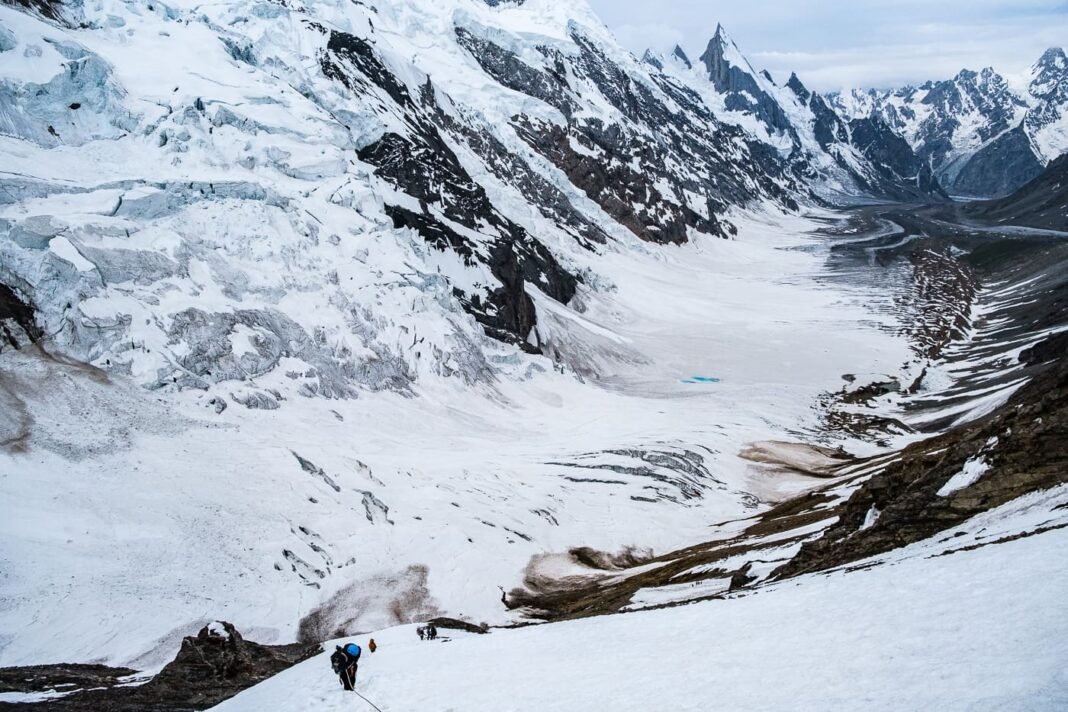
The crossing itself is the experience of a lifetime. Trekkers leave Ali Camp around 2:00 in the morning, moving by headlamp across the Vigne Glacier to reach the base of the pass by dawn. The ascent — on fixed ropes over snow slopes that can reach 50 degrees — is done in the cold hours before sunrise to avoid icefall and avalanche danger as the sun warms the slopes. Cresting the pass around 9:00 AM, after the steepest climbing is done, is the payoff: the full panorama of K2, Broad Peak, and the Gasherbrums unfolding in morning light. The descent drops steeply into the Gondogoro valley to camps like Hispang, surrounded by alpine flowers and glacial streams.
Camp at Concordia
Before the pass comes Concordia, the most famous campsite in the Karakoram, set at the confluence of the Baltoro and Godwin-Austen glaciers. Within a radius of about 24 kilometres rise ten of the world’s thirty highest peaks. Every Gondogoro La trek passes through here, and the night (or two) spent on the ice at Concordia, with K2 dominating the horizon, is a highlight that rivals the pass itself.
Visit K2 Base Camp
Most Gondogoro itineraries include a day walk from Concordia to the base camp beneath K2’s south face. Standing at the foot of the world’s second-highest mountain, watching expeditions prepare on the Godwin-Austen Glacier, is one of the great moments in world trekking — and it comes bundled into the same journey as the pass.
Trek the Baltoro Glacier
The approach to the pass is a week on the Baltoro itself: the glacier’s towers and ice pinnacles, the camps at Paiju, Urdukas, and Goro II, the side views of Trango Towers and Masherbrum. This is not dead walking time between highlights; the Baltoro is one of the planet’s great glacier journeys in its own right, and our Baltoro Glacier travel guide covers it in detail.
Descend Through the Hushe Valley
The days after the crossing — easy walking down the Gondogoro valley through alpine meadows, shepherds’ pastures, and shining lakes to Hushe village — are the gentle reward after the pass. Masherbrum’s far side reveals itself on the way down, and the villages of the Hushe Valley offer the warmest cultural welcome of the whole route.
Famous Places In and Around Gondogoro La
- Concordia (4,650 m): The legendary glacier junction, surrounded by the highest concentration of 7,000-metre peaks on earth.
- K2 Base Camp (5,150 m): The foot of K2 (8,611 m), the world’s second-highest mountain.
- Ali Camp (4,800 m): The staging camp beneath Chogolisa, where the pass attempt begins.
- Vigne Glacier: The glacier crossed in the small hours before the ascent.
- Hushe Valley: The traditional Balti valley where the trek ends; gateway to Masherbrum and Laila Peak.
- Laila Peak (6,096 m): The famously spear-shaped peak visible from the Hushe side.
- Chogolisa (“Bride Peak”): The fluted white mountain towering over Ali Camp.
- Askole: The last village on the Baltoro side and the trek’s traditional trailhead.
How to Reach Gondogoro La
There is no casual way to reach Gondogoro La — the journey is the trek itself, and it begins in Skardu. From Islamabad, most trekkers either fly to Skardu (a spectacular flight past Nanga Parbat, under an hour when the mountain weather cooperates) or take the long road journey up the Karakoram Highway via Gilgit, which takes the better part of a day and more. International visitors typically fly into Islamabad first, then connect. From Lahore or Karachi, the route also funnels through Islamabad — fly or drive to the capital, then onward to Skardu. Independent travel is strongly discouraged for this route; trekkers go with licensed Pakistani tour operators who handle permits, logistics, porters, and safety.
From Skardu, a jeep track runs to Askole, the roadhead — roughly a 6-to-8-hour drive over rough mountain roads. The trek then follows the classic Baltoro stages: Askole to Jhola, Paiju, Urdukas, Goro II, Concordia, on to K2 base camp and back to Concordia, then up the upper Baltoro and Vigne Glacier to Ali Camp. After crossing the pass, the descent leads through Hispang and Saicho to Hushe village, from where jeeps drive back to Skardu along the Shyok and Indus rivers.
Permits are mandatory: a trekking permit arranged through a registered tour operator, plus the usual briefing requirements in Skardu. Porters are hired at Askole and Hushe, and a licensed guide is essential — the pass crossing is technical and weather-dependent, and groups carry a contingency day in case conditions force a delay. If the pass cannot be crossed safely, the standard fallback is to walk back out down the Baltoro to Askole.
Route Details
- Islamabad → Skardu: flight (weather permitting) or KKH road journey via Gilgit.
- Skardu: gear checks, permit formalities, and team briefing; hire porters.
- Skardu → Askole: 6–8 hour jeep drive to the trailhead.
- Askole → Jhola → Paiju → Urdukas → Goro II → Concordia: 6–7 days up the Baltoro Glacier.
- Concordia → K2 Base Camp (day trip) → Concordia.
- Concordia → Ali Camp via the upper Baltoro and Vigne Glacier.
- Ali Camp → Gondogoro La (5,585 m) → descend to Hispang: the big day, 8–10 hours, departing ~2:00 AM.
- Hispang → Saicho → Hushe village: 2–3 days of easy descent.
- Hushe → Skardu: jeep drive along the Shyok and Indus rivers.
Where to Stay in Gondogoro La
There are no hotels on the Gondogoro La route — accommodation is expedition camping, full stop. Tour operators provide high-quality four-season tents, sleeping systems, dining tents, and kitchen staff at wilderness campsites all the way from Askole to Hushe. Camps sit on glacier moraine, alpine meadows, and rocky shelves with names every trekker remembers: Paiju with its famous rock, Urdukas beneath the Trango Towers, Goro II in the white heart of the glacier, Concordia, Ali Camp, and the flower-fringed camps of the descent like Hispang.
Before and after the trek, Skardu has the full range of options, from comfortable hotels to guesthouses, where teams spend their arrival and debriefing nights. Hushe and Askole villages have very basic guesthouse-style rooms run by locals — fine for a night before the jeep ride, but spartan. The honest advice: the nights that matter on this journey are the tent nights. Bring a good sleeping bag rated well below freezing even in summer, because high camps like Ali Camp are cold at any time of year, and weather can turn any night into winter.
Where to Eat: Local Foods of Gondogoro La
On the trek, your expedition’s cook team handles everything — hearty mountain food designed for high-altitude appetites: lentils, rice, pasta, soups, porridge, and endless tea. At altitude, appetite fades, so cooks lean on soups, garlic, and ginger to keep trekkers eating. Bring your own favorite snacks and energy bars from Islamabad or Skardu; there is nothing to buy beyond Askole.
In Skardu, and in the villages at either end of the route, eat Balti food. The Balti kitchen is one of northern Pakistan’s great cuisines: try the buckwheat pancakes, the steaming bowls of thukpa noodle soup, momos, and anything made with apricots — dried apricots, apricot oil, apricot juice. Hushe and Askole families dry apricots by the sackful, and a handful of them on the trail is the classic Karakoram energy food. In Skardu town, restaurants serve Pakistani and Chinese dishes alongside Balti specialties; stock up on trail snacks, dried fruit, and nuts before the jeep leaves for Askole, because after that, the mountains provide the scenery and your cook tent provides everything else.
Weather in Gondogoro La
Weather on the Gondogoro route is the whole game. The trekking season is short — roughly June to August — and even then, storms can stall a pass crossing for days. Nights at high camps are below freezing year-round; days in July can be surprisingly warm on the lower glacier and bitterly cold at the pass. Wind is the great variable: a calm clear morning makes the crossing; a stormy one cancels it. Groups build contingency days into the itinerary for exactly this reason.
| Season | Temperature Range | Conditions |
|---|---|---|
| Winter (Nov–Mar) | -30°C to -10°C at high camps | Route impassable; deep snow, extreme cold, no expeditions |
| Spring (Apr–May) | -20°C to -5°C | Still winter at altitude; route not attempted; access roads may be blocked |
| Summer (Jun–Aug) | -10°C to 15°C (varies hugely by altitude) | The trekking season; pass crossing possible in stable weather; afternoon clouds common |
| Autumn (Sep–Oct) | -20°C to 5°C | Season ends; early snow closes the pass; occasional late attempts in September only |
Language and Culture of Gondogoro La
The valleys at both ends of the route are Balti country. The Balti people — of Tibetan descent, speaking the Balti language — are the high-altitude porters, guides, and hosts of the Karakoram, and their villages, Askole and Hushe, are among the most traditional in Baltistan. Most Baltis are Shia Muslims, and visitors should dress modestly and ask before photographing people, especially women. A greeting in Balti (“Juley” works across the western Himalaya) is always appreciated.
The porter culture deserves respect: these are not casual laborers but mountain professionals whose families have worked the Baltoro for generations. Tipping fairly, following the guide’s instructions on the glacier, and keeping the camps clean are basic courtesies. Alcohol is not part of local culture — keep celebrations low-key. In Skardu, Urdu and English are widely understood; on the trail, your guide bridges the language gap.
Shopping in Gondogoro La
This is not a shopping destination — it is a wilderness expedition. The only real shopping happens in Skardu before and after the trek: dried apricots and apricot oil from Baltistan’s orchards, Balti woolen shawls and caps, wood carvings, and gemstones from the region’s mines. Askole and Hushe have tiny village shops selling biscuits, soap, and not much else. Buy any forgotten gear in Skardu’s small trekking shops, or better, arrive fully equipped from Islamabad. The best souvenir of Gondogoro La is not something you buy — it is the dawn photograph from the top of the pass.
Travel Tips for Gondogoro La
Packing Essentials
Beyond the operator’s group gear, your personal kit must include: broken-in mountaineering or stiff trekking boots compatible with crampons, a down jacket, a sleeping bag rated to at least -20°C, thermal layers, waterproof shell jacket and trousers, glacier glasses, high-SPF sunscreen, headlamp with spare batteries, trekking poles, and a personal first-aid kit including altitude medication only on your doctor’s advice. Your operator provides crampons, harness, and helmet for the pass — confirm this in writing before you go.
Safety Tips
Altitude is the main risk: the itinerary builds in acclimatization days for a reason — do not skip them. The pass crossing is technical; follow the fixed ropes, cross before sunrise as instructed, and accept the guide’s decision if conditions are unsafe — the mountain will be there next year. A seasonal rescue team from Hushe maintains the route, but evacuation from the Baltoro is by helicopter only in genuinely life-threatening emergencies and is weather-dependent, so comprehensive travel insurance with high-altitude helicopter evacuation cover is non-negotiable. Register with your embassy, carry a satellite communicator if possible, and never wander off the marked glacier route — crevasses are real.
Money & Connectivity
Carry all cash in Pakistani rupees from Skardu — there are no ATMs beyond the town, and none at all on the trek. Pay porters and staff through your operator. Mobile signal is patchy: you may get signal in Skardu and parts of the lower valleys, but nothing reliable on the glacier. Tell family you will be offline for two to three weeks. Some operators carry satellite phones for emergencies.
Best Time to Visit Gondogoro La
June to July: The Main Season
Early summer is when most groups cross. Snow conditions on the pass are usually stable, the rescue team has the ropes fixed, and the long daylight helps with the huge crossing day. Concordia and the Baltoro are at their most dramatic, though afternoon cloud build-ups are common.
August: Late Season
August crossings are very possible, but the pass can be icier as summer snow melts off, and late-season storms begin to threaten. Some years the season extends cleanly; other years groups are turned back. Build in your contingency days and listen to your guide.
September to May: Off Season
The pass is not attempted outside summer. By September, early snow and returning cold close the window; from October through May the route is a winter wilderness of extreme cold and deep snow, visited by no one.
Final Thoughts
Gondogoro La is not a place you visit — it is a place you cross, and the crossing changes how you see mountains. The dawn panorama from the pass, with K2 and the great 8,000-metre peaks burning pink in the first light, is the kind of sight trekkers spend entire careers chasing. The route demands fitness, patience, and respect for altitude, but it repays all three many times over.
If you are the kind of traveler who measures a journey by what it asks of you, put Gondogoro La on your list — and start preparing now. Read the Baltoro Glacier travel guide to understand the approach, choose a reputable operator, train for the altitude, and give the Karakoram the time it deserves. The pass has been waiting since long before 1986; it can wait for you to be ready.
FAQs
Where is Gondogoro La?
Gondogoro La is a high mountain pass in the Karakoram Range of Gilgit-Baltistan, Pakistan, connecting the Baltoro Glacier region (near Concordia) with the Hushe Valley.
What is the altitude of Gondogoro La?
The pass sits at around 5,585 metres (18,323 feet) above sea level.
When is the best time to cross Gondogoro La?
June to August is the trekking season, with most crossings in June and July when snow conditions are most stable. The pass is not attempted in winter.
How difficult is the Gondogoro La trek?
It is one of the world’s most challenging treks — a multi-week expedition with a technical pass crossing on fixed ropes over steep snow slopes, requiring crampons, high-altitude fitness, and prior trekking experience.
How do I reach Gondogoro La?
Fly or drive from Islamabad to Skardu, take a jeep to Askole, then trek up the Baltoro Glacier via Concordia to Ali Camp, cross the pass, and descend to Hushe. The whole expedition takes about three weeks.
Is Gondogoro La safe for beginners?
No. It is suitable only for experienced, physically fit trekkers with high-altitude experience, traveling with a licensed operator, guide, and proper equipment.
Can families visit Gondogoro La?
This is not a family destination. There are no roads, hotels, or facilities — only expedition camping at extreme altitude. Families should consider accessible northern valleys instead; see Explore Pakistan for options.
What permits do I need for Gondogoro La?
A trekking permit arranged through a registered Pakistani tour operator is mandatory, along with a licensed guide. Your operator handles the paperwork in Skardu.
What can you see from the top of Gondogoro La?
Four 8,000-metre peaks — K2 (8,611 m), Broad Peak (8,051 m), Gasherbrum I (8,080 m), and Gasherbrum II (8,035 m) — plus Laila Peak, Chogolisa, Trinity Peak, and the vast Karakoram glacier system.
Do I need crampons and ropes for Gondogoro La?
Yes. The pass has steep snow slopes requiring fixed ropes, crampons, harness, and helmet. A seasonal rescue team from Hushe maintains the ropes, and your operator provides the technical gear.