If your idea of the perfect trip blends deep history, living faith, and a story that has just turned a hopeful new page, then the Gurdwara Chhevin Patshahi, Amar Sidhu travel guide you are reading right now deserves your full attention. Hidden inside Lahore on the old road toward Kasur stands a shrine that carries the memory of Guru Hargobind, the sixth Sikh Guru, and in July 2026 it reopened its doors to worshippers for the first time since Partition — ending a silence of nearly 79 years. Few places in Pakistan let you stand this close to four centuries of history while watching a brand-new chapter begin. Whether you are a Sikh pilgrim, a heritage traveller, or simply someone who loves discovering the quiet corners of Lahore beyond the Fort and the Food Street, Amar Sidhu belongs on your list.
Quick Facts
- Location: Amar Sidhu, near Kainchi Chungi on the Lahore–Kasur (old Lahore–Ferozepur) road, Lahore, Punjab, Pakistan
- Altitude: around 215 metres above sea level (typical of the Lahore plain)
- Famous For: being one of the three historic Lahore gurdwaras associated with Guru Hargobind; also known as Gurdwara Bibi Kaulan; its grand 1923 building designed with help from Sir Ganga Ram; reopened in July 2026 after 79 years
- Nearest City: Lahore (inside the city’s urban limits today)
- Accessibility: very easy — reachable by car, rickshaw, or ride-hailing from anywhere in Lahore; around 380 km from Islamabad and over 1,200 km from Karachi
- Known Landmarks: the domed 1923 gurdwara building, the original tharra (resting place of the Guru), the surviving sarovar site, inscriptions in Gurmukhi and Shahmukhi on the marble floor
- Best For: Sikh pilgrims, history lovers, heritage photographers, families, and anyone exploring Lahore’s spiritual side
Why Visit Gurdwara Chhevin Patshahi, Amar Sidhu
There is a particular electricity in visiting a place the moment it wakes up again. When the Gurdwara Chhevin Patshahi at Amar Sidhu reopened on 11 July 2026, local Sikh families gathered to recite Sukhmani Sahib Path and ardas on ground their grandparents had prayed on before 1947. As a visitor today, you are not touring a frozen monument — you are stepping into a living shrine at the very start of its second life. That alone makes this one of the most meaningful short trips you can take in Lahore right now.
The history here runs four centuries deep. Guru Hargobind, the sixth Sikh Guru, is believed to have stayed at this spot while returning from Kashmir on his way to Amritsar, and the shrine is also linked to Bibi Kaulan, who is said to have accompanied the Guru on the journey with the Sikh congregation. The original marker was nothing grand — a simple tharra, a raised platform marking where the Guru had rested. In 1923, through the efforts of Bhai Mohan Singh Akali (Nihang) and Lahore’s Sikh community, that humble memorial grew into an imposing gurdwara with a grand dome, surrounding verandahs, and marble flooring inscribed in both Gurmukhi and Shahmukhi with the names of devotees who funded it. Renowned civil engineer Sir Ganga Ram, the man behind many of undivided Punjab’s landmark buildings, contributed to its construction. You can still trace all of this in the building’s bones.
Then there is the honesty of the place. This is not a polished, ticketed tourist attraction. It is a shrine that survived Partition, decades of illegal occupation, encroachment, a buried sarovar, and even a grave built inside its compound — and came back. Standing in its verandahs, you are witnessing what heritage preservation actually looks like in Pakistan: led by figures like Dr. Gulab Singh, who campaigned for the shrine’s release, and supported by Ramesh Singh Arora, president of the Pakistan Sikh Gurdwara Parbandhak Committee, the reopening has become a symbol of the country’s renewed push to restore its Sikh heritage, with dozens more gurdwaras lined up for renovation.
Finally, it is simply easy. Amar Sidhu sits inside modern Lahore now, so this is a half-day trip you can combine with the city’s famous food and markets. Come for the history, stay for the langar, and leave with a story few travellers can tell yet.
History of Gurdwara Chhevin Patshahi, Amar Sidhu
The story begins in the early 1600s with Guru Hargobind (1595–1644), the sixth Sikh Guru, whose title “Chhevin Patshahi” (the Sixth Mastership) gives this shrine its name. Historical accounts hold that the Guru stayed here while returning from Kashmir, before proceeding toward Amritsar. One tradition recorded in the early Sikh surveys says the Guru had come from Guru Mangat and rested at Amar Sidhu for some time in the company of Bibi Kaulan — which is why the shrine is also widely known as Gurdwara Bibi Kaulan. In those days Amar Sidhu was a village with a big bus stop on the Lahore–Ferozepur road, and Kot Lakhpat served as its railway station.
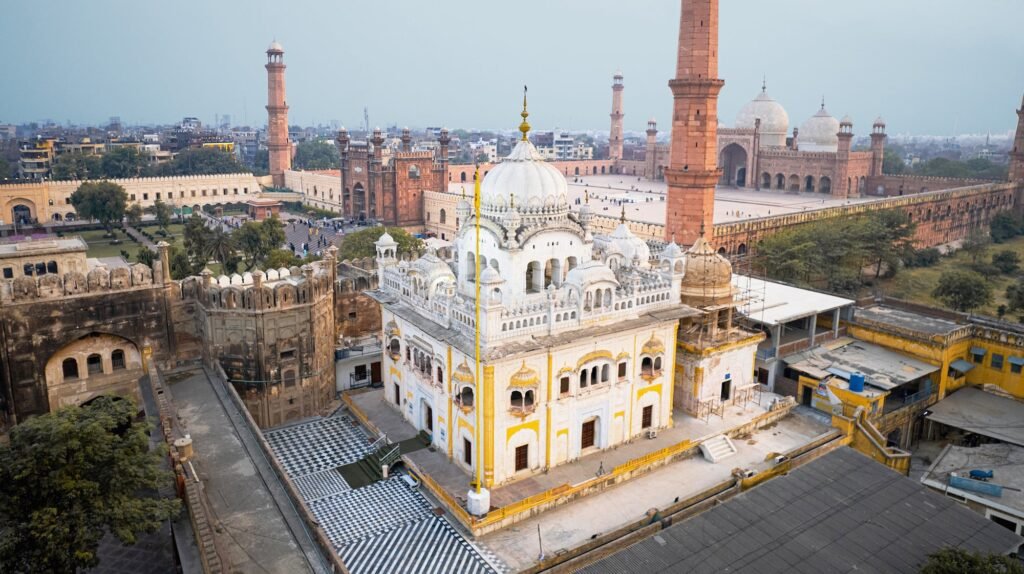
For generations the site was marked only by a simple memorial — the tharra where the Guru had rested. That changed in 1923 (Samvat 1979), when Bhai Mohan Singh Akali, a Nihang, took the initiative to build a proper gurdwara with the support of Lahore’s Sikh community. Sir Ganga Ram, the celebrated civil engineer whose public buildings still define old Lahore, made a significant contribution to the construction and repairs, including the gurdwara’s well. The result was a handsome complex on around 17 kanals of land, with an imposing dome, verandahs, marble flooring carrying inscriptions in Gurmukhi and Shahmukhi honouring Sikh contributors, plus facilities for langar and accommodation for pilgrims.
Before Partition, the shrine was managed by the local Sikh sangat under the supervision of the Shiromani Gurdwara Parbandhak Committee, and a fair was traditionally held in the month of Saawan (July–August). After 1947 the gurdwara fell into other hands. Its sarovar was buried, land was encroached upon, and even the grave of a pir and his horse was built within the compound. Worship stopped, and the site stayed closed to devotees for nearly eight decades.
The turning point came in 2026. After the site was freed from illegal occupation by the local administration and police, it was handed back to the Sikh community. On 11 July 2026 the gurdwara formally reopened: Sikh devotees gathered to recite paths of Sri Guru Granth Sahib Ji, perform Gurbani Kirtan and Naam Simran, and offer ardas — the first regular worship there since Partition. Leaders including Dr. Gulab Singh, who led the campaign for the shrine, and Ramesh Singh Arora of the PSGPC were present, and the Punjab government announced plans to restore dozens more gurdwaras across the province. The Amar Sidhu shrine, one of three historic Lahore gurdwaras associated with Guru Hargobind, is now a working place of worship again — and its restoration is still continuing, so every visit supports the revival.
Top Things to Do in Gurdwara Chhevin Patshahi, Amar Sidhu
Pay respects at the historic shrine
The heart of any visit is the gurdwara itself. Cover your head, remove your shoes, wash your hands, and step into the darbar hall beneath the grand 1923 dome. Take a quiet moment at the site of the original tharra, the resting place of Guru Hargobind, which the 1923 builders enclosed within the new structure at the centre of a garden. Whether or not you are Sikh, the atmosphere of a shrine that has just come back to life after 79 years is genuinely moving.
Read the marble inscriptions
Look down. The marble flooring of the shrine carries inscriptions in both Gurmukhi and Shahmukhi recording the names of the Sikh devotees who contributed to the gurdwara’s construction in 1923. It is a rare, tangible record of the community that built this place — ordinary Lahore families whose names were literally set in stone a century ago.
Admire Sir Ganga Ram’s craftsmanship
Architecture lovers should study the building’s bones: the imposing central dome, the surrounding verandahs, and the well that Sir Ganga Ram helped repair. Ganga Ram’s public buildings — from museum halls to hospital blocks — shaped colonial Lahore, and this modest shrine is part of that same legacy. Photographers will find the play of light across the verandahs especially rewarding in the morning.
Join or observe the langar
With worship restored, the tradition of langar — the free community kitchen — is returning to Amar Sidhu. Sharing a simple vegetarian meal seated together on the floor is one of the most welcoming experiences in Sikh tradition, and it costs nothing. If langar is being served during your visit, accept it with both hands and an open heart.
Walk the old Lahore–Kasur road neighbourhood
Amar Sidhu was once a standalone village on the Lahore–Ferozepur road; today it is a bustling Lahore neighbourhood near Kainchi Chungi. A short walk shows you the layered city — old havelis and shrines sitting beside workshops, bus stands, and food stalls. It is Lahore without the polish, and all the more real for it.
Famous Places In and Around Gurdwara Chhevin Patshahi, Amar Sidhu
- Wagah Border — the famous flag-lowering ceremony at the India–Pakistan border, east of Lahore
- Badshahi Mosque and Lahore Fort — the Mughal heart of the walled city, an easy drive from Amar Sidhu
- Shalimar Gardens — the Mughal pleasure gardens on the Grand Trunk Road
- Minar-e-Pakistan and Greater Iqbal Park — the national monument in the historic core
- Gurdwara Dera Sahib — Lahore’s great gurdwara beside the Fort, marking the martyrdom of Guru Arjan
- Anarkali and Ichhra Bazaars — two of Lahore’s oldest shopping streets, close to Amar Sidhu
How to Reach Gurdwara Chhevin Patshahi, Amar Sidhu
Reaching Amar Sidhu could hardly be simpler: it lies inside Lahore’s urban limits, near Kainchi Chungi on the Lahore–Kasur (old Ferozepur) road, on the eastern side of the old village. From central Lahore it is a short drive by car, rickshaw, or ride-hailing service. The nearest major railway station is Lahore Junction (with Kot Lakhpat station also close by), and Allama Iqbal International Airport is roughly a 30–45 minute drive depending on traffic.
From Islamabad (around 380 km): take the M-2 motorway to Lahore (about 4.5–5 hours), then follow Ferozepur Road toward Kainchi and Amar Sidhu. Daewoo and other bus services run constantly between Islamabad and Lahore.
From Lahore: you are already there — head out on Ferozepur Road toward Kainchi Chungi; local transport, Qingqi rickshaws, and ride-hailing apps all serve the area.
From Karachi (over 1,200 km): fly to Lahore (about 2 hours) and drive, or take the train to Lahore Junction and continue by road. The road journey via the N-5 or motorway network takes the better part of a day.
Route Details
- From central Lahore (e.g. Kalma Chowk), take Ferozepur Road south-east toward Kainchi.
- Continue past Kainchi Chungi onto the Lahore–Kasur road toward Amar Sidhu.
- The gurdwara stands on the eastern side of the old village — ask any local for “Gurdwara Amar Sidhu” or “Gurdwara Bibi Kaulan”; it is well known in the neighbourhood.
- Park on the main road and walk in; remove shoes and cover your head before entering the complex.
Where to Stay in Gurdwara Chhevin Patshahi, Amar Sidhu
Because the shrine sits inside Lahore, you have the entire city’s accommodation at your feet — from five-star hotels on Mall Road and in Gulberg to comfortable mid-range hotels and family-run guesthouses. If you are combining the gurdwara with a wider Lahore trip, staying in Gulberg or near Kalma Chowk puts you within easy reach of Amar Sidhu as well as the Fort, Food Street, and the museums. Budget travellers will find clean, affordable guesthouses and hostels across the city; pilgrim groups often prefer simple hotels near the railway station or in the old city. Since the gurdwara’s own pilgrim accommodation is being revived along with the shrine, check locally whether sarai rooms are available — the original complex included lodging for pilgrims, and the restoration aims to bring it back.
Where to Eat: Local Foods of Gurdwara Chhevin Patshahi, Amar Sidhu
You are in Lahore, the food capital of Pakistan, so eat like it. Within reach of Amar Sidhu you will find the full Lahori spread: siri paye for breakfast, nihari, chicken karahi, daal fry with tandoori roti, and the great Lahori breakfast of halwa puri with lassi. The streets around Kainchi and Ichhra are full of dhabas and small restaurants where a hearty meal is genuinely budget-friendly. Do not miss a glass of thick Punjabi lassi, and if you visit in winter, look for saag with makki di roti. At the gurdwara itself, the langar serves simple vegetarian food — daal, roti, rice — free to all, and sharing it is part of the experience.
Weather in Gurdwara Chhevin Patshahi, Amar Sidhu
Amar Sidhu sits on the Lahore plain, so expect classic Punjab weather: a short, foggy winter; a glorious spring; a long, fierce summer; and a humid monsoon. The shrine is outdoors-accessible all year, but your comfort will vary hugely by season.
| Season | Temperature Range | Conditions |
|---|---|---|
| Winter (Dec–Feb) | around 5–18°C | Cool, often foggy mornings; pleasant sunny afternoons. Best season for sightseeing. |
| Spring (Mar–Apr) | around 15–32°C | Warm and lovely; gardens at their best. Excellent for visiting. |
| Summer (May–Jun) | around 30–45°C | Very hot and dry; plan indoor or early-morning visits only. |
| Monsoon (Jul–Aug) | around 28–38°C | Hot and humid with heavy showers; the traditional Saawan fair month. |
| Autumn (Sep–Nov) | around 18–35°C | Cooling down; October–November is comfortable and clear. |
Language and Culture of Gurdwara Chhevin Patshahi, Amar Sidhu
The everyday language of the neighbourhood is Punjabi, with Urdu understood everywhere and English common in hotels and tourist areas. The culture is classic Lahori Punjabi — warm, food-loving, and quick to help a stranger. As a gurdwara, the shrine has its own etiquette that every visitor should honour: cover your head (scarves are usually available at the entrance), remove your shoes, dress modestly, avoid tobacco and alcohol on the premises, and sit on the floor in the darbar hall. Photography inside the prayer hall may be restricted during services — ask first. When langar is served, everyone eats together as equals; accept the food graciously and return your plate.
Shopping in Gurdwara Chhevin Patshahi, Amar Sidhu
Combine your visit with Lahore’s legendary bazaars. Anarkali, one of South Asia’s oldest markets, sells everything from traditional khussas and lawn suits to brassware and books. Ichhra Bazaar, close to Amar Sidhu, is famous for affordable clothing, bangles, and household goods — a favourite with local families. For Sikh visitors, shops around the old city sell rumallas (cloth for the Guru Granth Sahib), kirpans, and religious books. If you want a sweet souvenir, pick up Lahori specialties like habshi halwa or a box of fresh patisa from a reputed sweet shop.
Local Events and Festivals
Historically, a fair was held at the Amar Sidhu gurdwara in the month of Saawan (July–August) — and the shrine’s reopening itself fell in that same season, on 11 July 2026. With worship restored, the Sikh calendar’s great days are returning to the shrine: expect gatherings at Baisakhi (April), the birth anniversary of Guru Nanak (November), and the martyrdom days. Since the restoration is ongoing, check with the local Sikh community or the Pakistan Sikh Gurdwara Parbandhak Committee for the current year’s programme before planning a festival trip.
Travel Tips for Gurdwara Chhevin Patshahi, Amar Sidhu
Packing Essentials
Carry a light scarf or dupatta for covering your head at the gurdwara, comfortable slip-on shoes (you will remove them often), sunscreen and a water bottle in summer, and a warm layer for December–January mornings when fog can make it feel colder than the thermometer says.
Safety Tips
Amar Sidhu is a busy urban neighbourhood and generally safe for visitors during the day. Keep valuables out of sight in crowded bazaars, use registered ride-hailing rather than unmarked taxis at night, and dress modestly around the shrine. The gurdwara is a place of worship — keep voices low and phones silent inside the darbar hall.
Money & Connectivity
ATMs are plentiful across Lahore, and mobile signals from all major networks (Jazz, Telenor, Zong, Ufone) are strong in the area. Cash is still king in the bazaars and dhabas, though cards work in malls and larger restaurants. Free Wi-Fi is common in hotels and cafes.
Best Time to Visit Gurdwara Chhevin Patshahi, Amar Sidhu
Winter (November to February) — the sweet spot
Cool, clear days and festive city energy make winter the best time for this Gurdwara Chhevin Patshahi, Amar Sidhu travel guide’s top recommendation. Fog can delay morning travel in December and January, so plan shrine visits for late morning onward.
Spring (March–April) — beautiful and lively
Pleasant temperatures and Baisakhi celebrations in the Sikh calendar make spring a wonderful second choice, especially if you want to see the shrine during a festival gathering.
Summer and Monsoon (May–August) — for the devoted
May and June are punishingly hot; visit at dawn if you must. July–August brings the monsoon and the traditional Saawan season of the shrine — atmospheric, but humid.
Autumn (September–October) — the quiet window
Comfortable weather, fewer crowds, and golden light for photography. A fine time for a peaceful, unhurried visit.
Final Thoughts
The Gurdwara Chhevin Patshahi at Amar Sidhu is that rare thing: a heritage site you can visit at the exact moment it comes back to life. The dome that Sir Ganga Ram helped raise in 1923, the marble inscriptions of long-ago devotees, the memory of Guru Hargobind’s rest and Bibi Kaulan’s journey — all of it is here, newly accessible after 79 silent years. Few travel experiences in Pakistan right now carry this much quiet emotional weight.
So plan that half-day in Lahore. Walk the verandahs, read the inscriptions, share the langar, and then tell people what you saw — because places like this survive on being remembered. For more heritage journeys across the country, browse our Explore Pakistan collection, and if the mountains are calling too, our Malam Jabba guide makes a fine next read. The story of Amar Sidhu is still being written — go and be part of it.
FAQs
Where is Gurdwara Chhevin Patshahi, Amar Sidhu located?
It stands in Amar Sidhu near Kainchi Chungi on the Lahore–Kasur (old Lahore–Ferozepur) road, inside Lahore’s urban limits in Punjab, Pakistan.
What is the best time to visit Gurdwara Chhevin Patshahi, Amar Sidhu?
November to February offers the most comfortable weather. March–April is also lovely, especially around Baisakhi.
How do I reach Gurdwara Chhevin Patshahi, Amar Sidhu?
It is inside Lahore, so drive, rickshaw, or ride-hailing from anywhere in the city. From Islamabad take the M-2 (around 380 km); from Karachi fly to Lahore and drive.
Is the gurdwara open to visitors now?
Yes. It reopened on 11 July 2026 after restoration, ending nearly 79 years of closure since Partition. Worship and langar have resumed.
Is it suitable for families?
Absolutely. The shrine is peaceful, the visit is short, and Lahore’s food and bazaars around it are family favourites.
Where can I stay near the gurdwara?
Anywhere in Lahore — Gulberg and Kalma Chowk put you close to both the shrine and the city’s main attractions. Pilgrim sarai rooms at the shrine are being revived; ask locally.
What food should I try nearby?
Lahori classics: siri paye, nihari, chicken karahi, halwa puri with lassi — plus the free vegetarian langar at the gurdwara itself.
Why is it also called Gurdwara Bibi Kaulan?
Tradition holds that Bibi Kaulan accompanied Guru Hargobind on his journey and stayed with him at this spot, so the shrine carries her name as well.