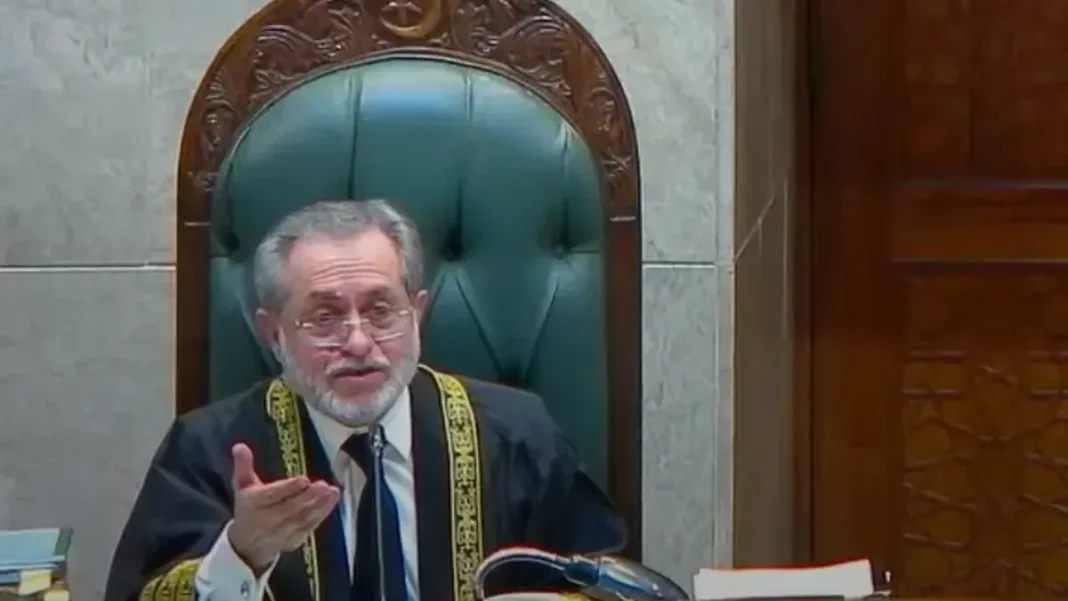
Senior Supreme Court judge Justice Jamal Khan Mandokhail has urged all stakeholders in Balochistan to sit together and find ways to restore peace. The Justice Mandokhail Balochistan peace appeal came at a reception hosted by the Balochistan Bar Council in Quetta on Friday.
Addressing the reception, Justice Mandokhail said the province’s condition brings tears to his eyes. He said all sides must come together to restore the peace the province enjoyed in the past.
He recalled that people were now advised to take precautions while travelling to Quetta, whereas there was a time when he could travel anywhere without security personnel. He said it was a matter of serious concern how the province had reached its present state.
Justice Mandokhail said improving conditions in Balochistan was not solely the government’s responsibility. Every citizen needed to reflect on the causes behind the prevailing situation, he said.
“We need peace because business activities can flourish and people can freely visit courts only when there is peace,” he said.
Justice Mandokhail Balochistan peace: a judge who knows the province
Justice Mandokhail speaks about Balochistan from long experience. Born in Quetta, he served as a judge of the Balochistan High Court from 2009 and as its chief justice from October 2019 to August 2021, before his elevation to the Supreme Court on August 9, 2021.
Dawn reported his remarks at the Bar Council reception, where he also said the services he had rendered during his career were part of his responsibilities and duties.
His warning carries weight because it comes from a judge who has watched the province change. The contrast he drew was plain: a time when he travelled freely across Balochistan, and today, when even a trip to Quetta comes with security advice. That shift captures what years of violence have done to daily life in the province.
A province searching for a way forward
The judge’s call for dialogue comes at a tense time for Balochistan. Political parties in the province have announced a shutter-down protest for November 19, and the province’s security situation remains fragile. Balochistan parties have launched a protest campaign, while a sit-in in Qila Abdullah ended this week after the government held talks with protesters.
The Qila Abdullah case shows that talks can work. Families agreed to bury the dead after an abducted man was recovered and the government pledged an amicable resolution. Justice Mandokhail’s message points in the same direction: a settlement reached through dialogue, not imposed from above.
Registration of 96 seminaries is being fast-tracked in Quetta, and Punjab has agreed to support Balochistan’s Safe City projects. These are administrative steps, yet the judge’s point was broader. Peace, he argued, is not only the government’s job. Citizens, institutions and political forces all have a part to play.
His focus on courts and business was deliberate. When people cannot visit courts freely, justice itself becomes harder to reach. When traders cannot move goods safely, livelihoods suffer. Peace, in his framing, is the ground on which everything else stands.
The reception was a legal community event, not a political rally, which makes the remarks stand out. A senior judge used a Bar gathering to speak plainly about a province in distress and to ask every stakeholder to take part in the repair.
Frequently asked questions
What did Justice Mandokhail say about Balochistan?
He said the province’s condition brings tears to his eyes and urged all stakeholders to sit together and find ways to restore peace.
Why did he mention travel to Quetta?
He recalled a time when he could travel anywhere in Balochistan without security personnel, while people are now advised to take precautions even travelling to Quetta.
Who is Justice Jamal Khan Mandokhail?
He is a judge of the Supreme Court of Pakistan since August 2021. He previously served as chief justice of the Balochistan High Court from October 2019 to August 2021 and was born in Quetta.
What did he say peace would bring?
He said business activities can flourish and people can freely visit courts only when there is peace, and that improving conditions is not solely the government’s responsibility.