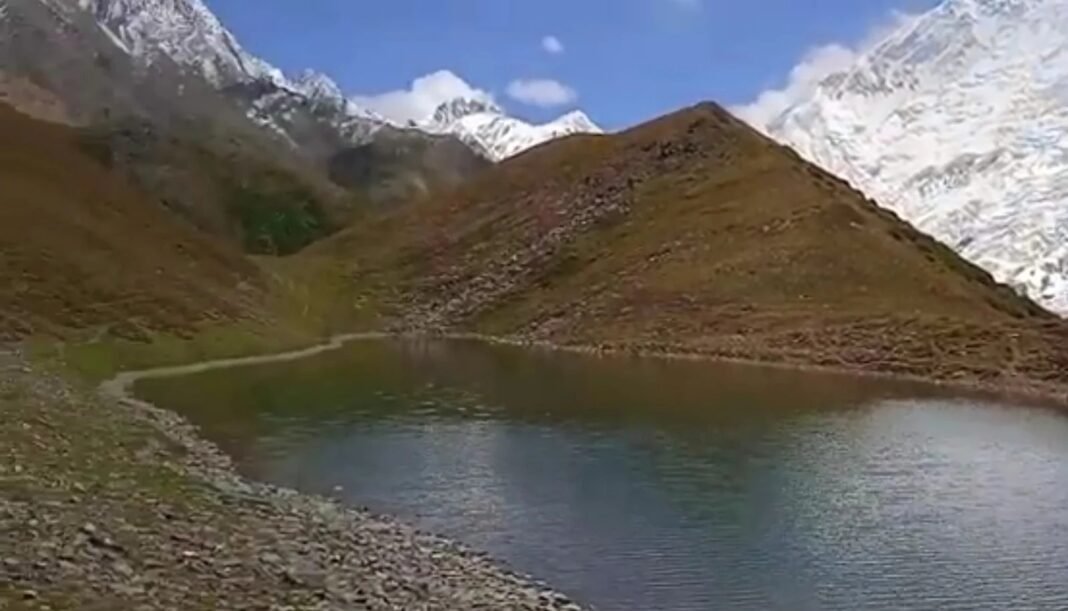
Most of Pakistan’s famous lakes sit beside a road. Also, you park, you walk a few steps, you take your photograph. Kacheli Lake is not that kind of lake. In fact, it sits at nearly 4,000 metres in the Kacheli Meadows of the Miachar valley, in Nagar district of Gilgit-Baltistan, across the Minapin glacier. And the only way to reach it is to earn it: a night at the Daman-e-Koh base camp and a steep two-hour climb on foot. What waits at the top is one of the most untouched alpine lakes in the Karakoram — deep, still. It framed by the giants of the Nagar valley.
This Kacheli Lake travel guide covers everything a trekker needs: why the lake is worth the effort, the real history of the valley, what to do around it, the exact route from Islamabad, Lahore and Karachi, where to stay, what to eat, weather by season, and honest safety advice. Also, for more northern Pakistan destinations, see our Hunza Valley guide and the Explore Pakistan collection.
Quick Facts
- Location: Kacheli Meadows, Miachar Valley, Nagar District, Gilgit-Baltistan
- Altitude: Around 3,970 metres (13,020 ft)
- Famous For: A high-altitude alpine lake reached only by trekking; views of Rakaposhi and Diran across the Minapin glacier
- Nearest City: Gilgit — the trek starts from Minapin village, a short drive up the Karakoram Highway from Gilgit
- Accessibility: Trekking only — drive to Minapin/Miachar, overnight at the Daman-e-Koh base camp, then a steep two-hour climb on foot
- Known Landmarks: Minapin glacier, Rakaposhi (7,788 m), Diran, Miachar village, Hoper valley
- Best For: Trekkers, campers and photographers seeking an uncrowded high-altitude lake; not a roadside stop for casual sightseeing
Why Visit Kacheli Lake
Kacheli Lake is for the traveller who has already seen the roadside lakes — the ones with the car parks and the tea stalls — and wants something wilder. Because you cannot drive to it, the lake keeps its silence. Also, the water is a deep, cold blue-green, the meadows around it bloom briefly and brilliantly in summer. The backdrop is absurdly grand: the Minapin glacier below, Rakaposhi’s massive white pyramid dominating the skyline. Diran’s elegant peak rising behind. On a still morning, the lake holds the mountains in perfect reflection. You will likely have the entire scene to yourself.
The trek itself is part of the reward. The Miachar valley is one of Nagar’s most beautiful — terraced fields, apricot orchards, and villages that still move at the pace of the agricultural year. Also, the climb from the Daman-e-Koh base camp winds through alpine meadows where herders graze their animals in summer, and every few hundred metres of altitude buys you a wider, more dramatic panorama. It is a genuine mountain trek, not a stroll. This means the sense of arrival at the lake is earned and unforgettable.
Kacheli Lake also makes an ideal add-on to the great Nagar treks. The same base camp serves the Rakaposhi base camp (Tagaphari) and Diran base camp routes, so trekkers can build a multi-day itinerary — Kacheli one day, the glaciers and base camps the next — and leave with a far deeper experience of the Karakoram than a single day-trip could give. If you are the kind of traveller who chooses destinations by how quiet they are, put Kacheli Lake near the top of your list.
History of Kacheli Lake
Kacheli Lake has no recorded human history of its own — no fort, no inscription, no ancient settlement on its shores. Also, its story is the story of the valley below it. In fact, Nagar was for centuries one of the small mountain principalities of the Karakoram, ruled by its own mirs (princes) from the town of Nagar. The valley sat on the fringes of the great trade routes between Kashmir, Ladakh and Central Asia. Its people — Burusho, speaking the unique Burushaski language — developed a self-reliant mountain culture of terraced farming, fruit orchards and high-pasture herding that continues essentially unchanged today.
The region entered the modern map in the late 19th century. Also, the British established the Gilgit Agency and Nagar, along with neighbouring Hunza, came under British influence as a princely state. Meanwhile, after 1947, Nagar acceded to Pakistan. The mirs’ rule ended with the abolition of the princely states in the 1970s. For most of the 20th century, the Miachar valley and its high meadows were known only to locals, herders and a handful of mountaineers drawn to Rakaposhi and Diran.
Kacheli Lake’s life as a destination is recent. Also, as trekking tourism grew in Gilgit-Baltistan from the 2000s onward, local guides from Minapin and Miachar began leading visitors up from the Daman-e-Koh base camp — the same base used for the Rakaposhi and Diran expeditions — to the lake above. Word spread through trekking circles and, more recently, through tour operators offering combined Rakaposhi–Kacheli itineraries. The lake remains what it has always been: a herders’ meadow lake, now shared with a small but growing number of trekkers who treat it with the respect it deserves.
Top Things to Do in Kacheli Lake
Trek from Daman-e-Koh base camp to the lake
This is the essential experience: the steep two-hour climb from the Miachar Daman-e-Koh base camp up to Kacheli Meadows and the lake. Also, Start early in the morning, carry water and snacks, and pace yourself — at nearly 4,000 metres, the air is thin and the climb is genuinely demanding. The reward is the lake itself, appearing suddenly as you crest the final rise: deep blue water ringed by meadows, with the great peaks beyond.
Photograph the lake and its reflections
Kacheli Lake is a photographer’s lake. Arrive before the afternoon winds pick up for the stillest water and the sharpest mountain reflections. Also, the meadows around the lake, green and flower-dotted in July and August, give you foreground interest for wide shots. The Minapin glacier across the valley adds drama to panoramic compositions. A polarising filter helps cut the high-altitude glare.
Camp in the Miachar valley
Most trekkers spend the night at the Daman-e-Koh base camp before the climb, and camping here is an experience in itself — a high mountain camp with glacier views, cold starry nights. Also, the sounds of the valley below. Bring a proper four-season-capable sleeping bag; even in summer, nights at this altitude are cold.
Walk the Kacheli Meadows
Give yourself time at the top to wander the meadows around the lake rather than rushing back down. In midsummer the pastures are at their greenest, herders’ animals graze nearby, and short walks along the lakeshore reveal new angles on the peaks. This is also excellent ground for spotting alpine birds and, with luck, marmots.
Combine with Rakaposhi and Diran base camps
The same valley serves the classic Nagar treks: the Rakaposhi base camp at Tagaphari, with its sweeping views of the 7,788-metre Rakaposhi. Also, the Diran base camp across the Minapin/Maani glacier. In fact, a three-to-four-day itinerary combining Kacheli Lake with one or both base camps is one of the finest short trekking programmes in the Karakoram.
Famous Places In and Around Kacheli Lake
- Minapin village — the trailhead village on the Karakoram Highway, gateway to the Miachar valley treks
- Rakaposhi base camp (Tagaphari) — the classic Nagar trek, facing the great 7,788 m Rakaposhi
- Diran base camp — across the glacier, beneath the elegant Diran peak
- Minapin glacier — the glacier the lake lies across, visible from the meadows
- Hoper valley — neighbouring Nagar valley with its own glacier and villages
- Karimabad, Hunza — the famous Hunza town, an easy excursion across the river from Nagar
How to Reach Kacheli Lake
Reaching Kacheli Lake is a three-stage journey: fly or drive to Gilgit, drive up the Karakoram Highway to Minapin and into the Miachar valley, then trek from the Daman-e-Koh base camp. Allow two full days for the approach and the climb, with a night at base camp.
From Islamabad: Fly to Gilgit (about 1 hour; flights are weather-dependent and frequently cancelled — always have a road backup). Also, by road, take the Karakoram Highway via Mansehra, Besham and Chilas to Gilgit — roughly 500 km and 10–12 hours of demanding mountain driving. From Gilgit, drive up the KKH to Minapin (1.5–2 hours), then into the Miachar valley to the Daman-e-Koh base camp, and climb two hours on foot to the lake.
From Lahore: Fly to Islamabad and continue as above, or drive the full distance to Gilgit (700+ km, the best part of two days). Also, Most Lahore-based trekkers overnight in Islamabad or Besham on the way up.
From Karachi: Fly to Islamabad (about 2 hours), then fly or drive to Gilgit as above. The full overland journey from Karachi to Gilgit is three very long days — fly to Islamabad at minimum.
Nearest airport: Gilgit Airport, with PIA flights from Islamabad (weather permitting). Road conditions: The Karakoram Highway is paved but subject to landslides, especially in the monsoon months. Also, the Minapin–Miachar track needs a 4×4. Transport options: NATCO and private coaches run Islamabad–Gilgit. From Gilgit hire a jeep with a local driver for Minapin and the base camp. A local guide from Nagar is strongly recommended for the trek.
Route Details
- Islamabad → Mansehra → Besham → Chilas → Gilgit (Karakoram Highway; 10–12 hours by road, or fly).
- Gilgit → Minapin village (up the KKH toward Hunza; 1.5–2 hours).
- Minapin → Miachar valley → Daman-e-Koh base camp (jeep track; overnight here).
- Base camp → Kacheli Meadows → Kacheli Lake (steep two-hour climb on foot; start early).
- Return the same way; do not attempt the climb in bad weather or without daylight to spare.
Where to Stay in Kacheli Lake
There are no hotels at the lake — and that is the point. Accommodation on a Kacheli trip is in three tiers. In Gilgit, you will find the full range: mid-range hotels along the main bazaar road, comfortable guesthouses. A few well-known upmarket options. Stay here the night before heading up the valley.
In Minapin and the Miachar valley, accommodation is simpler: family-run guesthouses and village homestays that offer a bed, home-cooked food and priceless local knowledge. Also, these are the places to arrange your guide, your jeep to base camp, and your provisions. Book through a local operator or ask around on arrival in the summer season. The valley’s small tourism network is informal but reliable.
At the Daman-e-Koh base camp, you camp. Bring your own tent and a warm sleeping bag, or check whether your guide service provides camp gear — many Nagar trekking outfits run fully supported trips with tents, meals and porters. Camping at the lake itself is not standard practice. Also, the base camp is the established overnight point, and the lake is a day objective from it.
Where to Eat: Local Foods of Kacheli Lake
You will eat in Minapin, Miachar and Gilgit. There are no restaurants at the lake or the base camp, so carry trail food for the climb. Also, Nagar’s mountain cuisine is hearty and distinctive. Look for chapshuro, the savoury meat-filled flatbread that is the region’s signature dish. Giyal, buckwheat pancakes served with apricot oil; and diram pitti, a traditional wheat-and-butter dish. Dried apricots, apricot kernels, walnuts and mulberries — the valley’s famous produce — are sold in every village shop and make perfect trail snacks.
In Gilgit, the main bazaar has restaurants serving Pakistani-Chinese staples, barbecue, daal and fresh river trout. Also, village guesthouses in Minapin cook simple, generous home meals — daal, seasonal vegetables, chapati and yak-butter tea — included in the stay. In fact, carry your own water-purification method for the trek, and pack high-energy food (nuts, dried fruit, chocolate) for the two-hour climb. Meal costs in the valley are modest; Gilgit’s restaurants are only slightly more expensive.
Weather in Kacheli Lake
At 3,970 metres, Kacheli Lake lives in a harsh alpine climate: snowbound for more than half the year, briefly glorious in summer. Also, the trekking season is short — roughly June to September — and even in summer, weather changes fast and nights are cold. The figures below are approximate for the lake’s altitude.
| Season | Temperature Range | Conditions |
|---|---|---|
| Winter (Dec–Feb) | Around −20 to −5°C | Deep snow; lake frozen; completely inaccessible |
| Spring (Mar–May) | Around −10 to 5°C | Still snowbound; route closed until the melt |
| Summer (Jun–Sep) | Around 2–15°C | The trekking season; meadows green, lake ice-free; cold nights, possible afternoon storms |
| Autumn (Oct–Nov) | Around −12 to 2°C | Snow returns quickly; the route closes |
Language and Culture of Kacheli Lake
Nagar is home to the Burusho people, who speak Burushaski. A language isolate unrelated to any other known language. A source of quiet pride in the valley. Shina is also spoken in parts of Nagar. Urdu works everywhere for visitors. The valley is devoutly Muslim and socially conservative: dress modestly (cover shoulders and knees. Women should carry a headscarf), ask before photographing people, and respect prayer times in the villages.
Nagar’s culture is built around the agricultural year — apricot harvest, wheat threshing, the movement of animals to high pastures — and visitors who show interest in it are welcomed warmly. Also, the valley has a strong tradition of hospitality toward trekkers. Hiring a local guide is both the practical choice and the respectful one, since it keeps tourism income in the villages. Follow Leave No Trace principles rigorously: carry out all rubbish, avoid single-use plastics, and never disturb livestock or wildlife.
Shopping in Kacheli Lake
There are no shops at the lake or the base camp — buy everything in Gilgit or Minapin. Also, the valley’s best souvenirs are its produce: dried apricots, apricot kernels, walnuts and dried mulberries from Minapin and Miachar village shops, sold by weight at very reasonable prices. In fact, handmade woollen caps, shawls and socks appear in village shops and the Gilgit bazaar. The embroidered Hunza-Nagar caps make distinctive gifts.
Gilgit’s main bazaar is the place for trekking supplies, batteries, snacks and any gear you forgot in Islamabad. Bargaining is normal in the bazaar but keep it friendly — and buy your dried fruit from the valley villages rather than Gilgit when you can. Also, the money reaches the producers.
Travel Tips for Kacheli Lake
Packing Essentials
Four-season sleeping bag, tent (unless your operator provides them), warm layers including a down or synthetic insulated jacket, waterproof shell, sturdy trekking boots with ankle support, trekking poles, sun protection (hat, sunglasses, high-SPF sunscreen. UV is fierce at 4,000 m), headlamp, water purification, first-aid kit, and two days of high-energy trail food.
Safety Tips
Do not underestimate this trek. The two-hour climb is steep, the altitude is real, and weather can close in fast. Hire a local guide from Minapin or Miachar — non-negotiable for first-time visitors. Start the climb early, turn back if weather deteriorates, and never attempt the lake in rain, fog or high wind. Acclimatise with a night at base camp before climbing. There is no rescue post at the lake; carry a charged phone and tell your guesthouse your plan.
Money & Connectivity
Carry all the cash you will need from Gilgit. There are no ATMs in Minapin or the Miachar valley, and cards are useless beyond Gilgit. Mobile signals are patchy: some networks reach Minapin village, but expect no coverage at the base camp or the lake. Download offline maps before leaving Gilgit.
Best Time to Visit Kacheli Lake
Summer (June–September) — the only season
This is the trekking window, when the snow has melted and the route is open. July and August bring the greenest meadows and the warmest days. June and September are quieter but colder, with a higher chance of early or late snow. Mid-July to late August is the sweet spot for the best conditions.
Spring (March–May) — not possible
The valley is still snowbound and the route to the lake is closed. The villages are beautiful in blossom season (April), but Kacheli Lake itself is unreachable.
Autumn (October–November) — the window closes
Snow returns to the high meadows and the trek becomes unsafe. Also, By November the lake is frozen and the season is over.
Winter (December–February) — inaccessible
Deep snow, sub-zero temperatures, and a frozen lake. Also, Kacheli in winter belongs to the mountains alone.
Final Thoughts
Kacheli Lake is not a destination you stumble upon — it is a destination you choose, prepare for, and earn. That is precisely why it stays with you. Meanwhile, long after the roadside lakes blur together in memory, you will remember the morning you climbed out of the Daman-e-Koh camp, the moment the lake appeared below the ridge. The silence of 4,000 metres broken only by the wind.
If Nagar’s high country calls to you, answer it properly: hire a local guide, give the valley the days it deserves, and consider adding the Rakaposhi or Diran base camps to the same trip. For more of Pakistan’s great mountain destinations, browse the Explore Pakistan collection.
FAQs
Where is Kacheli Lake located?
In the Kacheli Meadows of the Miachar valley, Nagar District, Gilgit-Baltistan — at around 3,970 metres, across the Minapin glacier.
How do I reach Kacheli Lake?
Drive to Gilgit, continue up the Karakoram Highway to Minapin, jeep into the Miachar valley to the Daman-e-Koh base camp, then climb about two hours on foot. There is no road to the lake.
What is the best time to visit Kacheli Lake?
June to September. Also, mid-July to late August offers the greenest meadows and most reliable weather. In fact, snow closes the route the rest of the year.
How difficult is the Kacheli Lake trek?
Moderately difficult — a steep two-hour climb at nearly 4,000 m. Reasonably fit trekkers can manage it with a guide, but it is not a casual walk.
Is Kacheli Lake safe for families?
It suits active families with older children who trek. Also, it is not suitable for small children or anyone with limited mobility. In fact, Hire a local guide.
Where can I stay near Kacheli Lake?
Camp at the Daman-e-Koh base camp. Stay in guesthouses in Minapin/Miachar or hotels in Gilgit before and after the trek.
What should I eat or carry?
Eat in Minapin and Gilgit (try chapshuro and local dried fruit). Also, carry water, purification, and high-energy snacks for the climb — there is nothing at the lake.
Is there mobile signal at Kacheli Lake?
no. Expect no coverage at the base camp or the lake. Also, some signal reaches Minapin village. In fact, download offline maps in Gilgit.