Most visitors to Karachi head for the obvious sights — the white dome of the Mazar-e-Quaid, the sea breeze at Clifton, the bustle of Burns Road. But if you want to understand the city the way old Karachi understands itself, stand one afternoon on M.A. Also, Jinnah Road near Light House and walk toward the Kacchi Memon Masjid, a stone mosque that has watched this street for well over a century and a half. It will not overwhelm you the way the great Mughal mosques of Lahore do.
It will do something quieter: it will show you the Karachi of the Memon traders — the Gujarati-origin Muslim merchants whose warehouses, counting houses and charitable trusts built the commercial backbone of this city — and the old-town Karachi of narrow lanes, wholesale markets and mosques that have anchored entire communities for generations.
This Kacchi Memon Masjid, Karachi travel guide gives you everything you need to plan the visit: the mosque’s remarkable history, what to see in its architecture, how to reach it from Islamabad, Lahore and within Karachi, where to eat in the old city around it, what the weather is like through the year, and practical tips on mosque etiquette and safety. Also, pair it with the Explore Pakistan collection for more heritage destinations across the country.
Quick Facts
- Location: M.A. Jinnah Road near Light House, Gari Khata, old Karachi, Sindh
- Altitude: At sea level — Karachi is a coastal city
- Famous For: One of Karachi’s oldest mosques; the historic house of worship of the city’s Kacchi (Kutchi) Memon trading community
- Nearest City: It is inside Karachi itself; Saddar and Empress Market are a few minutes away
- Accessibility: Very easy — by car, taxi, ride-hailing or local bus from anywhere in Karachi; Karachi is connected by air, rail and road to the rest of Pakistan
- Known Landmarks: Empress Market, New Memon Masjid (Bolton Market), Burns Road, Light House, Mazar-e-Quaid
- Best For: Heritage lovers, architecture and photography enthusiasts, travellers exploring old Karachi, and anyone interested in the city’s merchant-community history
Why Visit Kacchi Memon Masjid, Karachi
Karachi’s old city rewards travellers who slow down. The Kacchi Memon Masjid stands in one of the oldest commercial quarters of Karachi, surrounded by the very markets the Memon community built its name in. Visiting it is less about ticking off a monument and more about stepping into a living piece of Karachi’s social history. The mosque is still in daily use — the courtyard fills for Friday prayers, the neighbourhood’s shopkeepers close their shutters and walk over at prayer time, and during Ramadan the whole lane takes on a festive, devotional rhythm.
Few places in Karachi let you feel the continuity of the old city so directly.
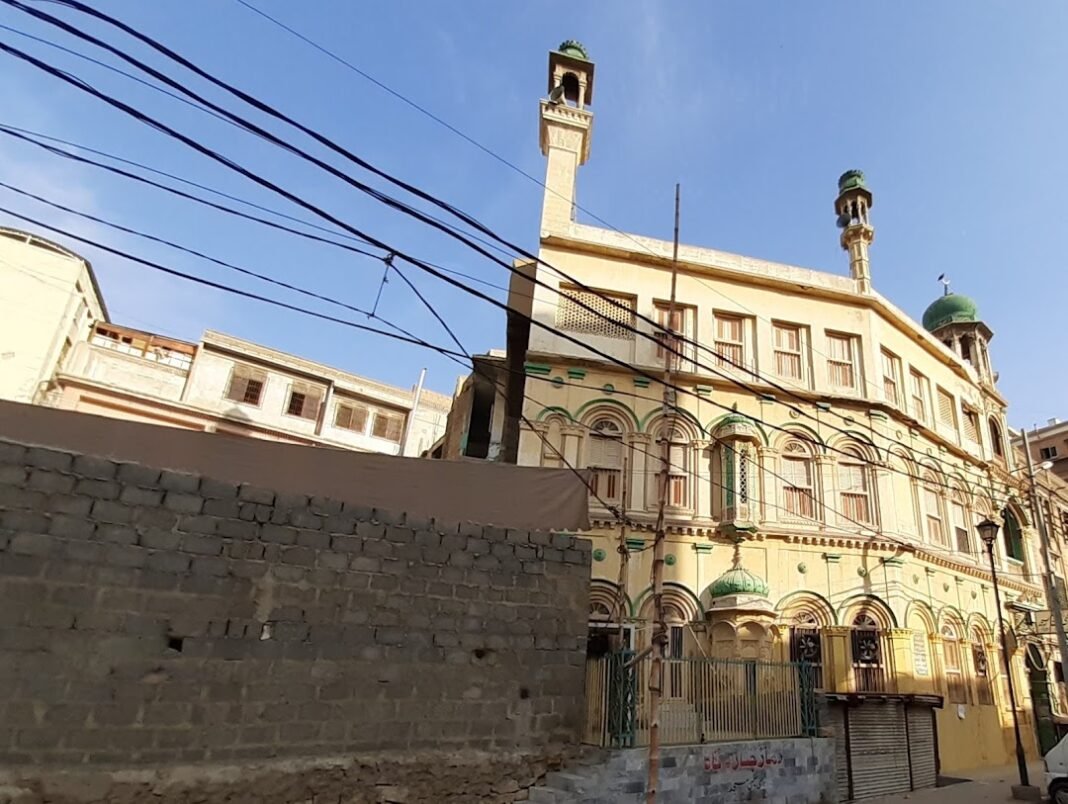
For architecture lovers, the mosque is a study in restraint. Also, the Sindh government’s cultural-property inventory describes it as a stone mosque plastered with lime and cement, a ground-plus-two-storey structure roughly 20 by 30 metres, entered from the south-west corner, with a large central minaret flanked by two smaller ones. It is not a grand imperial commission. It is a community-built mosque, financed and maintained by merchants. Its design reflects that: sturdy, honest stonework, graceful minarets, and a prayer hall arranged for maximum capacity rather than display. If you appreciate buildings that tell you how people actually lived, this one speaks volumes.
The visit also works beautifully as the anchor of a half-day heritage walk through old Karachi. Also, From the mosque you can walk to Empress Market, wander the Burns Road food street, pass the great New Memon Masjid at Bolton Market, and finish at the Mazar-e-Quaid — all within a few kilometres. For anyone who has only seen Karachi from a hotel window in Clifton or DHA, this route is the antidote: it is the old city, dense, noisy, historical and unmistakably alive.
History of Kacchi Memon Masjid, Karachi
The history of this mosque is the history of the Memon community in Karachi. Also, the Memons are a Muslim merchant community originating from Kutch, in what is today the Indian state of Gujarat. Memon traders began settling in Karachi and other Sindh towns in the 19th century, drawn by the city’s growing port trade. They became one of the commercial engines of colonial Karachi — dealing in textiles, grains, hardware and shipping. Like many migrant merchant communities, they built their religious institutions first: the mosque was the community’s anchor, its meeting place, its school and its charity house all at once.
Exactly when the Kacchi Memon Masjid was founded is a point on which the records differ. Also, it is worth stating this honestly. A well-known account published in The Express Tribune dates the Kachi Memon Mosque on M.A. Jinnah Road near Light House in Gari Khata to 1850. This would make it one of the oldest mosques in Karachi. The Sindh government’s own inventory of cultural property (2015), compiled from the archaeological work of Jansen and Yasmeen Lari, lists the mosque as a 20th-century structure while documenting its stone-and-lime construction in detail.
Karachi’s Earliest Community Mosques
What is certain is that the mosque belongs to Karachi’s earliest generation of community-built mosques, raised by the Kacchi Memon community when the old town around M.A. Jinnah Road was the heart of the city.
Karachi has three great Memon mosques and travellers often confuse them.. As a result, it helps to distinguish this mosque from its two famous namesakes, The Kutchi Memon Masjid near Saddar — reported in multiple accounts to have been built in 1893, with a famously neglected but beautiful pistachio-green interior — serves the same community a short distance away. Meanwhile, the New Memon Masjid at Bolton Market is the grand modern one: its first committee was formed on 17 September 1948, the first adhan was called on 15 July 1949. The foundation stone was laid on 24 August 1949 by Governor General Khawaja Nazimuddin.
Today the New Memon Masjid spans 17,280 square yards with a capacity of around 10,000 worshippers and is famous for its Ramadan Shabeena prayers. The Kacchi Memon Masjid is the oldest and smallest of the three — the ancestor, in a sense. The one closest to the original Memon settlement in old Karachi.
Gari Khata and the Horse-Cart Era
The mosque’s story is inseparable from the commercial streets around it. Also, Gari Khata, Light House and the lanes off M.A. Jinnah Road were the Karachi of the horse-cart era. The city’s wholesale trade moved through these streets and the Memon, Bohra and other merchant communities built their godowns and homes here. The Partition of 1947 and the decades of growth since have transformed Karachi beyond recognition. The Kacchi Memon Masjid still stands where it has always stood — still owned and run by the community, still serving the same streets.
Top Things to Do in Kacchi Memon Masjid, Karachi
Study the stone architecture and the three minarets
Walk slowly around the building and take in what the government inventory recorded so carefully: stone walls plastered with lime and cement, a compact 20-by-30-metre footprint. The distinctive minaret arrangement — a large central minaret with a smaller one on each side. The entrance sits at the south-west corner. It is a modest building by the standards of Karachi’s great mosques. Its proportions are graceful, and the stonework has the quiet dignity of a structure built to last centuries rather than impress visitors.
Join the Friday congregation
If your schedule allows, time your visit for Friday prayers. The mosque fills with shopkeepers and residents from the surrounding lanes. Also, the atmosphere — the recitation, the packed courtyard, the rows of worshippers spilling into the street — is the living culture of old Karachi. Non-Muslim visitors are welcome to observe respectfully from the courtyard. Dress modestly, keep your voice low, and avoid walking in front of people at prayer.
Walk the old-town lanes around Gari Khata
The mosque’s neighbourhood is the attraction as much as the mosque itself. Also, the lanes around Light House and Gari Khata are lined with century-old shop-houses, wholesale godowns and tiny eateries that have been serving the same streets for generations. This is one of the best areas in Karachi for street photography of the old city — weathered facades, hand-painted shop signs. The constant theatre of the wholesale trade.
Visit the New Memon Masjid at Bolton Market
A short walk or drive away, the great New Memon Masjid makes the perfect comparison visit: the 1949 foundation-stone mosque with its 17,280-square-yard complex, its capacity of 10,000 worshippers. Also, its famous Ramadan traditions. In fact, seeing the community’s oldest and largest mosques in one afternoon tells the whole story of the Memons’ growth in Karachi.
Combine with a heritage walk: Empress Market to Mazar-e-Quaid
From the mosque, Empress Market — the great colonial market hall completed in 1889 — is a short distance away. The white marble dome of the Mazar-e-Quaid, the mausoleum of Muhammad Ali Jinnah completed in 1970, is a short drive further. Also, together these stops form one of Karachi’s finest half-day heritage routes.
Famous Places In and Around Kacchi Memon Masjid, Karachi
- Empress Market — the landmark 1889 colonial market hall of Saddar, a few minutes from the mosque
- New Memon Masjid, Bolton Market — the community’s great 1949 mosque; capacity around 10,000
- Burns Road — Karachi’s legendary food street, a short drive away
- Mazar-e-Quaid — the mausoleum of Muhammad Ali Jinnah, Pakistan’s founder
- Frere Hall — the 1865 colonial-era hall in its gardens, one of Karachi’s most photographed buildings
- St Patrick’s Cathedral — the 19th-century Gothic cathedral near Empress Market
- Mohatta Palace — the beautiful 1927 stone palace, now a museum (a longer drive toward Clifton)
How to Reach Kacchi Memon Masjid, Karachi
The mosque sits in old Karachi on M.A. Also, Jinnah Road near Light House, in the Gari Khata area. In fact, it is a dense commercial quarter. The easiest approach is to navigate to Light House or Empress Market and ask any shopkeeper for the Kacchi Memon Masjid — everyone in the neighbourhood knows it.
From Islamabad: Fly to Karachi (about 1.5–2 hours. Also, multiple daily flights) and take a taxi or ride-hailing car from Jinnah International Airport to Saddar/Gari Khata — roughly 12–15 km, 25–45 minutes depending on traffic. In fact, the road journey is about 1,400 km and takes 14–16 hours; comfortable coach services run overnight. Trains from Islamabad/Rawalpindi to Karachi Cantonment station take 20–24 hours.
From Lahore: Fly to Karachi (about 1.75 hours) or take the train (16–20 hours) or an overnight coach (about 1,200 km, 14–16 hours). Also, From the airport or Cantt station, the mosque area is a short taxi ride.
Within Karachi: From Clifton or DHA, allow 30–45 minutes by car to reach Saddar, longer in rush hour. From Gulshan, North Nazimabad or the airport side, Saddar is 20–40 minutes. Ride-hailing apps work everywhere; for the old-city lanes, you can also take a rickshaw from Empress Market. Local buses and minibuses serve M.A. Jinnah Road, but they are crowded — most visitors prefer a car or rickshaw for this trip.
Nearest airport: Jinnah International Airport, Karachi — about 12–15 km from the mosque. Road conditions: M.A. Also, Jinnah Road is a major artery and is paved and maintained. In fact, the lanes around the mosque are narrow and congested — park on the main road and walk in. Transport options: Private car, taxi, ride-hailing, rickshaw, and local bus/minibus.
Route Details
- Reach Saddar via M.A. Jinnah Road (from the airport, take Shahrah-e-Faisal to Saddar).
- Continue to the Light House area; the mosque is in the Gari Khata quarter just off the main road.
- Park on M.A. Jinnah Road or near Empress Market and walk the last few hundred metres — the lanes are too narrow for cars.
- Ask any shopkeeper for “Kacchi Memon Masjid” if you lose the way; the whole neighbourhood knows it.
- Combine the visit with Empress Market and the New Memon Masjid at Bolton Market for a complete old-city circuit.
Where to Stay in Kacchi Memon Masjid, Karachi
The mosque is in old Karachi, and most visitors stay in Saddar or nearby and make it a half-day stop. Also, Saddar has a long-established strip of mid-range and budget hotels around Empress Market and the railway station — practical, walkable to the old city, and well connected. Guesthouses and budget hotels here are simple but serviceable. They put you within minutes of the mosque, Burns Road and the Bolton Market area.
For more comfort, the upmarket hotels of the city — the five-star properties along Club Road and in DHA/Clifton — are a 20–40 minute drive away, depending on traffic. These offer the full range of luxury amenities and are the natural base if you are combining the old-city heritage walk with Karachi’s seaside attractions. Meanwhile, families and first-time visitors to Karachi often prefer staying in Clifton or DHA and hiring a car with a driver for the old-city day. This removes any navigation stress in the congested lanes around the mosque.
Whatever tier you choose, book ahead during winter (October–March), which is Karachi’s peak visitor season, and confirm that your hotel has reliable air-conditioning — Karachi’s humidity makes it essential for most of the year.
Where to Eat: Local Foods of Kacchi Memon Masjid, Karachi
Eating is half the reason to visit this part of Karachi. Also, the old city around the mosque is one of Pakistan’s great food quarters. Burns Road, a short drive away, is Karachi’s legendary food street — generations of families have eaten their way down it. Its nihari, haleem, kebabs and lassi shops are institutions. Walk it in the evening when the grills are lit and the whole street smells of charcoal and spices.
The Memon community itself has a distinctive food culture: rich, slow-cooked dishes influenced by Gujarati and Kutchi traditions — think deeply spiced curries, khichda. Also, the community’s famous wedding feasts. In fact, you will find Memon-style eateries and bakeries in the lanes around the mosque and in nearby Bolton Market. Karachi’s universal favourites are everywhere here too: biryani (the city’s signature dish), chicken tikka, seekh kebabs, bun kebabs from street carts, and fresh sugarcane juice.
For dessert, try the traditional sweet shops of the old city — gulab jamun, jalebi fried fresh in the evening, and kulfi. Also, a full meal at a Burns Road or Saddar eatery is budget-friendly by any standard. In fact, expect a generous dinner for two at a local restaurant to cost well under what a single main course costs at a Clifton fine-dining spot. Prices rise as you move toward the upmarket restaurants of DHA and Clifton. The old city’s food is honest, filling and cheap.
Weather in Kacchi Memon Masjid, Karachi
Karachi is a coastal city with a hot, humid climate moderated by sea breezes — and by Pakistani standards, a mild winter that makes it one of the country’s most comfortable winter destinations. Summer heatwaves can be intense, so plan the old-city walk for the cooler months if you can.
| Season | Temperature Range | Conditions |
|---|---|---|
| Winter (Dec–Feb) | Around 10–26°C | Mild and pleasant; the best season for walking the old city |
| Spring (Mar–Apr) | Around 20–34°C | Warming up; mornings still comfortable, afternoons hot |
| Summer (May–Aug) | Around 30–38°C | Hot and humid; monsoon showers in July–August; avoid midday walks |
| Autumn (Sep–Nov) | Around 24–35°C | Humidity eases from October; good for sightseeing by late October |
Language and Culture of Kacchi Memon Masjid, Karachi
Karachi is Pakistan’s most linguistically mixed city. Urdu is the lingua franca and is spoken everywhere. Also, Sindhi is the provincial language; English is widely understood in business and hospitality. In the mosque’s own community, many older Memons speak Memoni (also called Kutchi), the community’s ancestral language from Kutch, alongside Urdu and Gujarati influences.
The Memons are known across Pakistan as a close-knit, trade-oriented, and deeply philanthropic community — their charitable trusts run schools, hospitals and mosques across the country. The mosque you are visiting is itself a product of that tradition of community endowment. As a visitor, the cultural notes that matter are the universal ones for mosques: dress modestly (cover shoulders and knees. Women should carry a scarf to cover the head), remove shoes before entering the prayer hall, keep your voice low, and avoid visiting during the main congregational prayers unless you intend to join or observe quietly. Photography of the architecture is generally fine, but ask before photographing people.
Shopping in Kacchi Memon Masjid, Karachi
The streets around the mosque are wholesale Karachi at its most authentic. Bolton Market — the great wholesale bazaar next to the New Memon Masjid — is one of the city’s oldest trading centres, dealing in everything from textiles to hardware. Empress Market, completed in 1889, is the architectural showpiece: its clock tower and arched halls house spice sellers, fruit vendors, pet shops and household goods in a genuinely historic setting.
For visitors, the practical shopping is at Zainab Market and the Saddar bazaars — famous for export-surplus garments, leather goods and handicrafts at bargain prices — and Bohri Bazaar for fabrics and household items. Also, this is bargaining territory: start at half the asking price and meet in the middle with a smile. In fact, dry fruits, spices and traditional sweets from the old-city shops make excellent, packable souvenirs. (Karachi’s modern malls are in Clifton and DHA — fine for air-conditioned browsing. The old-city bazaars are where the city’s real shopping character lives.)
Local Events and Festivals
The mosque’s calendar follows the Islamic year, and the two great Eids transform the neighbourhood. During Ramadan, the mosque fills for Taraweeh prayers each night and the surrounding lanes take on a festive night-time life, with food stalls and sweet shops doing their busiest trade of the year. Eid al-Fitr (at the end of Ramadan, in Shawwal) and Eid al-Adha (in Dhul-Hijjah) bring large congregational prayers and a celebratory atmosphere across old Karachi. If you visit during Ramadan, the evenings around the mosque are the best time to experience the community at its most vibrant. And the iftar-time food on Burns Road is a destination in itself.
Travel Tips for Kacchi Memon Masjid, Karachi
Packing Essentials
Modest, light clothing (Karachi is warm most of the year). Also, a scarf for women to cover the head inside the mosque. In fact, comfortable walking shoes for the old-city lanes; sunscreen and a water bottle; a power bank for your phone.
Safety Tips
Visit the mosque and its lanes in daylight hours. Also, the markets are busy and the streets are full of people. In fact, keep valuables out of sight in crowded bazaars, as you would in any old-city market anywhere in the world. In addition, the area around the mosque is a working commercial quarter, not a tourist zone — a calm, respectful manner goes a long way. Traffic on M.A. Jinnah Road is heavy; use pedestrian crossings and footpaths where they exist.
Money & Connectivity
ATMs are plentiful in Saddar and along M.A. Also, Jinnah Road; carry cash for the bazaars and street food, where cards are rarely accepted. In fact, all major mobile networks (Jazz, Telenor, Zong, Ufone) have strong 4G coverage in central Karachi. Ride-hailing apps work reliably for getting to and from the area.
Best Time to Visit Kacchi Memon Masjid, Karachi
Winter (December–February) — the best season
Karachi’s mild winter is the ideal time for the old-city walk: daytime temperatures in the low to mid-20s, cool evenings, and clear skies. This is peak season, so book hotels early.
Spring (March–April) — still good
Mornings remain pleasant, though afternoons grow hot. Plan the mosque and bazaar walk for early morning or late afternoon.
Summer (May–August) — avoid if possible
Heat and humidity make midday walking uncomfortable, and heatwaves can push temperatures past 40°C. If you must visit, go at dawn and retreat to air-conditioning by noon.
Autumn (September–November) — improving
Humidity drops from October onward. By November the weather is genuinely pleasant again and the bazaars are less crowded than in winter.
Final Thoughts
The Kacchi Memon Masjid will not be the most spectacular building you see in Pakistan. Also, what it will be is one of the most honest. A working community mosque in the working old city, still doing exactly what it was built to do more than a century and a half ago. In a city that reinvents itself every decade, that continuity is rare and worth travelling for.
Go in the cool of a winter morning, walk the lanes, eat on Burns Road, and stand for a while in the courtyard listening to the old city move around you. That is the real Karachi. And this quiet stone mosque is one of its truest doors. For more of the country’s heritage, from mountain forts to ancient temples, explore the Explore Pakistan collection.
FAQs
Where is the Kacchi Memon Masjid located?
On M.A. Also, Jinnah Road near Light House, in the Gari Khata quarter of old Karachi, Sindh — a short distance from Empress Market and Saddar.
How old is the Kacchi Memon Masjid?
Accounts differ: a well-known press account dates it to 1850. Also, the Sindh government’s cultural-property inventory lists it as a 20th-century structure. Either way, it belongs to Karachi’s earliest generation of community-built mosques.
What is the best time to visit the Kacchi Memon Masjid?
October to March. Also, Karachi’s weather is mild and pleasant. In fact, visit in the morning or late afternoon for the most comfortable walk through the old city.
How do I reach the mosque from Karachi airport?
Jinnah International Airport is about 12–15 km away. Also, take a taxi or ride-hailing car via Shahrah-e-Faisal to Saddar/Light House — 25–45 minutes depending on traffic.
Is the Kacchi Memon Masjid the same as the New Memon Masjid?
no. The New Memon Masjid at Bolton Market (foundation stone laid 1949) is the community’s large modern mosque. Also, the Kacchi Memon Masjid is the older, smaller historic mosque near Light House.
Is the mosque safe for tourists and families?
Yes — visit in daylight when the markets are busy, dress modestly, keep valuables discreet in the bazaars. You will find a welcoming, working neighbourhood.
Where can I eat near the mosque?
Burns Road food street (nihari, haleem, kebabs) is a short drive away. Also, the lanes around the mosque have Memon eateries, bakeries and street-food carts. In fact, meals at local eateries are very budget-friendly.
What else can I see nearby?
Empress Market, the New Memon Masjid at Bolton Market, Burns Road, the Mazar-e-Quaid, Frere Hall and St Patrick’s Cathedral are all within a short distance.