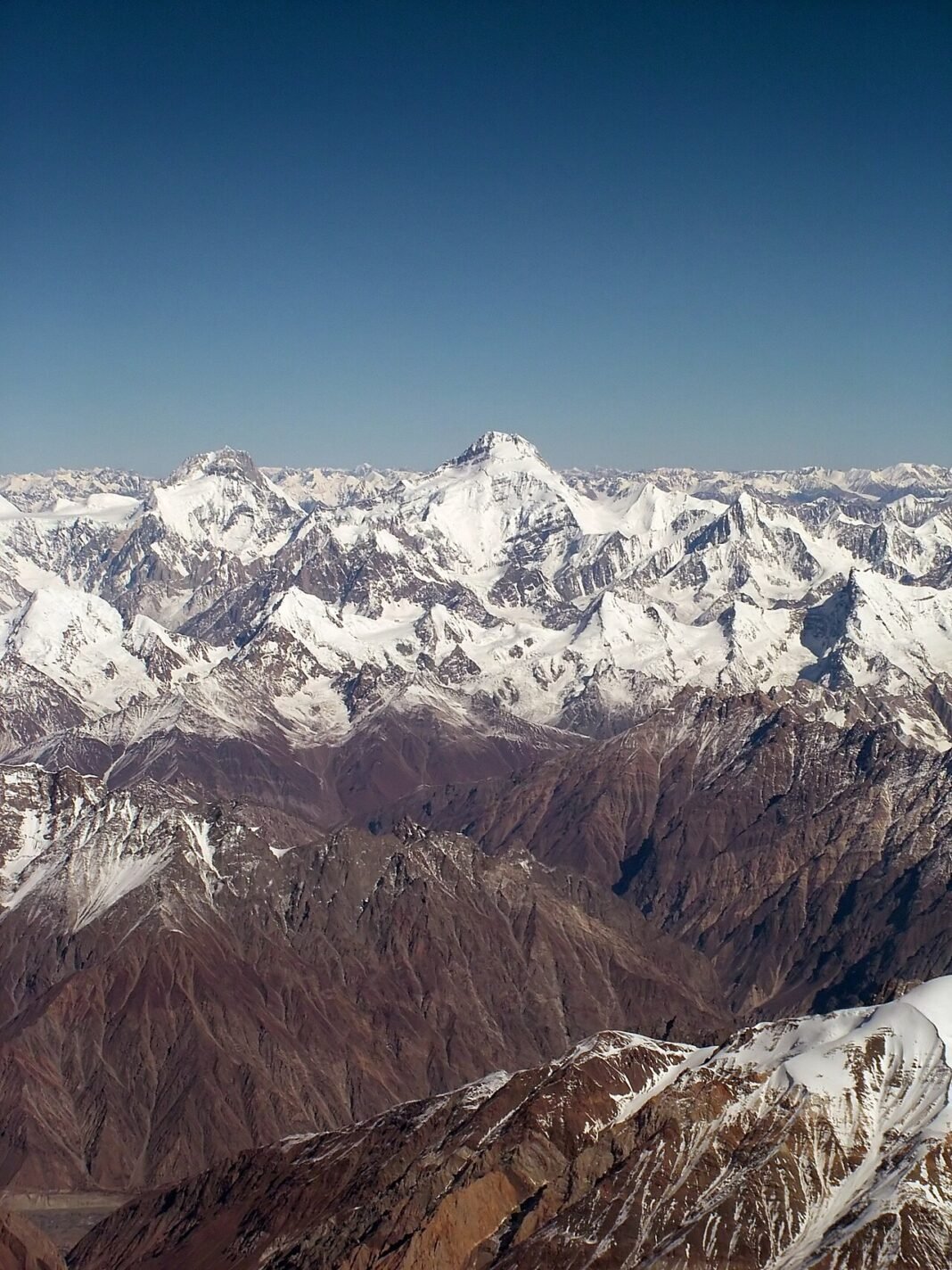
At 7,760 metres, Kanjut Sar rises out of the Hispar Muztagh as one of the great silent giants of the Karakoram. It is the 26th-highest mountain on Earth and the 11th-highest in Pakistan, and yet most travellers have never heard its name. That is precisely its appeal. While crowds gather at the more famous peaks, Kanjut Sar stands in magnificent isolation above the Hispar Glacier, climbed by only a handful of expeditions since its first ascent in 1959.
This Kanjut Sar travel guide is for the mountaineers who dream of serious high-altitude objectives, and for the trekkers and travellers who want to stand in the shadow of a true Karakoram giant.
Quick Facts
- Location: Hispar Muztagh, Karakoram range, Gilgit-Baltistan, Pakistan
- Altitude: 7,760 metres (25,459 feet); the second summit, Kanjut Sar II, is 6,831 metres
- Famous For: 26th-highest mountain in the world; first climbed in 1959 by Camillo Pellissier; one of the least-visited high summits of the Karakoram
- Nearest City: Gilgit, the gateway to the Nagar Valley and the Hispar region
- Accessibility: Expedition access via Hispar village in Nagar Valley and the Hispar Glacier; permits required for climbing
- Known Landmarks: Hispar Glacier, nearby peaks Yukshin Garden Sar, Yutmaru Sar, Pumari Chhish and Kunyang Chhish
- Best For: Experienced mountaineers, high-altitude trekkers, photographers and serious adventure travellers
Why Visit Kanjut Sar
Kanjut Sar is not a mountain you visit casually. That is exactly why it matters. In an age when the world’s famous peaks see queues on their fixed ropes, Kanjut Sar remains what the great ranges used to be: remote, demanding and profoundly quiet. Since the first ascent in 1959, only a handful of teams have stood on its summit. To attempt it, or even to trek into its shadow, is to experience the Karakoram as the pioneers did.
The mountain’s setting is extraordinary. Also, it rises above the tributaries of the vast Hispar Glacier, surrounded by a court of high peaks: Yukshin Garden Sar, Yutmaru Sar, Pumari Chhish and Kunyang Chhish. In fact, the name itself comes from the Wakhi language, in which “Kanjut” or “Kunjudh” refers to lower Hunza. The peak is literally “that which overlooks Kunjudh”. For the Wakhi people of nearby Shimshal and the communities of Nagar, this mountain has shaped routes, stories and horizons for generations.
For mountaineers, Kanjut Sar is a genuine 7,000-metre objective with a distinguished history: the 1959 Italian expedition led by Guido Monzino, the 1981 Japanese ascent, the 2010 Russian-American attempt that reached 7,450 metres before weather turned them back. Trekkers rate the approach through the Hispar Valley and along the Hispar Glacier is one of the great glacier journeys of the Karakoram, with the option of continuing toward Concordia, the famous “throne room of the mountain gods”.
And for the traveller who simply wants to see it, the valleys of Nagar and Shimshal offer views of this imposing wall of ice and rock from trails that are challenging but achievable. Kanjut Sar rewards everyone who makes the effort to come close.
History of Kanjut Sar
Unlike the inhabited valleys below it, Kanjut Sar has no ancient human history on its slopes. Its history is the history of exploration. The peak was surveyed and named during the great Karakoram mapping efforts of the early twentieth century. British and international surveyors charted the Hispar Muztagh and its glaciers.
The mountain’s climbing history began in 1959, when an Italian expedition directed by Guido Monzino targeted the peak. On 19 July 1959, Camillo Pellissier reached the summit alone during the final stage of the expedition, completing the first ascent of Kanjut Sar via the southern side. It was a landmark achievement on a peak that had defeated all previous attempts. It remains the defining event in the mountain’s history.
After 1959, the mountain fell quiet for two decades. Then, between 4 and 6 August 1981, seven Japanese climbers of a single expedition reached the top, the second successful ascent. In 2010, a Russian-American expedition attempted a new line on the Eastern Ridge and climbed to 7,450 metres before retreating in bad weather. Since then, only a handful of teams have attempted the peak, making it one of the least-visited high summits in the entire Karakoram.
Locally, the mountain has always been part of the landscape of the Wakhi and Burusho communities. Also, people from the nearby village of Shimshal have their own geography of these peaks. The mountain is sometimes confused with neighbouring Yukshin Gardan Sar when viewed from the valleys below, a reminder that the communities here read the mountains in their own way, independent of official maps.
Top Things to Do in Kanjut Sar
Attempt the Summit (for Expert Mountaineers)
Kanjut Sar is a serious mountaineering objective for experienced teams only. Also, the standard approach starts from Hispar village in Nagar Valley and follows the Hispar Glacier toward base camp. In fact, expeditions need full high-altitude equipment, experienced guides and porters, and climbing permits arranged through Pakistani authorities and tour operators. The best window is May to August. This is not a trekking peak. It demands technical skill, acclimatisation and expedition logistics.
Trek the Hispar Glacier
For trekkers, the journey along the Hispar Glacier toward Kanjut Sar’s base is one of the great glacier treks of the Karakoram. Also, the route passes through a landscape of ice pinnacles, lateral moraines and side valleys, with the great peaks of the Hispar Muztagh rising on every side. In fact, it is a long, demanding trek that requires a guide, porters and full camping equipment.
View the Peak from Shimshal and Nagar Valleys
You do not need to climb Kanjut Sar to be moved by it. Also, treks in the Shimshal Valley and viewpoints in the Nagar Valley offer sightings of the peak’s massive south face. In fact, the Verjerav Valley area of Shimshal has been used by explorers photographing the mountain, and local guides know the best vantage points.
Combine with a Concordia Trek
After an expedition or a Hispar Glacier trek, many teams continue toward Concordia, where the Baltoro, Godwin-Austen and Vigne glaciers meet beneath K2, Broad Peak and the Gasherbrums. Also, it is the classic extension that turns a Kanjut Sar journey into a full Karakoram grand tour.
Photograph the Hispar Muztagh
The peaks around Kanjut Sar, Yukshin Garden Sar, Yutmaru Sar, Pumari Chhish and Kunyang Chhish, form one of the most photogenic mountain groups in Pakistan. Also, clear summer mornings give the sharpest light, and the contrast of dark rock, white ice and blue sky is unforgettable.
Experience Wakhi and Nagar Culture
The gateway communities, Shimshal’s Wakhi villagers and the towns of Nagar Valley, offer a cultural dimension that enriches any expedition. Also, traditional stone houses, terraced fields, apricot orchards and warm hospitality make the approach march as memorable as the mountain itself.
Famous Places In and Around Kanjut Sar
- Hispar Glacier: One of the great glaciers of the Karakoram and the main approach route to the peak.
- Shimshal Valley: Remote Wakhi valley with stunning views and trekking routes toward the peak’s southern aspects.
- Nagar Valley: Beautiful valley of green pastures and heritage, the starting point at Hispar village.
- Concordia: The famous glacial junction beneath the great 8,000-metre peaks, reachable as an extension.
- Hunza Valley: The cultural heart of the region, a natural stop before or after the expedition.
How to Reach Kanjut Sar
Reaching Kanjut Sar is an expedition in itself. Also, the gateway is Gilgit, the main city of Gilgit-Baltistan. From Islamabad, you can fly to Gilgit in about an hour (weather permitting), or drive the Karakoram Highway, a spectacular but long journey of roughly ten to fourteen hours depending on road conditions. From Lahore, fly to Islamabad first and connect onward. The overland route follows the motorway to Islamabad and then the Karakoram Highway north. From Karachi, fly to Islamabad and continue as above.
From Gilgit, travel by jeep to the Nagar Valley and on to Hispar village, the last settlement before the glacier. Also, this is where expeditions organise porters, supplies and local guides. The trek from Hispar onto the Hispar Glacier and up to base camp takes several days across demanding terrain.
The nearest airport is Gilgit Airport, with daily flights from Islamabad subject to weather. Also, Skardu Airport is an alternative gateway for teams approaching from the Baltoro side. In fact, all climbing expeditions require permits, which are arranged through the Alpine Club of Pakistan and licensed tour operators, along with liaison arrangements. Independent, unpermitted attempts on 7,000-metre peaks are not allowed.
An alternative, more difficult approach exists from the Biafo Glacier on the Baltoro side. Also, the Hispar route from Nagar Valley is the relatively shorter and more established option.
Route Details
From Islamabad: Fly Islamabad to Gilgit (about one hour, weather-dependent) or drive the Karakoram Highway via Mansehra, Besham and Chilas to Gilgit (ten to fourteen hours). Also, From Gilgit, jeep to Nagar Valley and Hispar village (several hours on mountain roads). In fact, trek from Hispar onto the Hispar Glacier toward Kanjut Sar base camp (multiple days with porters).
From Lahore: Fly or drive to Islamabad, then follow the Islamabad route above.
From Karachi: Fly to Islamabad (about two hours), then follow the Islamabad route above. The full overland journey from Karachi to Gilgit takes several days and is only for dedicated road travellers.
Where to Stay in Kanjut Sar
Accommodation on a Kanjut Sar journey falls into three phases. Also, In Gilgit, there are established hotels ranging from comfortable mid-range options to simpler guesthouses, where expeditions typically spend a night or two organising supplies. In the Nagar Valley and at Hispar village, expect basic guesthouses and homestays run by local families. These are simple but warm, and staying in them directly supports the local economy.
Beyond Hispar, it is expedition camping all the way: high-altitude tents, with base camp and higher camps established by the team. Also, tour operators organising Kanjut Sar expeditions typically handle all camping equipment, kitchen gear and food as part of their packages. In fact, there are no hotels, huts or lodges on the glacier; self-sufficiency is absolute.
Trekkers heading for viewpoints rather than the summit can base themselves in the guesthouses of Shimshal or Nagar and do day walks with local guides, returning to a bed each night.
Where to Eat: Local Foods of Kanjut Sar
The valleys around Kanjut Sar have a distinctive mountain cuisine shaped by altitude and short growing seasons. Also, In Nagar and Hunza, try chapshuro, the region’s famous meat-filled flatbread, along with buckwheat pancakes, apricot soup and hearty lentil and barley dishes. Dairy products, including fresh butter and local cheese, are staples. It dried apricots, mulberries and walnuts from the valley orchards are eaten everywhere.
In Gilgit, restaurants serve a mix of regional dishes and standard Pakistani fare: karahi, BBQ, pulao and fresh trout from mountain streams where available. On the trek and at base camp, expedition cooks prepare high-energy meals. At altitude, appetites shrink, so simple, warm, carbohydrate-rich food is the rule. Carry energy bars and snacks for the trail, and drink far more water than you think you need.
Food costs in the valleys are modest; expedition catering is normally included in organised packages.
Weather in Kanjut Sar
Kanjut Sar is a high-altitude Arctic-alpine environment. Also, conditions change brutally fast, and the climbing season is short. In fact, the figures below are approximate and describe conditions at trekking and base-camp altitudes. The summit zone is far colder and windier in every season.
| Season | Temperature Range (around 4,000-5,000m) | Conditions |
|---|---|---|
| Winter (Dec-Feb) | Around -30 to -10°C | Extreme cold, deep snow, hurricane winds; no expeditions; valleys cut off |
| Spring (Mar-May) | Around -20 to 0°C | Still winter at altitude; heavy snow; early-season reconnaissance only |
| Summer (Jun-Aug) | Around -10 to 8°C | Climbing season; most stable weather windows; still sudden storms |
| Autumn (Sep-Nov) | Around -20 to -2°C | Rapidly deteriorating; short post-monsoon window sometimes usable in September |
Language and Culture of Kanjut Sar
The valleys around Kanjut Sar are home to distinct mountain cultures. Also, In Shimshal and the upper valleys, the Wakhi people speak Wakhi, an Eastern Iranian language. The peak’s very name comes from their tongue. In Nagar and Hunza, Burushaski and Shina are spoken alongside Urdu. These communities are known for their mountaineering heritage: Shimshalis in particular are celebrated as some of the finest high-altitude porters and climbers in the Karakoram.
Visitors should respect local customs: dress modestly, ask permission before photographing people, and accept the hospitality that is offered. Also, In these valleys, a guest is a trust, and the welcome is genuine. Environmental respect is critical: carry out all waste, avoid single-use plastics where possible, and follow your guide’s instructions on the glacier.
Shopping in Kanjut Sar
There is no shopping on the mountain, but the gateway valleys offer some of the most characterful souvenirs in Pakistan. Also, In Karimabad (Hunza) and Gilgit’s bazaars, look for hand-knitted Wakhi caps and woollen shawls, dried apricots and apricot oil, local honey, and gemstones from the region’s mines. Handicraft shops sell woodwork and traditional embroidery made by women’s cooperatives.
Buy supplies, from fuel to snacks, in Gilgit before heading to Hispar. Also, beyond the city, shops are small and stock is limited. As ever in mountain bazaars, bargaining is expected and friendly.
Travel Tips for Kanjut Sar
Packing Essentials
For expeditions: full high-altitude clothing systems, double boots, sleeping bag rated to extreme cold, glacier travel and crevasse rescue gear, and personal medications. Meanwhile, for trekkers: layered clothing, sturdy boots, sun protection (glacier glare is fierce), water purification and a comprehensive first-aid kit.
Safety Tips
Kanjut Sar is a serious objective: altitude sickness, crevasses, avalanches, rockfall and sudden storms are all real hazards. Also, never travel on the glacier without a qualified guide, rope up on crevassed terrain, and build generous acclimatisation into your schedule. In fact, register your expedition properly and carry a satellite communication device. Travel insurance with high-altitude evacuation cover is essential.
Money & Connectivity
Carry all the cash you will need in Pakistani rupees. There are no ATMs beyond the main towns and no card facilities in the valleys. Mobile signals from SCOM and other networks reach parts of the valleys but vanish on the glacier. Inform family of your itinerary and expected return dates before leaving Gilgit.
Best Time to Visit Kanjut Sar
Summer (June to August) — The Climbing Season
This is the only realistic window for expeditions and high treks. Also, weather windows are most stable, the glacier is most passable, and temperatures are at their least punishing. Even so, storms can arrive without warning, so build buffer days into every plan.
Late Spring (May) — Approach and Acclimatisation
May is when expeditions typically arrive, trek in and begin acclimatisation rotations. The valleys are greening, apricot blossoms may still linger at lower altitudes, and the great summer push lies ahead.
Autumn (September to October) — Valley Travel
For non-climbers, early autumn is a beautiful time in Nagar and Shimshal: harvest season, clear skies and golden light. High-altitude objectives are generally finished by now, but valley viewpoints and cultural travel are at their best.
Winter (November to April) — Not for Travel
Winter at Kanjut Sar is a world of extreme cold and deep snow. Also, the valleys see few visitors, and the mountain is left to itself. Admire it from photographs until summer returns.
Final Thoughts
Kanjut Sar will never be famous, and that is its gift. It stands apart from the crowded classics of the Karakoram, a 7,760-metre test piece with a noble history and an almost untouched aura. Whether you are a mountaineer measuring yourself against one of the world’s great unclimbed-feeling summits, a trekker walking the Hispar Glacier. A traveller simply gazing up from a Shimshal trail, this mountain gives you something increasingly rare: wilderness on its own terms.
Come prepared, come respectfully, and come in summer. Also, the Karakoram does not perform for visitors; it simply is, and Kanjut Sar is one of its purest expressions. In fact, discover more of Pakistan’s great ranges in our Explore Pakistan series.
FAQs
Where is Kanjut Sar?
Kanjut Sar is in the Hispar Muztagh subrange of the Karakoram, in Gilgit-Baltistan, Pakistan, rising above the Hispar Glacier near the Nagar Valley and Shimshal.
How high is Kanjut Sar?
The main summit, Kanjut Sar I, is 7,760 metres (25,459 feet), making it the 26th-highest mountain in the world and the 11th-highest in Pakistan. Also, Kanjut Sar II is 6,831 metres.
Who first climbed Kanjut Sar?
Camillo Pellissier made the first ascent on 19 July 1959, as a member of the Italian expedition led by Guido Monzino.
What is the best time to visit Kanjut Sar?
May to August is the climbing and high-trekking season. For valley travel and viewpoints, September and October are also beautiful.
How do I reach Kanjut Sar?
Fly or drive from Islamabad to Gilgit, travel by jeep to Hispar village in Nagar Valley, then trek along the Hispar Glacier. Climbing expeditions require permits arranged through licensed operators.
Is Kanjut Sar suitable for beginners?
no. It is a serious 7,000-metre mountaineering objective for experienced teams. Also, beginners can enjoy the region through guided valley treks and viewpoints in Nagar and Shimshal.
Can I see Kanjut Sar without climbing?
Yes. Also, treks in the Shimshal Valley and viewpoints in the Nagar Valley offer sightings of the peak. In fact, the Hispar Glacier trek brings you into its shadow.
What does the name Kanjut Sar mean?
In the Wakhi language, “Kanjut” or “Kunjudh” refers to lower Hunza. As a result, Kanjut Sar means the peak that overlooks Kunjudh.