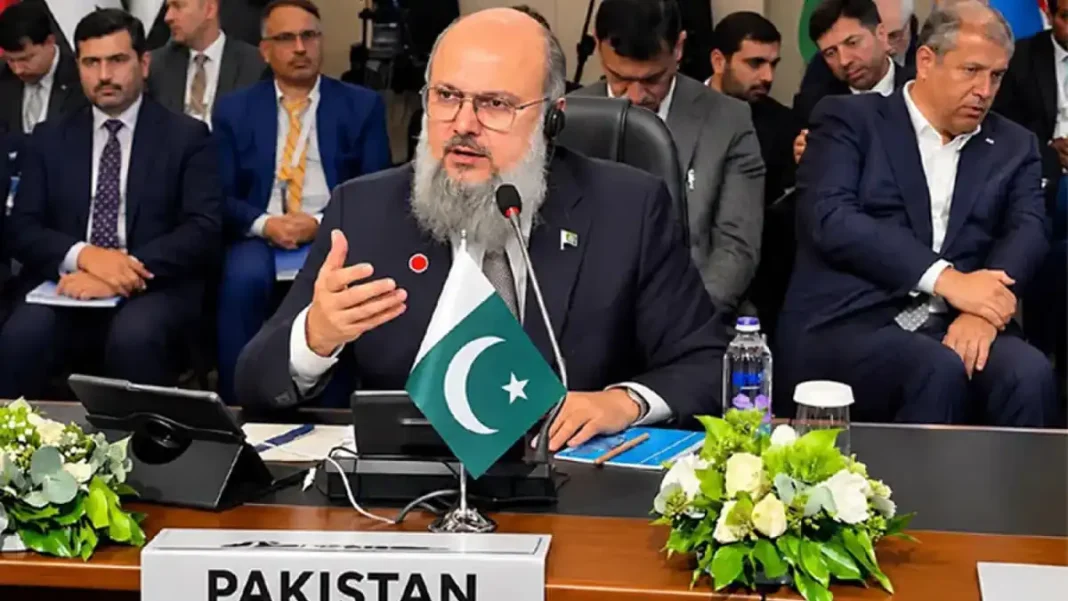
Commerce Minister Jam Kamal has called for OIC economic solidarity among Islamic countries, with better access to trade financing and coordinated efforts to boost trade within the Muslim world.
Kamal spoke on behalf of the member states of the Organisation of Islamic Cooperation (OIC) at the closing session of the 42nd COMCEC Ministerial Session in Istanbul. He said growing geopolitical tensions, supply chain disruptions, financial vulnerabilities and increasing protectionism had made economic cooperation and collective action among Islamic countries more important than ever.
The high-level gathering was chaired by Vice President of Türkiye Cevdet Yilmaz. Kamal thanked the government and people of Türkiye for their hospitality, and acknowledged the COMCEC Coordination Office and OIC institutions for the successful conduct of the session.
OIC economic solidarity: what Pakistan asked for
The minister said OIC countries possessed significant economic potential, geographical advantages, human resources and natural endowments that could be transformed into shared prosperity through stronger partnerships and coordinated policies.
He observed that while OIC member states had made considerable progress in sustainable development, technological advancement and economic prosperity over the decades, emerging global challenges required them to work together and develop practical solutions suited to their circumstances.
The deliberations identified key areas for collective action, including intra-OIC trade, transport connectivity, sustainable tourism, agricultural productivity, food security, poverty alleviation and digital transformation.
The session’s priority theme was “Developing Effective Trade Financing Tools for Increasing Exports in the OIC Member Countries”. Kamal stressed that affordable, diversified and sustainable trade financing was essential to improve export competitiveness, expand international trade and accelerate economic growth.
Small exporters struggle to get finance
Exporters, particularly micro, small and medium-sized enterprises, continued to face difficulties in accessing suitable financing, the minister said. The reasons were fragmented regulatory frameworks, high collateral requirements, transaction costs and lengthy administrative procedures.
To address these challenges, Kamal outlined five priority areas requiring closer cooperation among OIC member states. They included strengthening and harmonising national legal, regulatory and supervisory frameworks to ease cross-border transactions and improve access to trade financing. He also called for diversified trade financing instruments, stronger export credit guarantee mechanisms, and innovative financial arrangements tailored to exporters’ needs, particularly small firms and technology-driven enterprises.
Why this matters for Pakistan
The call carries weight for Pakistan because its own exporters face the same barriers Kamal described. Pakistan’s small exporters face a trade finance gap that leaves many unable to fund orders, and the problem is most acute for the small firms that make up the bulk of the exporting base.
Pakistan’s export numbers show why financing matters now. Exports reached $11.34 billion in July-October, up 8.52 per cent on the year, while the trade deficit widened to $14.63 billion. Export growth slowed in October to 2.84 per cent, and the Afghan market, worth more than $1.5 billion, has stayed closed since October 2025.
The government has already moved to fix the export machinery at home. Shehbaz Sharif has approved a restructuring of the Trade Development Authority of Pakistan, and a debate is under way over tariff cuts to help exporters compete. New markets are also opening: Egypt has invited Pakistani factories to serve the US market.
Trade financing is the missing piece that links those efforts. A factory that wins an order still needs credit to buy raw material, ship the goods and wait for payment. When that credit is costly or slow, the order goes elsewhere. Kamal’s five priorities are aimed at that gap, across the OIC’s 57 member states rather than in one country alone.
Whether the session’s words turn into cheaper credit will depend on what member states do next. The COMCEC session has set out the areas for action. The test will be whether regulators harmonise their rules, whether export credit agencies expand their cover, and whether small exporters in Pakistan and elsewhere find finance easier to reach in the months ahead.
Frequently asked questions
What is COMCEC?
COMCEC is the Standing Committee for Economic and Commercial Cooperation of the OIC. Its 42nd Ministerial Session met in Istanbul, with the closing session chaired by Vice President of Türkiye Cevdet Yilmaz.
What did Pakistan ask for at the session?
Commerce Minister Jam Kamal, speaking for OIC member states, called for stronger economic solidarity, better access to trade financing and coordinated efforts to boost intra-OIC trade, with five priority areas for closer cooperation.
Why do small exporters struggle to get trade finance?
Exporters, particularly micro, small and medium-sized enterprises, face fragmented regulatory frameworks, high collateral requirements, transaction costs and lengthy administrative procedures, according to the commerce minister.
What are the five priority areas?
They include harmonising legal, regulatory and supervisory frameworks for cross-border transactions, diversified trade financing instruments, stronger export credit guarantee mechanisms, and innovative financial arrangements tailored to exporters, particularly small firms and technology-driven enterprises.