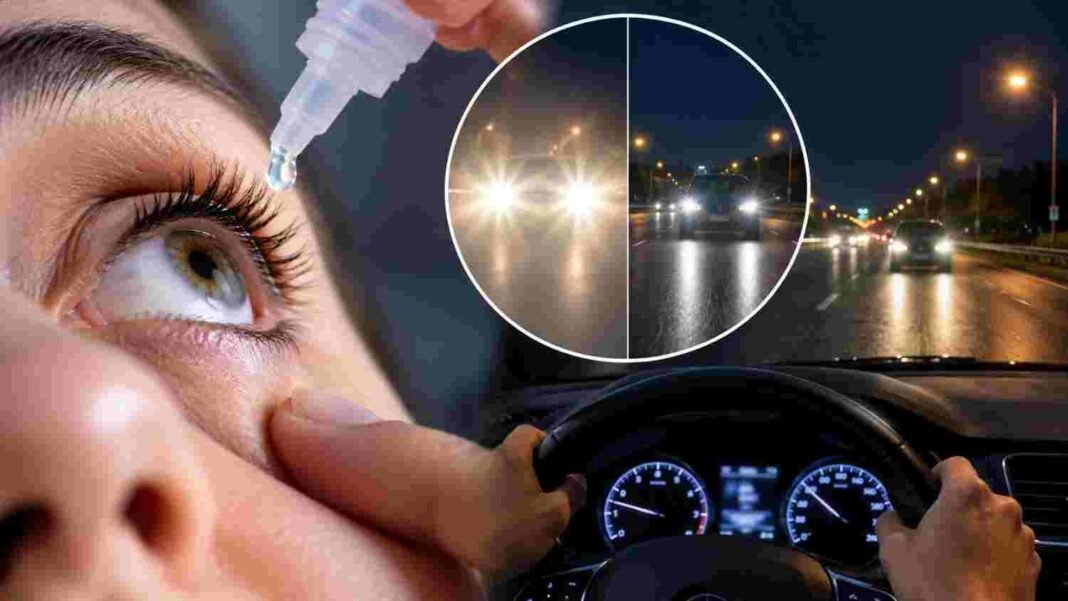
Drivers who struggle with glare and bright headlights after dark may soon have a new treatment option. New Night Vision Eye Drops have shown encouraging results in late-stage clinical trials involving people with poor vision in low-light conditions.
The experimental treatment could help people who see halos, glare, or starburst patterns around lights. These problems can make night driving difficult, especially when another vehicle approaches with bright headlights.
US-based biotechnology company Opus Genetics developed the treatment. Researchers tested the eye drops in Phase 3 clinical studies to determine whether they could improve vision in dim light and darkness.
The results showed promising improvements among some participants. Moreover, people who received the Night Vision Eye Drops reported fewer problems with glare, halos, and starburst effects around lights.
Researchers included 145 people in the first clinical trial. All participants experienced difficulty seeing in darkness or low-light conditions, while many also struggled with bright lights during nighttime activities.
The research team divided participants into treatment and placebo groups. Participants in the treatment group received eye drops containing 0.75% phentolamine every day for either eight or 15 days.
Meanwhile, researchers gave the other participants a placebo for comparison. They then checked changes in eyesight and asked participants to describe their night vision problems throughout the study.
After eight days, 13% of people using the medication improved by at least three lines on an eye chart. That improvement represented about 15 additional letters that participants could correctly identify.
In comparison, only 3% of people in the placebo group achieved the same improvement. Therefore, researchers found a clear difference between the two groups early in treatment.
The results became more encouraging after 15 days. About 21% of participants receiving the Night Vision Eye Drops achieved an improvement of at least three lines on the eye chart.
However, the placebo group continued to show a much lower improvement rate of only 3%. The difference strengthened researchers’ interest in the potential treatment for night vision difficulties.
Researchers also asked participants to rate symptom severity. They used a scale from 1 to 7, with 7 representing the most serious night vision problems.
Among people receiving phentolamine, the average symptom score fell to 4.3 after eight days. Furthermore, the score dropped to 3.3 after 15 days of treatment.
In contrast, participants in the placebo group recorded scores of 4.6 on day eight and 4.3 on day 15. These results suggested that the treatment group improved more over time.
Participants also reported fewer problems with glare, halos, and starburst patterns after 15 days. As a result, the Night Vision Eye Drops could eventually offer another option for people who find night driving uncomfortable or difficult.
The treatment works by targeting a muscle inside the iris. Phentolamine makes the pupil moderately smaller, which may help the eye manage incoming light more effectively.
According to researchers, this effect can continue for at least 20 hours. Therefore, a single treatment could provide extended support for people who have trouble in low-light environments.
Several trial participants developed night vision problems after procedures that changed their corneal shape. These procedures included LASIK, a widely used surgery for correcting common eyesight problems.
Doctors use LASIK to treat conditions such as nearsightedness, farsightedness and astigmatism. However, some people may experience glare, halos, or other visual disturbances after the procedure, particularly at night.
Opus Genetics has also shared encouraging early results from another Phase 3 study. Participants in that trial reported improvements while looking at roads affected by bright headlights from approaching vehicles.
In addition, patients reported fewer glare problems at dawn and dusk. These findings could further support the potential benefits of Night Vision Eye Drops for people who regularly struggle in changing light conditions.
The US Food and Drug Administration has already granted the treatment Fast Track designation. The designation covers its development for severe and persistent vision problems related to night driving.
Fast Track status helps support the development and review of treatments that could address serious conditions or important unmet medical needs. However, the designation does not mean the FDA has approved the treatment for general use.
Therefore, drivers should not consider these eye drops an approved solution yet. Researchers and the company still need to complete the required regulatory steps before doctors can widely recommend the treatment.
The latest results nevertheless offer hope to people who struggle with headlights, glare, and halos while driving after sunset. If future reviews confirm the treatment’s safety and effectiveness, it could provide another option for managing these problems.
For now, the Night Vision Eye Drops remain an experimental treatment rather than a widely available medicine. Still, the Phase 3 findings mark an important step toward a possible new way to help people see more clearly and comfortably after dark.