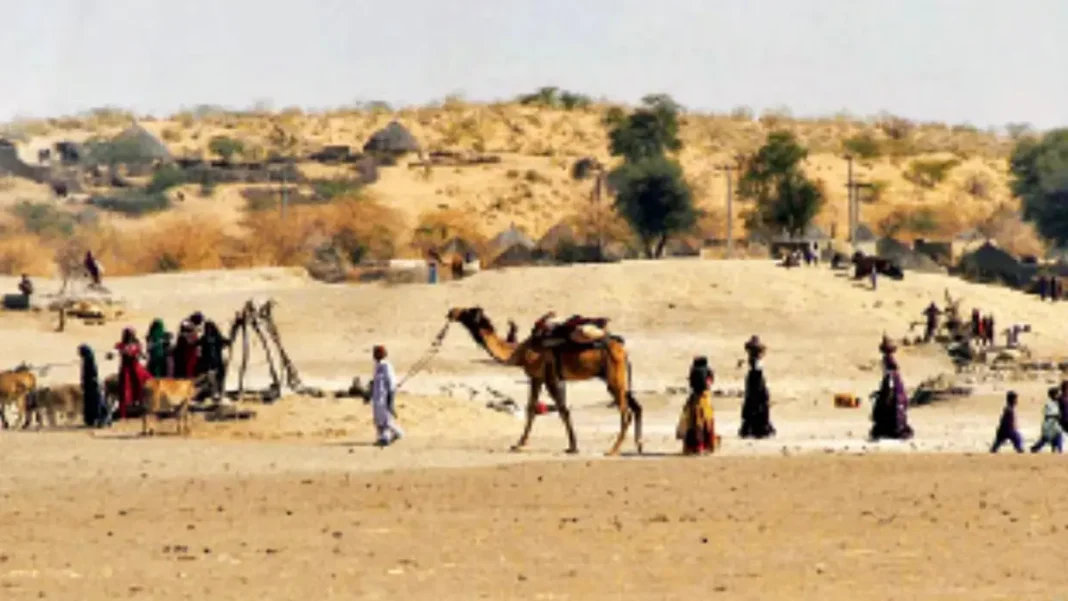
On World Food Day, drought pushes Tharparkar families to migrate with livestock
With rain-fed crops failing, natural grazing drying up and fodder running short, drought-hit families in Tharparkar district are once again packing up and migrating with their livestock in search of water and food. The Tharparkar drought is deepening hunger and malnutrition just as the world marks World Food Day, and rising food costs are hitting the poorest households hardest.
Farmers who sowed millet, guar and other rain-dependent crops after the first rains this year have watched their hopes fade as the rains that followed never arrived on time. Parched fields and withered vegetation have left families and their animals struggling to survive, forcing livestock owners to abandon their villages for the irrigated barrage areas. For many, the journey means carrying provisions for more than a week and surviving on dry bread, jaggery and water along the way.
Tharparkar drought: one farmer’s ruined season
Khemoon Bhel, a livestock owner from Vee Hangorja village in Mithi taluka, is among those heading toward the barrage region. He said he had cultivated 20 acres after the initial rains, but the dry spell that followed destroyed his crops and left his animals without fodder.
Bhel had returned to his village from the barrage areas only two months ago. Now he is being forced to migrate again with his livestock. The money he spent on tractor work and buying seeds has gone to waste, with little prospect of recovering his investment through the failed harvest.
For rural households across Tharparkar, the damage runs deeper than lost crops. Their livelihoods depend heavily on seasonal rainfall, limited agricultural production and livestock. When crops fail and grazing grounds dry up, families lose not only their grain harvest but also access to fodder, milk and a crucial source of income. With local wheat production limited, most households depend on market purchases for their staple food, and failed crops, shrinking work and rising prices are making it harder for poor families to afford enough meals.
Children face a nutritional crisis
The strain on household food supplies is raising concerns about malnutrition among children and pregnant women. A medical study examining 129 children treated for severe acute malnutrition at Mithi Civil Hospital between March and June 2024 found that 117 of them, or 90.7 per cent, were suffering from anaemia. The findings were published in a scientific paper in January 2026.
Rainwater harvesting, drought-resilient crops, reliable fodder and water supplies for livestock, affordable staple foods and targeted help for vulnerable families are among the measures needed to strengthen food security. Better nutritional screening and treatment for children and pregnant women must also be prioritised.
The district administration has yet to declare Tharparkar calamity-hit or begin the process of seeking relief measures from the Sindh government. That inaction has become a legal battle: local social activist and lawyer Qurban Samejo has filed a constitutional petition before the Sindh High Court’s Mirpurkhas circuit. Samejo alleged that the administration had neither conducted the required survey and forwarded it to the provincial government nor shown any apparent intention to do so, despite the deteriorating conditions. He said the court had summoned the National Disaster Management Authority, relevant Sindh government departments and the deputy commissioner to submit reports.
Lawyer Ashiq Ali said drought-like conditions returned to Thar every three to four years, with climate change making the district even more vulnerable.
The Thar crisis lands on a day when the country is already thinking about food: World Food Day 2026 was marked this week, and Sindh earlier faced a monsoon rainfall deficit that set the stage for the current dry spell. Hunger is not only a Thar problem: acute hunger in Afghanistan has reached the highest levels ever recorded, and rising fuel costs from the latest petrol and diesel revision are adding to food prices everywhere.
Frequently asked questions
Why are Tharparkar families migrating?
Failed rains destroyed millet and guar crops and dried up grazing, leaving families and livestock without food or fodder. They are moving with their animals toward the irrigated barrage areas.
What is the malnutrition situation in Thar?
A medical study found that 90.7 per cent of 129 severely malnourished children treated at Mithi Civil Hospital between March and June 2024 also suffered from anaemia.
Has Tharparkar been declared calamity-hit?
No. The district administration has not declared it calamity-hit, prompting activist-lawyer Qurban Samejo to file a constitutional petition in the Sindh High Court’s Mirpurkhas circuit; the court has summoned NDMA and Sindh departments for reports.