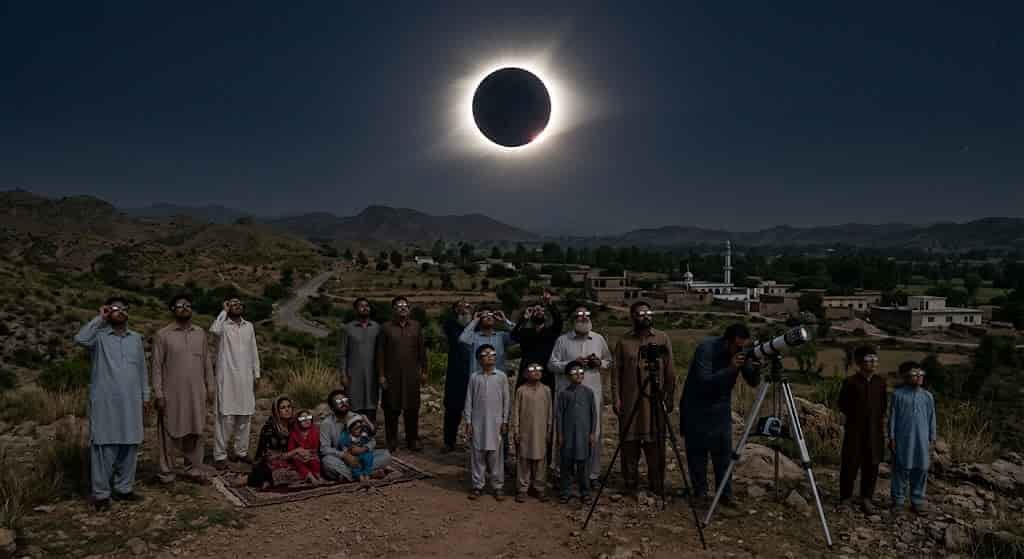
A rare astronomical event is set to amaze skywatchers around the world when the 2027 solar eclipse occurs on August 2. The event will be one of the longest total solar eclipses of the 21st century, creating a breathtaking view as the Moon completely covers the Sun in several parts of the world.
Pakistan will also witness this historic celestial event, although the country will experience a partial solar eclipse rather than a total eclipse.
During a total solar eclipse, the Moon moves directly between the Earth and the Sun, blocking the Sun’s entire disk for a short period. In areas located under the path of totality, daytime darkness appears for several minutes, creating a scene similar to nighttime.
The upcoming 2027 solar eclipse in Pakistan will attract attention from astronomy enthusiasts because people across the country will be able to observe the Moon passing in front of the Sun.
According to astronomical calculations, the total phase of the eclipse will last up to 6 minutes and 23 seconds, making it one of the longest total solar eclipses expected in this century.
The eclipse will begin over the Atlantic Ocean before moving across several regions of Europe, North Africa, and the Middle East. The path of totality will pass through Spain, northern Morocco, Algeria, Tunisia, Libya, Egypt, Sudan, Saudi Arabia, Yemen, and parts of Somalia before ending near the Indian Ocean.
Countries located along the central path will experience complete darkness during the day. Scientists say this rare phenomenon provides an excellent opportunity to study the Sun’s outer atmosphere, known as the corona.
For people in Pakistan, the solar eclipse visibility in Pakistan will be different from countries experiencing totality. The Moon will cover only a portion of the Sun, but the partial eclipse will still create a unique view in the sky.
The solar eclipse 2027 date and time in Pakistan is expected to be August 2, with the eclipse beginning around 2:43 PM and continuing until approximately 4:51 PM.
In Islamabad, the eclipse is expected to begin around 3:14 PM. The event will reach its peak at approximately 3:47 PM before ending around 4:19 PM.
Residents of Karachi will also be able to observe the celestial event. The eclipse is expected to start around 3 PM and continue until approximately 4:48 PM.
Although Pakistan will not fall under the path of totality, skywatchers will still be able to observe the Moon covering part of the Sun, creating a memorable astronomical experience.
Experts explain that solar eclipses happen because of the special alignment of the Earth, Moon, and Sun. When the Moon passes between the Earth and the Sun, it casts a shadow on Earth and blocks sunlight in specific areas.
A total solar eclipse is considered one of the most impressive natural events because viewers can see the Sun’s outer atmosphere during the brief period of complete coverage.
The 2027 total solar eclipse will be especially important because of its unusually long duration. Egypt is expected to become one of the major locations for eclipse tourism, with some areas experiencing total darkness for more than six minutes.
Several famous locations in the Middle East and North Africa will witness the complete eclipse, including parts of Egypt, Saudi Arabia, Morocco, Algeria, Tunisia, and Libya.
Makkah is also expected to experience a total solar eclipse, with the complete phase lasting around 5 minutes and 10 seconds.
Scientists and astronomy organizations around the world are preparing for this event because long-duration total solar eclipses are rare opportunities for research and observation.
According to astronomical experts, the eclipse will allow researchers to study solar activity, including the Sun’s corona, magnetic fields, and other processes that are difficult to observe under normal conditions.
However, experts have warned people not to look directly at the Sun during the eclipse without proper protection.
Looking at the Sun with naked eyes can permanently damage eyesight because harmful solar rays can affect the retina.
People planning to watch the 2027 solar eclipse in Pakistan should use certified solar viewing glasses or special solar filters designed for eclipse observation.
Normal sunglasses, cameras without solar filters, or mobile phone screens do not provide enough protection during the eclipse.
The upcoming celestial event is expected to generate excitement among students, photographers, astronomy lovers, and families across Pakistan.
Many people may organize eclipse-watching activities to experience this rare moment and learn more about space science.
The 2027 solar eclipse is not only a scientific event but also a reminder of the fascinating movements of celestial bodies. The precise alignment of the Earth, Moon, and Sun creates a spectacular natural display that millions of people will observe.
For Pakistan, August 2, 2027, will provide a chance to witness a rare astronomical phenomenon. While the country will not experience complete daytime darkness, the partial solar eclipse will still offer a remarkable view of the changing sky.
As the countdown begins for this historic event, astronomers are encouraging people to prepare in advance and follow safety guidelines to enjoy the eclipse without risking their eyesight.
The longest solar eclipse of the 21st century will become one of the biggest astronomical highlights of 2027, giving people around the world a chance to witness one of nature’s most extraordinary spectacles.