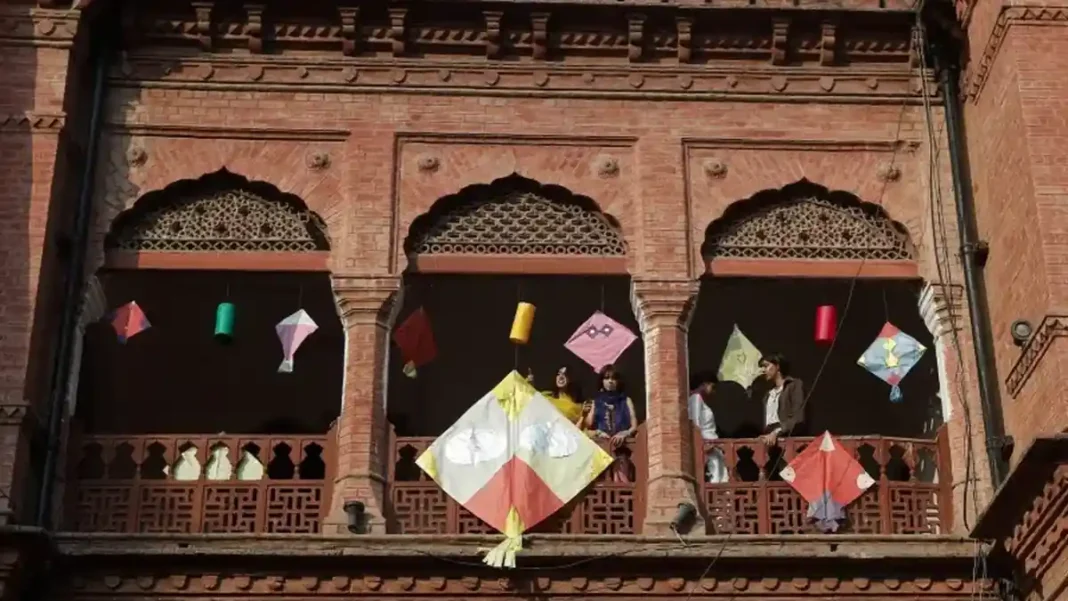
The Lahore deputy commissioner on Friday gave the formal go-ahead for three-day Basant festivities in the district from March 12 to 14 next year. The Basant 2027 Lahore notification sets kite sizes, string materials, no-fly zones and safety measures in an enforceable framework.
Basant returned to Lahore earlier this year after an 18-year hiatus, when the Punjab Regulation of Kite Flying Bill, 2025 authorised deputy commissioners to grant conditional permission for kite-flying, otherwise banned in Punjab, on specified days. In August, Chief Minister Maryam Nawaz announced the March 12-14 dates. On Friday, the DC’s notification formalised them, turning the original festival announcement into binding rules.
What the Basant 2027 Lahore notification allows
Kite-flying will be allowed except in prohibited zones and only with permissible material under the 2025 rules and regulations, from March 12 to 14, 2027.
The manufacturing of permissible material will be allowed from September 5, 2026 to March 14, 2027, subject to valid digital registration. Trade, including purchase, transportation and storage, will be permitted from February 1 to March 14, 2027, while sales to the public will be allowed from February 10, exclusively through registered sellers.
No one may manufacture, trade, store or sell the material unless registered with the deputy commissioner through the government’s eBiz application. Registered businesses must display their certificates prominently and keep complete stock, sales and movement records for inspection.
Kite sizes and string rules
The notification sets precise limits. A patang (kite) must not exceed four-and-a-half githi, the span of a hand, and must measure no more than 35 inches in width and 30 inches in length. A gudda, the larger kite, must not exceed one-and-a-half tawa and 40 inches in width and 34 inches in length.
The kite string, known as dor, must be wound only in the shape of a pinna. It must be made of cotton with no more than nine taars (threads) and no fewer than 28 counts, and coated with maanjha having a minimum sheesha size of 350 mesh.
Preparation or coating of dor or maanjha is strictly restricted to maya (laundry starch), 350-mesh glass powder and rice flour only. No other material, chemical, adhesive, hardener, abrasive, metallic substance or strengthening agent, including rema tip top and amri powder, may be added or applied at any stage.
The DC also prohibited the manufacture, trading, transportation, storage, sale, possession and use of charkhi, sharp maanjha, metallic wire, nylon (plastic) dandi, and any thread coated with sharp or injurious material. The crackdown follows the restrictions already placed on kite deliveries through the postal system.
No-fly zones and motorcyclist safety
Kite-flying will not be permitted in areas falling under aircraft approach and take-off paths. On the approach path, the banned areas are Nadirabad, Gulshan Ali Colony, Nishat Colony, Bhatta Chowk and DHA Lahore’s blocks R, S, P and Q. On the take-off path, kite-flying is barred in Al-Faisal Town, Jorraypul, Canal Bank Road (adjacent to Tajoura) and Tajpura.
Motorcyclists in Lahore must comply with all safety measures, including the installation of safety rods, as specified in Chapter-III of the Punjab Kite Flying Regulations 2025 and the guidelines issued by the Punjab government secretary and the Home Department. All departments and agencies must assist the district administration and police in strict compliance to ensure public safety.
Registered kite-flying associations must comply with the functions assigned under the 2025 rules and stay in close coordination with the deputy commissioner for the smooth and safe conduct of the festival.
Why the rules are so strict
Basant was banned in 2007 after deaths and serious injuries caused by sharp strings, particularly to motorcyclists and pillion riders, as well as celebratory gunfire. It returned earlier this year for the first time since, but only in Lahore.
The detailed rulebook reflects that history. Safety advocates have long demanded strict precautions for a safe Basant, and Wasim Akram has appealed for responsible celebrations. The DC’s notification is the administration’s answer: the festival returns, but inside a tightly policed framework.
Frequently asked questions
When is Basant 2027 in Lahore?
The Lahore deputy commissioner has formally notified Basant for March 12 to 14, 2027, a three-day festival.
What kite sizes are allowed?
A patang must not exceed 4.5 githi and 35 by 30 inches; a gudda must not exceed 1.5 tawa and 40 by 34 inches.