Pakistan Warns UN Over Taliban Repression
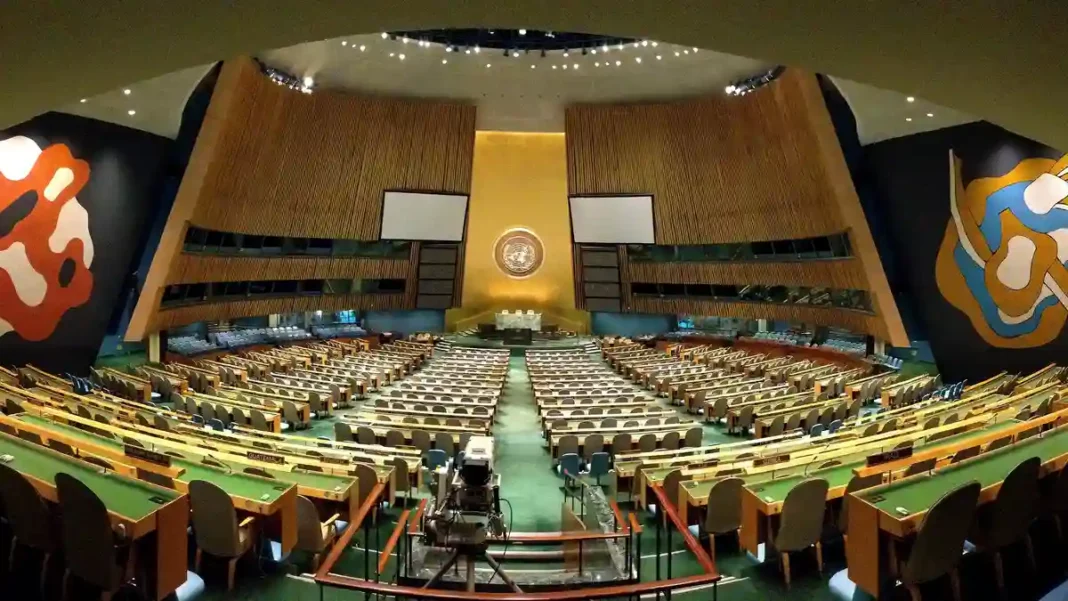
Pakistan has warned the United Nations over Taliban repression in Afghanistan, telling delegates that attacks originating from Afghan soil have killed more than 4,700 Pakistanis in the past three years. The warning came during an interactive dialogue at the United Nations in New York with Richard Bennett, the UN Special Rapporteur on the human rights situation in Afghanistan.
Pakistan’s delegate, Muhammad Jawad Ajmal, said his country could not sit idle in the face of what he called an externally backed terrorist onslaught from Afghanistan. He said Pakistan retained the right to respond in self-defence, in line with international law.
Ajmal, a counsellor at Pakistan’s Mission to the UN, linked the Taliban regime to banned militant groups operating across the region. He named the Tehreek-i-Taliban Pakistan (TTP) and the Baloch Liberation Army (BLA) and its Majeed Brigade.
Bennett’s findings on Taliban repression
Bennett presented his latest report to the General Assembly’s Third Committee on Thursday, October 29. He said the Taliban had shown no willingness to reverse their systematic human rights violations five years after returning to power. Instead, he said, they had deepened and formalised their repression, above all against women and girls.
The report documented arbitrary detention, torture, sexual violence, enforced disappearances and extrajudicial killings. It also recorded curbs on expression and discrimination against minorities and persons with disabilities.
Bennett said new decrees had further undermined women’s rights, including rules under which violence against women and girls drew punishment only when it left broken bones or visible bruises, and a decree under which a girl’s silence could count as consent to marriage. Quoting a girl from Balkh, he told delegates that three words had come to define Afghan girls’ lives: fear, tears and despair.
He warned that more than 2.6 million girls had been denied secondary education since 2021, while about 9 million children faced severe hunger and 3.7 million children under five suffered acute malnutrition. “The regime is teaching a generation of boys that the exclusion of their sisters and mothers is normal,” Bennett said.
Pakistan’s case on cross-border attacks
Ajmal accused the Taliban of maintaining close links with terrorist organisations operating with impunity on Afghan soil. The Taliban’s failure to publicly denounce them, he said, showed complicity and active support.
He cited Pakistan’s strike on March 16, when Pakistan precisely targeted TTP military installations and support infrastructure, including drone and ammunition stores. “We will respond in self-defence, as and when needed and in accordance with international law against whosoever attempts to harm our citizens and our national security,” Ajmal said.
Ajmal said Pakistan had welcomed millions of Afghan refugees and urged the international community to shoulder its share of responsibility. He also cited the Islamabad Declaration, adopted by the Organisation of Islamic Cooperation at a ministerial conference on women hosted by Pakistan in July, which expressed concern that Taliban restrictions on women and girls were inconsistent with Islamic values.
What Bennett asked the world to do
Why this matters for Pakistan
What happens next
Frequently asked questions
Who is Richard Bennett?
Richard Bennett is the United Nations Special Rapporteur on the human rights situation in Afghanistan. He reports on rights conditions in the country and presents his findings to UN bodies in New York and Geneva.
What did Pakistan tell the UN?
Pakistan’s delegate, Muhammad Jawad Ajmal, said attacks originating from Afghanistan had killed more than 4,700 Pakistanis in three years. He said Pakistan would respond in self-defence, in line with international law, when its citizens faced harm.
What did Bennett’s report document?
The report documented arbitrary detention, torture, sexual violence, enforced disappearances and extrajudicial killings, along with curbs on expression and deepening restrictions on women and girls.
Did Bennett ask states to cut ties with the Taliban?
He urged states not to normalise relations with the Taliban until their oppressive policies were reversed and improvements were independently verified, while sustaining humanitarian assistance.
What is the Islamabad Declaration?
It is a declaration adopted by the Organisation of Islamic Cooperation at a ministerial conference on women hosted by Pakistan in Islamabad in July, expressing concern that Taliban restrictions on women and girls were inconsistent with Islamic values.
Source: Dawn, with session details from The Nation.