Four Polio Workers Abducted in Tank District
Four polio workers abducted in Tank district of Khyber Pakhtunkhwa on Monday, 2 November 2026, were working on the first day of a subnational vaccination campaign that aims to protect nearly 24 million children across Pakistan.
Tribune reported that unidentified armed men fired on the team and then took the four workers from a village in the Sheikh Attar union council. Police said the gunmen took all four workers to an undisclosed location, and an investigation has started.
No further detail about the identity of the attackers or the whereabouts of the workers was available when the report was published. Police have not yet released the names of the workers.
Second incident in South Waziristan
In a separate incident, two members of a polio vaccination team were abducted by armed men in the Azam Warsak area of Lower South Waziristan. Both vaccinators were later released, Tribune reported.
Sources cited in the report said the suspects in the Azam Warsak incident were affiliated with the proscribed Tehreek-e-Taliban Pakistan. That link was reported as a source account, not as a confirmed police finding, and no such link was stated for the Tank abduction.
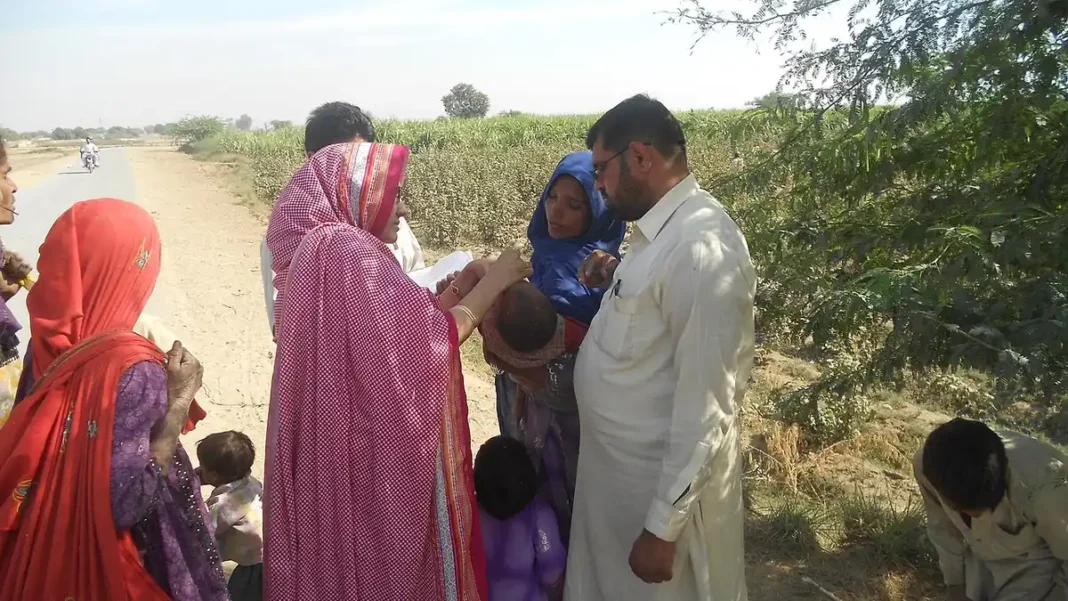
The two incidents, reported on the same day, have raised fresh concern over the safety of vaccination teams working in remote districts. Teams in these areas travel door to door, often through sparsely populated terrain, and they carry no protection beyond the security arrangements made for each campaign round.
Polio workers abducted in Tank during a 97-district drive
The Tank polio workers abducted on Monday were working in a campaign that runs from 2 November to 8 November. The National Emergency Operations Centre for Polio Eradication said the subnational campaign covers 97 districts and aims to vaccinate more than 24 million children under the age of five.
Parents have been urged to ensure that every child under five receives oral polio vaccine drops during this round, and to complete routine immunisation on time. The centre said polio is incurable but preventable through vaccination.
The campaign follows a new case reported from Khyber district a day earlier. Dawn reported that the affected child is a 13-month-old girl from Union Council Janbaz-B in Bara tehsil, and that it was the second case reported from Khyber district this year. The Pakistan Polio Eradication Initiative has opened an investigation into that case and is assessing the response needed to stop further transmission.
Dawn also reported that positive environmental samples from the Peshawar Block, which covers Khyber and Peshawar districts, show that the virus is still circulating there. That finding is one reason health officials keep returning to the same districts with repeated rounds.
Why the abduction matters for the campaign
An abduction during a campaign round does more than endanger the workers involved. It can also disrupt the round itself, because teams may be pulled back, routes may change, and parents in nearby villages may keep children indoors until the situation is clear.
Health officials have long faced this problem in Khyber Pakhtunkhwa. Vaccination teams work in areas where armed groups have opposed the programme in the past, and where rumours about the vaccine still circulate. Each round therefore depends on local elders, police escorts where assigned, and the willingness of families to open their doors.
The scale of the current round shows what is at stake. Pakistan has conducted four large-scale polio campaigns so far in 2026, protecting more than 45 million children multiple times, according to the emergency operations centre. A subnational campaign in September covered more than 29.3 million children.
In Balochistan alone, the current round targets more than 2.2 million children under five in 31 districts, with 8,888 vaccination teams assigned there.
A similar drive is under way in Rawalpindi, where a polio drive aims to vaccinate 990,000 children. The Tank abduction is therefore not a local story alone. It touches a programme that is working in cities and remote districts at the same time, and that depends on the safety of thousands of front-line workers.
Security incidents reported in the region
The Tank incident follows other security incidents reported in the wider region in recent days. In Bannu, a police van incident injured a student and three policemen, while in South Waziristan, shopkeepers were taken from Shakai. In Balochistan, two people died and one was taken in the Qila Abdullah area.
None of those reports, on its own, explains the Tank abduction. Together, they describe a security setting in which vaccination teams, police patrols and traders all face risk in remote areas. For now, the central facts remain limited. Four workers are missing in Tank, two workers taken in Azam Warsak have been released, and police say the Tank investigation is under way.
Frequently asked questions
What happened in Tank?
Four polio vaccination workers were abducted by unidentified armed men in the Sheikh Attar union council of Tank district, after the team came under fire. Police said the workers were taken to an undisclosed location.
What happened in Azam Warsak?
Two members of a polio vaccination team were abducted in the Azam Warsak area of Lower South Waziristan, and both were later released. Sources cited in the report linked the suspects in that incident to the proscribed Tehreek-e-Taliban Pakistan.
Which campaign were the workers part of?
The workers were part of a subnational polio campaign running from 2 November to 8 November, covering 97 districts and aiming to vaccinate more than 24 million children under the age of five.
How many children has Pakistan vaccinated this year?
The emergency operations centre said four large-scale campaigns in 2026 have protected more than 45 million children multiple times, and a subnational campaign in September covered more than 29.3 million children.
What should parents do during the campaign?
Parents should ensure that every child under five receives oral polio vaccine drops during this round, and should complete routine immunisation on schedule, as polio is incurable but preventable through vaccination.