UK Court Hears Palestine Action Ban Appeal
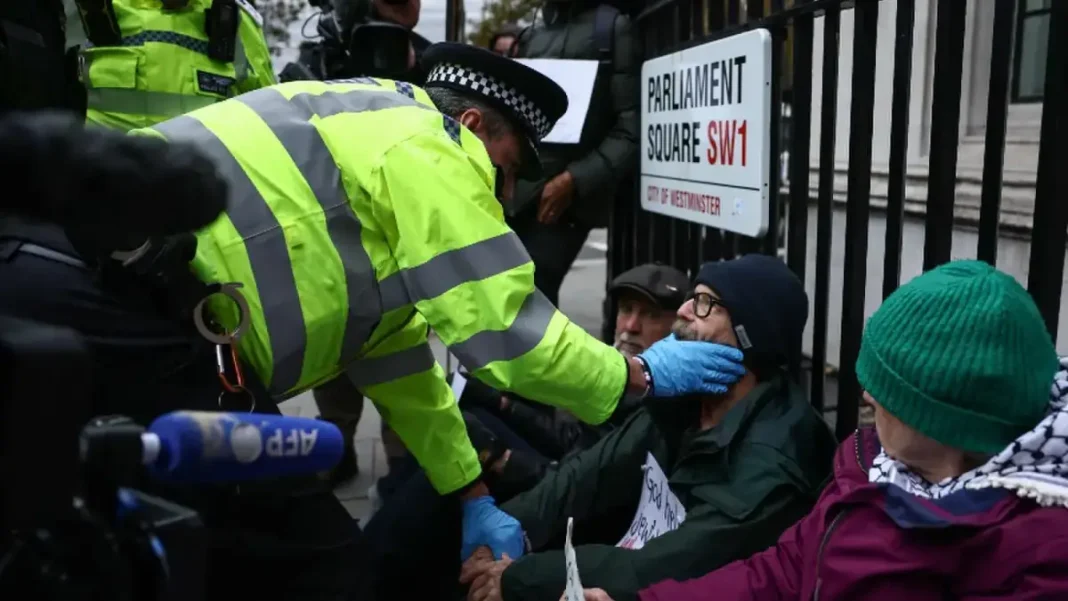
Britain’s highest court on Wednesday heard an appeal against the Palestine Action ban, as police arrested protesters gathered outside.
The two-day hearing at the Supreme Court comes as the ban has failed to quell support for the pro-Palestinian group co-founded by Huda Ammori, leading to mass arrests across the UK. “I urge the Supreme Court justices to bring this authoritarian overreach and the chilling censorship it has unleashed to an end once and for all,” Ammori said in a statement. Dawn reported the hearing on Thursday.
Multiple protesters carrying signs supporting Palestine Action, prohibited under terrorism laws, were arrested by police on Wednesday. More than 300 supporters were detained at protests at the weekend.
The Palestine Action ban has produced thousands of arrests
According to campaign group Defend Our Juries, which has organised demonstrations backing the movement, around 4,200 people have been arrested since the British government outlawed Palestine Action in July last year. Those detained include large numbers of pensioners, among them a priest, a former financial adviser, a military veteran and Swedish student climate activist Greta Thunberg.
Public support for Palestine Action is a criminal offence as the ban places the group in the same legal category as the Al Qaeda organisation and Lebanon’s Iran-backed Hezbollah. The ban followed a series of acts of vandalism linked to the movement, including a trail of damage at a Royal Air Force base and actions targeting Israeli arms manufacturer Elbit Systems in August 2024.
It was imposed under the UK’s Terrorism Act and made membership of or support for the pro-Palestinian group a criminal offence punishable by up to 14 years in prison. Ammori’s lawyer Raza Husain told the court that out of 385 actions undertaken by the group in the last five years, “only three passed the terrorism threshold”.
“Palestine Action fall within the tradition of a direct action protest group motivated by conscience,” Husain said. The group has “never advocated for violence against the persons”, he added.
What proscription means in practice
Proscription under the Terrorism Act is one of the strongest tools in British law. Once a group is proscribed, it becomes a criminal offence to belong to it, to support it, to arrange meetings for it, or even to wear or display something that suggests support for it. That is why people have been arrested for holding placards, not only for taking part in direct action.
UK-Brazilian actor Alfred Enoch said he was demonstrating against the ban because it “has a chilling effect on people’s ability to engage democratically in one of the great issues of their time, which is the struggle for emancipation of the Palestinian people”. Protester Yael Kahn said she joined Wednesday’s demonstrations because people “have been arrested, just for the words” written on a placard.
The legal question before the Supreme Court is whether the ban was lawful and proportionate. The group’s lawyers argue that almost all of its actions were protests and vandalism aimed at property, not violence against people, and that only three of 385 actions met the terrorism threshold. The government will argue that the pattern of damage, including at a military base and at an arms manufacturer, justified proscription.
Courts checking executive power
The hearing is part of a wider pattern in which courts are being asked to check decisions by governments. In the United States this week, a federal court blocked a plan to deport Afghan nationals, ruling that they could not be sent to Afghanistan or Pakistan. In France, trade unions have taken to the streets in protests that have brought large parts of the country to a halt.
In Pakistan, the Federal Constitutional Court has been deciding detention cases from Khyber-Pakhtunkhwa. The questions differ, but the shape is the same.
The Supreme Court hearing continues on Thursday. Its ruling will decide whether the ban stands, and with it whether the thousands of arrests made under it were lawful.
Frequently asked questions
What is Palestine Action?
A pro-Palestinian direct action group, co-founded by Huda Ammori, which the British government proscribed as a terrorist organisation in July 2025.
Why is the Supreme Court hearing the case?
The court is hearing an appeal against the ban. The group’s lawyers argue that almost all of its actions were conscience-driven protest, and that only three of 385 actions in five years passed the terrorism threshold.
How many people have been arrested?
Around 4,200 people since the ban, according to campaign group Defend Our Juries, including more than 300 detained at protests at the weekend.
What punishment does the ban carry?
Membership of or support for the group is a criminal offence punishable by up to 14 years in prison under the UK’s Terrorism Act.