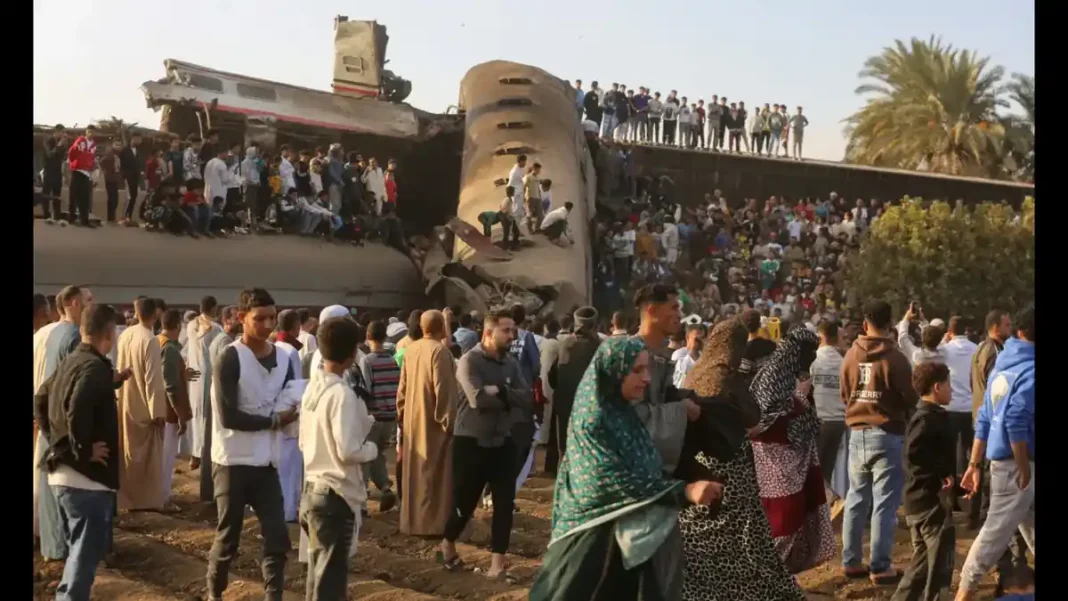
The Egypt train collision south of Cairo on Sunday killed four people and injured 88, after two trains crashed and derailed several carriages, according to the authorities.
According to Egypt’s railway authority, a service from Giza to Fayoum ran into the back of another train travelling south from Cairo to Aswan. The health ministry’s first count put the dead at four, with 88 more being treated in hospitals around Giza.
State media had first put the wounded at 120, without saying how badly hurt they were. The health ministry’s later count of 88 injured is the official figure for now, and it may change as hospitals report more cases.
President Abdel Fattah al-Sisi said he was following the accident “with great concern”, and had directed authorities to conduct an urgent investigation to “hold accountable anyone found to have been negligent”.
Cranes were brought in to clear the wreckage, the authority said. An investigation into the cause has begun, the authorities said. The crash happened in Giza’s Al-Ayyat area.
Egypt train collision in Al-Ayyat
The crash happened in Al-Ayyat, an area with a grim record in Egypt’s rail history. It is the site of Egypt’s worst-ever rail disaster. In 2002, a fire tore through a train carrying holiday travellers south of Cairo, killing more than 370 people.
In 2009, several crashes in the same area killed dozens more. The latest collision adds to a long list of deadly accidents on a network that carries millions of Egyptians every day.
Rail is a lifeline for Egypt’s 110 million people, but the network — among Africa’s largest — has seen repeated deadly accidents. Egypt has spent billions over the past decade on new highways and high-speed rail, yet much of the older network has still not been overhauled.
Why Egypt’s railways keep failing
The pattern behind the accidents is familiar. Much of Egypt’s rail network is old, and investment has gone to new showcase projects while older lines, signals and rolling stock have waited for upgrades. The result is a system that moves huge numbers of people on infrastructure that has not kept pace.
Each major crash brings the same response: an urgent investigation, promises to hold the negligent accountable, and fresh spending announcements. The Al-Ayyat crash will test whether this one is different. The president’s public order for an investigation puts pressure on the railway authority to produce answers, but the cause of the collision has not yet been established, and no official has been named as responsible.
For the families of the four people killed and the 88 injured, the investigation matters less than the treatment of the wounded and the question of how a train could run into the back of another service on the same line. That question, of signalling, scheduling and control, is the one the investigation must answer.
The crash comes at a time of wider strain in the region. Three tankers caught fire in the Strait of Hormuz on Sunday, and a building in Riyadh’s financial district was damaged in a Houthi attack. Egypt reopened its embassy in Libya last week after a 12-year closure, while a UN report has accused a UAE firm of backing mercenaries in Sudan. Tents housing displaced families in Gaza were flooded by heavy rain.
Frequently asked questions
What happened in the Egypt train collision?
A service from Giza to Fayoum ran into the back of another train heading from Cairo to Aswan. Several carriages derailed in Giza’s Al-Ayyat area, south of Cairo.
How many people were killed and injured?
Four people were killed and 88 injured, according to an initial count from Egypt’s health ministry. State-owned media had earlier reported 120 wounded, but the health ministry’s figure of 88 is the official count for now.
Where did the crash happen?
The crash happened in Giza’s Al-Ayyat area, south of Cairo. Al-Ayyat is the site of Egypt’s worst-ever rail disaster, a 2002 fire that killed more than 370 people.
What has President Sisi said?
President Abdel Fattah al-Sisi said he was following the accident “with great concern” and directed authorities to conduct an urgent investigation to “hold accountable anyone found to have been negligent”.
Has this area seen rail disasters before?
Yes. In 2002, a fire on a train in Al-Ayyat killed more than 370 people. In 2009, several crashes in the same area killed dozens more.