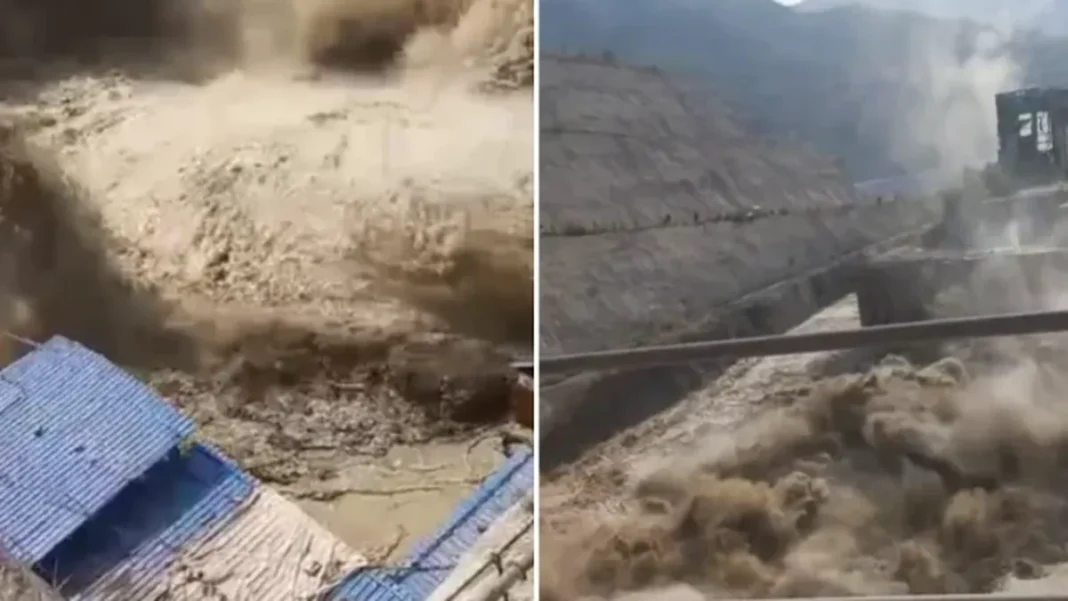
Work on the Tarbela T-5 project has been suspended indefinitely after a protective bund gave way on Monday and sent a large volume of water flooding into Tunnel Five. All workers were moved to safety, and no casualties were reported.
Haripur Deputy Commissioner Waseem Ahmed visited the site after the incident and confirmed water had entered the tunnel once the bund failed. The district administration and rescue agencies moved all Pakistani and foreign workers to a safe place as the water spread through the tunnel.
One Pakistani worker was swept into the water as the tunnel flooded, but emergency teams pulled him out. Ahmed said no casualties had been reported from the incident.
Tarbela T-5 project workers evacuated safely
Construction and development work on the Tarbela T-5 project has been suspended indefinitely following the incident. An investigation has been launched to determine the cause of the breach.
Ahmed said a high-level inquiry would examine the circumstances behind the failure of the protective bund and establish whether a structural weakness or a technical fault had caused it. He added that the next course of action would be decided after the investigation report was received.
Tribune reported that the breach took place on Monday morning at the Tarbela Dam site in Haripur district. The water entered Tunnel Five, where construction work on the fifth extension of the dam was under way.
WAPDA says main tunnel undamaged
WAPDA has said the water entered the tunnel after a weak rock mass collapsed during excavation of the second bench of the connecting tunnel, allowing water from the intake pit to flow into the tunnel and the powerhouse area. The authority said the water had been completely drained from the intake pit and that dewatering of the under-construction powerhouse had begun, with no further water entering the downstream work sites.
WAPDA rejected reports that the T-5 tunnel had collapsed, saying there was no damage to the main tunnel, the under-construction powerhouse, the tailrace culvert or the switchyard. Senior WAPDA officers, the project engineer and the contractor are assessing the situation.
A project already running late
The Tarbela 5th Extension Hydropower Project is a major WAPDA scheme being built at Tunnel No. 5 of Tarbela Dam. It was intended to add 1,530 megawatts to the dam’s installed generation capacity through three units of 510 megawatts each.
WAPDA gave a $354.6 million contract for the project’s civil works to China’s Power Construction Corporation of China Limited in May 2021. The project had an approved cost of $807 million, with the World Bank providing $390 million and the Asian Infrastructure Investment Bank contributing $300 million.
Once completed, it was expected to generate an average of 1.347 billion units of electricity each year and raise Tarbela Dam’s installed capacity from 4,888 megawatts to 6,418 megawatts.
The project has faced repeated delays, pushing its completion deadline back from the original five-year schedule to September 2027. In September 2024, a project director told a Senate committee that delays had been caused, among other factors, by difficulties in obtaining a no-objection certificate from the Indus River System Authority for the closure of Tunnel 5.
The project also faced a temporary suspension in August 2025 after rising reservoir levels and increased water inflows led to water entering the construction site. Monday’s breach is the second time in just over a year that water has forced work to stop at the site.
Why the delay matters for power supply
The setback comes at a time when Pakistan’s power sector is already under strain. The World Bank approved a further $300 million in June 2026 to cover cost overruns on the Tarbela extension, and rated the project’s progress as satisfactory in August 2026. WAPDA had said the first unit of the project was scheduled to start generating electricity in April 2027, a date that now looks uncertain after the latest suspension.
Cheap hydropower from Tarbela matters because electricity costs are already squeezing homes and businesses. Nepra has raised the special industrial power rate to Rs25.30 per unit, up from Rs22.98, and industrialists are demanding a third-party audit of power sector data to verify the figures behind their bills.
Water flows also remain a concern. Sindh recorded a sharp monsoon rainfall deficit this year, adding to worries about water storage and farm output, while Karachi’s factories are already struggling with broken infrastructure and high costs.
What happens next
The inquiry ordered by the Haripur deputy commissioner will be the first step. Its findings will decide whether work can resume, what repairs are needed to the bund and the tunnel, and whether the failure points to a deeper problem with the project’s design or construction.
WAPDA will also need to assess the damage inside Tunnel Five before any timetable for resuming work can be set. Until the report is received, construction stays suspended, and the April 2027 target for the first generating unit remains in doubt.
Frequently asked questions
What happened at Tarbela on Monday?
A protective bund at the Tarbela Dam’s T-5 hydropower project gave way on Monday, 9 November 2026, and a large volume of water flooded Tunnel Five. Construction work was suspended indefinitely after the incident.
Was anyone hurt in the incident?
No casualties were reported. All Pakistani and foreign workers were moved to safety, and one worker swept into the water was rescued by emergency teams.
What is the T-5 project?
The Tarbela 5th Extension Hydropower Project is a WAPDA scheme at Tunnel No. 5 of Tarbela Dam. It adds 1,530 megawatts through three 510-megawatt units, raising the dam’s capacity from 4,888 to 6,418 megawatts.
How is the project funded?
The project had an approved cost of $807 million. The World Bank provided $390 million and the Asian Infrastructure Investment Bank contributed $300 million. The World Bank approved a further $300 million in June 2026 to cover cost overruns.
Has work stopped at Tarbela before?
Yes. Work was temporarily suspended in August 2025 after rising reservoir levels and increased inflows sent water into the construction site. Completion has also been pushed back to September 2027.