

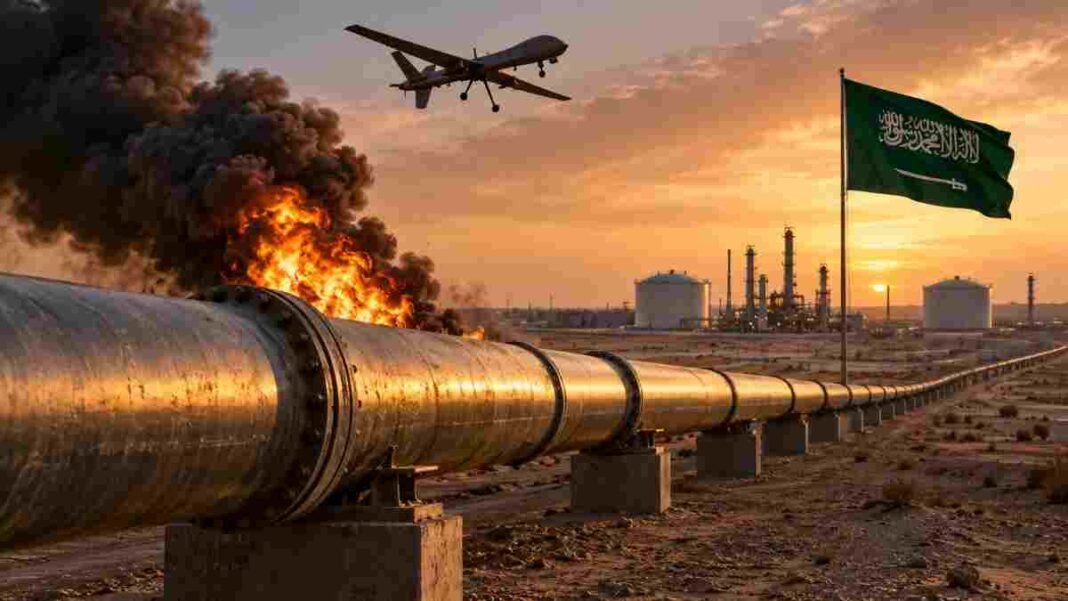
Saudi Arabia has temporarily shut down its major East-West oil route after drone attacks targeted key energy infrastructure. The government described the closure as a safety measure while teams inspect the affected areas.
The Saudi Oil Pipeline plays a major role in moving crude across the country. Therefore, authorities acted quickly after reports of attacks in the Riyadh and Madinah regions.
Saudi Arabia’s Ministry of Energy said technical and emergency teams reached the targeted locations. They began inspecting the pipeline, securing key facilities, and assessing the extent of any damage.
Meanwhile, the East-West route carries crude oil from Abqaiq in eastern Saudi Arabia to the Red Sea port of Yanbu. This route gives the Kingdom an important alternative for transporting large volumes of oil.
The Saudi Oil Pipeline can move around five million barrels of crude per day. As a result, any prolonged disruption could attract attention from global oil traders and energy markets.
However, Saudi officials described the shutdown as a precaution rather than a permanent suspension. Authorities want to complete safety checks before they make further decisions about operations.
At the same time, Saudi Arabia’s Foreign Ministry linked the attack to several drones that allegedly came from Iraq. The development has heightened security concerns across the wider region.
Still, Saudi Arabia said it would avoid an immediate retaliatory response. Instead, the Kingdom wants to allow Iraqi authorities to investigate the incident and take necessary action.
Iraqi authorities also moved quickly after the allegations emerged. Prime Minister Ali al-Zaidi ordered an investigation into the security command responsible for Maysan province.
The Iraqi government also dismissed the commander of the province’s operations command. Government officials said investigators had identified a location inside the province connected with the attacks on Saudi Arabia.
The Saudi Oil Pipeline has strategic importance beyond its daily transportation capacity. In particular, the route helps Saudi Arabia reduce its dependence on oil shipments through the Strait of Hormuz.
The Strait of Hormuz remains one of the world’s most important energy shipping routes. As a result, regional tensions around the waterway can quickly raise concerns about international oil supplies.
Saudi Arabia developed the East-West pipeline during the 1980s. Since then, the route has helped the country move crude from its eastern oil-producing areas toward export facilities on the Red Sea.
As a result, the pipeline gives Saudi Arabia greater flexibility during periods of regional instability. It can also support exports when security problems threaten traditional Gulf shipping routes.
Recent tensions have made this alternative increasingly important. Saudi Arabia and the United States previously targeted positions linked to Iran-backed militias in Iraq following accusations involving attacks on Saudi energy facilities.
In addition, the Houthis claimed responsibility for earlier attacks on Saudi oil targets. Regional officials also alleged that Iraqi militias received assistance in planning and carrying out some operations.
These developments have increased concerns about the security of energy infrastructure across the Middle East. Drone technology poses serious challenges because attackers can target key facilities from long distances.
For that reason, the temporary closure of the Saudi Oil Pipeline carries significance beyond Saudi Arabia. International energy markets closely follow any event that could affect the movement of millions of barrels of crude.
Saudi Arabia has also increased the importance of its Red Sea export route. The country can use Yanbu to send crude toward international markets without relying entirely on the Strait of Hormuz.
Furthermore, the International Energy Agency has previously highlighted growing Saudi oil movements through the Red Sea. Such exports strengthen the Kingdom’s ability to maintain supply routes during periods of regional uncertainty.
Oil traders will now watch how quickly Saudi authorities complete their inspections. A short shutdown may have a limited effect, while a longer disruption could raise wider concerns about supply security.
At the same time, Iraq faces pressure to investigate the alleged launch sites and prevent further attacks. Cooperation between both countries could help prevent the incident from developing into a broader regional confrontation.
The Saudi Oil Pipeline remains one of the Kingdom’s most valuable pieces of energy infrastructure. Its ability to connect eastern oil fields with the Red Sea gives Saudi Arabia an important strategic advantage.
For now, Saudi authorities continue to assess security and damage along the route. The timing of its reopening will likely depend on the results of technical inspections and the wider security situation.
Meanwhile, global energy markets will continue watching developments closely. Any fresh attack or prolonged closure could increase concerns about oil transportation and regional stability.