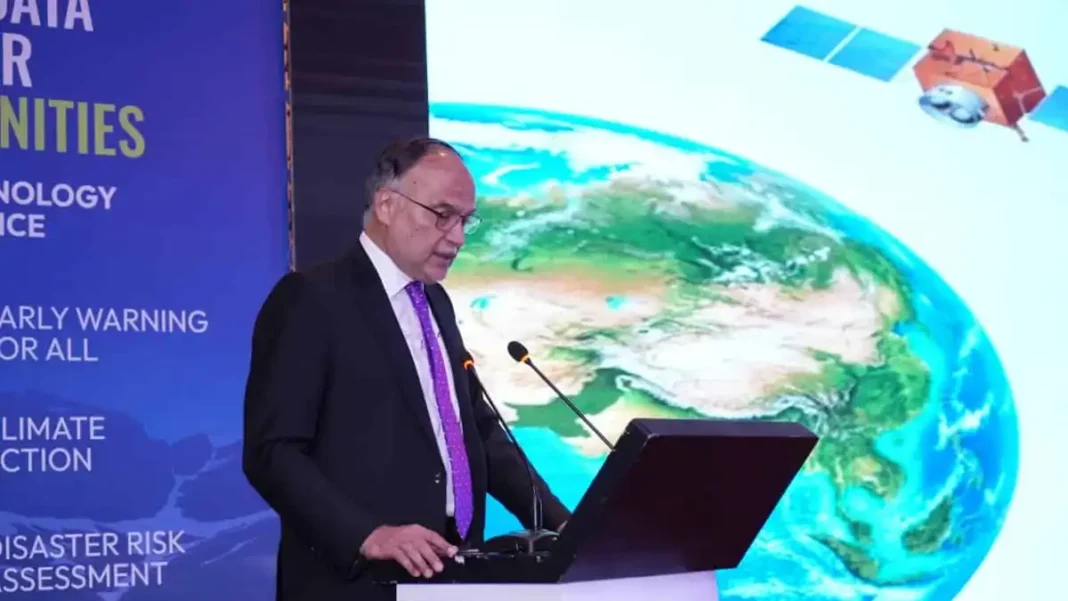
The Space and Upper Atmosphere Research Commission (SUPARCO) has opened a five-day space technology conference in Islamabad on using space technology for early warnings, climate action and disaster risk assessment.
The SUPARCO space technology conference opened at Serena Hotel, Islamabad, on October 27, 2026. It runs until October 31, 2026, and brings together around 250 national and international participants from 20 countries.
SUPARCO organised the event with the United Nations Office for Outer Space Affairs (UNOOSA), the Inter-Islamic Network on Space Sciences and Technology (ISNET) and the Asia-Pacific Space Cooperation Organization (APSCO), as reported by ProPakistani.
Federal Minister for Planning, Development and Special Initiatives, Professor Ahsan Iqbal, attended the opening ceremony as chief guest. SUPARCO Chairman Muhammad Yousaf Khan welcomed the participants and spoke about the growing role of satellite-based tools in climate monitoring and disaster management.
Who is taking part in the SUPARCO space technology conference
International partners include UNOOSA, UN-SPIDER, ISNET and APSCO, along with the United Nations World Food Programme and the International Telecommunication Union.
Space and research agencies from partner countries are also present. They include Indonesia’s National Research and Innovation Agency (BRIN), the Iranian Space Research Center, the Space Research and Technology Center of Iraq, the Turkish Space Agency, the TUBITAK Space Technologies Research Institute, Vietnam’s National Remote Sensing Department and Ministry of Agriculture and Environment, and Nepal’s Ministry of Energy, Water Resources and Irrigation.
On the Pakistan side, the participants span government, disaster management and public-sector bodies. They include the Ministry of Climate Change and Environmental Coordination, the Ministry of Foreign Affairs, the National Disaster Management Authority (NDMA), the Pakistan Meteorological Department, the Pakistan Climate Change Authority, the National Disaster Risk Management Fund, the Planning Commission, the State Bank of Pakistan, the Securities and Exchange Commission of Pakistan, the Federal Flood Commission, Pak-EPA, the Punjab Forest Department and the Punjab Information Technology Board.
What the conference will cover
The main focus is the Early Warnings for All (EW4All) initiative, which aims to ensure that timely and reliable warnings reach people at risk from disasters.
Other topics include disaster risk assessment, climate action and the use of satellite data and geospatial technology to support decisions. Sessions will cover flood risk modelling, multi-hazard mapping, glacial lake outburst flood early warning, hydrodynamic modelling and satellite monitoring of glaciers, forests, farms and water resources.
Experts will also discuss climate-resilient infrastructure, climate risk financing, crop-yield loss estimation, climate monitoring and the use of artificial intelligence and GeoAI to improve hazard detection and early warning.
The programme also covers the Sendai Framework for Disaster Risk Reduction and the Paris Agreement. A technical visit to NDMA is part of the schedule, so participants can study Pakistan’s disaster management system in practice.
Why early warnings matter for Pakistan
Ahsan Iqbal stressed the link between climate risk, economic development, fiscal stability and poverty reduction. He recalled that the floods of 2022 caused direct losses equal to about 2.2 per cent of GDP.
He said space-based tools, including satellite Earth observation, meteorology and communication systems, can strengthen early warning, disaster risk assessment, climate monitoring and emergency response. He also called for better data sharing, investment in people and institutions, innovative financing and stronger regional cooperation.
He urged the conference to produce practical recommendations on institutional arrangements, data sharing, financing and capacity building. He said the Planning Ministry would consider those recommendations in the national planning process.
The conference fits a wider climate push in Pakistan, including the revival of the dormant Clean Environment Fund.
What comes after the conference
The closing ceremony on October 31, 2026, will present a summary of the proceedings and SUPARCO’s Space4Climate initiative.
After the conference, a five-day training course will run at the COMSTECH Secretariat in Islamabad from November 2 to 6, 2026. The course aims to build technical knowledge on space technology for early warning and climate action.
Frequently asked questions
When and where is the conference taking place?
The conference runs from October 27 to 31, 2026, at Serena Hotel, Islamabad.
How many people are taking part?
Around 250 national and international participants from 20 countries are attending.
What is EW4All?
Early Warnings for All is an initiative to ensure timely and reliable warnings reach people at risk from disasters, so losses can be reduced and communities protected.
What happens after the conference?
The closing ceremony takes place on October 31, 2026, and a five-day training course follows at the COMSTECH Secretariat in Islamabad from November 2 to 6, 2026.