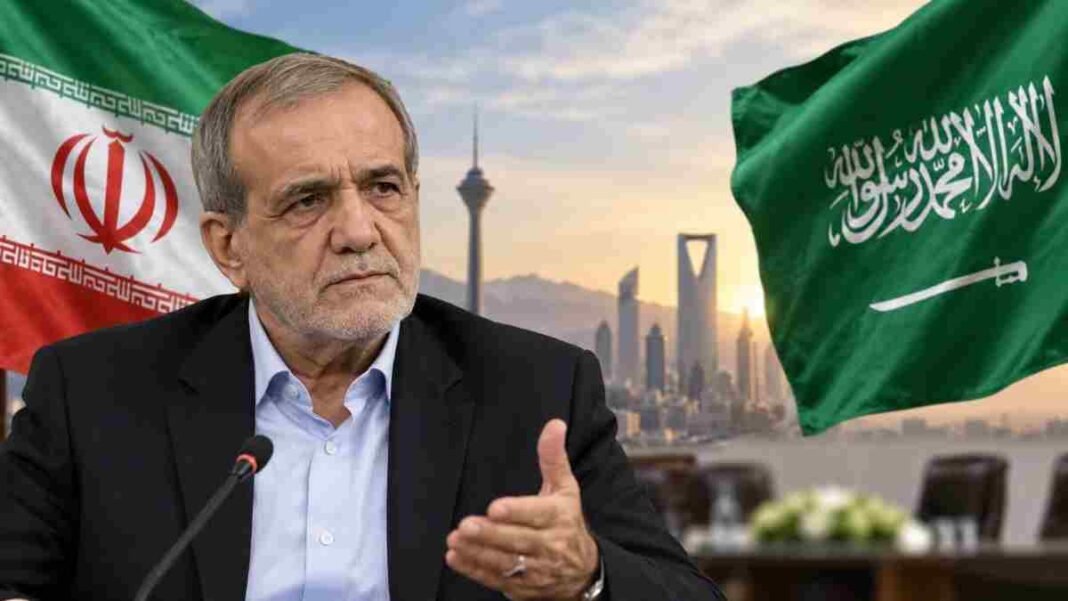
Iranian President Masoud Pezeshkian has firmly rejected the idea of a direct conflict between Tehran and Riyadh. He said Iran-Saudi Arabia relations should focus on dialogue and regional peace rather than confrontation.
Speaking in an interview with Indian media, Pezeshkian said Iran is not at war with Saudi Arabia. He also separated Tehran’s position from the actions and disputes involving Yemen’s Houthis.
According to Pezeshkian, the Houthis have their own issues and concerns regarding Saudi Arabia. Therefore, he argued that their actions should not define Iran’s relationship with the Saudi government.
Meanwhile, the Iranian president stressed that regional countries have no valid reason to fight each other. Instead, he urged governments across the region to resolve their differences through direct talks.
Pezeshkian said he has repeatedly supported dialogue between Middle Eastern countries. He believes regional leaders should sit at one table and discuss practical ways to protect peace and security.
Moreover, his comments put renewed attention on Iran-Saudi Arabia ties at a sensitive time for the Middle East. Political and security tensions across the region have increased concerns about a wider confrontation.
However, Pezeshkian insisted that Iran does not seek another war. He said Tehran wants to secure its international rights while continuing to prioritize peace.
At the same time, the Iranian president discussed upcoming diplomatic talks in Muscat, Oman. He said countries connected to recent attacks against Iran would participate in negotiations concerning the Strait of Hormuz.
According to Pezeshkian, the talks will bring together countries whose territories served as locations for attacks against Iran. Therefore, Tehran expects those governments to join discussions on regional security.
The Strait of Hormuz remains strategically important for the region and the wider world. As a result, any tension surrounding the waterway can quickly raise international concerns about security and energy supplies.
Pezeshkian’s remarks also suggest that Tehran wants diplomatic engagement despite ongoing disagreements. In particular, his statement on Iran-Saudi Arabia relations indicates that Iran wants to avoid opening another direct front in the region.
Furthermore, the Iranian leader called for cooperation among neighboring countries. He argued that dialogue offers a better path than military confrontation when governments face political or security disputes.
His comments come as several Middle Eastern countries continue to assess their security policies. Consequently, diplomatic efforts could play an important role in preventing existing tensions from spreading across borders.
Pezeshkian also stressed that Iran will continue to defend what it considers its legitimate international rights. Nevertheless, he said the country prefers peace and does not view war as its desired course of action.
In addition, the president answered a question about Iran’s Supreme Leader. Pezeshkian expressed gratitude that the Supreme Leader remains alive and continues to serve in Iran’s political system.
He also claimed that Iran’s enemies had failed to discover the Supreme Leader’s location. His statement aimed to dismiss speculation surrounding the Iranian leadership during the current period of regional tension.
Meanwhile, the president’s message on Iran-Saudi Arabia relations could attract particular attention across the Gulf. Both countries hold significant political influence, and their relationship can affect security calculations throughout the Middle East.
For years, Tehran and Riyadh have held different positions on several regional issues. Yet diplomatic engagement between the two sides remains important because confrontation could create wider political and economic consequences.
Therefore, Pezeshkian’s latest remarks highlight dialogue as Iran’s preferred approach toward Saudi Arabia and other regional states. He wants neighboring governments to address disputes through negotiations rather than military escalation.
The upcoming Muscat discussions could also provide another opportunity for regional diplomacy. Oman has often provided a setting where countries can discuss difficult issues and explore ways to reduce tensions.
Still, the outcome will depend on the positions of participating governments. Pezeshkian’s comments, however, make Tehran’s public position clear ahead of the expected negotiations.
Ultimately, the Iranian president presented Iran-Saudi Arabia relations as an issue that requires cooperation rather than war. He also called on regional governments to work together for stability while protecting their respective national and international rights.
For now, Pezeshkian says Iran remains committed to peace despite serious regional tensions. His message emphasizes talks, cooperation, and diplomacy as the preferred way to prevent another major conflict in the Middle East.