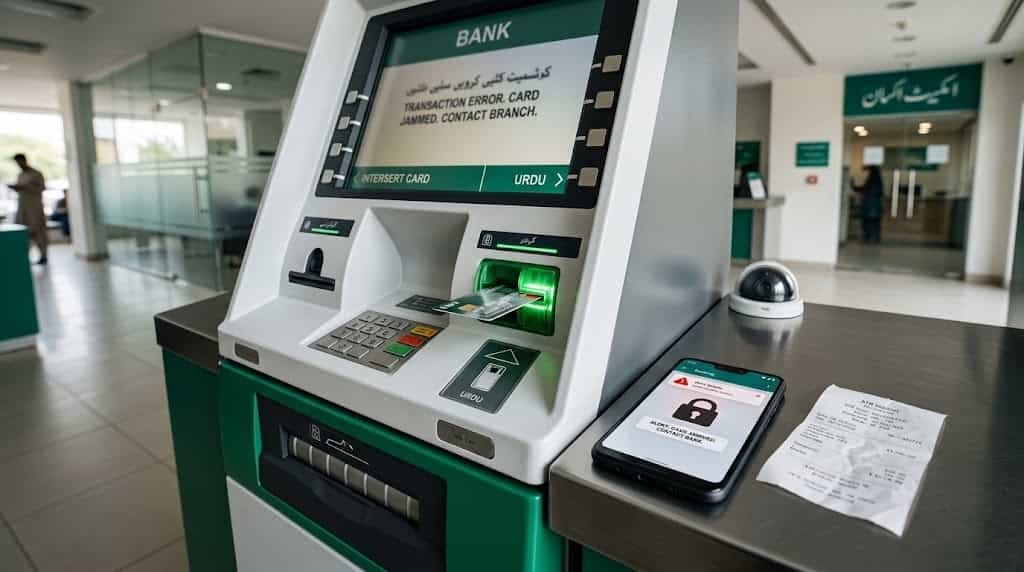
You insert your debit card into an ATM, enter your PIN and request cash.
The transaction finishes—or perhaps fails—but suddenly there is another problem.
The ATM does not return your card.
For many people, this immediately creates panic.
Should you wait?
Should you switch the ATM off?
Should you ask the security guard to open the machine?
Should you call the bank whose ATM you used or the bank that issued your card?
And most importantly, can someone take your money now?
An ATM retaining your debit card can be stressful, particularly when it happens at night, during a weekend or while using another bank’s ATM.
However, your next few actions can protect both your card and your bank account.
Here is exactly what Pakistani bank customers should know.
First: Do Not Leave the ATM Immediately
If the ATM has retained your card, stay near the machine for a short time.
Look carefully at the screen.
The ATM may display a message explaining that the card has been retained or captured.
Do not repeatedly press buttons or insert another card.
Also, never attempt to physically open, shake or damage the ATM.
Take note of the ATM location, bank name and approximate time of the incident.
If the ATM displays an identification number or terminal number, note that too.
This information can help when you contact your bank.
Wait Briefly, but Don’t Stand There Forever
Sometimes an ATM can take a few seconds longer than expected to return a card.
Wait briefly and watch the screen.
If the machine clearly says that it has retained your card, or the transaction ends without returning it, treat the card as captured.
Do not spend a long time waiting beside the machine hoping it will suddenly come out.
Your priority should now move from recovering the physical card yourself to protecting the account connected to it.
Call Your Bank Immediately
This is the most important step.
The State Bank of Pakistan’s cardholder guidance says that if a cash machine does not return your card, you should report it immediately to your bank.
Call the official helpline of the bank that issued your debit or ATM card.
For example, if your HBL card gets stuck inside another bank’s ATM, your card-issuing bank is HBL.
Inform the bank that:
- Your ATM/debit card has been retained
- Which bank’s ATM retained it
- Where the ATM is located
- What time the incident happened
- Whether you attempted a withdrawal
- Whether money was deducted
Ask the representative what you should do next.
Most importantly, obtain a complaint or reference number.
SBP’s consumer guidance encourages customers experiencing ATM problems to contact their bank and obtain a complaint number.
Keep that number until the entire matter has been resolved.
Should You Block the Card?
Ask your card-issuing bank immediately whether the card should be blocked.
If there is any doubt about the security of the card, blocking it is usually the safest approach.
This becomes particularly important if the incident happens at:
- An off-site ATM
- Another bank’s ATM
- An ATM at night
- An unfamiliar location
- A machine that appears damaged or suspicious
Modern banking applications may also provide an option to temporarily freeze or permanently block a debit card.
If your bank provides that facility, follow the bank’s instructions.
Do not assume that because the physical card is inside the ATM, nobody can misuse it.
Treat a card outside your possession as a security issue until your bank confirms otherwise.
Never Accept Help From a Stranger
This rule can protect you from a much bigger problem.
Imagine your card gets stuck.
A person standing nearby approaches and says:
“Don’t worry. This machine does this all the time. Enter your PIN again and press these buttons.”
Do not do it.
The person may genuinely want to help.
But they may also be attempting fraud.
SBP advises ATM users not to accept help from strangers and not to allow themselves to become distracted while using an ATM.
Never tell anyone your PIN.
Never enter your PIN because a stranger tells you to.
Never give your banking-app password, OTP or verification code to anyone claiming they can recover your card.
Your bank does not need your ATM PIN to register a complaint about a retained card.
Check the ATM for Signs of Tampering
Before leaving, look at the machine without touching suspicious components.
Does the card slot look unusual?
Is something attached over it?
Does the keypad appear different?
Is there loose plastic around the card reader?
If something looks suspicious, do not try to remove it yourself.
Inform the bank.
SBP’s ATM security guidance advises customers not to use a machine when there are signs of tampering and to report suspicious machines to the bank.
Criminals can sometimes use devices designed to interfere with cards or capture card information.
Therefore, a card that appears “stuck” should not automatically be treated as a harmless technical malfunction.
Take a Photo of the ATM Details, Not Your Banking Information
If safe and permitted, record the ATM’s location and identifying information.
You may photograph the ATM booth or terminal identification displayed on the machine.
However, be careful.
Do not photograph or publicly share:
- Your PIN
- Full card number
- CVV
- Banking application screen containing sensitive details
- Account balance
- OTP
- Full bank statement
You only need enough information to identify where and when the problem happened.
What If the ATM Belongs to Your Own Bank?
This can make recovery simpler.
If the ATM is attached to a branch of your own bank and the branch is open, inform branch staff immediately.
Do not ask a security guard or unrelated employee to physically retrieve the card.
Speak to authorised bank staff.
SBP’s retained-card guidelines require banks to have procedures for handling cards captured by ATMs.
Under SBP’s published guidelines, acquiring branches are required to check ATMs for captured cards and log retained cards under controlled procedures.
Therefore, the card does not simply become available to whoever happens to open the machine.
What If Your Card Gets Stuck in Another Bank’s ATM?
This is where many Pakistani customers become confused.
Suppose:
Your account is with Bank A.
But you use an ATM belonging to Bank B.
The machine keeps your card.
Which bank should you contact?
Start by contacting the bank that issued your card.
You should also inform the bank operating the ATM if its contact details are available.
The ATM-operating bank is generally known as the acquiring bank, while the bank that issued your card is the issuing bank.
SBP has established procedures for retained cards involving acquiring and issuing banks.
The banks can guide you on whether the physical card can be recovered or whether you need a replacement.
Can You Get Your Captured ATM Card Back?
Potentially, yes, depending on the circumstances and the bank’s current procedures.
SBP’s published retained-card guidelines state that an ATM should provide information when a card has been captured.
The regulator’s guidelines also establish procedures for acquiring banks to check ATMs, record captured cards and arrange their return through proper verification procedures.
However, do not assume that every captured card will automatically be returned to you.
Your bank may decide that cancelling the retained card and issuing a replacement is safer.
The exact process can depend on where the card was captured, the bank’s procedures, the card status and security considerations.
Always follow the instructions of your issuing bank.
Never Try to Pull the Card Out With Tools
You may see internet videos suggesting tricks such as:
- Using tweezers
- Inserting another object into the card slot
- Applying tape
- Pushing another card inside
- Pulling the card reader
- Switching the machine off
Do not attempt these methods.
You could damage the ATM.
You could damage your card.
More importantly, interfering with banking equipment can create a serious security issue.
Once the ATM retains the card, allow authorised bank personnel to handle the machine.
What If Money Was Deducted Too?
This creates a second issue.
Suppose you requested Rs20,000.
The ATM did not give you cash.
It also retained your card.
Then you check mobile banking and discover Rs20,000 has been deducted.
Now you have two complaints:
1. Retained ATM card
2. Cash withdrawal dispute
Tell your bank about both issues.
Do not assume that reporting the captured card automatically creates a complaint about the missing cash.
Clearly tell the representative:
“The ATM retained my card and my account was also debited, but I did not receive the cash.”
Obtain a complaint/reference number.
Keep any ATM receipt if the machine produced one.
Also keep the SMS transaction alert.
Don’t Throw Away Your ATM Receipt
ATM receipts can contain useful transaction information.
SBP advises cardholders to keep transaction slips when they may need to refer to a transaction later.
If your card becomes stuck after a transaction, keep the receipt.
Do not leave it beside the ATM.
If you no longer need a receipt, destroy it properly rather than throwing it intact into a nearby bin.
Check Your Banking App Immediately
After contacting your bank, open your official mobile banking application if you can do so safely.
Check recent transactions.
Look for:
- The withdrawal you attempted
- Any duplicate debit
- Unknown ATM withdrawals
- Card purchases you do not recognise
- Online transactions you did not make
Continue checking the account until the card issue has been resolved.
If you notice an unfamiliar transaction, report it immediately.
Do not wait until the next day.
Change Your PIN After Recovering the Card
If the bank returns your original card and confirms that it remains active, consider changing your PIN—particularly if anything about the incident seemed suspicious.
This provides an additional security layer.
If anyone may have observed your PIN while you were using the ATM, changing it becomes even more important.
Never use easily guessed PINs such as:
1234
0000
Your birth year
Your phone-number digits
Or another obvious sequence.
What If Someone Calls Saying They Found Your Card?
Be extremely careful.
A fraudster may contact you pretending to represent the bank.
They might say:
“We have recovered your ATM card. Please tell us the OTP we just sent you so we can verify your identity.”
Do not provide it.
Your OTP is a security credential.
Never share an OTP, PIN, CVV or online banking password with someone calling you.
If you receive such a call, end it and contact your bank through its official helpline yourself.
What If the ATM Is Inside a Closed Branch?
This commonly happens at night or during weekends.
Your card gets stuck in an ATM attached to a bank branch, but the branch itself is closed.
Do not wait until the next working day before doing anything.
Call your card-issuing bank immediately.
SBP’s operational guidance requires banks to maintain customer-support arrangements for ATM-related issues, including helpline facilities.
Report the retained card first.
Then follow the bank’s instructions regarding collection or replacement.
What If You Are Travelling?
A captured card can become much more serious when you are away from home.
You may have limited cash.
You may not have access to your branch.
This is one reason travellers should avoid depending on a single payment method.
If your card gets retained while travelling:
Contact the issuing bank immediately.
Secure or block the card.
Check the account.
Use another payment method if available.
Never accept help from strangers around the ATM.
If you are abroad, ask your bank whether an emergency replacement or another solution is available.
Why Do ATMs Keep Cards?
There can be several reasons.
One common reason is repeated incorrect PIN attempts.
SBP’s retained/disabled-card guidance specifically notes that a card can become disabled after three invalid PIN attempts.
Technical problems can also cause an ATM to retain a card.
Other possible situations can involve:
- An expired card
- A card reported lost or stolen
- A security restriction
- Communication problems
- ATM hardware malfunction
- A damaged card
The exact reason can vary.
Do not repeatedly attempt random PINs if you have forgotten yours.
Contact your bank instead.
What If the Bank Does Not Resolve Your Complaint?
Your bank should be your first point of contact.
SBP says customers with banking grievances should first approach the relevant bank’s Complaint Management Unit.
Keep your complaint/reference number and supporting evidence.
If the issue remains unresolved, Pakistan has additional complaint mechanisms.
The Banking Mohtasib Pakistan can handle eligible unresolved banking disputes.
SBP also provides consumer-protection channels and says urgent matters such as ATM issues can be raised with it where appropriate.
SBP operates its Sunwai customer complaint service, which helps consumers lodge and track banking complaints.
Do not jump immediately to escalation if the bank is actively resolving a straightforward retained-card issue.
But do not abandon an unresolved complaint either.
10 Things to Do When an ATM Keeps Your Card
Remember this simple checklist:
1. Stay calm and read the ATM screen.
2. Wait briefly to confirm the machine will not return the card.
3. Note the bank, ATM location and time.
4. Call your card-issuing bank immediately.
5. Ask whether the card should be blocked or frozen.
6. Obtain a complaint/reference number.
7. Never accept help from strangers or reveal your PIN.
8. Check your mobile banking transactions.
9. Report separately if money was deducted but no cash came out.
10. Follow your bank’s official procedure for card recovery or replacement.
How to Avoid ATM Problems in the Future
You cannot prevent every technical problem, but safer ATM habits can reduce your risk.
Use ATMs in well-lit and busy locations.
Prefer ATMs attached to bank branches when practical.
Check the card slot before inserting your card.
Cover the keypad when entering your PIN.
Do not let strangers stand too close.
Do not accept unsolicited assistance.
Keep your bank’s official helpline accessible.
Enable transaction alerts.
Regularly review your account.
And always remember to collect your card before leaving the ATM.
SBP specifically advises customers to pay attention to their surroundings, avoid suspicious ATMs and never accept help from strangers.
Always Remember
An ATM retaining your debit card is inconvenient, but it does not need to become a financial disaster.
The biggest mistake is simply walking away and assuming the bank will automatically take care of everything.
Treat a card that is no longer in your possession seriously.
Contact your card-issuing bank immediately.
Secure the card if advised.
Check your account.
Keep the complaint number.
And never reveal your PIN or OTP to anyone offering to “help” recover the card.
If cash was deducted without being dispensed, report that transaction separately as well.
Your ATM card can be replaced.
Money lost to fraud can create a much bigger problem.
So if an ATM ever keeps your card, remember the most important rule:
Don’t panic—but don’t delay. Call your bank immediately.