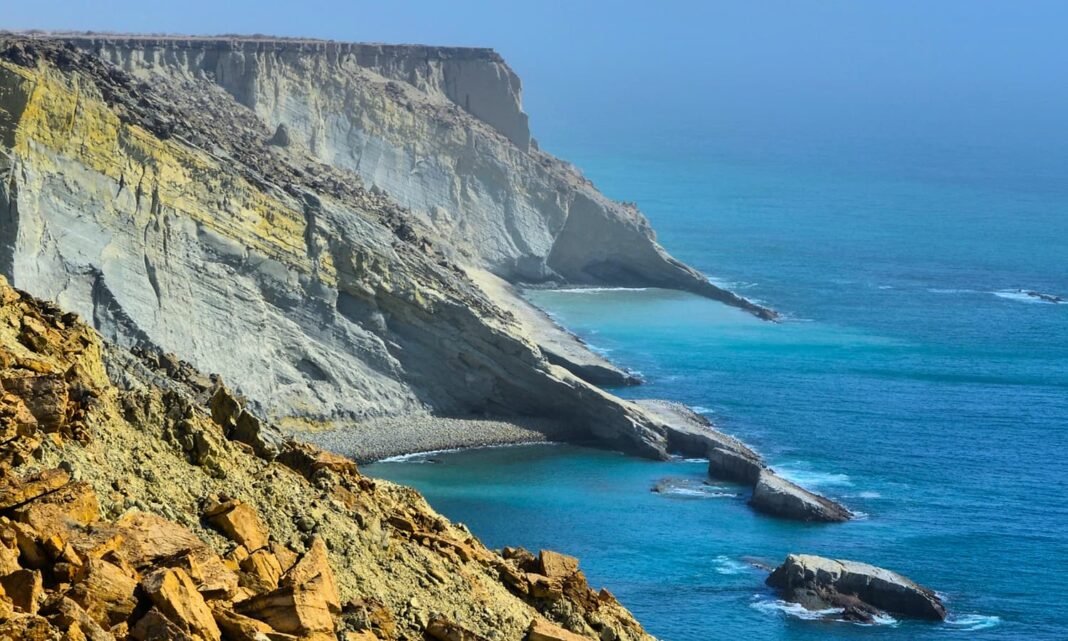
Twenty-five kilometres off the coast of Balochistan, in the open Arabian Sea, lies an island with no fresh water, no electricity, no buildings, and no permanent residents. What it does have is some of the clearest turquoise water in Pakistan, coral reefs, nesting sea turtles, cliffs that glow at sunset, and some of the darkest night skies you will ever sleep under. Astola Island, also called the Island of the Seven Hills, is Pakistan’s largest offshore island and its first marine protected area. Getting there is an expedition, not a day trip, and that is precisely the point. This Astola Island travel guide explains the real logistics of reaching it: the boat from Pasni, the best time to visit for calm seas, what to pack for camping, and what makes this wild island worth the effort in 2026.
Quick Facts
- Location: Arabian Sea, about 25 km off the Makran coast and 39 km south-east of the fishing port of Pasni, Gwadar District, Balochistan
- Size: About 6.7 km long and up to 2.3 km wide, with an area of roughly 6.7 square kilometres; the highest point is 75 metres above sea level
- Famous For: Pakistan’s largest offshore island, first marine protected area, coral reefs, turtle nesting beaches, and wilderness camping
- Nearest City: Pasni (the boat departure point); Karachi is the usual starting point for the whole trip
- Accessibility: Expedition-style: long road journey to Pasni, then a 2 to 4 hour boat ride each way; no facilities on the island
- Known Landmarks: The Seven Hills cliffs, turtle nesting beaches, a small fishermen’s prayer area, and the island’s lighthouse point
- Best For: Adventure travellers, campers, snorkellers, wildlife watchers, and photographers; not for luxury seekers or casual tourists
Why Visit Astola Island
Astola is the closest thing Pakistan has to a true wilderness island. There are no hotels, no restaurants, no roads, and no shops. The moment your boat pulls away from the cliffs and you watch the sun drop into the Arabian Sea with nobody else around, you understand why people make the journey. It is raw, silent, and completely unlike anywhere else in the country.
The island’s marine life is genuinely special. On 15 June 2017, Astola was declared Pakistan’s first marine protected area, specifically to safeguard its nesting sea turtles, coral reefs, and endemic species. Green and hawksbill turtles nest on its beaches, coral gardens fringe its shores, and the surrounding waters hold reef fish, dolphins, and seabird colonies. For snorkellers and divers, the underwater scenery is the main attraction; for everyone else, it is the beaches themselves, empty and clean in a way mainland beaches rarely are.
Astola also offers one of the finest camping experiences in Pakistan. With zero light pollution, the night sky over the island is extraordinary: the Milky Way arches overhead, and on moonless nights the sea itself can glow with bioluminescence. Falling asleep to the sound of waves on an uninhabited island, 25 kilometres from the nearest shore, is the kind of memory that stays with you for years.
Finally, there is the sheer adventure of the journey. The drive down the Makran Coastal Highway past Kund Malir, the Princess of Hope, and the Hingol river delta is one of the great road trips of Pakistan. Then comes the open-sea boat crossing from Pasni, watching the island’s cliffs rise out of the blue. Astola is not a place you stumble upon; it is a place you earn. In 2026, as domestic adventure travel keeps growing, it remains the definitive expedition destination for travellers who want the wildest version of Pakistan.
History of Astola Island
Astola has no ancient temples or old cities; its history is written in geography and seamanship. The island sits on the ancient maritime routes of the Arabian Sea, and for centuries it was known to the fishermen of the Makran coast, who used its sheltered coves during fishing expeditions. Its name, and the local title Island of the Seven Hills, come from the seven prominent rocky hillocks that give the island its rugged profile, visible from far out at sea.
Administratively, the island is part of the Pasni subdistrict of Gwadar District in Balochistan. It has never had a permanent settlement, simply because it has no fresh water. Everything on the island, from the seasonal fishermen’s shelters to the small prayer area used by visiting fishermen, exists only because someone carried it there by boat.
The modern history of Astola is a conservation story. For years, the island suffered from unsustainable fishing, coral extraction, and plastic pollution. In response, and after years of advocacy by conservationists, the Government of Balochistan declared Astola Pakistan’s first marine protected area on 15 June 2017. The designation recognises both the island’s underwater wealth, its coral reefs and reef fish, and its role as a critical nesting refuge for green and hawksbill turtles. Organisations such as WWF-Pakistan and the IUCN now work with local communities to monitor biodiversity and enforce marine protection around the island.
Tourism to Astola is a recent phenomenon. For most of its history the island was visited only by fishermen and the occasional adventurer. Over the last decade, tour operators from Karachi began running organised camping trips, and the island slowly entered the imagination of Pakistani travellers through viral photographs of its turquoise water and sea cliffs. It remains, deliberately, undeveloped: the absence of facilities is part of what keeps its ecosystem intact, and visitors are expected to follow strict leave-no-trace principles.
Top Things to Do in Astola Island
Camp on an Uninhabited Island
Camping is the heart of the Astola experience. Because there is nothing on the island, you carry in everything: tents, sleeping bags, food, and above all water, and you carry out every scrap of waste. Set up camp above the high-tide line on the sandy stretches, and you will have one of the great nights of your travelling life. The stars are extraordinary, the sea sounds never stop, and sunrise over the cliffs is worth waking for. Most organised trips run two or three days, giving you at least one full day and two nights on the island.
Snorkel the Coral Reefs
The reefs around Astola are among the best snorkelling in Pakistan. Coral gardens and reef fish ring parts of the island, and the water clarity in the calm season is excellent. Bring your own mask and snorkel, as none are available on the island, and never stand on or touch the coral. Go with a buddy, stay within sight of your boat, and respect the marine protected area rules: this is a conservation zone first and a playground second.
Watch for Turtles and Wildlife
Astola is a nesting site for green and hawksbill turtles, with the nesting season running roughly from May to August. If your trip coincides with the season, you may see nesting females or hatchlings at night, but keep your distance, use no white lights, and follow your guide’s instructions. The island is also home to the endemic Astola saw-scaled viper, a venomous snake found nowhere else. Wear covered footwear, watch where you step and sit, and do not go poking around rock crevices. Seabird colonies on the cliffs are another highlight for birdwatchers.
Explore the Seven Hills and Sea Cliffs
The island’s seven rocky hillocks and dramatic sea cliffs are its signature landscape. A walk along the clifftops gives sweeping views of the Arabian Sea in every direction, and the golden light of late afternoon turns the rocks a deep amber. There is a small lighthouse point and the fishermen’s prayer area to find, and tide pools along the rocky shore are worth exploring at low tide. Everything is walkable; the island is only about 6.7 kilometres long.
Stargaze and Night Photography
With no light pollution for dozens of kilometres, Astola’s night sky is among the darkest accessible in Pakistan. The Milky Way is vivid on moonless nights, and long-exposure photographers can capture the island’s silhouette against the stars. This is one of the few places in the country where you can reliably see this quality of sky without a multi-day mountain trek.
Famous Places In and Around Astola Island
- Pasni — The fishing port and boat departure point, worth a look for its working harbour and fish market.
- Gwadar — The famous port city further west along the coast, with its hammerhead-shaped peninsula and beaches.
- Kund Malir Beach — A stunning desert-meets-sea beach on the Makran Coastal Highway, usually visited on the drive to Pasni.
- Princess of Hope and the Sphinx — Natural rock formations in Hingol National Park that resemble a princess and a sphinx, passed on the coastal highway.
- Ormara Beach — A long, quiet beach town between Karachi and Pasni, often used as an overnight stop.
- Hingol National Park — Pakistan’s largest national park, crossed by the coastal highway, with dramatic mud volcanoes and desert landscapes.
- Buzi Pass — A scenic mountain pass on the coastal highway with panoramic views of the sea and desert.
How to Reach Astola Island
Reaching Astola takes two stages: a long road journey to the fishing town of Pasni on the Makran coast, and then a boat crossing to the island. There is no other way to get there, and the whole trip needs to be planned around sea conditions.
From Karachi: This is the standard starting point. Drive the Makran Coastal Highway (N-10) from Karachi to Pasni, a journey of roughly seven to eight hours with stops. The highway passes Ormara, Kund Malir, and the Princess of Hope, so most travellers break the drive with sightseeing. From Pasni, take a motorised fishing boat to the island: the crossing covers about 39 kilometres and takes roughly two to four hours each way, depending on the sea and the vessel. Negotiate the boat fare before departure, as there is no fixed price; going through a reputable tour operator is the simplest option.
From Lahore: Fly to Karachi first; the overland distance is far too long for this kind of trip. From Karachi, follow the route above.
From Islamabad: Fly to Karachi, then follow the Karachi route. Some travellers fly to Gwadar and drive east to Pasni, but Karachi remains the most practical gateway with the most operator options.
Nearest airport: Jinnah International Airport, Karachi. Pasni has a small airport with very limited scheduled service, so Karachi is the realistic choice.
Road conditions: The Makran Coastal Highway is paved and generally in good condition, though it is a two-lane road through remote desert. Fuel up in Karachi or at major stops, as stations are sparse. The final stretch into Pasni is straightforward.
Transport options: Almost everyone visits Astola through an organised tour operator from Karachi, which handles the 4×4 or coaster to Pasni, the boat hire, camping gear, food, and water. Independent travel is possible but difficult: you would need to arrange your own boat at the Pasni harbour, bring all supplies, and have solid contingency plans. For first-timers, an operator is strongly recommended.
Route Details
- Travel from Karachi to Pasni via the Makran Coastal Highway (N-10), about seven to eight hours. Common stops: Kund Malir Beach, Princess of Hope, Ormara.
- Reach Pasni by afternoon or evening; most operators overnight in Pasni or drive straight through depending on the plan.
- At Pasni harbour, board the hired boat early in the morning when the sea is calmest. The crossing to Astola takes two to four hours.
- Land on the island’s beach, unload all supplies, and set up camp above the high-tide line.
- Spend one to two nights on the island, then boat back to Pasni in the morning and drive back to Karachi.
Important: The sea crossing is entirely weather-dependent. In rough conditions, even experienced local boatmen will not attempt it. Build a buffer day into your plan, and never pressure a boatman to sail in bad weather.
Where to Stay in Astola Island
There are no hotels, guesthouses, or any accommodation on Astola Island. You sleep in a tent, full stop. This is non-negotiable and part of the island’s protected status. Here is how sleeping arrangements actually work.
Camping on the island: Bring a sturdy tent, sleeping bag, and ground mat. Organised tours provide shared tents (usually three to four persons), sleeping bags, and mattresses. Nights can be windy, especially in winter, and temperatures drop noticeably after midnight even when afternoons are warm. A warm sleeping bag is essential from November to February.
Pasni: The fishing town has basic hotels and rest houses where operators typically put groups the night before or after the island stay. Do not expect luxury; expect clean, simple rooms.
Ormara or Gwadar: If your itinerary includes stops along the coast, both towns have mid-range hotels. Gwadar has the better options of the two, including some well-known chain-affiliated properties.
Karachi: Most trips start and end in Karachi, where the full range of hotels is available.
There is no fresh water on the island, so carry a minimum of four to five litres of drinking water per person per day, plus water for cooking and washing.
Where to Eat: Local Foods of Astola Island
There is no food on the island, so every meal is either carried in or cooked at camp. That said, the food culture of the journey is one of its highlights.
Fresh seafood at Pasni: Pasni is a working fishing port, and its fish market is the place to buy the catch of the day before sailing. Many groups buy fresh fish in Pasni and grill it on the island over a campfire: the definitive Astola meal. Pomfret, mackerel, and prawns are common when in season.
Balochi sajji: On the road through Balochistan, stop for sajji, the region’s signature dish of whole lamb or chicken slow-roasted over coals. Roadside sajji shops along the coastal highway serve it with fresh naan and it is the taste of the Makran coast.
Kaak: The traditional stone-baked bread of Balochistan, cooked on hot stones, is sold in towns along the route and keeps well for the island leg.
Camp cooking: Operators typically provide standard Pakistani camp meals: daal, rice, chicken karahi, BBQ, and chai. If travelling independently, bring non-perishable food, cooking fuel, and all utensils. There is nothing to buy on Astola, so the rule is simple: if you did not bring it, you do not have it.
Costs: Roadside meals in Balochistan are budget-friendly. The main cost of the trip is the boat hire and operator package, not the food.
Weather in Astola Island
Astola has a hot, dry coastal climate for most of the year, moderated slightly by the surrounding Arabian Sea. But for visitors, the sea matters more than the air temperature: the boat crossing is only comfortable when the sea is calm, and that defines the visiting season. Winter brings mild days and calm seas; summer brings heat and the rough monsoon sea that can make the island completely inaccessible.
| Season | Temperature Range | Conditions |
|---|---|---|
| Winter (Nov-Mar) | 18-25°C | Mild and comfortable; calm seas; the best and safest visiting season |
| Spring (Apr-May) | 25-32°C | Warming up; still accessible; sea conditions less predictable |
| Summer (Jun-Aug) | 30-38°C | Hot and humid; rough monsoon seas; crossings often impossible |
| Autumn (Sep-Oct) | 28-33°C | Seas calming after the monsoon; a possible late-season window |
The turtle nesting season runs roughly from May to August, which unfortunately overlaps with the roughest seas. Most travellers therefore choose the calm winter season and accept missing the turtles.
Language and Culture of Astola Island
The island itself is uninhabited, but the culture you encounter on this trip is that of the Makran coast. Balochi is the main language of Pasni, Gwadar, and the coastal towns; Urdu is widely understood, and fishermen and boatmen will communicate in a mix of both. English is limited outside the tour operators.
The coastal communities are fishing people, and their lives revolve around the sea: the tides, the seasons, and the catch. Respect their working harbour at Pasni; ask before photographing fishermen and their boats. The culture is conservative and hospitable. Dress modestly in the towns, and remember that on the island itself you are a guest in a protected natural area: keep noise down at night, never disturb nesting turtles or bird colonies, and leave every beach cleaner than you found it.
One cultural note specific to Astola: the small prayer area used by visiting fishermen is a place of worship. Treat it with the same respect you would any mosque or shrine.
Shopping in Astola Island
There is nothing to buy on the island, and that is the point. Your shopping happens in the coastal towns. Pasni’s fish market is the essential stop: buy fresh fish and prawns for the island barbecue. Gwadar’s bazaars sell Balochi embroidery, traditional shawls, and handicrafts, and the town is known for dry fruits brought in from upcountry.
Along the Makran Coastal Highway, roadside stalls sell dates and local produce. If you want a genuine souvenir of the trip, Balochi needlework and camel-skin crafts from the Gwadar or Pasni markets are the authentic choice. There are no malls anywhere on this route; this is bazaar and market shopping, and you should carry cash, as card acceptance is rare.
Travel Tips for Astola Island
Packing Essentials
Pack like an expedition, because it is one. Minimum four to five litres of drinking water per person per day. Sturdy tent, warm sleeping bag, and ground mat. Reef-safe sunscreen, sunglasses, and a hat. First aid kit, seasickness medicine, and any personal medication: there are no medical facilities anywhere near the island. Power bank or solar charger, headlamp with spare batteries, and dry bags for electronics. Covered footwear is essential because of the endemic saw-scaled viper. Snorkel gear if you want to snorkel, as none exists on the island.
Safety Tips
The main risks on Astola are the remoteness itself. There is no hospital, no pharmacy, and no quick rescue; the nearest help is hours away by boat and road. Travel with a reputable operator, never swim alone, and wear a life jacket on the boat crossing. Take the viper seriously: shake out shoes and sleeping bags, and do not reach into crevices. Check current government travel advisories for Balochistan before you go, and register your plans with someone reliable on the mainland. Do not attempt the crossing in rough seas, whatever the schedule pressure.
Money & Connectivity
Carry all the cash you will need for the entire trip: there are no ATMs on the island and very few along the coastal highway. Mobile signals are patchy on the highway and generally absent on Astola itself; inform family beforehand that you will be unreachable on the island. Download offline maps of the Makran coast before leaving Karachi.
Best Time to Visit Astola Island
Winter (November to March) — Best Season
This is the definitive Astola season and the core recommendation of this Astola Island travel guide. Daytime temperatures sit between 18 and 25°C, the sea is at its calmest, and the boat crossing is comfortable and safe. Nights are cool and the stargazing is at its best. Book operators early, as winter weekends fill up.
October — Good Shoulder Season
October is often cited alongside winter as an ideal month: the monsoon has passed, seas are calming, and the weather is still warm. A fine choice if you want slightly warmer water for snorkelling.
April to May — Possible but Warming
Late spring is still accessible, but temperatures climb past 30°C and sea conditions become less predictable. Trips run, but check the marine forecast carefully.
June to August — Avoid
The monsoon makes the Arabian Sea rough, and the crossing to Astola is often impossible. Even experienced local boatmen will not sail. This is also the turtle nesting season, but the sea simply does not allow safe visits for most travellers.
Final Thoughts
Astola Island is not an easy destination, and it is not trying to be. It asks you to drive for eight hours, sail for three more, carry your own water, sleep on the sand, and accept that there is no backup plan if the sea turns rough. In exchange, it gives you something almost no other place in Pakistan can: a genuinely wild island, all to yourself, under some of the darkest skies and clearest water in the country.
If you go, go prepared and go respectfully. This is Pakistan’s first marine protected area, a turtle nesting refuge and a fragile coral ecosystem, not just a photo backdrop. Camp clean, snorkel gently, and leave the island exactly as wild as you found it. Do that, and Astola will give you the adventure of a lifetime.
FAQs
Where is Astola Island located?
Astola Island lies in the Arabian Sea about 25 kilometres off the Makran coast and 39 kilometres south-east of Pasni, in Gwadar District, Balochistan. It is Pakistan’s largest offshore island.
How do I reach Astola Island?
Drive from Karachi to Pasni via the Makran Coastal Highway (seven to eight hours), then take a motorised boat from Pasni harbour to the island (two to four hours each way). Most visitors go through an organised tour operator.
What is the best time to visit Astola Island?
October to March, when the seas are calm and daytime temperatures are 18 to 25°C. Avoid June to August, when monsoon seas make the crossing dangerous or impossible.
Can I stay overnight on Astola Island?
Yes, camping is the only option: there are no hotels or facilities of any kind. Bring your own tent, sleeping bag, food, and at least four to five litres of drinking water per person per day.
Is Astola Island safe for tourists?
The island itself is peaceful, but it is extremely remote with no medical facilities. The main risks are the sea crossing, dehydration, and the venomous Astola saw-scaled viper. Go with a reputable operator, check travel advisories for Balochistan, and never sail in rough seas.
Is Astola Island suitable for families?
It suits adventurous families with older children who are comfortable with basic camping and long journeys. It is not suitable for small children, elderly travellers, or anyone needing medical access or comfortable facilities.
What should I pack for Astola Island?
Drinking water, tent, sleeping bag, food and cooking gear, sunscreen, first aid kit, seasickness tablets, power bank, headlamp, covered footwear, and snorkel gear. There is nothing to buy on the island.
Why is Astola Island a marine protected area?
It was declared Pakistan’s first marine protected area on 15 June 2017 to protect its nesting green and hawksbill turtles, coral reefs, and endemic species such as the Astola saw-scaled viper, following years of damage from unsustainable fishing and pollution.
For more coastal and island adventures, browse our Explore Pakistan section, or head north for a completely different world in our Hunza Valley guide.