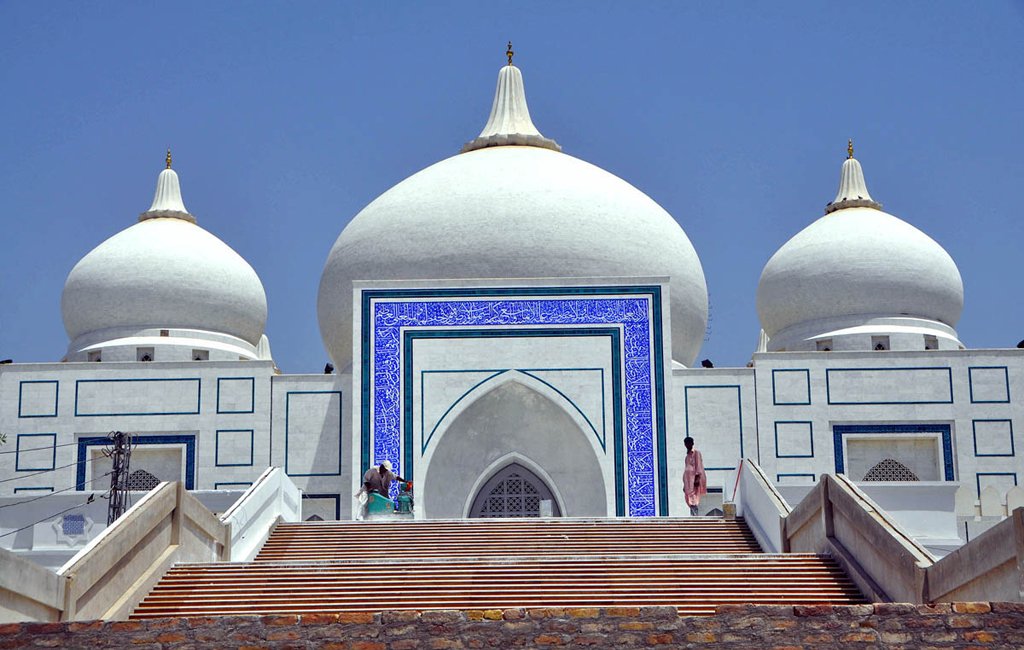
In a quiet village near Larkana, Sindh, rises one of the most striking modern monuments in Pakistan: a white-marble mausoleum of five domes where two prime ministers — Zulfikar Ali Bhutto and his daughter Benazir Bhutto — rest side by side. The Bhutto family mausoleum at Garhi Khuda Bakhsh draws historians, architecture admirers, and thousands of visitors each year. This Bhutto family mausoleum Garhi Khuda Bakhsh travel guide covers its real history, how to reach it, the best time to visit, and how to combine it with nearby Mohenjo-daro.
Quick Facts
- Location: Garhi Khuda Bakhsh village, Ratodero Taluka, Larkana District, Sindh, Pakistan — near the town of Naudero
- Altitude: Lowland plains of upper Sindh (no significant elevation)
- Famous For: The white-marble mausoleum of the Bhutto family, with five domes and four iwans, containing the graves of Zulfikar Ali Bhutto, Benazir Bhutto, Nusrat Bhutto, Murtaza Bhutto, and Shahnawaz Bhutto
- Nearest City: Larkana, about 25-30 km away; Sukkur, about 90 km away
- Accessibility: Good metalled roads from Larkana and Sukkur; trains run to Larkana from Karachi, Lahore, and Islamabad; nearest airport is at Sukkur
- Known Landmarks: The central domed mazar, the graves’ chambers with Quranic calligraphy, glazed Sindhi tilework, the surrounding memorial grounds and visitor facilities
- Best For: History enthusiasts, students of Pakistani politics, architecture admirers, and travelers exploring upper Sindh
Why Visit Bhutto Family Mausoleum, Garhi Khuda Bakhsh
Few places in Pakistan compress so much modern history into a single site. The mausoleum holds the graves of the two Bhuttos who each became prime minister and each died violently — Zulfikar, executed in 1979, and Benazir, assassinated in 2007 — alongside other members of a family that has shaped the country’s politics for three generations. Whatever your political views, the site is a powerful place to understand Pakistan’s story, and visitors consistently describe it as peaceful and beautifully kept.
The architecture is the second reason. The white-marble complex — five domes, four iwans in the manner of the Taj Mahal, glazed tiles inscribed with Quranic calligraphy, fresco work based on Sindhi Hala patterns — is a serious piece of contemporary Islamic architecture, the product of two design phases and two architects. It photographs magnificently in the morning and late-afternoon light, and the craftsmanship of the tile and marble work rewards close attention.
Third, the mausoleum anchors a wider upper-Sindh itinerary. Mohenjo-daro, one of the world’s great archaeological sites, lies near Larkana; Sukkur’s historic bridges and the shrines of the region are within reach. Travelers who come only for the mazar often leave having discovered a corner of Pakistan they knew little about — which is exactly what good travel should do.
Finally, visiting is straightforward. The site is open to the public, well managed, and easy to reach by road from Larkana in under an hour. It fits naturally into a day trip, or a two-day circuit with Mohenjo-daro, and it costs nothing but your time and respect.
History of Bhutto Family Mausoleum, Garhi Khuda Bakhsh
The site’s history begins long before the mausoleum: Garhi Khuda Bakhsh was already the ancestral graveyard of the Bhutto family, dating back to before the British Raj. When Zulfikar Ali Bhutto — the founder of the Pakistan Peoples Party and a former prime minister — was laid to rest here in 1979, the site was still simply the family burial ground.
The transformation into a national monument was initiated by his daughter Benazir Bhutto, then prime minister, who in 1993 approved plans for a 56,000-square-foot building at the burial ground. In March 1994, the Government of Sindh approved the mausoleum project, then estimated at $9.4 million, with the cost to be shared equally by the federal and Sindh governments. The initial construction ran from 1993 to 1997 under architect Zaigham Jaffery, who studied the mausoleums of Ayatollah Khomeini and Mustafa Kemal Ataturk for inspiration and also drew on Lahore’s Shalimar Gardens. Work was delayed when it emerged that much of the project site was occupied by village residents; the site was evacuated in November 1995, and design changes pushed costs higher.
Construction then paused for about six years while Benazir Bhutto sought a redesign with stronger Islamic architectural elements. The project resumed in 2003 after a second design competition, won by architect Waqar Akbar Rizvi, whose revised scheme gave the complex its defining features: five domes and four iwans echoing the Taj Mahal, the whole building clad in white marble, with glazed tiles inscribed with calligraphy and fresco work based on Sindhi Hala patterns. The National Construction Company served as the main contractor. By 2007 the core mausoleum was sufficiently complete to receive Benazir Bhutto herself after her assassination on 27 December 2007, with finishing enhancements continuing into the early 2010s.
Those buried in the mausoleum include Sir Shah Nawaz Bhutto and his wife Lady Khurshid; Zulfikar Ali Bhutto; his wife Nusrat Bhutto; and his children Benazir, Murtaza, and Shahnawaz Bhutto. Every year on the anniversary of Benazir Bhutto’s death, large crowds gather at the site, and the Shaheed Bhutto Mazar Committee oversees the arrangements for public gatherings. The mausoleum thus functions both as a family shrine and as a living site of Pakistan’s political memory.
Top Things to Do in Bhutto Family Mausoleum, Garhi Khuda Bakhsh
Walk the marble complex and study the domes
Approach the mausoleum slowly: the five white domes and four iwans reveal themselves gradually across the 65,000-square-foot grounds. The Taj Mahal-inspired composition is best appreciated from the forecourt, where the symmetry of the design reads clearly. Early morning visits offer soft light and smaller crowds.
See the tilework and calligraphy
Look closely at the glazed tiles inscribed with Quranic calligraphy and the fresco work based on Sindhi Hala patterns — the details that root this modern monument in Sindh’s craft traditions. The marble inlay and carved screens inside the chambers are equally fine, and photography of the architecture is welcomed.
Pay respects at the graves
Visitors may enter the chambers where the Bhutto family graves rest. Maintain silence, dress modestly, and keep your visit brief and dignified — this is an active place of remembrance, and on anniversaries it fills with mourners. Offer fateha if you wish, as many visitors do.
Visit the memorial grounds and museum displays
The surrounding grounds include memorial areas and displays connected with the Bhutto family story. Allow time to walk the full complex; reviewers of the site consistently note that photographs do not do justice to its scale and detail.
Combine with Mohenjo-daro
No trip to Larkana is complete without Mohenjo-daro, the 4,500-year-old Indus Valley city and UNESCO World Heritage Site, roughly half an hour from Larkana. Pairing the ancient city with the modern mausoleum gives you five millennia of Sindh in two days.
Explore Larkana city
Larkana itself — one of Sindh’s oldest continuously inhabited cities — has bazaars, the historic city core, and the regional museum. It is also your base for food, fuel, and accommodation.
Famous Places In and Around Bhutto Family Mausoleum, Garhi Khuda Bakhsh
- Mohenjo-daro: The great Indus Valley archaeological site, a UNESCO World Heritage Site, near Larkana — the essential pairing with the mausoleum.
- Naudero: The nearby town and the Bhutto family’s political home turf, on the road between Larkana and Garhi Khuda Bakhsh.
- Larkana city: District headquarters with bazaars, the regional museum, and the full range of traveler services.
- Sukkur: About 90 km away, with the historic Lansdowne and Ayub bridges over the Indus and the bustling city bazaars.
- Ratodero: The taluka town closest to the mausoleum, a typical upper-Sindh market town.
How to Reach Bhutto Family Mausoleum, Garhi Khuda Bakhsh
Garhi Khuda Bakhsh lies about 25-30 km from Larkana city — roughly a 30-45 minute drive — and about 90 km from Sukkur (1.5 to 2 hours). The roads are metalled and in reasonable condition. The nearest airport is at Sukkur, with flights from Karachi and other cities; from the airport, hire a taxi or car for the onward journey. Note that visitors pass through security checkpoints near the site and walk a few hundred metres from the parking area to the mausoleum itself, so allow a little extra time.
From Karachi: The comfortable option is to fly to Sukkur and drive to Larkana and Garhi Khuda Bakhsh. Overland, drive north via the highway network toward Sukkur and onward to Larkana — a long, full day’s drive. Pakistan Railways also runs trains from Karachi to Larkana, a relaxed overnight option.
From Lahore: Take the train to Larkana — Pakistan Railways operates services to Larkana from Lahore and other cities — or fly to Sukkur via Karachi and drive. The road journey from Lahore is very long and best broken with stops.
From Islamabad: Fly to Sukkur (usually via Karachi) or take the train to Larkana; then continue by road. As with Lahore, the overland drive is a multi-day undertaking.
Within the area, hire a private taxi or car from Larkana for the round trip — drivers know the route well, especially around the death anniversaries when traffic increases. Local buses and vans connect Larkana with Naudero and Ratodero. Travel in daylight, and if visiting on 27 December or 4 April, expect large crowds and heightened security; check local conditions before setting out.
Route Details
From Larkana city, take the road toward Naudero/Ratodero and follow local signs to Garhi Khuda Bakhsh village — about 25-30 km, 30-45 minutes. The mausoleum’s white domes are visible from a distance and the site is well signposted locally. Park in the designated area, pass through the security check, and walk to the main gate. From Sukkur, drive to Larkana first (about 90 km, 1.5-2 hours), then onward as above.
Where to Stay in Bhutto Family Mausoleum, Garhi Khuda Bakhsh
Stay in Larkana city, which has the district’s full range of accommodation: mid-range hotels, simple guesthouses, and budget lodges. No specific hotel has been verified for this guide, so book through a reputable platform and check recent guest reviews. Sukkur, 90 km away, offers a wider and generally better selection of hotels for travelers who prefer more comfort and don’t mind the extra driving. There is no tourist accommodation at Garhi Khuda Bakhsh village itself — it is a small rural settlement — so plan the mausoleum as a half-day excursion from Larkana. On major anniversaries, Larkana’s hotels fill with visitors and political workers; book well ahead if your dates coincide.
Where to Eat: Local Foods of Bhutto Family Mausoleum, Garhi Khuda Bakhsh
Upper Sindh’s food is distinct and delicious. The signature dish to try is sai bhaji — the slow-cooked Sindhi staple of spinach, lentils, and vegetables — along with Sindhi-style biryani, which locals insist is a thing apart from its Karachi cousin. Larkana’s bazaars and dhabas serve fresh tandoori roti, dal, river fish from the Indus when in season, and the sweet, milky chai of the region. A small market near the mausoleum sells tea and samosas to visitors. Meals at local dhabas are budget-friendly; hotel restaurants in Larkana and Sukkur cost more but offer greater variety and comfort. As elsewhere in Sindh, eat where turnover is high, drink bottled or filtered water, and carry water for the mausoleum visit itself.
Weather in Bhutto Family Mausoleum, Garhi Khuda Bakhsh
Garhi Khuda Bakhsh shares upper Sindh’s extreme continental climate: fiercely hot summers, mild and pleasant winters, and a short monsoon. Winter is the comfortable season for sightseeing; summer visits demand an early start.
| Season | Temperature Range | Conditions |
|---|---|---|
| Winter (Nov-Feb) | 8-25°C | Mild and pleasant; cool mornings, ideal for visiting |
| Spring (Mar-Apr) | 20-35°C | Warming up; still manageable for sightseeing |
| Summer (May-Aug) | 35-48°C | Extremely hot; visit at dawn or not at all |
| Monsoon (Jul-Sep) | 30-40°C | Occasional rain and high humidity |
| Autumn (Oct) | 20-35°C | Cooling down; a good shoulder season |
Language and Culture of Bhutto Family Mausoleum, Garhi Khuda Bakhsh
Sindhi is the first language of the area, with Urdu widely understood. The culture is deeply Sindhi: the values of hospitality, respect for guests, and reverence for shrines and memorials run strong. At the mausoleum, modest dress is expected — covered shoulders and legs, and a headscarf for women — and visitors should keep noise low and phones discreet inside the grave chambers. Photography of the architecture is fine; avoid posing playfully at the graves. The site carries intense political meaning for many Pakistanis, particularly supporters of the Pakistan Peoples Party: whatever your own views, treat it as you would any memorial — with quiet respect. Accept tea from locals with thanks, and you will hear personal stories of the Bhutto years that no book quite captures.
Shopping in Bhutto Family Mausoleum, Garhi Khuda Bakhsh
A small market near the mausoleum sells tea, samosas, and basic souvenirs for visitors. For real shopping, head to Larkana’s bazaars, where you will find classic Sindhi crafts: ajrak shawls with their distinctive block-printed patterns, Sindhi topi caps, rilli quilts, and embroidered textiles — all genuine regional handicrafts and reasonably priced. Sukkur’s larger bazaars offer a wider selection of the same. There are no shopping malls in the immediate area; the mausoleum trip is about history, not retail. Buy ajrak from reputable cloth merchants in Larkana city for the best quality.
Local Events and Festivals
The mausoleum’s calendar revolves around the Bhutto family’s death anniversaries, which are observed as major public gatherings. The largest is the death anniversary of Benazir Bhutto on 27 December, when large crowds converge on Garhi Khuda Bakhsh for speeches, prayers, and remembrance ceremonies organized with the Shaheed Bhutto Mazar Committee. The death anniversary of Zulfikar Ali Bhutto on 4 April is likewise marked by gatherings and wreath-laying at the mazar. These are solemn political-religious occasions rather than festivals: expect heavy security, road diversions, and packed accommodation in Larkana. Many travelers prefer to visit in the quiet weeks around these dates rather than on the anniversaries themselves.
Travel Tips for Bhutto Family Mausoleum, Garhi Khuda Bakhsh
Packing Essentials
Sun protection is essential — hat, sunglasses, sunscreen — as the mausoleum grounds are open and exposed. Carry drinking water, a scarf or shawl for modest dress, and comfortable walking shoes for the few hundred metres from parking to the graves. In winter, a warm layer for the cool mornings suffices.
Safety Tips
The site is well managed with security checkpoints, and the area is accustomed to visitors. Travel in daylight, keep to the main roads, and follow the instructions of security staff at the mausoleum. On anniversaries, arrive early, expect crowds, and keep valuables secure. Women travelers will be most comfortable in modest dress and, if possible, with a companion.
Money & Connectivity
Carry cash: the village has no ATMs or card facilities. Withdraw in Larkana or Sukkur before heading out. Mobile signals from all major networks reach Garhi Khuda Bakhsh, and data coverage is adequate for navigation. Fuel up in Larkana — village fuel availability is unreliable.
Best Time to Visit Bhutto Family Mausoleum, Garhi Khuda Bakhsh
Winter (November to February) — the best season
Temperatures of 8-25°C make this the ideal window: comfortable walking weather, clear light for photography, and the white marble at its most luminous. This is when most travelers should come.
Spring and autumn (March-April, October) — good
Warming but still manageable. October in particular is a pleasant shoulder month with fewer visitors than winter.
Death anniversaries (27 December, 4 April) — for the experience
Come on these dates only if you want to witness the gatherings themselves; otherwise, visit in the surrounding weeks for a quieter experience.
Summer and monsoon (May to September) — avoid if possible
With temperatures reaching 35-48°C, sightseeing is punishing. If you must come, arrive at dawn and leave by mid-morning.
Final Thoughts
The Bhutto family mausoleum is two things at once: a fine work of modern Islamic architecture in white marble, and the emotional heart of Pakistan’s most storied political family. Visitors come for the history and leave thinking about the country — which is precisely what memorials are for. Give it a slow morning, walk the full grounds, and read the tilework closely.
Then keep going: Mohenjo-daro is half an hour away, and five thousand years of Sindh are waiting. For more journeys through Pakistan’s heritage, browse Explore Pakistan, compare with the mountain mausoleums of the north via the Hunza Valley, or see places to visit in Islamabad for the capital’s own landmarks.
FAQs
Where is the Bhutto family mausoleum located?
At Garhi Khuda Bakhsh village, Ratodero Taluka, Larkana District, Sindh — about 25-30 km from Larkana city and 90 km from Sukkur, near the town of Naudero.
Who is buried in the Bhutto family mausoleum?
Zulfikar Ali Bhutto, his wife Nusrat Bhutto, their children Benazir, Murtaza, and Shahnawaz Bhutto, and earlier family members including Sir Shah Nawaz Bhutto and Lady Khurshid.
What is the best time to visit the mausoleum?
November to February, when temperatures are a mild 8-25°C. Avoid May-August, when upper Sindh reaches 35-48°C.
How do I reach Garhi Khuda Bakhsh?
Drive or take a taxi from Larkana (30-45 minutes) or Sukkur (1.5-2 hours). Trains run to Larkana from Karachi, Lahore, and Islamabad; the nearest airport is at Sukkur.
Is there an entry fee or timing to know?
The site is open to the public; visitors pass through security checkpoints and walk a few hundred metres from parking to the graves. Visit in daylight and dress modestly.
Is the mausoleum suitable for families?
Yes. It is a peaceful, well-managed site. Keep children close, dress modestly, and maintain quiet inside the grave chambers.
What food should I try in the area?
Sindhi specialties: sai bhaji (spinach and lentils), Sindhi-style biryani, fresh tandoori roti, and Indus river fish in season — all inexpensive at Larkana’s dhabas.
What else can I see nearby?
Mohenjo-daro, the 4,500-year-old UNESCO-listed Indus Valley city near Larkana, is the essential pairing; also visit Naudero, Larkana’s bazaars, and Sukkur’s historic Indus bridges.